Social work students meet Urie Bronfenbrenner's ecological systems theory early, usually as a diagram: four or five concentric circles, a child in the middle, "microsystem" and "macrosystem" labelled round the rings like a target. It remains one of the most widely taught frameworks in the profession's training, and for good reason — it gave researchers and practitioners a structured way to think about a person's development in context, at a time when that context was often left out of the picture entirely. Alongside it sits a rich seam of ongoing research into how the theory itself went on to grow: Bronfenbrenner spent the better part of three decades testing his own idea against the evidence, refining it, and in places substantially rebuilding it. The version taught today carries the imprint of all of that development. Later researchers, and Bronfenbrenner himself, continued to build on and refine the original framework as new evidence came to light.
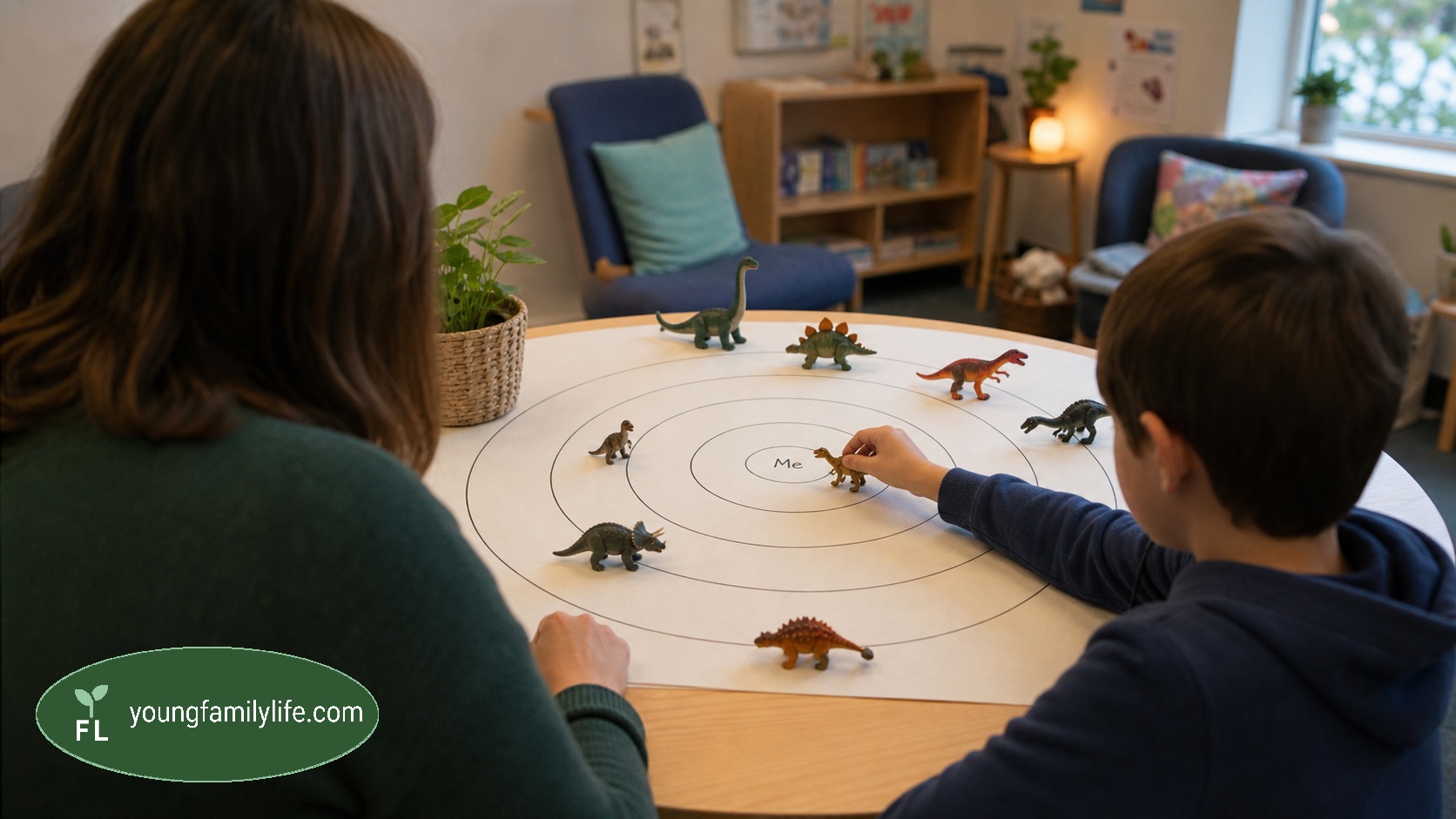
That process — what the theory set out to explore, and how it was subsequently developed and refined — is arguably as useful to a practitioner as the diagram itself, and for those who delve deeper into the ongoing research, the context becomes more informative still.
What Problem Was This Actually Trying to Solve?
In the 1970s, developmental psychology leaned heavily on laboratory-based, decontextualised studies of children. Bronfenbrenner's own later description of the field was memorably blunt: much of it amounted to the study of "the behavior of children in strange situations with strange adults for the briefest possible periods of time" (Bronfenbrenner, 1979). His dissatisfaction wasn't purely theoretical. He was simultaneously involved in applied, real-world territory — as one of the academic advisors behind the design of the United States' Head Start program in 1965, a federal early-years intervention aimed at breaking cycles of poverty through preschool education (Wikipedia, 2024; EBSCO, 2024).
The theory and the policy work were not sequential. They ran alongside each other. Head Start needed a rationale for why a child's environment beyond the classroom mattered; Bronfenbrenner's academic dissatisfaction needed a real-world proving ground. Each pushed the other forward. Two intellectual debts stand out precisely rather than vaguely: Lev Vygotsky's sociocultural theory — the idea that development happens through social and cultural interaction, not in isolation — and Kurt Lewin's field theory, which framed behaviour as a function of person and environment together, both feed directly into the nested-systems idea that followed (Frontiers in Psychology, 2023).
The Theory as First Published
The Ecology of Human Development (Bronfenbrenner, 1979) set out the now-familiar structure: the microsystem (immediate settings such as family and school), the mesosystem (the connections between those settings), the exosystem (settings the child doesn't directly enter but which affect them, such as a parent's workplace), and the macrosystem (the overarching cultural and ideological context). The chronosystem — the dimension of time, historical change, and life transitions — was added more fully in later work (Bronfenbrenner, 1995).
This model was explicitly framed as a conceptual model rather than a predictive, testable theory in the hard-science sense — closer to a framework for organising how researchers and practitioners should think about context than a fixed set of hypotheses to be proven or disproven.
Testing the Theory in the Real World
This is where the theory's real value comes through — not the diagram, but what happened when the thinking behind it met real-world evidence.
Head Start's own early evaluation produced mixed results. The 1969 Westinghouse Learning Corporation study found that the cognitive gains children made in Head Start reduced within a few years of leaving the programme — the so-called "fade-out effect" (Westinghouse Learning Corporation, 1969). This gave researchers a great deal to explore, and it became a valuable prompt for further enquiry into how such programmes might work best.
One reading, offered here with appropriate care, is that the fade-out findings sit comfortably alongside ecological thinking rather than against it: if a child's development is genuinely shaped by the continuing interaction of multiple systems, then a short intervention in one system — a year or two of preschool — might be expected to soften over time if the surrounding systems, such as family income, housing, and school quality, stayed the same. This reading, however reasonable, is offered after the fact rather than something the original evaluation set out to test, and the theory shouldn't be presented as confirmed by data it wasn't designed to explain.
Something more unusual followed. By the mid-1980s, Bronfenbrenner had grown concerned about how researchers were using his own model. In a 1986 paper he argued that the field had produced "context without development": researchers were carefully mapping which system a factor belonged to — micro, meso, exo, macro — without always going on to measure developmental process or outcome at all (Bronfenbrenner, 1986). In effect, his own diagram had spread further than his own argument, and that popularity pointed to an opportunity to sharpen the theory further. It's a genuinely unusual moment in a major theory's life: the originator openly using his own framework's popularity as the prompt for its next stage of development.
From “Ecological” to “Bioecological”
In response, through the 1980s and into the 1990s, Bronfenbrenner substantially reworked the model — renaming it the Bioecological Model and introducing what became known as the PPCT framework: Process, Person, Context, Time (Bronfenbrenner & Morris, 2006).
The key shift was that process moved to the centre. The earlier model implied that simply identifying which layer of context a factor sat in was doing useful analytical work. The revised model insists that what actually drives development is the "proximal process" — the recurring, increasingly complex reciprocal interaction between a developing person and the people, objects, and symbols in their immediate environment — and that context only matters in terms of how it shapes those processes (Frontiers in Psychology, 2023). The chronosystem was folded in more fully during this period too, and biology — genetic and constitutional characteristics of "the person" — was reintroduced as an active component rather than something bracketed out, which is part of why "ecological" became "bioecological."
Put in plain terms: the 1979 version asked, in effect, which layer of a child's world a given factor belonged to. The bioecological version asks what is actually happening, between which people, how often, and whether it becomes more complex over time. That is a genuinely different, and considerably more practice-relevant, question for an assessment.
A worked example of this same shift, arrived at independently and for a different purpose, sits in YFL's own Family Climate framework. Rather than describing a family's functioning as belonging to a fixed category, that essay proposes a temperate, seasonal pattern — predominantly warm or predominantly difficult, but with cold fronts moving through it under stress, and a return to the underlying pattern afterwards. That is process thinking, not category thinking: two families sitting in the same nominal "system" can be living through entirely different processes, and the same family can move through very different processes across time as circumstances change. It is also broader than any one person's development. A stress trigger — a redundancy, a major medical event, a bereavement — can push any member of a family network toward older, less regulated functioning, and a parent's own regulation slipping changes the household climate a child is living inside, quite apart from anything the child's own development is doing on its own account.
The Development Continued Beyond Him
Scholarly reviews (Tudge et al., 2009; Fisher & Lombardi, 2025) note that the mature, bioecological version is sometimes still cited in its earlier, 1979 form — a useful reminder to draw on the fuller three decades of subsequent development where possible, rather than the starting point alone.
A live, contemporary strand of scholarship comes from developmental researchers Vélez-Agosto and colleagues, who, drawing on Vygotsky and on the anthropologists Barbara Rogoff and Thomas Weisner, have argued that Bronfenbrenner's placement of culture out in the distant macrosystem may itself need revisiting — that culture isn't a remote backdrop but something woven into the daily, proximal processes of the microsystem from the outset (Vélez-Agosto et al., 2017). This sits in the literature as an ongoing refinement of Bronfenbrenner's own logic rather than a rejection of it — a useful example of how a good theory keeps being worked with rather than settling into orthodoxy.
This matters for a safeguarding and family-support readership specifically. It's a caution against treating "cultural context" as a single box to tick at arm's length — the macrosystem, ticked and left — rather than something present in how a family actually interacts day to day. A sharper, practitioner-grounded version of this same point sits alongside the theoretical one: real influence over a family's decisions doesn't always sort itself neatly into nested layers by relationship type at all. A deceased relative, or someone entirely outside the family — a neighbour, a family friend — can outweigh a structurally "closer" figure. This is explored directly, through ecomaps and genograms, in the companion essay linked below.
What This Means for Practice
The module language that usually accompanies this theory — "multifaceted perspectives," "human development within different sociocultural, material, and discursive contexts," strengths-based and anti-oppressive practice — points toward exactly the discipline this history teaches. The practice takeaway isn't the diagram. It's the discipline of asking, for any family being assessed, what the process actually is — the real, repeated pattern of interaction — rather than simply which system a stressor technically belongs to. A workplace redundancy sitting in the exosystem only matters to a child insofar as it changes something in the proximal, everyday process: a parent's mood, a routine, a presence at the school gate. The theory's own history is an argument against using it as a static checklist.
There's a practical edge to this worth drawing out directly. When a time-limited programme or piece of involvement ends, the service's own presence in a family's life disappears — a support that sat in the family's mesosystem during the intervention period is withdrawn, usually at exactly the point new stressors are as likely as ever to arrive. What gets recorded afterwards as a gradual "fade-out" in outcomes may sometimes be closer to a collapse triggered by a fresh stressor hitting the family system, simply observed less closely because the professional network has, quite naturally, pulled back once its funded involvement concluded. The withdrawal itself is an ecological event, not a neutral end point, and it's worth building that into how any time-limited intervention is designed and followed up.
There's a fitting closing image in the theory's own trajectory: it did exactly what it describes. It was shaped, reciprocally, by its environment — the Head Start evaluation data, the researchers who worked from its earlier diagram, the later scholars who kept refining its edges — and it grew as a result. A theory about development that itself continued to develop.
References
Anna Freud. Resources and research for children, young people, and families. Anna Freud, London. (Charity registration no. 1077106; resource, not a specific publication cited above.)
Bronfenbrenner, U. (1979). The Ecology of Human Development: Experiments by Nature and Design. Harvard University Press.
Bronfenbrenner, U. (1986). Ecology of the family as a context for human development: Research perspectives. Developmental Psychology, 22(6), 723–742.
Bronfenbrenner, U. (1995). Developmental ecology through space and time: A future perspective. In P. Moen, G. H. Elder, & K. Lüscher (Eds.), Examining Lives in Context. American Psychological Association.
Bronfenbrenner, U., & Morris, P. A. (2006). The bioecological model of human development. In W. Damon & R. M. Lerner (Eds.), Handbook of Child Psychology (6th ed., Vol. 1). Wiley.
Fisher, P. A., & Lombardi, J. (2025). The New Ecology of Early Childhood: Revisiting Bronfenbrenner's Theory in the Context of Contemporary Challenges and Opportunities. Stanford Center on Early Childhood working paper.
Frontiers in Psychology. (2023). Review of studies applying Bronfenbrenner's bioecological theory in international and intercultural education research. Frontiers in Psychology, 14.
Tudge, J. R. H., Mokrova, I., Hatfield, B. E., & Karnik, R. B. (2009). Uses and misuses of Bronfenbrenner's bioecological theory of human development. Journal of Family Theory & Review, 1(4), 198–210.
Vélez-Agosto, N. M., Soto-Crespo, J. G., Vizcarrondo-Oppenheimer, M., Vega-Molina, S., & García Coll, C. (2017). Bronfenbrenner's bioecological theory revision: Moving culture from the macro into the micro. Perspectives on Psychological Science, 12(5), 900–910.
Westinghouse Learning Corporation. (1969). The Impact of Head Start: An Evaluation of the Effects of Head Start on Children's Cognitive and Affective Development. Ohio University report to the U.S. Office of Economic Opportunity.
Young, S. (2026). Family Climate: A Framework for Understanding the Relational Environments That Shape Children's Developmental Wellbeing. YoungFamilyLife Ltd.
Topics: #EcologicalSystemsTheory #Bronfenbrenner #ChildDevelopment #AssessmentFrameworks #SystemsThinking #SocialWorkEducation #FamilySafeguarding