1. Where the age limits stand
As at 7 October 2026, on the sources checked, United Kingdom law set the following limits. Four different ages appear (ten, twelve, sixteen and eighteen), and one limit is set by year of birth and not by age.
Criminal responsibility
10 in England and Wales and in Northern Ireland; 12 in Scotland
Marriage and civil partnership
18 in England and Wales; 16 in Scotland, with no consent required; 16 in Northern Ireland, with parental consent
Voting
16 for the Scottish Parliament and Scottish local elections, and for the Senedd and Welsh local elections; 18 for the UK Parliament, the Northern Ireland Assembly and local elections in England and Northern Ireland, with a Bill to lower it to 16 in the House of Lords
School and training (England)
School leaving age 16; required participation in education or training to 18
Medical consent
16 is presumed capable; under-16s who show sufficient understanding may consent (England and Wales); Scotland has its own statute
Sexual activity
16 in each of the three jurisdictions
Tobacco
Sale to under-18s prohibited; from 1 January 2027, sale prohibited to anyone born on or after 1 January 2009; vapes and nicotine products at 18 from 29 October 2026
"Child" in the Children Act 1989
Under 18
Three of these were moving at the date of writing. The Scottish Government had consulted on raising the marriage age to 18, and a Bill to do the same in Northern Ireland was before the Assembly. The Representation of the People Bill, which would lower the voting age to 16 for the remaining elections, had passed the House of Commons on 2 September 2026 and had its second reading in the House of Lords on 14 September 2026. The Tobacco and Vapes Act 2026 had received Royal Assent on 29 April 2026, with its main provisions still to take effect.
The Children Act 1989 defines a child as a person under eighteen (s. 105(1)), and the UN Convention on the Rights of the Child, which the United Kingdom ratified in 1991, defines a child as a person under eighteen unless majority is reached earlier (art. 1). Neither definition governs the limits in the table. Each of them has its own history.
This essay follows these limits back to the points where the law moved them, and asks what moved them. It concerns England and Wales for the most part, with Scotland and Northern Ireland where they differ. The YFL essay Who Decided the Child Was Grown? describes the older thresholds set by households, employers, parishes and religion, and the YFL essay Counting a Child's Age describes how age was counted and proved.
2. The inherited ladder
William Blackstone's Commentaries on the Laws of England (1765) lists the ages at which English law treated a boy as able to do different things: the oath of allegiance at twelve, years of discretion at fourteen, executorship at seventeen, and his own disposal at twenty-one. A girl's list ran differently: betrothal at seven, dower at nine, consent to marriage at twelve, a guardian of her own choosing at fourteen, executorship at seventeen and disposal of herself at twenty-one (Commentaries I.17). In criminal law a child under seven could not be guilty of felony, a child of seven to fourteen was presumed incapable unless the evidence of understanding was strong, and after fourteen a young person was as liable as an adult (Commentaries I.17 and IV.2).
The ladder was a composite of separate rules on property, marriage, guardianship, wills and crime, gathered from common law and statute. None had been designed beside another. The minimum age for marriage shows how long one of them stood: until 1929, the common law and canon law allowed marriage at the age of puberty, twelve for a girl and fourteen for a boy (Age of Marriage Act 1929, and summaries of the law before it). Several of Blackstone's ages remained law well into the twentieth century, and the limits the rest of the essay follows were set on top of them.
3. Work and school
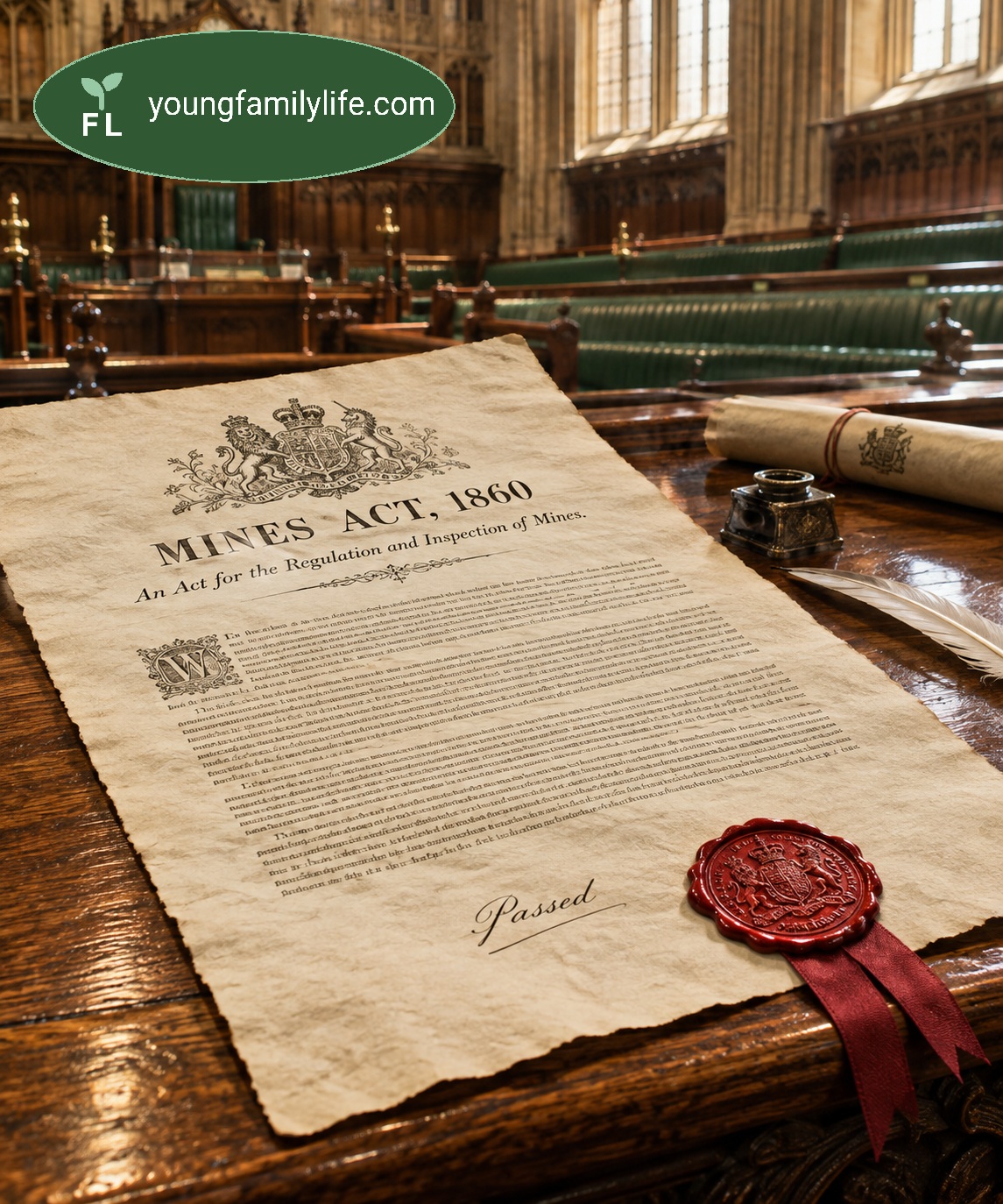
Among the first limits set by statute were those on work. The Mines and Collieries Act 1842 forbade any female underground from 1 March 1843 and any male under ten, other than boys who had reached nine and were already employed (5 & 6 Vict. c. 99, ss. 1 and 2). It followed a government commission that had questioned children underground. The Mines Act 1860 raised the age for boys to twelve, with exceptions on conditions that have not been checked here (as summarised by the UK Parliament). Earlier, the Factory Act 1833 had limited the hours of children of nine to thirteen in textile mills, according to a teaching timeline, so this point has limited verification.
Schooling then followed. The Elementary Education Act 1870 set a framework for children of five to thirteen and left it to school boards to make attendance compulsory, and the Elementary Education Act 1880 made attendance compulsory from five to ten. The minimum leaving age was raised to eleven in 1893 and to twelve in 1899. The Education Act 1918 (the Fisher Act) raised it to fourteen and abolished the exceptions that had let children leave earlier for work (Margaret Thatcher, speaking as Secretary of State for Education, on the centenary of the 1870 Act). The Education Act 1944 raised it to fifteen, which took effect in 1947, and the leaving age rose to sixteen from 1 September 1972, after preparations that began in 1964. The Education and Skills Act 2008 then required young people in England to continue in education or training to seventeen from 2013 and to eighteen from 2015. The leaving age itself stayed at sixteen.
The age for leaving school and the minimum age for work were two sides of one movement. As the age below which a child could not be employed rose, the age below which a child had to be at school rose with it, and the last steps, in 1972 and 2015, moved the end of childhood from the age work defined it to the age education defines it. The school age rose by a year or two at a time, about once in a generation after 1880. Each step was a separate Act with its own debate.
4. Protection: sex, tobacco and marriage
A second group of limits concerned protection, and these moved after exposure or campaign. The age of consent for girls was twelve in 1861, with an offence of a lesser kind for girls between ten and twelve, was raised to thirteen in 1875, and was raised to sixteen by the Criminal Law Amendment Act 1885. The 1885 Act followed W. T. Stead's newspaper articles of that summer, "The Maiden Tribute of Modern Babylon", and the case in which he purchased a thirteen-year-old girl, Eliza Armstrong, the daughter of a chimney sweep, to show that it could be done (these points rest on secondary summaries, so the account has limited verification; Sexual Offences Act 2003 and its Scottish and Northern Irish equivalents now fix the age at sixteen).
The Children Act 1908, known as the Children's Charter, set several limits at once. It prohibited the sale of tobacco and cigarette papers to anyone under sixteen, raised from five to seven the age of children to whom the infant-life protection provisions applied, and set up juvenile courts (Hansard, House of Lords, 28 October 1908, and later summaries). The Children and Young Persons Act 1933 consolidated the law and kept the tobacco age at sixteen. That age stayed there for ninety-nine years. It was raised to eighteen in England and Wales on 1 October 2007 (Children and Young Persons (Sale of Tobacco etc.) Order 2007, made under powers in the Health Act 2006), in Scotland on the same date by a separate order, and in Northern Ireland on 1 September 2008 by separate regulations.
The minimum age for marriage moved twice. The Age of Marriage Act 1929 made void any marriage in which either party was under sixteen, replacing a rule of twelve for girls and fourteen for boys with a single age. It followed a campaign by the National Union of Societies for Equal Citizenship and was influenced by international and imperial concerns, including a parallel measure in India the same year (summaries by legal historians and campaigning bodies; limited verification). The Marriage and Civil Partnership (Minimum Age) Act 2022 raised the minimum to eighteen in England and Wales from 27 February 2023, abolishing the route to marriage at sixteen and seventeen with parental or judicial consent, and making it an offence to cause a child to enter a marriage. Scotland's age stayed at sixteen under section 1 of the Marriage (Scotland) Act 1977, and the Scottish Government's family law consultation, which closed on 21 April 2026, asked whether to raise it. In Northern Ireland the age was sixteen with consent, and the Marriage and Civil Partnership Bill, introduced in March 2026, would raise it to eighteen and was at committee stage on the latest sources seen (June 2026). On the sources checked, neither had become law by 7 October 2026, and no Scottish decision on the consultation was found.
5. Crime and the courts
The age of criminal responsibility is the limit that has stood still longest. The common law fixed it at seven, and the Children and Young Persons Act 1933 (section 50) raised it to eight. The Children and Young Persons Act 1963 (section 16) raised it to ten, where it has remained in England and Wales and in Northern Ireland. The 1963 change followed the report of the Ingleby Committee on children and young persons in 1960, which had recommended that younger children in trouble with the law be dealt with by civil proceedings and not in the criminal court, and the rise to ten was a cautious response to its proposals (a Children's Commissioner submission to the Justice Committee and a child-care history page; limited verification). Until 1998 the presumption that a child of ten to thirteen did not know that an act was seriously wrong remained, as a rebuttable rule inherited from the older law, and section 34 of the Crime and Disorder Act 1998 abolished that presumption.
Scotland moved the other way. The age there was eight, with prosecution barred below twelve from 2010 (section 52 of the Criminal Justice and Licensing (Scotland) Act 2010), and the Age of Criminal Responsibility (Scotland) Act 2019 raised the age of responsibility itself from eight to twelve. The Act took effect in stages, and the change to twelve took effect on 17 December 2021 (S.S.I. 2021/449). In England and Wales the position in 2026 was under pressure. The UN Committee on the Rights of the Child had urged states to set the age at no lower than fourteen. In January 2026 the House of Lords debated the age, and Ministers answering said that Scotland's age had been eight until a few years before. In June 2026 the Bar Council of England and Wales published a report calling for fourteen, which the Law Society backed and the Government said it would consider "with the utmost care" (as reported by the Irish Law Society Gazette; limited verification). In Northern Ireland a consultation on raising the age from ten was reported.
The definitions of who counts as a young offender moved separately from the age of responsibility. The Children Act 1908, as introduced, defined a child as a person under fourteen and a young person as one aged fourteen to under sixteen. By the end of the twentieth century the upper limit for a young person in criminal proceedings had risen to seventeen (a change of 1963, not checked here). Section 68 and Schedule 8 of the Criminal Justice Act 1991, in force from 1 October 1992, moved it to eighteen by amending section 107 of the 1933 Act and the 1963 and 1969 Acts, so that seventeen-year-olds were tried as young persons. The juvenile court became the youth court at the same time. A study of the first months of the new youth court described sixteen- and seventeen-year-olds as in a transitional stage between childhood and adulthood.
6. Eighteen: the alignment of 1969
In July 1965 the Lord Chancellor appointed a committee under Mr Justice Latey to consider the minimum age at which young people could marry, marry without consent, own and dispose of property and make binding contracts, and the age at which they should no longer be liable to be made wards of court (National Archives catalogue). The committee reported in July 1967 (Cmnd. 3342) with a set of civil-law recommendations (Parliamentary Archives). The Family Law Reform Act 1969 (c. 46) provided in section 1 that a person attained full age at eighteen instead of twenty-one, and the Age of Majority (Scotland) Act 1969 (c. 39) did the same for Scotland, with both taking effect on 1 January 1970. The Representation of the People Act 1969 lowered the voting age from twenty-one to eighteen in the same year, for the general election of 1970 (Parliamentary Archives; History & Policy; the Act itself was not read here).
Historians disagree on why. One account holds that the voting age was lowered by political leaders who wished to align it with what society increasingly saw as the new age of adulthood, as one of a package of reforms that streamlined the age at which young people were seen to become adults (Loughran, Mycock and Tonge 2021). Another, cited in a news summary of Andrew Thorpe's history of the Labour Party, treats the change as less a principled commitment to young people than an assumption that young people would vote Labour (limited verification: the Thorpe passage was not read). Even in 1968 the limits did not move together. A letter in the Tribune of 19 April 1968 welcomed the Government's announced intention to reduce the age of majority to eighteen and complained that no decision had been taken on the voting age (limited verification; the letter was seen only in extract).
The same year's Act set one further limit at sixteen. Section 8 of the Family Law Reform Act 1969 provided that a person of sixteen could consent to surgical, medical and dental treatment (summarised in guidance on capacity; the section itself has not been read here). Eighteen was therefore not the only limit the 1969 reforms set, but it was the one that organised the others.
7. Pulling apart: 1985 to 2026
After 1969 the limits drew apart. In Gillick v West Norfolk and Wisbech Area Health Authority (1985), the House of Lords held by three to two that a child under sixteen could consent to medical treatment if the child had sufficient understanding, and that the parental right to decide ended when that understanding was reached (Lord Scarman's statement of the principle, as reported). The decision created a rule based on capacity, and Scotland later put a version of it into statute in the Age of Legal Capacity (Scotland) Act 1991. The Children Act 1989 then defined a child as under eighteen, and the Convention on the Rights of the Child, ratified in 1991, did the same. How a safeguarding framework treats sixteen- and seventeen-year-olds who make their own decisions is the subject of From Zebras to Ravens: A Typology for Safeguarding Young People Who Cannot Be Controlled.
From the 1990s the protective limits rose to eighteen. The tobacco age moved in 2007 and 2008, as above. Participation in education or training moved in 2013 and 2015. Marriage moved in England and Wales in 2023. Vapes and nicotine products reach eighteen on 29 October 2026 under the Tobacco and Vapes Act 2026, which also bars the sale of vapes to under-18s whether or not they contain nicotine.
At the same time the limits that confer a voice moved down. Sixteen- and seventeen-year-olds voted in the Scottish independence referendum of 2014. The Scottish Elections (Reduction of Voting Age) Act 2015 gave them the vote in elections to the Scottish Parliament and local government in Scotland, and the Senedd and Elections (Wales) Act 2020 did the same for the Senedd, with the first Senedd election at sixteen in 2021. The Local Government and Elections (Wales) Act 2021 extended the vote at sixteen to Welsh local elections, first held on that basis in 2022 (House of Commons Library; Full Fact; Welsh Government). The Representation of the People Bill was introduced in the Commons on 12 February 2026 and would lower the voting age to sixteen for the UK Parliament and for local elections in England and Northern Ireland, and the age at which a person may stand as a candidate would remain eighteen (Electoral Commission). It passed its Commons third reading on 2 September 2026 by 411 votes to 102 and went to the Lords, where it had its second reading on 14 September 2026. Opponents argued that the change was inconsistent with the Government's position on other ages of majority and citizenship (a news report of the debate; limited verification).
The Tobacco and Vapes Act 2026 introduced a limit of a different kind. From 1 January 2027 it will be an offence to sell tobacco, herbal smoking products or cigarette papers to anyone born on or after 1 January 2009, whatever their age at the time (Tobacco and Vapes Act 2026, c. 18; Department of Health, Northern Ireland; the World Health Organization notice of the Act). The Act does not ban smoking or possession, and adults who can buy tobacco in 2026 may continue to do so. The limit therefore stops moving with the person. A person born on 31 December 2008 and one born the next day, a day apart in age, are on opposite sides of it for life. It is the first of the limits described here that is fixed to a birth cohort.
8. What moved the age limits
Underground work: ten (1842). On 4 July 1838 a flood at Huskar Colliery, near Barnsley, drowned 26 children aged seven to seventeen. Public concern rose, and a Royal Commission on children's employment was set up in 1840. After its report of 1842, the Mines and Collieries Act 1842 banned women and girls of any age, and boys under ten, from working underground. Boys of nine who were already employed were excepted.
Age of consent for girls: thirteen, then sixteen (1875, 1885). In 1875 the age below which sexual intercourse with a girl was an offence rose from twelve to thirteen. In July 1885 W. T. Stead, editor of the Pall Mall Gazette, published four articles between 6 and 10 July, "The Maiden Tribute of Modern Babylon", on the trade in young girls, and bought thirteen-year-old Eliza Armstrong to show that it could be done. The articles were written to press the House of Commons to pass a Criminal Law Amendment Bill. Parliament passed the Criminal Law Amendment Act 1885 on 14 August 1885, raising the age of consent for girls from thirteen to sixteen (limited verification: the Act itself was not read).
Tobacco sales and juvenile courts: sixteen (1908). After the Boer War (1899 to 1902), a large percentage of army recruits had been rejected for physical reasons, and the Inter-Departmental Committee on Physical Deterioration reported in 1904, with a section on juvenile smoking. The Children Act 1908 made it an offence to sell tobacco or cigarette papers to anyone under sixteen, and set up juvenile courts for children under sixteen.
Marriage: sixteen (1929). In response to a campaign by the National Union of Societies for Equal Citizenship, Parliament passed the Age of Marriage Act 1929, which made sixteen the minimum age for both sexes. Before it, the common law and canon law had allowed marriage at twelve for a girl and fourteen for a boy.
Criminal responsibility: ten (1963). The Ingleby Committee was appointed in 1956 to inquire into the law on children and young people in England and Wales, with particular reference to delinquency and to children in moral or physical danger. It reported in 1960, recommending that younger children in trouble with the law be dealt with by civil proceedings and not in the criminal court. The Children and Young Persons Act 1963 raised the age of criminal responsibility in England and Wales from eight to ten (limited verification of the link between the report and the Act).
Age of majority: eighteen (1969). In July 1965 the Lord Chancellor appointed the Latey Committee to consider the minimum age at which young people should be able to marry, marry without consent, own and dispose of property and make binding contracts, and the age at which they should no longer be liable to be made wards of court. It reported in July 1967 with 44 civil-law recommendations. The Family Law Reform Act 1969 and the Age of Majority (Scotland) Act 1969 lowered the age of majority from twenty-one to eighteen, in force from 1 January 1970.
Voting: eighteen (1969). A report for the Labour Party, The Younger Generation, published in September 1959, recommended votes at eighteen. The Speaker's Conference on Electoral Law, set up by Harold Wilson's Government, recommended twenty. In July 1968 the Government announced that it would lower the voting age to eighteen, and the Representation of the People Act 1969 did so. The first general election at the new age was in June 1970.
Medical consent below sixteen (1985). In December 1980 the Department of Health and Social Security issued guidance saying that doctors could, in exceptional cases, give contraceptive advice and treatment to girls under sixteen without their parents' consent. Victoria Gillick, a mother of daughters under sixteen, asked her health authority in 1981 for an assurance that her daughters would not receive it without her consent, and began court proceedings in 1982. In 1985 the House of Lords held, by three to two, that a child under sixteen can consent to medical treatment if the child has sufficient understanding.
Youth court: seventeen-year-olds (1992). The Criminal Justice Act 1991, in force from 1 October 1992, brought seventeen-year-olds within the jurisdiction of the youth court, which replaced the juvenile court at the same time.
Tobacco sales: eighteen (2007, 2008). In July 2006 the Department of Health consulted on raising the age for buying tobacco from sixteen to seventeen or eighteen. The Health Act 2006 banned smoking in enclosed public places in England from 1 July 2007. The age for buying tobacco rose to eighteen on 1 October 2007 in England, Wales and Scotland, and on 1 September 2008 in Northern Ireland.
Education or training: eighteen in England (2013, 2015). The Leitch Review of Skills reported in 2006, and the Government's Green Paper Raising Expectations, published in March 2007, proposed requiring young people to stay in education or training until eighteen. The Education and Skills Act 2008 imposed the duty, to seventeen from 2013 and to eighteen from 2015.
Voting: sixteen in Scotland (2015). Sixteen- and seventeen-year-olds voted in the Scottish independence referendum of 2014. The Scottish Elections (Reduction of Voting Age) Act 2015 gave them the vote in elections to the Scottish Parliament and to local government in Scotland.
Criminal responsibility: twelve in Scotland (2019, 2021). In 2016 the United Nations Committee on the Rights of the Child recommended that Scotland, where the age was eight, raise it to an acceptable international standard. An advisory group set up by the Scottish Government in 2015 recommended twelve, and a consultation in 2016 found 95% of respondents in favour of twelve or above. The Age of Criminal Responsibility (Scotland) Act 2019 raised the age from eight to twelve, in force from 17 December 2021.
Voting: sixteen in Wales (2020, 2021). The Senedd and Elections (Wales) Act 2020 gave sixteen- and seventeen-year-olds the vote in Senedd elections, first held on that basis in May 2021. The Local Government and Elections (Wales) Act 2021 gave them the vote in local elections, first held on that basis in May 2022.
Marriage: eighteen in England and Wales (2022, 2023). Campaign organisations in the Girls Not Brides coalition supported the change, and campaigners worked for more than five years to bring it about. In 2020 the Government's Forced Marriage Unit advised in 113 cases involving the actual or potential marriage of a child aged fifteen or under. A Private Member's Bill brought by Pauline Latham MP became the Marriage and Civil Partnership (Minimum Age) Act 2022, in force from 27 February 2023, which ended the route to marriage at sixteen and seventeen with parental or judicial consent.
Tobacco: a year of birth (2026, 2027). The Khan review of smoking, published in June 2022, recommended raising the age of sale. In 2022 New Zealand passed a law barring tobacco sales to anyone born on or after 1 January 2009, which a new government elected in 2023 repealed in 2024. On 4 October 2023 the Prime Minister, Rishi Sunak, announced that tobacco sales in the United Kingdom would be barred to anyone born on or after 1 January 2009. The Tobacco and Vapes Act 2026, which received Royal Assent on 29 April 2026, bars the sale of tobacco to anyone born on or after 1 January 2009, from 1 January 2027.
An age limit, or a limit set by year of birth, depends on a record of the date, and the YFL essay Counting a Child's Age covers how age has been counted and proved.
9. A note on the evidence and the date
Statuses are stated as at 7 October 2026, on the sources checked. Some were moving, and later stages may have passed: the Representation of the People Bill had its second reading in the House of Lords on 14 September 2026 and its later stages were not confirmed; the Northern Ireland marriage Bill and the Scottish marriage proposal were not reported as law on the latest sources seen; and the main provisions of the Tobacco and Vapes Act 2026 take effect on 29 October 2026 and 1 January 2027, as set out in government guidance reported by trade and public-health bodies.
The essay draws on legislation and parliamentary records where these could be read (the Family Law Reform Act 1969, the Criminal Justice Act 1991, the Children Act 1989 section 105, the Marriage and Civil Partnership (Minimum Age) Act 2022, the 2007 tobacco orders, the Tobacco and Vapes Act 2026, Hansard) and, for other points, on Commons Library briefings, official government pages, scholarly summaries and news reports. Passages that rest on secondary sources only are marked as having limited verification. Several statutes from the nineteenth and early twentieth centuries were seen only through summaries. The account in section 8 is drawn from the age limits examined here and is provisional.
References
- Age of Criminal Responsibility (Scotland) Act 2019 (asp 7); Age of Criminal Responsibility (Scotland) Act 2019 (Commencement No. 4) Regulations 2021 (SSI 2021/449).
- Age of Majority (Scotland) Act 1969 (c. 39).
- Age of Marriage Act 1929 (19 & 20 Geo. V, c. 36).
- Department for Education and Skills (2007). Raising Expectations: staying in education and training post-16 (Green Paper).
- Inter-Departmental Committee on Physical Deterioration (1904). Report of the Inter-Departmental Committee on Physical Deterioration.
- Khan, J. (2022). The Khan review: making smoking obsolete. Department of Health and Social Care.
- Leitch Review of Skills (2006). Prosperity for all in the global economy: world class skills.
- Pall Mall Gazette (6 to 10 July 1885). The Maiden Tribute of Modern Babylon.
- Scottish Government (2016). Report of the Advisory Group on the Minimum Age of Criminal Responsibility.
- Senedd Research. Quick guide to the Local Government and Elections (Wales) Act 2021.
- United Nations Committee on the Rights of the Child (2016). Concluding observations on the fifth periodic report of the United Kingdom.
- UK Government (27 February 2023). Press release: Legal age of marriage in England and Wales rises to 18.
- Bates, V. The legacy of 1885: girls and the age of sexual consent. History & Policy policy paper.
- Blackstone, W. (1765). Commentaries on the Laws of England, Book I, ch. 17, and Book IV, ch. 2.
- Children Act 1908 (8 Edw. VII, c. 67).
- Children Act 1989 (c. 41), s. 105.
- Children and Young Persons Act 1933 (23 & 24 Geo. V, c. 12), ss. 7, 50 and 107; Children and Young Persons Act 1963 (c. 37), s. 16; Children and Young Persons Act 1969 (c. 54), s. 70.
- Children and Young Persons (Sale of Tobacco etc.) Order 2007 (SI 2007/767); Smoking, Health and Social Care (Scotland) Act 2005 (Variation of Age Limit for Sale of Tobacco etc. and Consequential Modifications) Order 2007 (SSI 2007/437); Children and Young Persons (Sale of Tobacco etc.) Regulations (Northern Ireland) 2008 (SR 2008/306).
- Crime and Disorder Act 1998, s. 34.
- Criminal Justice Act 1991 (c. 53), s. 68 and Sch. 8.
- Criminal Justice and Licensing (Scotland) Act 2010, s. 52.
- Criminal Law Amendment Act 1885 (48 & 49 Vict. c. 69).
- Education and Skills Act 2008.
- Education Acts 1870, 1880, 1918 and 1944 (as cited in the sources above).
- Electoral Commission. Parliamentary briefing: Representation of the People Bill, Part 1 (young voters), Committee stage.
- Family Law Reform Act 1969 (c. 46), ss. 1 and 8.
- Gillick v West Norfolk and Wisbech Area Health Authority [1986] AC 112; [1985] 3 All ER 402 (HL).
- Hansard. Marriage and Civil Partnership (Minimum Age) Bill, Public Bill Committee, 12 January 2022; HL Deb 28 October 1908 (Children Bill); HL Deb 21 January 2026 (age of criminal responsibility); HC Deb 2 September 2026 (Representation of the People Bill, third reading).
- House of Commons Library. Briefing papers on the voting age (SN01747); the age of criminal responsibility (CBP-7687); the Representation of the People Bill 2024–26.
- Loughran, T., Mycock, A. and Tonge, J. (2021). Lowering the voting age: three lessons from the 1969 Representation of the People's Act. LSE British Politics and Policy blog.
- Marriage and Civil Partnership (Minimum Age) Act 2022 (c. 28); Marriage and Civil Partnership (Minimum Age) Act 2022 (Commencement and Transitional Provisions) Regulations 2023 (SI 2023/88).
- Marriage (Scotland) Act 1977, s. 1. Scottish Government. Family law: consultation (closed 21 April 2026). Northern Ireland Department of Finance. Marriage and Civil Partnership Bill (introduced March 2026).
- Mines and Collieries Act 1842 (5 & 6 Vict. c. 99); Mines Act 1860 (23 & 24 Vict. c. 151).
- Office of the Children's Commissioner (2012). Written evidence to the House of Commons Justice Committee, session 2012–13, on the age of criminal responsibility.
- Report of the Committee on the Age of Majority (the Latey Committee) (1967), Cmnd. 3342.
- Representation of the People Act 1969; Representation of the People Bill 2024–26.
- Scottish Elections (Reduction of Voting Age) Act 2015; Senedd and Elections (Wales) Act 2020; Local Government and Elections (Wales) Act 2021.
- Tobacco and Vapes Act 2026 (c. 18).
- United Nations Convention on the Rights of the Child (1989), art. 1.
- Bingham, A. (2019). 50 years of debates about the voting age. History & Policy.
Topics: #LawAndChildhood #AgeOfMajority #ChildrensRights #LegalHistory #VotingAge #HistoryOfChildhood