Start Here
Most parents love their kids. That's not really the question. The question is whether the child can actually feel it — and that turns out to make a massive difference.
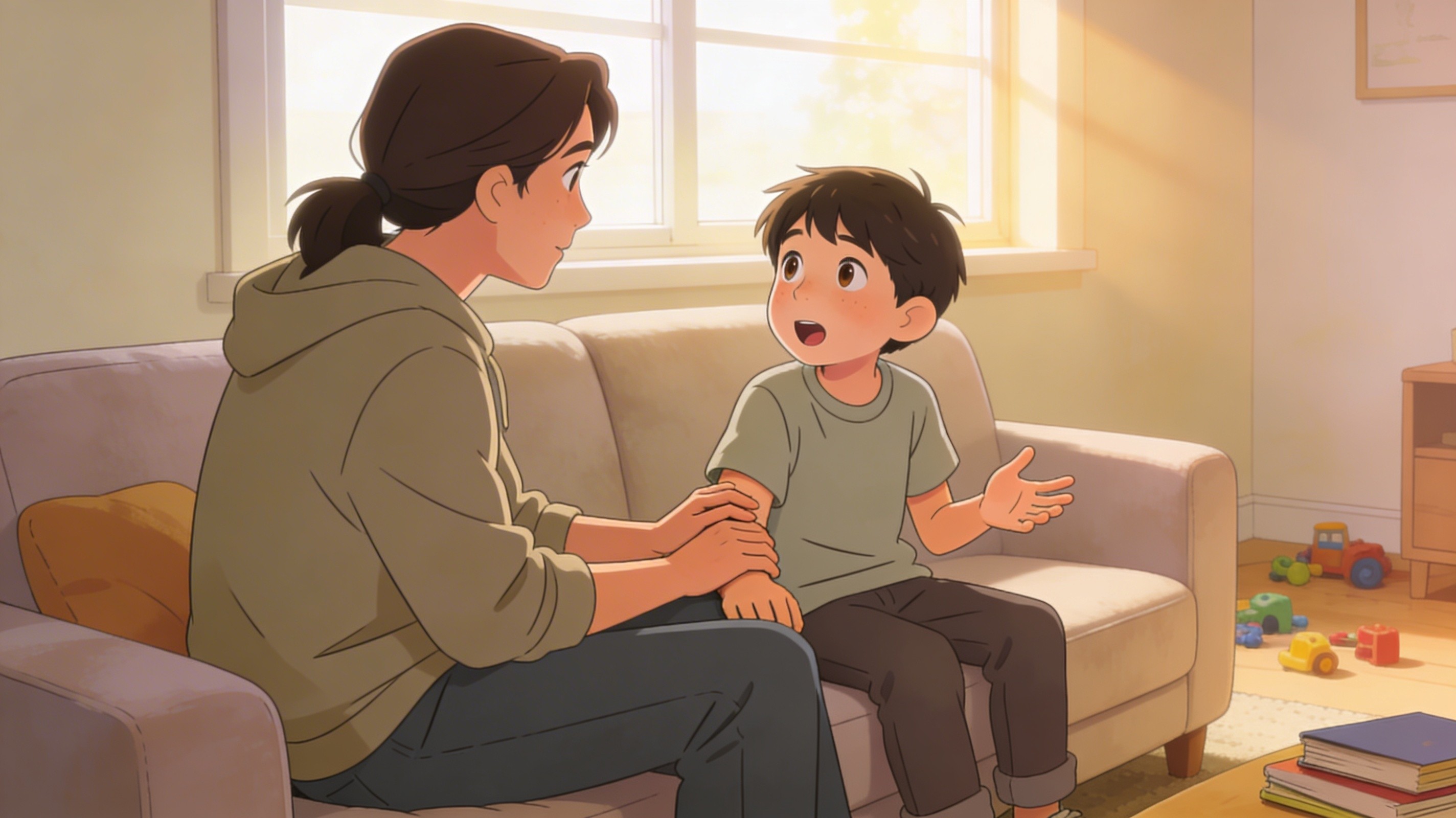
Emotional warmth is the phrase used throughout this piece. It means the emotional connection a child actually experiences day to day — not whether they're fed and clothed and kept safe, but whether they feel genuinely noticed. Seen. Like the person looking after them actually registers that they've got feelings worth responding to. Emotional warmth isn't the same as love. Love is what the parent feels inside. Emotional warmth is what the child picks up on — in a thousand small moments across an ordinary day. A parent can love a child completely and still come across, to that child's brain, as emotionally switched off.
The research on this is solid and worth knowing about. The emotional warmth a child grows up with — or goes without — directly shapes what gets built inside them. Not just how they feel, but how their brain actually develops, how they handle their own emotions, and how they deal with relationships for the rest of their life.
The Warmth Check-in Card maps out eight positions — from a relationship where emotional warmth is unconditional and always there, right down to one where the emotional side has basically gone quiet. That isn't a score. It's just a picture of what more or less emotional warmth actually looks like — and why it matters.
What a Child's Brain Is Actually Doing
A young child's brain isn't a smaller version of an adult brain. It's a brain that's still being built. And one of the biggest things shaping how it gets built is the emotional warmth — or the lack of it — in the home the child is growing up in.
The part of the brain that handles emotions, builds bonds, and decides whether the world feels safe or scary develops really early — long before a child can put any of this into words. That emotional part of the brain is learning constantly, just from what happens around it. When a child is upset and someone genuinely responds — pays attention, stays present, actually helps — the brain clocks that. It registers: when things go wrong, someone shows up. When a child is upset and gets ignored, or snapped at, or nothing happens at all, the brain clocks that too. It registers something very different.
And this isn't a one-off. It's the result of hundreds and hundreds of small everyday moments stacking up. The child's brain is quietly building a kind of internal map — a picture of what people are like, what to expect from relationships, and whether the emotional world is a safe place to be. That map stays with them. It shapes how they handle things for years to come.
Emotional warmth isn't a nice extra in this process. It's the main ingredient the map gets built from.
The Remarkable Science that Research Confirms
Most people assume the key thing about emotional warmth in parenting is being consistent — that a parent who's reliably warm will raise a more secure kid than one who gets it wrong sometimes. The research has a more interesting answer than that.
Making things right matters just as much as getting it right.
No parent is perfectly in tune with their child all the time. Moods shift. Patience runs out. A child's need gets missed or misread. That's just normal. These moments aren't the problem. What matters is what happens after — does the parent notice something went wrong and come back to emotional warmth, or does the gap just stay there?
A child who goes through a difficult moment and then experiences a genuine repair — where the parent comes back, reconnects, puts it right — is learning something that perfect consistency on its own can't teach. They're learning that things can go wrong between people and still be fixed. That feeling cut off doesn't have to last. That emotional warmth comes back. That's actually the bedrock of resilience — not that nothing goes wrong, but that when it does, it gets sorted.
A relationship that trips up sometimes but always finds its way back is building something stronger than one that looks smooth on the surface but never quite fully reconnects when things go off.
Emotional Warmth Is Not Affection
These two things are easy to mix up, and it's worth being clear about the difference.
Affection is what you can see — a hug, saying something kind, remembering a birthday. Emotional warmth is different. It's not what gets shown on the outside. It's what the child actually experiences on the inside, across hundreds of everyday moments. A parent can be very affectionate — lots of hugs, plenty of kind words — and still feel emotionally distant to the child, because what's being shown on the surface doesn't quite match what's actually being felt underneath.
Kids are remarkably good at picking this up. Not in a conscious way, not in a way they could explain, but they feel it. The part of the brain that's building its picture of what people are like is picking up on tiny signals all the time — whether a worried look actually gets noticed, whether a joke gets a genuine laugh, whether being upset is met with real attention or with something that looks okay but feels a bit hollow.
Emotional warmth, when it comes down to it, is less about what's said or done and more about whether the child feels genuinely seen — like they're a real person with real feelings, not just someone to be managed or kept quiet.
What Happens When Emotional Warmth Thins
The research isn't saying that anything less than perfect parenting causes lasting harm. Most kids manage — family life is messy, and most parents are somewhere in the middle, emotionally present most of the time but not perfectly so. But "managing" is worth thinking about. In the moment, managing might just mean getting through it — trying different things until something seems to work. The problem is that a child doesn't always know what the best response was, or whether what worked was actually healthy. They just know it got them through. And that can quietly become the start of behaviour patterns that nobody planned — because the child learned a strategy that felt useful at the time, but wasn't necessarily the right one for the long run.
But when emotional warmth genuinely goes thin — when a child's feelings are consistently ignored, dismissed, or met with irritation — something specific starts to happen to that internal map being built. The brain, getting no real response, adapts. It starts managing emotions more privately. It stops expecting much from other people. It learns to pull back rather than reach out when things get hard.
These aren't character flaws. They're not choices. They're exactly what a well-functioning brain does when emotional warmth isn't reliably there — it finds a way to get by without it. The problem is that those patterns don't stay in childhood. The kid who learned to cope alone, to expect little from others, to shut down rather than open up — that same pattern tends to show up in their adult relationships, their friendships, their workplaces. Often without them having any clear idea of where it started.
This is the part the research keeps coming back to: the emotional warmth a parent gives is largely shaped by the emotional warmth they got as a child. Not because people are stuck repeating history — but because these patterns get passed on through exactly the kind of everyday moments this piece is about. A parent who grew up in an emotionally cold home is trying to give something they never really had a clear picture of. That's not a failing. It's just where they're coming from.
Emotional Warmth Is Not the Whole Picture
Emotional warmth without any structure creates its own problems. A child who feels genuinely loved and emotionally connected, but who grows up without clear expectations or consistent rules, is getting something really nourishing on the emotional side — but not much preparation for how the world outside the front door actually works. Loved, but not quite equipped.
The research on healthy development is consistent on this: emotional warmth and a proper structure of rules and expectations work together. You can't swap one for the other. What emotional warmth alone can't build is the child's internal sense of what's expected of them in a world that has expectations. What rules and structure alone can't build is the feeling of safety and connection that makes those expectations worth bothering with.
The homes that give kids the most to work with have both: a warm, caring relationship and clear, consistent expectations. Rules that are kept because they genuinely matter — not because the relationship depends on them. Emotional warmth that's there regardless of whether the rules got followed. Both present. Both reliable.
That's why the Warmth Check-in Card has a companion — the Governance Check-in Card. The two scales sit side by side for a reason. The Warmth Check-in Card runs from W1 (Unconditional) at the healthy end through to W8 (Complete indifference) at the other — eight positions covering the full range of what emotional warmth in a relationship can look like. A home at W3 (Warmth isn't consistently given and might need to be earned) with a strong clear structure is a very different place from a home sitting at the same W3 with no real structure at all — even if the emotional warmth looks identical from the outside. Both together give a much fuller picture than either one on its own.
What to Do With This
Most people reading this will recognise something — either in the home they grew up in, the home they're providing now, or both. That recognition is the point. Not to feel judged, but to have something worth thinking about.
The Warmth Check-in Card is the natural next step. It takes what's in this piece and makes it practical — eight positions that show what different levels of emotional warmth actually look like, in a specific relationship, in specific kinds of moments. It's not a test. It's a starting point for some honest thinking and, if it feels right, an honest conversation.
And if the emotional warmth picture is clearer but something still feels off, the Governance Check-in Card is worth a look too. The two together give a much fuller picture than either one alone.
Topics: #Warmth #ChildDevelopment #EmotionalAttunement #Attachment #FamilyClimate #Parenting #Repair #Responsiveness #SelfRegulation #IntergenerationalPatterns #ReflectivePractice #HWTK #YoungFamilyLife
Further Reading
These links dig deeper into the topics covered here:
The research behind warmth and child development:
- Simply Psychology: Attachment Theory — accessible overview of Bowlby and Ainsworth's foundational research on how early relationships shape development
- Harvard Center on the Developing Child: Serve and Return — explains the back-and-forth of responsive interaction and why it shapes brain development in the early years
- American Psychological Association: Parenting Styles — research-based summary of what warmth and structure together look like, and what the evidence says about outcomes
Understanding warmth, repair, and emotional development:
- NHS: Raising Emotionally Healthy Children — practical UK-based guidance that reflects the warmth and attunement themes discussed here
- Wikipedia: Attachment Theory — broad overview of the theory and its development, covering Bowlby, Ainsworth, and subsequent research
Related YFL Content
Warmth Check-in — Awareness Card — the partner to this piece. Offers an eight-position scale for looking at how warmth currently sits in a specific relationship, and what to do with that reflection.
Family Climate — the full essay that develops both the Warmth and Governance scales in depth, including how the two dimensions interact and what different combinations mean for children's development over time.
Governance Check-in — Awareness Card — the companion to the Warmth Check-in. Warmth and governance work together, and understanding both gives a much fuller picture than either one alone.
Hey!, Want To Know: Why do household rules matter? — the companion HWTK piece that covers what a consistent rule framework builds inside a developing person, and why consistency matters more than strictness.
Copyright Notice
© 2026 Steve Young and YoungFamilyLife Ltd. All rights reserved.
"Hey!, Want To Know" is a copyrighted content format of YoungFamilyLife Ltd.
This essay was developed collaboratively using AI assistance to research academic sources and refine content structure, while maintaining the author's original voice, insights, and "Information Without Instruction" philosophy. No part of this essay may be reproduced, distributed, or transmitted in any form or by any means, including photocopying, recording, or other electronic or mechanical methods, without the prior written permission of the copyright holders, except in the case of brief quotations embodied in critical reviews and certain other noncommercial uses permitted by copyright law.
For permission requests, contact: info@youngfamilylife.com