Cold water as a health practice
Cold water immersion has attracted a sharp rise in participation. A UK guidance paper on cold water therapies describes an explosion in the number of individuals taking part for anecdotally claimed mental and physical health benefits (Tipton et al., 2022). Much of the public discussion treats the practice as one thing. The research treats it as several: a brief cold shower, a short plunge, a long swim, face-only cooling, and clinical cooling of a patient are different exposures with different effects.
YFL speaks primarily from a UK perspective. Where a study below was carried out elsewhere, the country is stated, because water temperatures, health systems and populations differ.
What cold water does to a healthy body
The first minute. Sudden immersion in cold water produces the cold shock response: a gasp, rapid uncontrollable breathing, a rise in heart rate and blood pressure, and release of stress hormones. UK guidance from the University of Portsmouth team describes cold shock as peaking in water at 10 to 15°C, as greatest in the first 30 seconds, and as fading after that (Tipton et al., 2022). A systematic review and meta-analysis of 17 groups of participants reports that repeated immersion reduces the response, with habituation after about four immersions, although studies varied (Barwood et al., 2024).
The first hour. In a controlled laboratory study in the Czech Republic, ten young men sat in water up to the neck for an hour at 32°C, 20°C and 14°C. At 32°C, close to the temperature at which a resting person neither gains nor loses heat, heart rate fell by 15%. At 14°C, metabolic rate rose by 350%, plasma noradrenaline by 530% and plasma dopamine by 250%, while core temperature fell (Šrámek et al., 2000). The authors attribute the cold responses mainly to increased sympathetic nervous system activity. The sample was small, male and young, and the exposure was an hour at 14°C, which is a considerably harder exposure than a short dip.
Over days. In a Dutch study, 17 healthy adults went through a 10-day cold acclimation protocol. Brown fat activity and non-shivering heat production increased, and the participants reported feeling more comfortable in the cold (van der Lans et al., 2013). Brown fat is a tissue that produces heat, and its presence in adult humans is now accepted. Whether the change brings any lasting health benefit was not tested in this study.
What research reports about cold water in a healthy regime
Sickness absence. The largest trial is Dutch. Buijze and colleagues randomised 3,018 adults without severe illness and without a cold shower habit to a hot shower, or a hot shower ending in 30, 60 or 90 seconds of cold. The cold groups showed a 29% reduction in self-reported sickness absence from work. Days of illness did not differ significantly between groups (Buijze et al., 2016). The trial was unblinded, relied on self-report, and cannot say whether the cold made people less ill or more willing to go to work.
Immune and inflammatory markers. A 2025 systematic review and meta-analysis from Australia pooled 11 randomised trials of cold water immersion in 3,177 healthy adults. It found increased inflammatory markers immediately after immersion and one hour later, no significant change in immune function at those times, and effects on stress, sleep and quality of life that depended on timing. The authors describe the evidence as limited by few trials, small samples and a lack of diversity among participants (Cain et al., 2025).
A smaller Dutch experiment points the same way on complexity. In 24 healthy men, a 10-day training programme combining meditation, breathing exercises and cold exposure was followed by a deliberate dose of bacterial endotoxin. The trained group showed a blunted inflammatory response and fewer flu-like symptoms (Kox et al., 2014). A follow-up study reported as a preprint, with 48 men, found that cold exposure training alone did not relevantly change the cytokine response, though flu-like symptoms were reduced (Zwaag et al.). The effect is a damping of an immune response in a laboratory model, not an immune "boost".
Mood. In a UK study, 64 undergraduates completed a mood questionnaire before and after a single immersion in cold water without swimming. Mood improved, and the authors conclude that cold itself can improve mood in young, fit and healthy individuals (Kelly and Bird, 2022). A Finnish study of winter swimmers and non-swimmers over a winter reported improved general wellbeing (Huttunen et al., 2004), while another study discussed by Kelly and Bird found no significant difference in psychopathology between 25 winter swimmers and 11 controls over four months. A 2018 UK case report described one woman with major depressive disorder who became symptom-free and medication-free after a programme of open water swimming, with the authors noting that the mechanisms remain hypotheses and that further study is needed (van Tulleken et al., 2018). One case is a hypothesis, not a finding.
Overall reading. A 2020 narrative review of cold water swimming concluded that benefits appear when it is practised by experienced people in good health in a regular, graded and adjusted way (Knechtle et al., 2020). A cardiologist quoted by American Heart Association News in 2022 put the position more bluntly: whether there are health benefits is not clear and has not been established.
Targeted uses for specific conditions and injuries
Medicine uses cold water in a few defined situations. The strength of evidence varies a great deal between them.
Exertional heatstroke. This is the strongest case. Exertional heatstroke is a medical emergency in which exercise drives core temperature dangerously high, typically in young, fit and healthy people. Whole-body cold water immersion is described in sports medicine reviews as the gold standard treatment (Casa et al., 2007), and a systematic review concluded that ice-water and cold-water immersion gave the fastest cooling rates (McDermott et al., 2009). Randomised trials are not possible, because an ethics board would not permit researchers to induce heatstroke in volunteers, so the evidence rests on physiological studies and case series. At the Falmouth Road Race in the United States, immediate on-site immersion effectively treated all cases of exertional heatstroke observed in the study (DeMartini et al., 2015). A 2022 review points out that the founding evidence came mainly from men, and that guidelines are applied to women without the same validation (Hutchins et al., 2022). The aim is to reverse overheating, not to cure a disease.
Racing heart rhythm in children. Supraventricular tachycardia is an abnormally fast heart rhythm that begins above the ventricles. In infants, paediatric guidelines from the Royal Children's Hospital Melbourne describe eliciting the diving reflex by immersing the face in an ice water slurry for five seconds, and note that it must not be used in an infant in shock. The reflex works through cold receptors in the face and the vagus nerve. In adults, a review of vagal manoeuvres reports that the diving reflex reverses the rhythm less often than other manoeuvres, with one cited success rate of 17%, and that it is technically harder to perform. Small early paediatric studies reported high success, including one Turkish series with 27 of 28 attacks terminated, but such series are small and uncontrolled (Smith et al., 2012, review).
Acute soft tissue injury. Ice is widely used for sprains and strains, and the evidence for it is weak. A systematic review of 22 randomised trials found a mean quality score of 3.4 out of 10 and concluded that many more high-quality trials were needed (Bleakley et al., 2004). A later review concluded there was insufficient evidence that cryotherapy improves clinical outcome in soft tissue injury (Collins, 2008). Collins also surveyed Irish emergency consultants: 73% always or frequently advised ice, and the reasons most often given were experience and common sense, not scientific evidence. The practice in this case has run ahead of the trials.
Muscle soreness after exercise. A Cochrane review of 17 studies with 366 participants found that cold water immersion reduced soreness compared with rest or no intervention, but few studies compared it with other methods, and the review authors could not set clear guidance on safe and effective use (Bleakley et al., 2012). The trials were small and unblinded.
A cost for athletes. In an Australian study, men who used cold water immersion after strength training for 12 weeks gained less muscle mass and strength than men who used active recovery, and the muscle biopsy findings fitted a dampening of the signals that drive muscle growth (Roberts et al., 2015). The finding suggests that the same cold that eases soreness may reduce the adaptation the training was meant to produce.
Cardiac arrest. Lowering a patient's body temperature after cardiac arrest was standard practice for years, using cooling devices and not baths. In 2021 the TTM2 trial randomised 1,861 patients to cooling at 33°C or to normal temperature with early treatment of fever and found no difference in survival at six months, while arrhythmia with haemodynamic compromise was more common in the cooled group (24% against 17%) (Dankiewicz et al., 2021). European guidance in 2022 concluded that evidence was insufficient to recommend for or against temperature control at 32 to 36°C, while recommending that fever be actively prevented (Nolan et al., 2022). A long-established cooling treatment was revised by a large trial.
Breath-hold diving: the body under cold, pressure and oxygen shortage
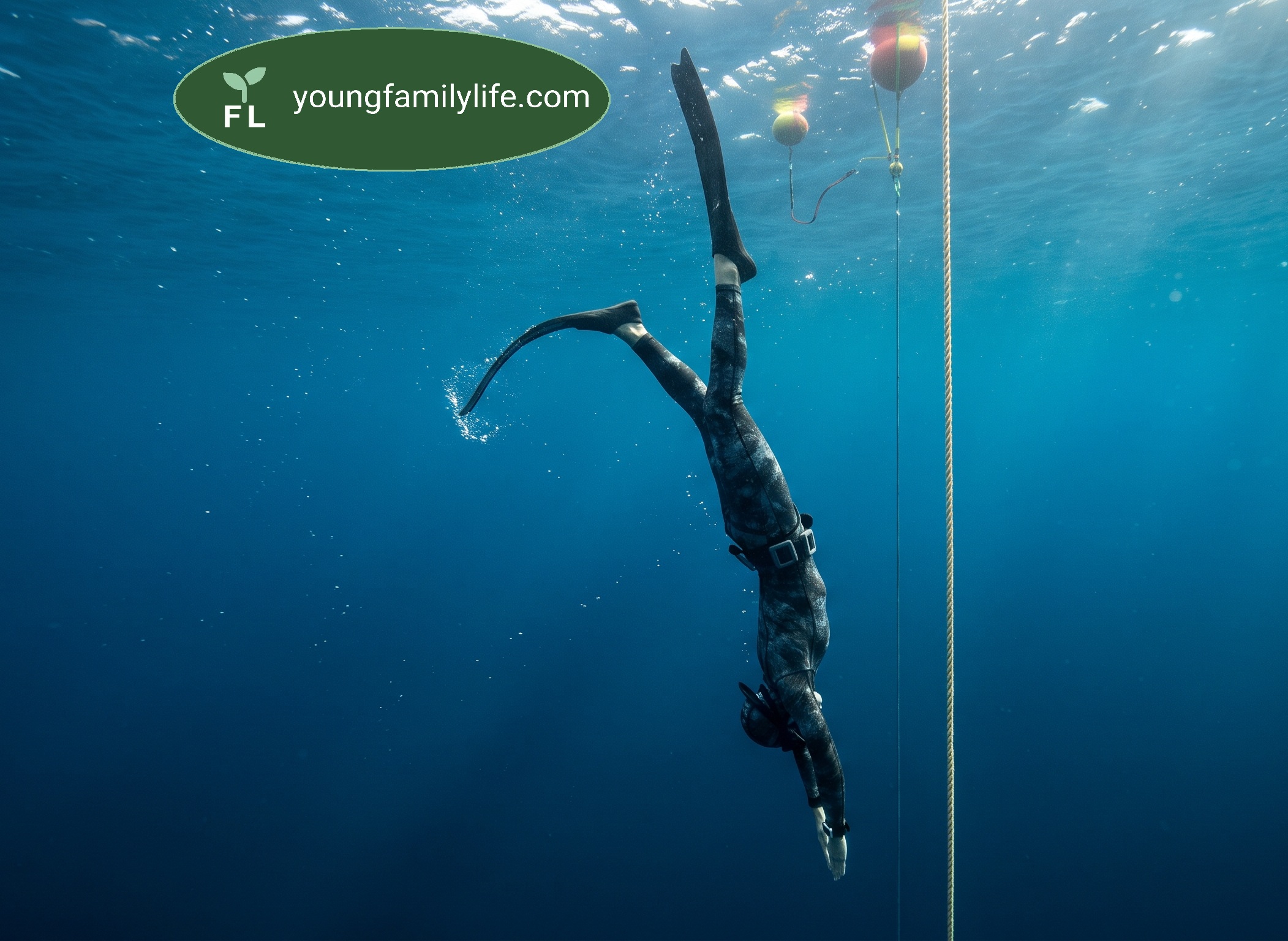
Breath-hold diving, also called free diving or apnoea diving, is useful here for a particular reason. It triggers the cold-water reflexes described above and adds an oxygen supply that cannot be replenished. Humans have been breath-hold diving since antiquity, and the competitive record shows the range: Herbert Nitsch, an Austrian free diver, reached 214 metres on a single breath in 2007 (Patrician et al., 2021). By 2021 the recognised static apnoea records, floating motionless face down, stood at 11 minutes 35 seconds for men and 9 minutes 2 seconds for women (Elia et al., 2021).
Pressure. For every 10 metres of seawater, pressure rises by one atmosphere. As pressure doubles, gas volume halves, so the lungs compress in stages with depth (Patrician et al., 2021). A review in Comprehensive Physiology describes immersion shifting blood into the heart and chest vessels, and a computer model in that review predicts that the first air sacs in the lungs reach closing volume at around 18 metres and that the lungs approach full collapse at around 235 metres (Comprehensive Physiology review, 2018). The depth figures are model predictions, not measurements.
The diving response. Holding the breath, especially with the face in cold water, triggers a set of reflexes: slowing of the heart, constriction of blood vessels in the limbs, a rise in blood pressure and contraction of the spleen (Foster and Sheel, 2005). The response occurs with apnoea alone, and is stronger when facial cooling is added. Its main function is thought to be conservation of oxygen for the heart and brain. Lindholm and Lundgren (2009) report that the response in elite divers resembles that of diving animals, although arrhythmias and large rises in blood pressure indicate a less perfect adaptation in humans.
The spleen. Swedish research found that the spleen contracts in humans during breath-holding, releasing stored red blood cells into the circulation and raising haemoglobin, which may prolong repeated apnoeas (Schagatay et al., 2001). In ten subjects, three maximal breath-holds produced a mean spleen volume reduction of 18% (Schagatay et al., 2005).
Use of oxygen. During a breath-hold, the body runs on a finite store held in the lungs, bound to haemoglobin in blood, and in muscle. Lung volume is directly proportional to oxygen stores, which is why competitors begin close to total lung capacity (Elia et al., 2021). Experienced divers add lung packing, a technique that forces extra air into the lungs, and review authors warn that too much packing can increase the risk of lung barotrauma, which is pressure injury to lung tissue (Patrician et al., 2021). Elite divers tolerate extreme conditions at the end of a maximal attempt, with arterial oxygen pressure around 20 mmHg and carbon dioxide pressure around 55 mmHg (Elia et al., 2021), which is far below what is normal at rest.
The brain. The urge to breathe is driven mainly by rising carbon dioxide, not by falling oxygen. A breath-holder who has hyperventilated beforehand lowers carbon dioxide, delays the urge to breathe, and can lose consciousness from lack of oxygen before any urgent need to breathe is felt (International Life Saving Federation, 2011). The mildest stage is loss of motor control, known among divers as "samba": tremor, loss of posture and speech difficulty. The briefing reports a suggested mechanism of reduced nerve signalling under low oxygen, and this is a hypothesis. In major international AIDA competitions in 2002 to 2004, of 355 static apnoea performances 1.1% ended in loss of consciousness and 9.6% in loss of motor control, and of 344 constant weight depth dives both occurred in 6.1%. The author notes that no fatal accidents or permanent injuries were reported from those competitions (Lindholm, 2007). Elite divers are described as able to withstand acute cerebrovascular and neuronal strain, and the same review concludes that preliminary evidence raises questions about cognitive, neurological, renal and bone health over the long term, with longitudinal studies still needed (Elia et al., 2021).
Harm to the lungs and body. Competitors approach what reviewers describe as absolute physiological limits, indicated by pulmonary oedema and bleeding into the air sacs after dives, with remarkable and poorly understood variation between individuals (Lindholm and Lundgren, 2009). A 2026 state-of-the-art review adds that decompression stress, once considered negligible, is now recognised in elite and repetitive divers (Paganini et al., 2026).
Who is harmed. Most deaths do not occur in elite divers. Lindholm and Lundgren report that breath-hold diving mortality is concentrated among less well-trained recreational divers and competitive spearfishers who fall victim to hypoxia. Australian figures cited in a 2023 paper record 175 breath-hold diving deaths between 2001 and 2013, of which 22 were considered associated with hypoxic blackout.
What a healthy body can do, and where the evidence stops
Cold-water immersion and breath-hold diving show the same thing from two directions. A healthy body has reflexes built for an emergency. Cold on the skin and face drives the sympathetic nervous system, which raises heart rate and blood pressure and releases noradrenaline. Breath-holding and facial cooling drive the diving response, which slows the heart and narrows the blood vessels in the limbs. Repeated exposure changes the response: cold shock lessens within a few immersions, brown fat activity rises, and trained divers show a stronger diving response, spleen contraction and adaptations in blood and muscle. In people with healthy hearts, lungs and blood vessels, this is within the range of normal physiology, and some people experience it as invigorating.
The same evidence shows these reflexes pulling in opposite directions. Cold shock speeds the heart, and the diving response slows it. When both fire together, as when the face goes under cold water with a held breath, the heart receives conflicting signals. A physiology paper on this "autonomic conflict" reported a high incidence of cardiac arrhythmias in healthy volunteers submerged in cold water, and proposed it as a different way to die during cold water immersion (Shattock and Tipton, 2012). The reflexes that protect also carry risk, and the risk is documented in healthy people.
For people with health problems, the research is thin and the caution is consistent.
No trials in the people most at risk. The large trials above excluded people with severe illness or enrolled young healthy volunteers. The shower trial excluded severe comorbidity. The immune experiments used healthy young men. The cardiologist quoted by the American Heart Association noted that little research on cold water immersion included people with heart conditions, and that medicines such as beta blockers may make adapting to the shock harder.
What guidance says. The British Heart Foundation describes cold water swimming as able to improve blood pressure and blood fats in people in good general health, and advises people with a heart condition to discuss risks with a doctor or specialist nurse before swimming. It cites guidance from the Association of Chartered Physiotherapists in Cardiac Rehabilitation that water between 26 and 33°C is safest for people with heart conditions. The Portsmouth guidance recommends that immersion be postponed or avoided during acute injury or illness, exhaustion, hypothermia and acute exacerbations of chronic medical conditions, and lists cardio-respiratory compromise, peripheral vascular disorders, medicines that raise the risk of rhythm disturbance and cold urticaria among the factors for medical screening (Tipton et al., 2022).
The gap. These statements rest on physiological reasoning and on documented harm in healthy swimmers. They are not measurements of outcomes in ill people. The research does not show that cold water cures chronic disease, and it does not show how often it harms people who have one. Both gaps matter.
Closing summary
Cold water has real, measurable effects on a healthy body. Within the first minute it triggers cold shock. Over an hour it multiplies metabolic rate and stress hormones. Over days it changes how the body produces heat. Randomised trials in healthy adults report fewer sick days at work in one large Dutch trial, short-lived changes in mood, stress and sleep, and an acute rise in inflammatory markers. They do not establish a lasting health benefit or an immune boost.
Medicine uses cold water in narrow ways: for exertional heatstroke, where the evidence is strongest and the patient is typically healthy; for some rhythm disturbances, especially in infants; and, with weak evidence, for soft tissue injuries and muscle soreness. Post-cardiac-arrest cooling has been revised by a large trial.
Breath-hold diving shows the limits of a healthy body. Trained divers use the diving response, spleen contraction, large lung stores and tolerance of low oxygen to extend breath-holds well beyond ordinary experience, and the same physiology produces blackouts, lung injury and deaths, mainly in less experienced divers.
For people with heart, lung, vascular or other serious conditions, the response that a healthy body handles can become the hazard. The research has not tested this directly, and published guidance asks for medical advice first. Cold water as a cure for illness is not supported by the evidence reviewed here, while cold water as a stressor that healthy bodies may adapt to, within limits, is.
A note on reliability
The weight of evidence is uneven. The heatstroke treatment rests on a large body of physiological research. The diving findings come from small studies of elite and trained divers. The wellbeing findings come from one large trial of self-reported sickness absence, a meta-analysis of 11 trials, small experiments in healthy young adults and one case report. No trial in this essay tested cold water as a treatment in people with serious chronic illness. Several of the sources cited were available to YFL in abstract form only. YFL's essay Cures Ahead of the Evidence: When Interventions Judged Beneficial Were Tested sets out cases where a practice was in use before it was tested.
References
Barwood, M. J., Eglin, C., Hills, S. P., Johnston, N., Massey, H., McMorris, T., Tipton, M. J., Wakabayashi, H. and Webster, L. (2024). Habituation of the cold shock response: a systematic review and meta-analysis. Journal of Thermal Biology, 119, 103775.
Bleakley, C., McDonough, S. and MacAuley, D. (2004). The use of ice in the treatment of acute soft-tissue injury: a systematic review of randomized controlled trials. American Journal of Sports Medicine, 32(1), 251–261.
Bleakley, C., McDonough, S., Gardner, E., Baxter, G. D., Hopkins, J. T. and Davison, G. W. (2012). Cold-water immersion (cryotherapy) for preventing and treating muscle soreness after exercise. Cochrane Database of Systematic Reviews, CD008262.
Breath-hold diving (2018). Comprehensive Physiology, 8(2), 585–630.
Buijze, G. A., Sierevelt, I. N., van der Heijden, B. C. J. M., Dijkgraaf, M. G. and Frings-Dresen, M. H. W. (2016). The effect of cold showering on health and work: a randomized controlled trial. PLOS ONE, 11(9), e0161749.
Cain, T., Brinsley, J., Bennett, H., Nelson, M., Maher, C. and Singh, B. (2025). Effects of cold-water immersion on health and wellbeing: a systematic review and meta-analysis. PLOS ONE, 20(1), e0317615.
Casa, D. J., McDermott, B. P., Lee, E. C., Yeargin, S. W., Armstrong, L. E. and Maresh, C. M. (2007). Cold water immersion: the gold standard for exertional heatstroke treatment. Exercise and Sport Sciences Reviews, 35(3), 141–149.
Collins, N. C. (2008). Is ice right? Does cryotherapy improve outcome for acute soft tissue injury? Emergency Medicine Journal, 25(2), 65–68.
Dankiewicz, J., Cronberg, T., Lilja, G. et al. (2021). Hypothermia versus normothermia after out-of-hospital cardiac arrest. New England Journal of Medicine, 384(24), 2283–2294.
DeMartini, J. K., Casa, D. J., Stearns, R., Belval, L., Crago, A., Davis, R. and Jardine, J. (2015). Effectiveness of cold water immersion in the treatment of exertional heat stroke at the Falmouth Road Race. Medicine and Science in Sports and Exercise, 47(2), 240–245.
Elia, A., Gennser, M., Harlow, P. S. and Lees, M. J. (2021). Physiology, pathophysiology and (mal)adaptations to chronic apnoeic training: a state-of-the-art review. European Journal of Applied Physiology, 121(6), 1543–1566.
Foster, G. E. and Sheel, A. W. (2005). The human diving response, its function, and its control. Scandinavian Journal of Medicine and Science in Sports, 15(1), 3–12.
Hutchins, K. P., Minett, G. M. and Stewart, I. B. (2022). Treating exertional heat stroke: limited understanding of the female response to cold water immersion. Frontiers in Physiology, 13, 1055810.
Huttunen, P., Kokko, L. and Ylijukuri, V. (2004). Winter swimming improves general well-being. International Journal of Circumpolar Health, 63(2), 140–144.
International Life Saving Federation (2011). Medical position statement MPS 16: shallow water blackout.
Kelly, J. S. and Bird, E. (2022). Improved mood following a single immersion in cold water. Lifestyle Medicine, 3(1), 1–9.
Knechtle, B., Waśkiewicz, Z., Sousa, C. V., Hill, L. and Nikolaidis, P. T. (2020). Cold water swimming: benefits and risks, a narrative review. International Journal of Environmental Research and Public Health, 17(23), 8984.
Kox, M., van Eijk, L. T., Zwaag, J., van den Wildenberg, J., Sweep, F. C. G. J., van der Hoeven, J. G. and Pickkers, P. (2014). Voluntary activation of the sympathetic nervous system and attenuation of the innate immune response in humans. Proceedings of the National Academy of Sciences, 111(20), 7379–7384.
Lindholm, P. (2007). Loss of motor control and/or loss of consciousness during breath-hold competitions. International Journal of Sports Medicine, 28(4), 295–299.
Lindholm, P. and Lundgren, C. E. G. (2009). The physiology and pathophysiology of human breath-hold diving. Journal of Applied Physiology, 106(1), 284–292.
McDermott, B. P., Casa, D. J., Ganio, M. S., Lopez, R. M., Yeargin, S. W., Armstrong, L. E. and Maresh, C. M. (2009). Acute whole-body cooling for exercise-induced hyperthermia: a systematic review. Journal of Athletic Training, 44(1), 84–93.
Nolan, J. P. et al. (2022). European Resuscitation Council and European Society of Intensive Care Medicine guidelines on temperature control after cardiac arrest in adults. Resuscitation, 172, 229–236.
Paganini, M., Moon, R. E., Camporesi, E. M. and Bosco, G. (2026). Advances in breath-hold diving research: a state-of-the-art review. European Journal of Applied Physiology, 126(3), 1223–1243.
Patrician, A., Dujić, Ž., Spajić, B., Drviš, I. and Ainslie, P. N. (2021). Breath-hold diving: the physiology of diving deep and returning. Frontiers in Physiology, 12, 639377.
Roberts, L. A., Raastad, T., Markworth, J. F., Figueiredo, V. C., Egner, I. M., Shield, A., Cameron-Smith, D., Coombes, J. S. and Peake, J. M. (2015). Post-exercise cold water immersion attenuates acute anabolic signalling and long-term adaptations in muscle to strength training. Journal of Physiology, 593(18), 4285–4301.
Royal Children's Hospital Melbourne. Clinical practice guideline: supraventricular tachycardia (SVT).
Schagatay, E., Andersson, J. P. A., Hallén, M. and Pålsson, B. (2001). Selected contribution: role of spleen emptying in prolonging apneas in humans. Journal of Applied Physiology, 90(4), 1623–1629.
Schagatay, E., Haughey, H. and Reimers, J. (2005). Speed of spleen volume changes evoked by serial apneas. European Journal of Applied Physiology, 93(4), 447–452.
Shattock, M. J. and Tipton, M. J. (2012). 'Autonomic conflict': a different way to die during cold water immersion? Journal of Physiology, 590(14), 3219–3230.
Smith, G. et al. (2012). Use of the human dive reflex for the management of supraventricular tachycardia: a review of the literature. Emergency Medicine Journal, 29(8), 611–616.
Šrámek, P., Šimečková, M., Janský, L., Šavlíková, J. and Vybíral, S. (2000). Human physiological responses to immersion into water of different temperatures. European Journal of Applied Physiology, 81(5), 436–442.
Tipton, M. J., Collier, N., Massey, H., Corbett, J. and Harper, M. (2017). Cold water immersion: kill or cure? Experimental Physiology, 102(11), 1335–1355.
Tipton, M., Massey, H., Mayhew, A. and Morgan, P. (2022). Cold water therapies: minimising risks. British Journal of Sports Medicine, 56(23), 1332–1334.
van der Lans, A. A. J. J., Hoeks, J., Brans, B., Vijgen, G. H. E. J., Visser, M. G. W., Vosselman, M. J. et al. (2013). Cold acclimation recruits human brown fat and increases nonshivering thermogenesis. Journal of Clinical Investigation, 123(8), 3395–3403.
van Tulleken, C., Tipton, M., Massey, H. and Harper, C. M. (2018). Open water swimming as a treatment for major depressive disorder. BMJ Case Reports, bcr2018225007.
Zwaag, J., Naaktgeboren, R., van Herwaarden, A. E., Pickkers, P. and Kox, M. (2020). The combination of cold exposure training and a breathing exercise attenuates the inflammatory response in humans. Preprint.
Topics: #ColdWaterTherapy #BreathHoldDiving #DivingResponse #EvidenceGrading #Physiology #InformationWithoutInstruction