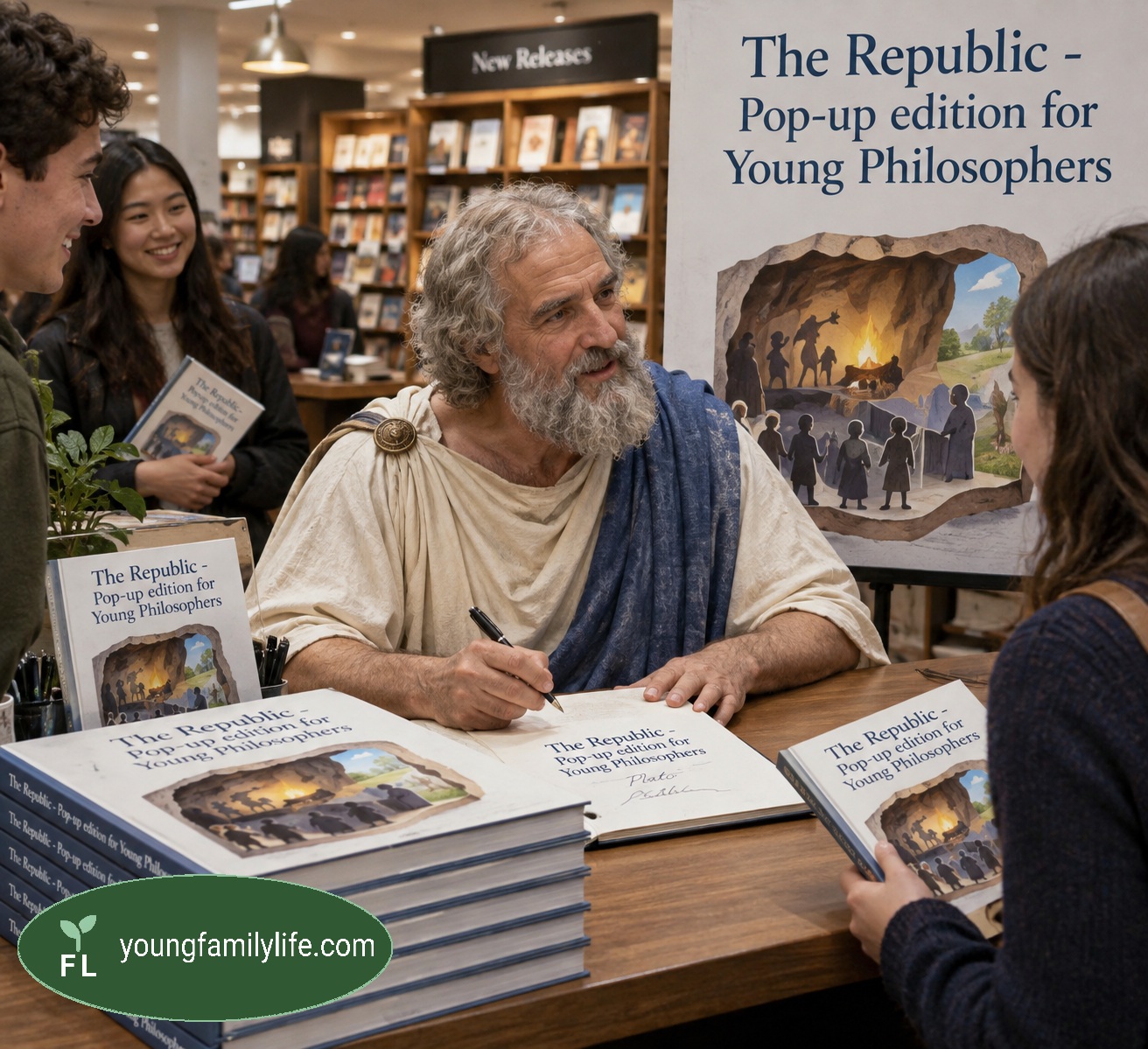
Plato is difficult to ignore
Plato has surfaced repeatedly across recent YFL essays and content — not sought out, but arriving uninvited. He turned up in The Noble Lie and the Ministry of Truth, an essay on who gets to author the story a society lives by; in a discussion of ancient precedent for state myth-making; and in a stray thought about who first theorised controlling a population’s beliefs for its own good. A figure who keeps appearing unbidden across unrelated lines of inquiry is worth meeting properly, in his own right, rather than only ever as a supporting citation in someone else’s argument.
A real family, not a marble bust
Plato was born in Athens, most likely in 428 or 427 BC, to a family of real social standing and real political entanglement — not the timeless, abstract figure later ages made of him. His father, Ariston, claimed descent from Codrus, a legendary early king of Athens. His mother, Perictione, traced her own line to the lawgiver Solon, and her family connections were considerably more consequential than decorative ancestry. Her cousin Critias was a leading figure among the Thirty Tyrants, the brief and violent oligarchic regime that seized Athens after its defeat in the Peloponnesian War in 404–403 BC. Her brother Charmides served on the board of ten that governed the Piraeus under them. Both died in 403 fighting the democratic exiles (Xenophon, trans. 1918; Nails, 2002). Plato had two older brothers, Adeimantus and Glaucon — both later given speaking roles in the Republic — and a sister, Potone, whose son Speusippus would eventually succeed his uncle as head of the school Plato founded.
Even his name carries a story rather than a certainty. Ancient sources report that he was originally named Aristocles, after his grandfather, and that a wrestling coach nicknamed him “Platon” — broad — for his physique, his wide forehead, or the breadth of his eloquence, depending on which ancient account is followed. Modern scholars are divided on whether any of this is reliable: “Plato” was a common Athenian name, with dozens of other attested holders, and some historians suspect the Aristocles story was itself invented later, once Plato had become famous enough to need an origin story of his own (Diogenes Laërtius, trans. 1925; Nails, 2002). Even the most basic fact about him — his own name — arrives already wrapped in the kind of embellished, half-legendary retelling that YFL has examined elsewhere as a feature of how stories survive, not a flaw in them.
The event that shaped everything after it
The single fact most necessary for understanding Plato is biographical rather than philosophical: he was a young man, closely related by blood to the leaders of a recent, failed, and bloody oligarchic coup, in a city that had just restored its democracy — and it was that restored democracy which, in 399 BC, tried and executed his teacher, Socrates, on charges of corrupting the young and impiety.
This is not incidental context. It explains a great deal that might otherwise look like abstract theorising for its own sake. A man whose own family had tried and failed at rule by a self-selected few, and who then watched the restored popular government kill the person he considered the wisest man he knew, had direct personal reason to distrust both alternatives on offer in his own city — mob rule and tyranny alike — and to spend the rest of his working life searching for a third way of arranging political authority that neither his relatives’ faction nor his teacher’s killers had offered him.
Founding a school that outlasted him by centuries
After Socrates’ death, Plato left Athens for a period, travelling — by later report — through Egypt, Italy, Sicily, and Cyrene. He returned in his early forties and founded the Academy, generally dated to around 387 BC, in a grove outside Athens sacred to the hero Academus. It is often described as the first institution of higher learning in the Western world: a standing place, not a single teacher’s temporary circle, where mathematics, dialectic, and natural philosophy were pursued across generations of students, including, for twenty years, Aristotle himself.
The Academy endured, in some form, for centuries after Plato’s own death around 348 BC. Its grove was ravaged during the Roman general Sulla’s siege of Athens in 87–86 BC, when timber for siege works was cut from the Academy and the Lyceum (Plutarch, trans. 1916). It was not, as is sometimes said, closed by imperial edict under Justinian in 529 AD. That date belongs to the later Neoplatonic school in Athens, whose continuity with Plato’s Academy is itself disputed.
How his words actually reached us
Plato’s own writings survived antiquity in a condition remarkably better than almost any other ancient philosopher’s — complete dialogues, not fragments quoted secondhand in other authors’ works. The specific route by which they reached the present is worth tracing, because it is a case study in durable cultural memory of the kind examined in Memory’s Oldest Machine, an essay on how story encodes what matters so that it survives retelling.
The dialogues were preserved and copied through the Byzantine Empire across the medieval centuries, kept alive by scholars such as the eleventh-century Michael Psellos and, more decisively, the fifteenth-century philosopher Gemistus Pletho. Pletho travelled to Italy with the Byzantine delegation to the Council of Ferrara–Florence in 1438–39, a council called over church union and the Ottoman threat rather than over philosophy, and lectured on Plato while there. According to Marsilio Ficino’s own later account, Pletho’s advocacy helped persuade the Florentine ruler Cosimo de’ Medici to patronise the study of Plato, although modern historians treat the strength of that link with some caution (Hankins, 1990). Ficino completed a full Latin translation in the late 1460s, published in 1484, which became for centuries the means by which readers across Europe who could not read Greek gained access to Plato at all. The first printed Greek edition followed in 1513, from the Aldine press in Venice. A further edition in 1578, by the French scholar Henri Estienne (known by his Latinised name, Stephanus), introduced the standardised page-and-letter reference system — “Republic 414b,” and so on — still used to cite Plato today, regardless of which modern translation or language an actual reader holds in their hands.
None of this transmission was guaranteed. Plato’s survival into the present depended on a diplomatic council that happened to carry a Byzantine philosopher to Italy, on one scholar’s enthusiasm for Platonism outliving him, and on a Florentine banking family’s patronage of translation as a form of prestige. The durability other YFL essays have examined as a general property of story and cultural memory is visible here in unusually concrete, traceable form: not myth this time, but a real historical chain of specific people, at specific moments, choosing to carry a body of text forward.
Enduring, and enduring criticism
Alfred North Whitehead’s often-quoted line — “the safest general characterization of the European philosophical tradition is that it consists of a series of footnotes to Plato” — is frequently taken to mean that Plato said everything worth saying and everyone since has merely annotated him. Whitehead himself immediately qualified the remark: he meant not the systematic doctrine scholars have tried to extract from Plato’s texts, but “the wealth of general ideas scattered through them” (Whitehead, 1929/1978, p. 39). The claim is narrower and more defensible than the popular version of the quote suggests — Plato as the source of an extraordinarily wide range of philosophical questions still being argued over, not as the source of settled answers to them.
That range of questions has not spared Plato from serious, direct criticism by contemporary standards, and YFL essays have already met one strand of it: the Republic’s censorship of poets and its “noble lie” read, by twentieth-century critics, as an early and troubling brief for authoritarian rule dressed in philosophical language. The philosopher Karl Popper made this case most forcefully and influentially, arguing in The Open Society and Its Enemies (1945) that Plato’s ideal state — rule by a small class of guardians who alone possess true knowledge, maintained in power partly through a deliberately fostered founding myth — amounted to a blueprint for totalitarianism, however nobly intended. Popper’s reading remains contested among Plato scholars, some of whom argue it reads twentieth-century political anxieties back into a fourth-century-BC text that was doing something more exploratory and less prescriptive than Popper’s polemic allows. Both the endurance and the argument are, in their own way, evidence of the same thing: a text still worth fighting over, roughly twenty-four centuries after it was written, is not a text that has been safely filed away as history.
Where this leaves the question of Why Plato
Plato keeps surfacing in YFL essays and content not by coincidence, but because so much of what those essays examine — how a story is built to survive, who gets to author the version that endures, what happens when a founding myth is challenged by contemporary standards — turns out to have one of its earliest, most fully worked examples sitting in his own writing, and in the specific, traceable, occasionally accidental history of how that writing reached us at all.
References
Diogenes Laërtius. (1925). Lives of eminent philosophers (R. D. Hicks, Trans.). Harvard University Press. (Original work c. 3rd century AD)
Hankins, J. (1990). Plato in the Italian Renaissance (2 vols.). Brill.
Nails, D. (2002). The people of Plato: A prosopography of Plato and other Socratics. Hackett Publishing.
Plutarch. (1916). Sulla. In Plutarch’s Lives (Vol. 4, B. Perrin, Trans.). Harvard University Press. (Original work c. 2nd century AD)
Popper, K. (1945). The open society and its enemies, Vol. 1: The spell of Plato. Routledge.
Whitehead, A. N. (1929/1978). Process and reality: An essay in cosmology (Corrected ed., D. R. Griffin & D. W. Sherburne, Eds.). Free Press.
Xenophon. (1918). Hellenica, Books 1–2. In Xenophon (Vol. 1, C. L. Brownson, Trans.). Harvard University Press. (Original work c. 4th century BC)
Topics: #Plato #Socrates #AncientGreece #HistoryOfIdeas #StoryAsMemory #NarrativeAndControl