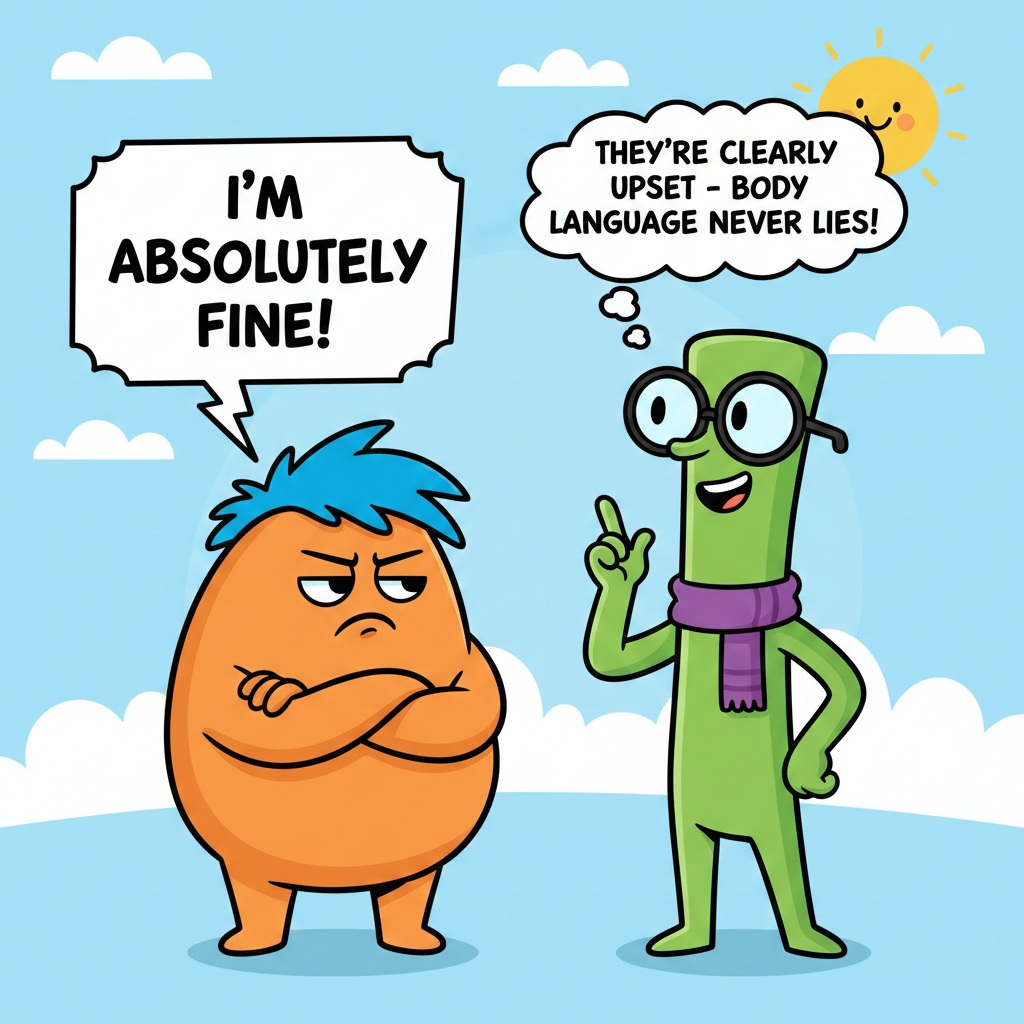
The Statistic Everyone Knows
Most people have heard this one: communication is 7% words, 38% tone of voice, 55% body language. It appears everywhere—business courses, therapy training, communication workshops. People use it as proof that "what someone says doesn't matter, it's all about how they say it."
The numbers come from a psychologist called Albert Mehrabian who did some studies back in the late 1960s. His research is often quoted. But what's rarely mentioned is what Mehrabian actually studied, or what he said about using his findings.
What Mehrabian Actually Did
In 1967, Mehrabian and his colleague Susan Ferris wanted to figure something out: when someone gets mixed messages—when words say one thing but tone and face say something else—which bit do people believe?
Their experiment worked like this: They recorded single words—like "maybe" or "really"—but said them in different tones. Warm and friendly. Cold and hostile. Completely neutral. Then they showed people photographs of faces: happy faces, angry faces, neutral faces. People listened to the word whilst looking at the photograph.
The question was: which bit matters most when trying to work out if someone likes another person or not? The actual word? The tone it was said in? Or the expression on their face?
In this very specific setup—single words, recorded voices, still photographs—they got those famous percentages. Roughly 7% from the word itself, 38% from how it was said, 55% from the facial expression in the photo.
That's what those numbers actually measure.
What This Actually Measured
When people quote those percentages, they leave out some important context:
It was only about feelings and attitudes. Not all communication. If someone's explaining how to fix a bike or discussing a business deal, the words clearly matter significantly. The content carries the meaning. Mehrabian never claimed this applied to everything people talk about.
They used single words. Not sentences. Not conversations. Just isolated words like "maybe" whilst people looked at photos. Real conversations involve context, history, relationships—not just random words and frozen faces.
They deliberately created conflict. The whole point was studying what happens when channels contradict each other. In normal conversation, someone's words, tone, and expression typically match up reasonably well. The percentages came from forcing things to clash in a lab.
They used photographs. Still images. Not real faces making constant tiny adjustments. Real nonverbal communication is typically dynamic—constantly changing and flowing. A photograph freezes one moment, not the continuous stream of signals that happens in actual interaction.
Mehrabian himself said his findings shouldn't be applied to all communication situations. But that warning got lost whilst the catchy percentages spread everywhere.
What Recent Research Actually Shows
In 2023, researchers called Patterson, Fridlund, and Crivelli published a massive review in Perspectives on Psychological Science. They looked at decades of research on nonverbal communication. One of their main points? Stop misusing Mehrabian's work.
They found something more interesting than simple percentages: nonverbal communication runs continuously—operating constantly—whilst verbal communication happens in distinct chunks. Both matter. Neither can be reduced to a percentage of "total communication."
When someone explains something complicated, the words carry essential information—specific ideas, logical connections, detailed descriptions. Without those words, the meaning wouldn't exist. But at the same time, nonverbal signals are happening: tone showing enthusiasm or doubt, facial expressions showing confidence or confusion, posture showing engagement or boredom.
These channels work together. They don't slice communication into percentage chunks. They run simultaneously through different systems that evolved for different jobs.
The Misapplication Problem
The "7-38-55" formula causes actual problems in how it gets used. Communication trainers say things like "it's not what someone says, it's how they say it." Business coaches tell people to focus on body language and tone, don't worry too much about words. Some therapists conclude that what people actually say barely matters compared to nonverbal signals.
But that's not what Mehrabian found. His research looked at one very specific thing: how people handle contradictions between channels when judging feelings based on single words with conflicting tones and facial expressions.
That doesn't provide insight into explaining how to fix a bike, discussing scientific theories, negotiating contracts, or many other forms of communication where the actual words carry the essential information.
Researchers like Khan and colleagues (2024, Frontiers in Psychology) developed tools for measuring nonverbal communication effectiveness. Their work showed that good communication needs all the channels working together—not dismissing some based on dodgy percentages.
What Research Actually Reveals
Recent research shows something more complex and more interesting than those simple percentages:
Nonverbal communication operates continuously. Even silence and stillness send signals. This continuous operation means nonverbal channels typically provide background information about emotional states, attitudes, relationship dynamics.
Verbal communication happens in chunks. Words and sentences have beginnings and endings. This chunky nature allows for precision, abstraction, and complexity that nonverbal channels generally can't achieve on their own.
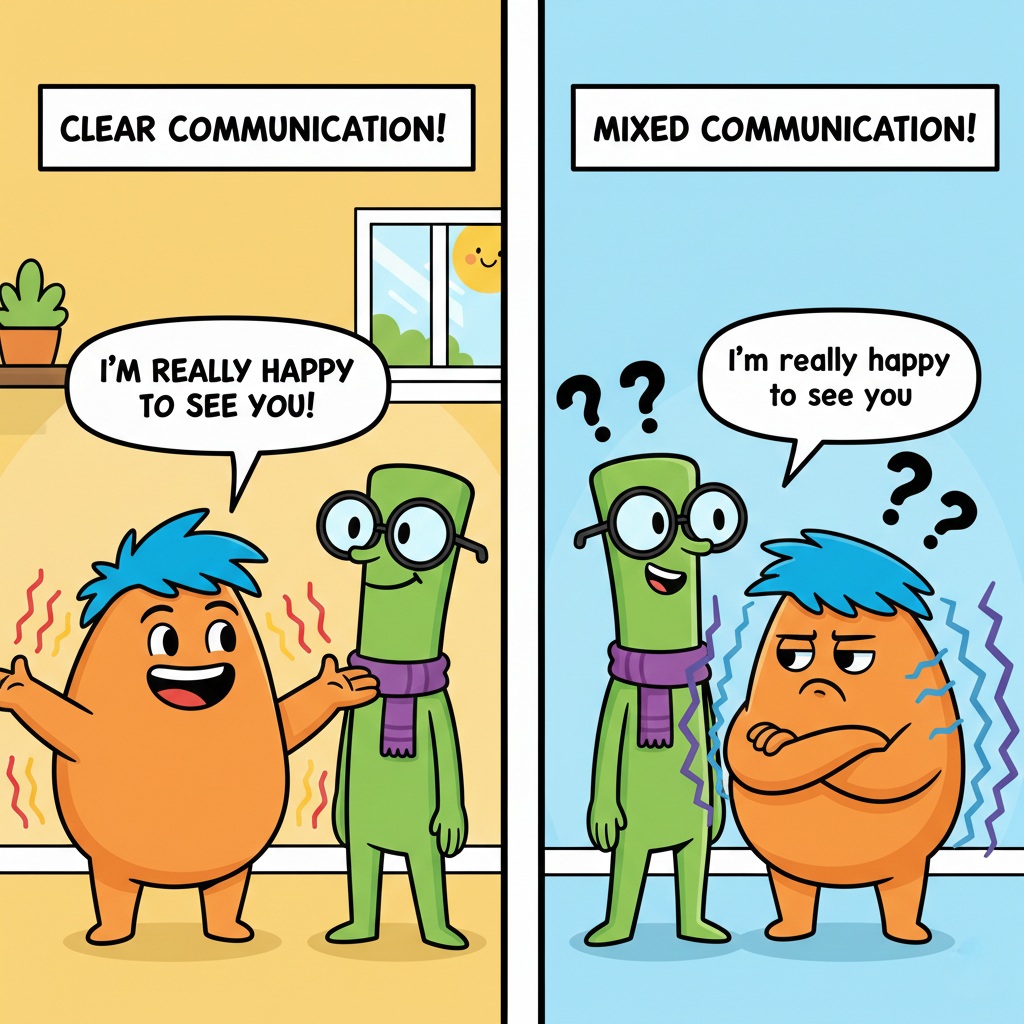
When these channels line up—when words, tone, expression, and posture all say consistent things—communication feels clear and trustworthy. When they clash—when words say one thing but tone and expression suggest another—people typically trust the nonverbal channels more because they're harder to consciously control and they operate continuously.
But "trusting" nonverbal when channels clash doesn't mean nonverbal always matters more. It means contradictions create confusion that people tend to solve by trusting what's harder to fake.
The Telephone Test
A phone call provides a simple test of the "93% nonverbal" claim. No facial expressions. No body posture. Just words and tone. Can people communicate effectively?
Clearly yes. Scientists work together across continents on phone calls. Friends maintain relationships through voice-only contact. Complex negotiations happen without anyone seeing faces.
If "93% of communication" really needed visible body language, phone calls would be nearly impossible. But they work fine. The words matter loads. The tone adds emotional context. Together, these channels provide enough information for complex communication.
The "7-38-55" formula can't explain phone calls if applied the way most people do. Mehrabian's actual research never claimed to explain telephone communication. It studied a very specific lab situation.
What Mehrabian Actually Said
Mehrabian's own summary of his work was clear about limitations. He said his findings applied to:
- Communication of feelings and attitudes (not general communication)
- Situations where channels contradict (not normal everyday communication)
- Judgments based on minimal information (single words plus tones and photographs)
He specifically warned against using the percentages in other contexts. But warnings don't travel as well as catchy formulas. The "7-38-55" rule spread everywhere whilst Mehrabian's careful warnings got left behind.
The Real Insight
Mehrabian's actual contribution wasn't the percentages. It was showing systematically that when channels conflict, people tend to trust the channels that are harder to control consciously.
This insight remains valuable. When someone's words say one thing but their tone and expression broadcast something else, people typically believe the nonverbal channels. Not because nonverbal always matters more, but because in contradictory situations, what's harder to fake tends to reveal truth more reliably than what can be carefully chosen.
Research by Carmichael and Mizrahi (2023, Current Opinion in Psychology) confirmed this pattern whilst also showing how words remain crucial for communication effectiveness. Their research showed that perceived responsiveness—a key relationship quality—depends on all channels working together, not one dominating the others.
What This Means for Communication
Research suggests communication works through multiple channels at once. Words allow for precision and complexity. Tone adds emotional colour. Facial expressions show reactions and responses. Posture suggests engagement or withdrawal. These channels evolved for different jobs. They work together rather than competing for percentage shares.
Effective communication typically requires attention to all channels, not dismissing some based on misleading statistics. A therapist needs both verbal skills (asking clear questions, explaining things precisely) and nonverbal awareness (reading facial expressions, managing tone, spotting when words and emotions don't match). Neither channel works well in isolation.
The "7-38-55" formula became popular probably because it simplified something genuinely complex. Communication involves multiple processes happening simultaneously that don't fit into simple percentages. But simplification that misleads doesn't help anyone.
The Research Foundation
Many researchers have worked to correct misuses of Mehrabian's findings. Patterson and colleagues' 2023 review tackled this directly. Other researchers studying communication across different contexts—healthcare, education, relationships, workplace settings—generally find that effective communication needs all channels working together.
Pang, Zhou, and Chu's 2024 research in Journal of Nonverbal Behavior looked at cross-cultural communication. They found that whilst specific nonverbal signals vary across cultures, the need for verbal and nonverbal channels to work together appears universal.
The evidence suggests replacing the misleading "7-38-55" formula with something more accurate (though less catchy): human communication operates through multiple channels simultaneously, each contributing essential information, with the relative importance of each channel depending on context, content, and whether channels align or contradict.
What Mehrabian Actually Discovered
Strip away the misapplied percentages, and Mehrabian's real finding stays interesting: when people judge emotions based on contradictory information from different channels, they weight channels differently depending on how much conscious control people typically have over each one.
Words—carefully selected, consciously produced—can be chosen to hide or manage emotions. Facial expressions and tone, operating partly outside conscious control, often reveal what words try to conceal. When these clash, people trust what's harder to fake.
This insight doesn't need percentages. It doesn't apply to all communication. But it shows an important pattern: contradictions between channels create confusion that people tend to solve by trusting signals most likely to reveal underlying states.
The famous formula became famous because it seemed to quantify communication precisely. But communication is difficult to quantify precisely. Mehrabian didn't claim his lab study with single words, recorded tones, and photographs could explain all human interaction. Using research accurately means paying attention to what was actually studied—not just repeating catchy statistics that travelled further than the careful warnings that should have come with them.
Topics: #Communication #Research #NonverbalCommunication #Psychology #Science #Mehrabian #Misconceptions #YoungFamilyLife
YFL Values: Information Without Instruction
This essay examines what Mehrabian actually studied versus how his findings get cited. His research used single words, recorded tones, and photographs in laboratory conditions. The famous percentages emerged from this very specific setup. Contemporary research shows communication operates through multiple channels simultaneously. The essay presents what research actually found.
Further Reading
These links dig deeper into the topics covered here:
Original Research:
- Mehrabian's 1967 studies - The original research papers
https://scholar.google.com/scholar?q=mehrabian+ferris+1967 - Mehrabian's own website - His clarifications about the research
http://www.kaaj.com/psych/
Contemporary Reviews:
- Perspectives on Psychological Science - Misconceptions - Patterson et al.'s 2023 comprehensive review
https://journals.sagepub.com/doi/10.1177/17456916231180593 - Wikipedia: Albert Mehrabian - Overview and context
https://en.wikipedia.org/wiki/Albert_Mehrabian
Communication Research:
- Current Opinion in Psychology - Responsiveness - Carmichael and Mizrahi's 2023 work
https://www.sciencedirect.com/science/article/abs/pii/S2352250X23001094
Related YFL Essays
Beyond Words: What Is Missed When Parents and Practitioners Focus on What is Spoken - Presents comprehensive research on nonverbal communication, examining what contemporary science actually reveals about how verbal and nonverbal channels work together
Eric Berne's Transactional Analysis: From Freudian Theory to Observable Interaction - Explores how Berne recognised in the 1950s that identical words could mean completely different things depending on tone, expression, and posture—decades before research confirmed his clinical observations
Copyright Notice
© 2025 Steve Young and YoungFamilyLife Ltd. All rights reserved.
"Hey!, Want To Know" is a copyrighted content format of YoungFamilyLife Ltd.
This essay was developed collaboratively using AI assistance to research academic sources and refine content structure, while maintaining the author's original voice, insights, and "Information Without Instruction" philosophy. No part of this essay may be reproduced, distributed, or transmitted in any form or by any means, including photocopying, recording, or other electronic or mechanical methods, without the prior written permission of the copyright holders, except in the case of brief quotations embodied in critical reviews and certain other noncommercial uses permitted by copyright law.
For permission requests, contact: info@youngfamilylife.com