Start Here
Most households have rules. Some are written down. Most aren't. Shoes off at the door. Homework before screens. Be home by ten. Some get followed reliably. Plenty don't.
And when they don't get followed — when the arguing starts, when the same conversation happens for the hundredth time, when it all feels exhausting — a reasonable question surfaces: do these rules actually matter? Or are they just friction?
The research says they matter. But not for the reason most people assume. Rules don't matter primarily because they produce obedient behaviour. They matter because of what a rule framework — consistent, predictable, reliably applied — builds inside the people living within it. And what the absence of one fails to build.
Everyone Needs a Map
Think about arriving somewhere unfamiliar. A new city, a new job, a new school. The first thing anyone does is look for the map — the signs, the patterns, the unspoken rules about how things work here. Where do people queue? What time do things start? What happens if something goes wrong?
Children are doing this constantly. Every day, in the different places they visit, a child's brain is building a map of how the world works. What causes what. What's expected. What happens next. This is one of the most important things a young brain does — because that internal map is what eventually allows a person to get on in life without needing someone else to direct every step.
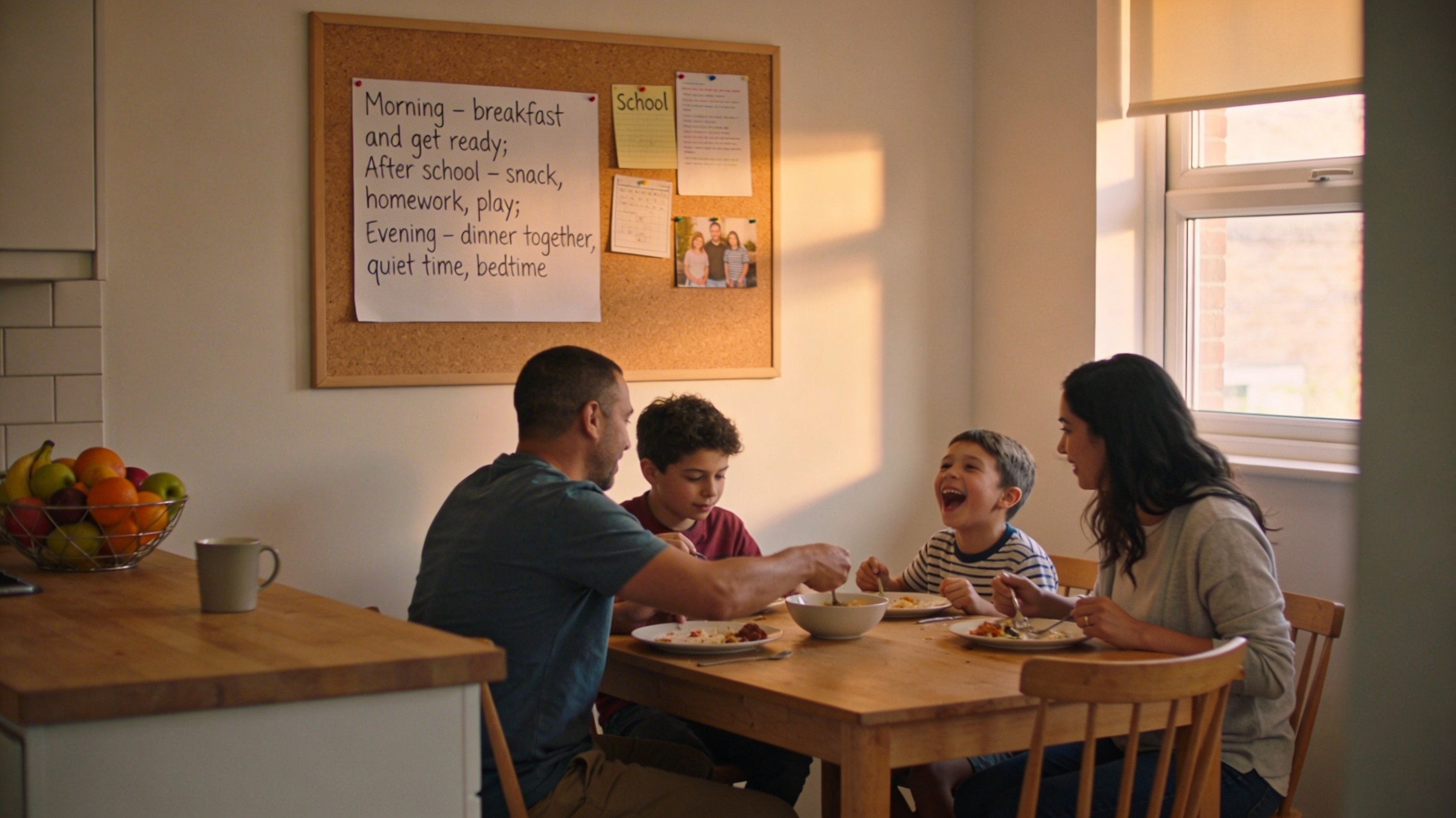
A household with a consistent rule framework gives children something concrete to map. Not because every rule is perfect, or because doing what you're told is the goal. But because a reliable set of expectations is the raw material from which an internal sense of structure gets built. Children who grow up with predictable rules — even imperfect ones — develop an internal compass. They learn that actions have consequences, that expectations are real, that the world has a shape that can be understood.
Children who grow up without it are still building a map. They just have far less to work with.
The Governance Check-in Card describes eight positions — from a household where rules are clear and reliably followed, right through to one where there is no consistent framework at all. That range isn't a judgement. It's a picture of what "more or less to work with" actually looks like in everyday life.
What the Research Actually Shows
The research finding that tends to surprise people most is this: consistency matters more than strictness.
A household with a modest but reliably applied set of expectations — everyone knows what's expected, and it's the same today as it was yesterday — gives children something they can count on. The level of rules doesn't have to be high. They just have to be predictable.
A household with lots of rules that get enforced unpredictably — sometimes there are consequences, sometimes there aren't, depending on the day — gives children something much harder to use. The rules exist, but they don't build the internal map. What gets built instead is a different kind of map: one that says the rule isn't the thing that matters, reading the situation is. People in these households become skilled at reading those around them. Less so at building their own sense of what's expected.
A small set of rules, reliably applied, turns out to build something more durable than a long list that nobody can quite rely on.
This is why the Governance Check-in Card focuses on a specific situation rather than household rules in general. Governance isn't one fixed thing across a whole household — it varies by situation, by child, by time of life. Bedroom tidying might sit at G5 — inconsistent, depending on the day. The morning routine might be G2 — mostly reliable, with the occasional rough patch. Both are worth knowing about separately.
What Children Are Actually Learning
When a household rule framework is working well, children aren't just learning the specific rules. They're picking up something much larger: that expectations are real, that behaviour has consequences, that structure is something that can be lived within. These are the early building blocks of self-regulation — the ability, eventually, to manage oneself.
Self-regulation doesn't arrive fully formed. It gets built, gradually, through thousands of everyday moments. A child who has grown up within a consistent set of expectations has spent years getting used to meeting them, handling frustration, and working within limits. By the time those external rules start to loosen — as they should, as children grow toward independence — there is an internal version already developing to take their place.
Without those external rules, the internal version has much less to develop from. It can still develop — people are remarkably adaptable — but it takes longer, requires more effort, and often involves learning through harder experiences than a household rule ever needed to be.
Rules Are Not the Whole Picture
Rules without warmth are a different kind of problem. A household where expectations are consistently applied but the emotional atmosphere is cold or distant produces compliance without connection. Children in these households learn to follow the rules — and also learn that meeting expectations is what earns closeness, which is a different lesson entirely.
Research into healthy development consistently finds that structure and warmth work together. Neither replaces the other. A warm household without structure leaves children loved but poorly prepared for a world that runs on expectations. A structured household without warmth leaves children capable but emotionally thin.
The households that work best for children combine both: a consistent set of rules held within a warm, caring relationship. Rules are maintained because they matter, not because the relationship depends on it. Warmth is available regardless of whether the rules get followed. Both are present. Both are reliable.
This is why the Governance Check-in Card has a companion — the Warmth Check-in Card. The two scales sit alongside each other deliberately. Knowing where governance sits is more useful when warmth is also in the picture. A household at G3 with high warmth is a very different place from a household at G3 with low warmth — even though the rules look the same from the outside.
When Rules Break Down — and Why That's Not the End
Every household has periods when things slip. Illness, stress, bereavement, relationship breakdown, a particularly difficult patch with a particular child. Rules that were reliable become inconsistent. Expectations that held start fraying.
This is normal. It's what life under pressure looks like. And it isn't lasting damage — provided things recover. What matters over time is the overall pattern, not any individual week. A household that is mostly consistent, with recognisable dips under stress and a return to normal afterwards, is giving children something solid enough.
What research into child development consistently shows is that repair matters as much as consistency. The experience of things going wrong and then being put right — expectations loosening and then holding again — teaches something that steady consistency alone can't. It teaches that disruption is survivable, that the structure comes back, that the rules are fundamentally reliable even when they temporarily aren't.
That's actually a more useful thing to learn for getting through adult life than perfect consistency ever could be.
What to Do With This
Most people reading this will recognise something — either in the household they grew up in, the household they currently live in, or both. That recognition is the point. Not to produce a verdict, but to open a question worth thinking about.
The Governance Check-in Card is the natural next step. It takes the ideas in this piece and makes them practical — offering eight positions that describe what different levels of governance actually look like, from fully consistent right through to no framework at all. The card works best when applied to one specific situation at a time rather than to a household in general. It's a starting point for a conversation, not a score to be judged by.
And if the Governance position looks clear but something still feels off, the Warmth Check-in Card is worth visiting too. The two scales together give a much fuller picture than either one alone.
Topics: #Governance #FamilyClimate #HouseholdRules #ChildDevelopment #SelfRegulation #Consistency #Structure #Parenting #ReflectivePractice #HWTK #YoungFamilyLife
Further Reading
These links dig deeper into the topics covered here:
The research behind governance and child development:
- Simply Psychology: Parenting Styles — accessible overview of the research from Baumrind and Maccoby that underpins what governance means for development
- Harvard Center on the Developing Child: Executive Function — explains how self-regulation develops and what conditions support it
Understanding consistency and structure in everyday life:
- Wikipedia: Self-regulation — broad overview of what self-regulation means, covering both the psychological and developmental dimensions
How This Essay Reflects YFL Values
This essay explains what household rules actually do — not in theory, but in terms of what builds inside a person over years of living within them. It starts with a question most people have asked themselves and works toward an answer that is a bit more surprising than expected. Rules matter because of what a consistent framework builds inside a developing person. Consistency matters more than strictness. Warmth and governance work together. Repair matters as much as consistency. The essay presents what the evidence shows and leaves the thinking to the reader.
Related YFL Content
Governance Check-in — Awareness Card — the partner to this piece. Offers an eight-position scale for looking at how governance currently sits in a specific situation, and what to do with that reflection.
Family Climate — the full essay that develops both the Governance and Warmth scales in depth, including how the two dimensions interact and what different combinations mean for children's development over time.
When Your Brain Has a Mind of Its Own — explores how stress affects the thinking brain's ability to maintain structure and consistency, which sheds light on why governance slips under pressure.
Humility Check-in — Awareness Card — useful for anyone who finds themselves resisting what the governance scale is showing them. Accurate self-awareness is the foundation of any honest reflection.
Copyright Notice
© 2026 Steve Young and YoungFamilyLife Ltd. All rights reserved.
"Hey!, Want To Know" is a copyrighted content format of YoungFamilyLife Ltd.
This essay was developed collaboratively using AI assistance to research academic sources and refine content structure, while maintaining the author's original voice, insights, and "Information Without Instruction" philosophy. No part of this essay may be reproduced, distributed, or transmitted in any form or by any means, including photocopying, recording, or other electronic or mechanical methods, without the prior written permission of the copyright holders, except in the case of brief quotations embodied in critical reviews and certain other noncommercial uses permitted by copyright law.
For permission requests, contact: info@youngfamilylife.com