What Happened
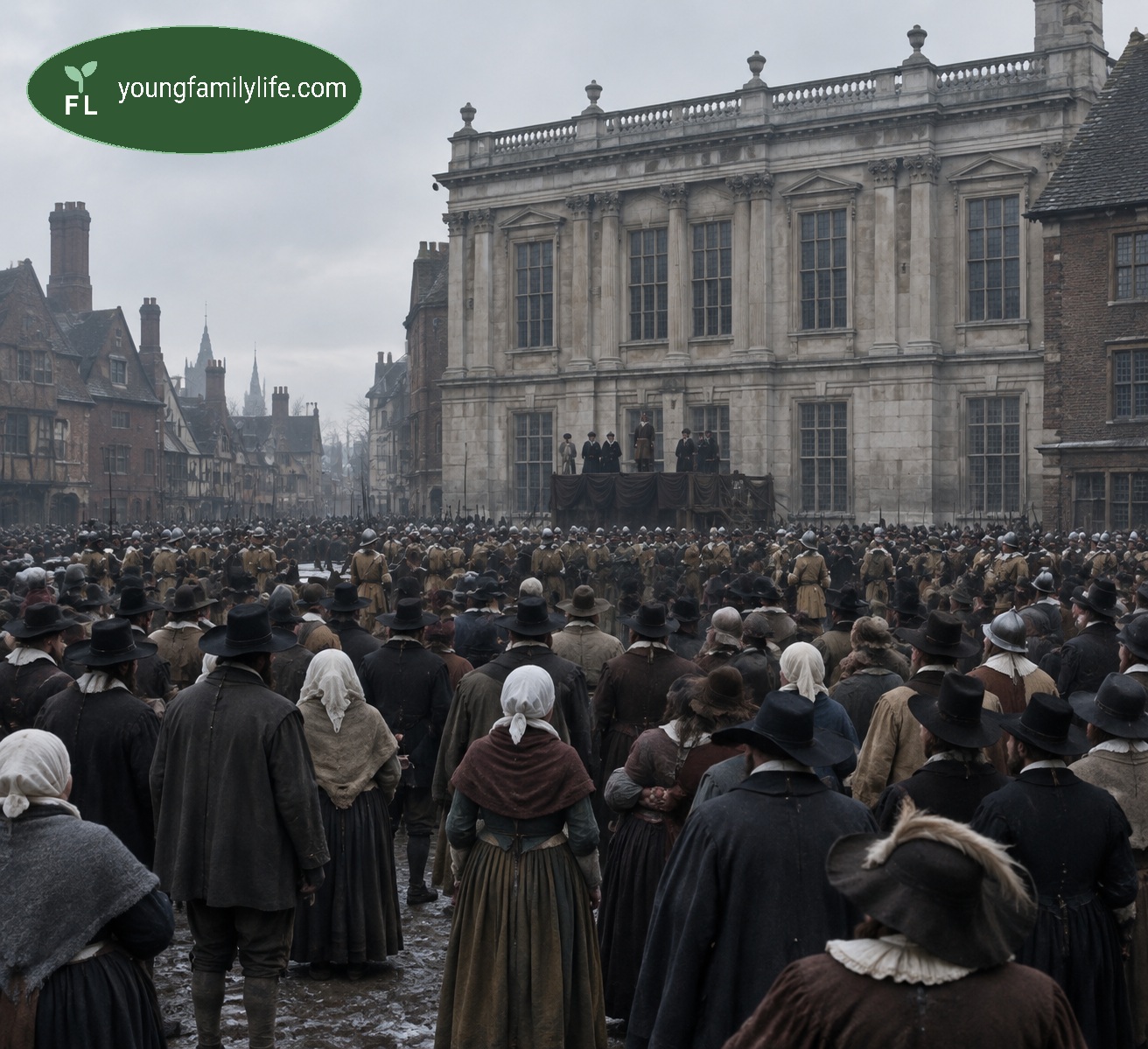
On 30 January 1649, King Charles I of England was executed outside the Banqueting House in Whitehall, London. Ten days earlier, a specially created court had put him on trial in Westminster Hall for treason against his own people. No English monarch had been tried by a court before, and none has been since.
Who Charles I Was
Charles I became king in 1625. He believed his authority came from God and that he had the right to rule as he saw fit. Parliament, which had the power to grant the money the Crown needed, disagreed about how far that right went. From 1629 to 1640 he ruled without calling Parliament at all, and raised money by methods many people regarded as illegal. When Parliament met again in 1640, the quarrel was already deep.
How It Reached This Point
1642. The quarrel turned into the English Civil War, between the king’s supporters and those of Parliament.
1646 to 1647. Charles lost the war and was taken prisoner. He did not accept defeat, and while in captivity he secretly made a deal with the Scots, who had fought against him, for them to invade England on his behalf.
1648. The deal led to a second civil war. The king’s side lost again. Many in the army that had won the war concluded that no settlement with Charles could be trusted.
Pride’s Purge
Many MPs still wanted to reach an agreement with the king. On 6 December 1648, soldiers under Colonel Thomas Pride stood at the door of the House of Commons and kept out or arrested those MPs who favoured a deal. What remained of the House, about two hundred members, became known as the Rump Parliament. It voted to put the king on trial. The House of Lords, which would have had to agree, refused, so the remaining MPs declared that they alone had the power to make law.
The Trial
The trial opened in Westminster Hall on 20 January 1649. A lawyer named John Bradshaw presided. The charge was that Charles, entrusted with limited power, had tried to set up unlimited power and had waged war against his own people, making him “a tyrant, traitor, murderer and public enemy”.
Charles refused to answer. He asked by what authority the court sat, and argued that no court could try a king, because the courts drew their power from the king. It was a strong legal point, because there was no law that allowed a court like this. He was sentenced to death on 27 January. Of the 135 men named to the court, about 68 attended, and 59 signed the death warrant.
Why Did They Do It?
The argument for. Supporters held that the king had caused the war and the deaths in it, and that a ruler who broke his duty to his people could be held to account. Some also used a biblical phrase, that Charles was “a man of blood” whose guilt had to be answered.
The argument against. Many at the time, including the House of Lords and many MPs, opposed the trial. They saw it as illegal and as the act of a small group backed by an army. Lord Fairfax, the commander of the army, was named to the court but did not take part in the trial.
What It Changed
England had no king for eleven years. Parliament abolished the monarchy and the House of Lords in March 1649 and declared England a republic. Oliver Cromwell, the army commander who had come to lead the country, became Lord Protector in 1653.
After Cromwell’s death in 1658, the republic broke down. In 1660 Charles I’s son returned as Charles II. Several of those who had signed the death warrant were executed, and in 1661 the bodies of Cromwell and two other leaders were dug up and displayed in public.
Does It Still Matter?
The trial left a question that has not gone away: can a monarch be held to account? The country’s later answer was different. In 1688, when James II lost the support of the political class, he was replaced without a trial, and in 1689 the Bill of Rights set limits on the Crown. Today the monarch is not prosecuted in the UK’s courts, and the government acts in the monarch’s name through ministers who answer to Parliament.
Historians still disagree about 1649. Some see an act of courage that established the principle that rulers answer to the law. Others see a coup by the army that broke the law to do it. The question remains open.
Topics: #HeyWantToKnow #CharlesI #EnglishCivilWar #Parliament #UKConstitution #OliverCromwell #Monarchy
Further Reading
These sources go deeper into the topics covered here:
History:
- C. V. Wedgwood, The Trial of Charles I (1964) — a narrative account of the trial
- Geoffrey Robertson, The Tyrannicide Brief (2005) — the story of the lawyer who drew up the case against the king
- Oxford Dictionary of National Biography, entries for Charles I and John Bradshaw
Official sources:
- Parliamentary Archives, the death warrant of Charles I — held by the UK Parliament
How This Essay Reflects YFL Values
YFL treats readers as capable adults who can weigh evidence for themselves. This piece sets out what happened in 1649, where historians disagree, and what remains open, and leaves the conclusions to the reader.
Related YFL Essays and Resources
In Other Words... How Parliament Took Over the Monarch’s Powers — the longer story from the 1530s to 1689.
Hey!, Want To Know... Who Was Thomas Cromwell, and How Did He Change the Way Laws Are Made? — how Parliament’s role grew a century before the civil war.
Hey!, Want To Know... Why Does the UK Have No Written Constitution? — what Oliver Cromwell wrote down in 1653.
In Other Words... Who Checks the Government? — the checks that Parliament, the courts and auditors place on ministers.
Holding State Power: The Crown, the Prime Minister and the Civil Service — the full Repositorium essay behind these pieces.