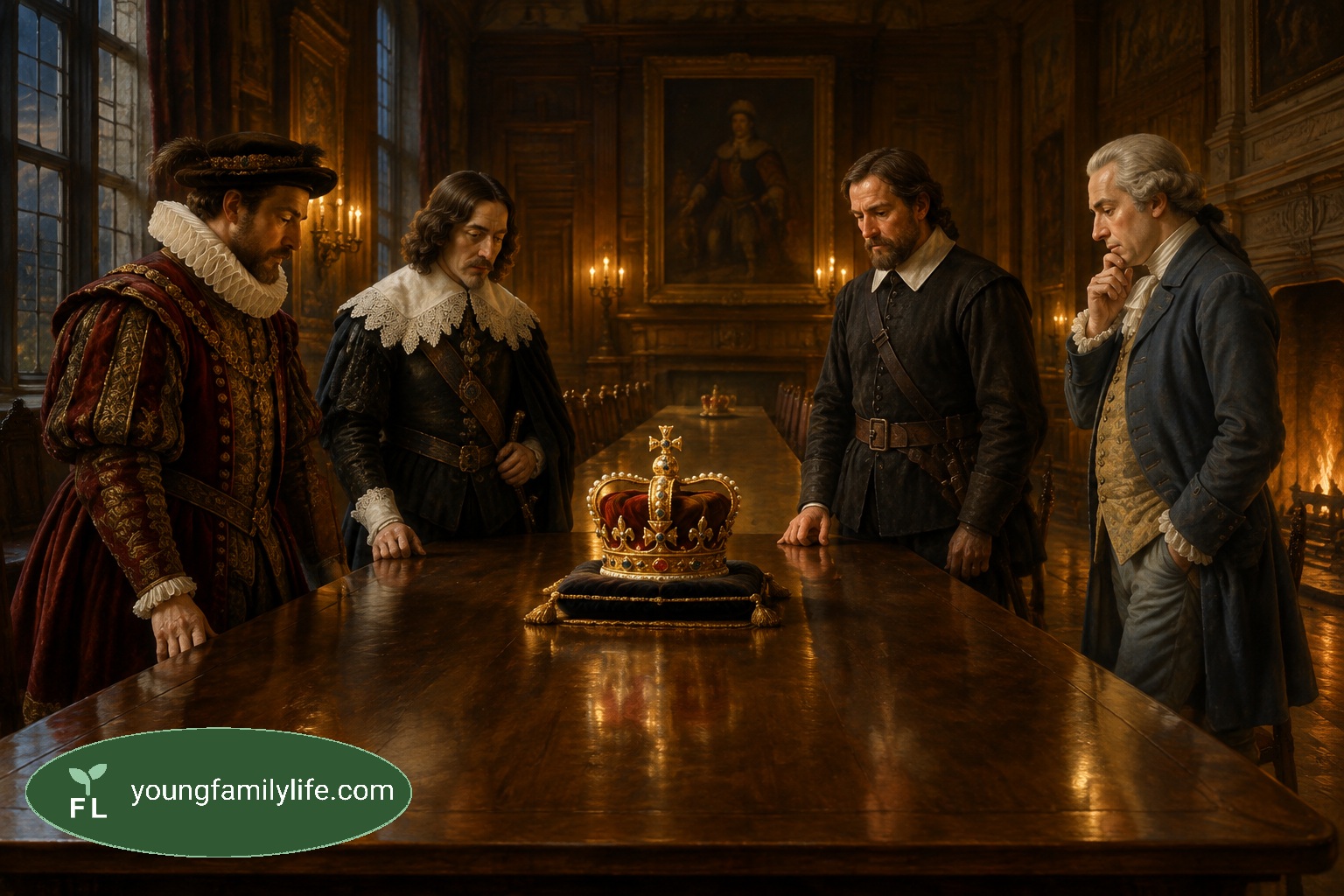
Where It Started
In the early 1500s the monarch decided. Ministers and a royal Council advised, and Parliament met when the monarch called it, mostly to agree taxes and to pass laws the monarch wanted. The monarch chose ministers and judges, decided when Parliament met and when it ended, and was expected to meet ordinary costs from royal revenues. Parliament was asked for money for extras such as war.
By 1689 the position had changed. The monarch could no longer suspend laws or raise money on the strength of royal power alone without Parliament’s consent. Five steps along the way explain how.
The 1530s: A Statute Changes the Church
Henry VIII, who reigned from 1509 to 1547, wanted to end his marriage, and the Pope would not agree. His chief minister, Thomas Cromwell, organised the break with Rome, and he did it through Parliament.
The Act in Restraint of Appeals in 1533 stopped English cases going to Rome. The Act of Supremacy in 1534 made Henry head of the Church of England. A change of that size was made by Act of Parliament, not by royal order. Passing it through the Lords and the Commons gave the break the weight of law and spread the responsibility.
The lasting idea was that a law agreed by the monarch, the Lords and the Commons together was the highest law in England. That helped Parliament, and it also helped a strong monarch. In 1539 the Statute of Proclamations gave royal proclamations the force of law. It was repealed in 1547. Cromwell himself was executed in 1540 after losing Henry’s favour.
1610: Judges Limit Proclamations
James I, who reigned from 1603 to 1625, issued proclamations on matters such as new building in London. In the Case of Proclamations in 1610 the judges ruled that a monarch could not create new offences by proclamation, and that the monarch had no powers beyond those the law allowed. The case is still cited. Its point was that the monarch’s power had limits, and that judges could say where they lay.
1629 to 1649: Charles I and the Civil War
Charles I, the son of James I, sent Parliament home in 1629 and ruled without it for eleven years. He raised money by other means, including Ship Money, a levy on ports that was later extended to inland counties. In 1637 a landowner, John Hampden, refused to pay and took the matter to court. The judges ruled for the Crown by a narrow majority, and the case made many people more suspicious of how far royal power could reach without Parliament.
He called Parliament again in 1640. It passed the Triennial Act in 1641, which required Parliament to meet at least every three years. Civil war between the king’s supporters and Parliament began in 1642. Charles I was tried and executed on 30 January 1649, and the monarchy and the House of Lords were abolished.
1653 to 1660: A Written Constitution, Then a Return
Oliver Cromwell was a distant relative of Thomas Cromwell, born about sixty years after Thomas Cromwell’s death. Thomas’s nephew, Richard Williams, took the Cromwell surname while serving his uncle, and Oliver was Richard’s great-grandson. Oliver was an MP and the most successful commander of Parliament’s army. In 1653 he became Lord Protector under the Instrument of Government, a written constitution often described as the only one Britain has had.
It did not outlast him. He died in 1658, and in 1660 Charles II, the son of Charles I, was invited back. The monarchy and the House of Lords returned with him.
1688 to 1689: Parliament Sets the Terms
Charles II was followed in 1685 by his brother, James II. In 1688 James II lost support and left the country. Parliament offered the throne jointly to his daughter Mary and her husband, William of Orange.
The Bill of Rights in 1689 set out the terms. Among other things, it declared illegal the monarch’s claimed power to suspend laws, and to raise money by royal prerogative, without Parliament’s consent. It also said Parliament should meet frequently, that elections should be free, and that members should be able to speak in Parliament without being punished for it elsewhere. Later generations called the change of monarch the Glorious Revolution, because it happened with little fighting in England.
What Changed and What Did Not
The monarchy survived, and so did the crown, the title and the ceremonies. What changed was who decided. Over the following centuries, powers that had belonged to the monarch were increasingly used by ministers who needed Parliament’s support to govern.
After 1689 the monarch still chose ministers and took part in government. The change was that the monarch now needed a Parliament willing to vote the money, and so ministers who could win its support. Queen Anne, who reigned from 1702 to 1714, was the last monarch to refuse assent to a Bill, in 1708. Since then, assent has followed as a matter of course on ministers’ advice.
The names stayed. The government still acts in the name of the Crown, and an Act still needs the monarch’s assent. No single plan produced the arrangement. It is the sum of these steps, each taking a little more for Parliament while the old titles stayed in place.
A Model Others Copied
Many countries adopted versions of this system. It is often called the Westminster system, after the place where the UK Parliament sits. In it, the government is drawn from the legislature and has to keep its support, a prime minister leads the government, and a separate head of state carries out the ceremonial role.
Much of the spread came with the British Empire. Canada, Australia, New Zealand and India all built their parliaments on it. Canada, Australia and New Zealand still share the UK’s monarch as head of state. Others dropped the monarch and kept the model. India became a republic in 1950, with a president as head of state, a prime minister, and two houses of parliament, the Lok Sabha and the Rajya Sabha.
Some countries outside the Commonwealth did the same. Ireland, which left the Commonwealth in 1949, has a president, a prime minister called the Taoiseach, and two houses, the Dáil and the Seanad. Japan’s post-war constitution of 1947 set up a prime minister and two houses of parliament, with an emperor in a ceremonial role, though it was written under American influence as well as British.
The United States took another route. Its founders kept two chambers, but they had no monarch and no hereditary house, and they placed the president outside Congress. Not every two-chamber parliament is a copy of Westminster, but the British pattern is one of the most widely used.
Topics: #InOtherWords #UKConstitution #Parliament #ThomasCromwell #CharlesI #BillOfRights #WestminsterSystem #HistoryOfGovernment
Related YFL Content
The big picture
In Other Words... Who Is Actually in Charge of the United Kingdom? — the layers of government that this history produced, and who holds which.
The monarch and the Crown
Hey!, Want To Know... When Did a Monarch Last Refuse to Sign a Law? — the monarch’s formal part in making laws.
How Parliament took over the Crown’s powers
Hey!, Want To Know... Why Does the UK Have No Written Constitution? — why the rules are spread across many sources.
Hey!, Want To Know... Who Was Thomas Cromwell, and How Did He Change the Way Laws Are Made? — the chief minister who used Acts of Parliament to break with Rome.
Hey!, Want To Know... Why Did England Put King Charles I on Trial? — why the 1649 trial happened and what followed.
In Other Words... Who Governed When the King Was a Child? — how a monarch’s power was exercised by others when the monarch was too young to use it.
Government in practice
How the Law Moved the Line — how separate Acts of Parliament set the UK’s different age limits.