The information in this piece is based on research detailed in the linked YoungFamilyLife essay. Researchers and frameworks are named where they add weight to what is described; the full academic sources and references are available there.
A need that was always there — and an industry that found it
The human tendency to reach toward an admired figure — to want, at some level, to be more like the person who seems to have what is most urgently wanted — is not a modern invention. Aristotle wrote about it. Medieval communities projected it onto saints. Most pre-modern communities had figures — a craftsman, an elder, a local leader — whose manner and bearing others quietly tried to absorb.
But the specific form it takes now — the sustained, identity-organising fixation on a distant figure who doesn’t know the admirer exists — required something that did not exist before the twentieth century. It required an industry willing to manufacture aspirational figures at scale, to manage the gap between those figures and their audience with deliberate precision, and to attach products, brands, and commercial propositions to the aspiration that gap generates.
Two conditions made all of this possible. The first was mass media — the technology to deliver a specific human presence into the lives of millions of people who would never meet them. The second was identity anxiety — the modern experience of needing to construct a self from available materials rather than receiving one from a fixed social structure. Before industrialisation, identity was largely assigned: by class, by trade, by family, by geography. For many people, the modern world has loosened those structures and left the question more open than it once was. The industry that grew up in the gap understood, very quickly, what that openness was worth.
How Hollywood invented the aspirational figure
The studio system of the 1920s and 1930s was the first institution to manufacture aspiration at industrial scale. The major studios — MGM, Paramount, Warner Bros. — did not simply make films. They made stars. And a star, in the studio system’s understanding, was not simply a talented performer. They were a managed projection of what the audience most wanted to be.
Studio heads understood that what audiences were responding to was not acting skill alone. It was presence — a specific animating quality that passed from a particular human being through the screen and into the watching body. Their achievement was to identify that quality in a small number of carefully selected people, then build a complete secondary economy around it: fan magazines, studio portraits, managed personal stories, and the controlled release of carefully calibrated personal information designed to sustain fascination without ever satisfying it.
The stars they produced were not simply popular. They were aspirational figures — living projections of qualities the audience experienced as absent in themselves. Clark Gable’s effortless masculine authority. Greta Garbo’s untouchable self-possession. The studio system took ordinary people — many from working-class or immigrant backgrounds — and transformed them, through training, costuming, and narrative management, into something that functioned like a demigod: unreachable by definition, and commercially productive precisely because of that unreachability.
The crucial feature of this model was that the distance had to be maintained. A star who became too ordinary, too accessible, too visibly human, ceased to function as a vehicle for aspiration. The gap between the audience and the star was not a limitation of the system. It was the system.
What the advertising industry understood next
Once the aspirational figure existed at mass scale, the question became what else the aspiration could be made to carry.
The American advertising industry of the 1920s and 1930s found the answer. Edward Bernays — who drew explicitly on psychoanalytic ideas about unconscious motivation in his influential 1928 book Propaganda — articulated the method with unusual directness: the public could be moved not by rational argument about a product’s merits, but by connecting the product to the desires and aspirations that already organised their behaviour. The celebrity’s presence does the work. The product borrows it. What the consumer purchases is not the object but proximity to the world the admired figure inhabits.
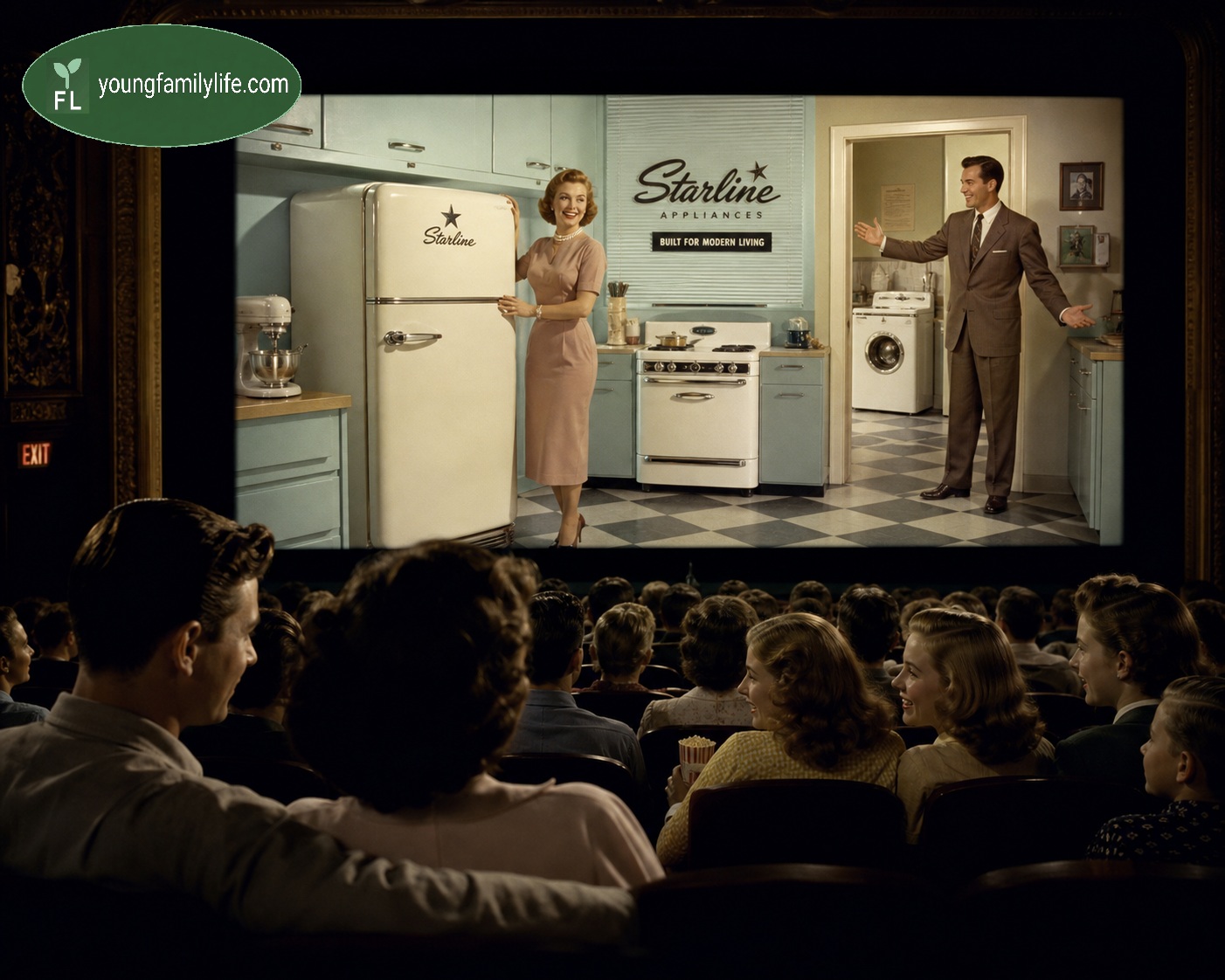
This logic was applied across domestic product categories from the 1910s onward. The vacuum cleaner and the washing machine were among the first household goods to be sold not as useful objects but as signals of a modern, aspirational way of living. By the 1930s, the electric refrigerator had become the most symbolically charged of these objects — not because it was first, but because it sat at the centre of the kitchen, the most aspirationally loaded domestic space in the mid-century imagination. Manufacturers used Hollywood-style film and imagery to place appliances within a world of glamour and ease. The object borrowed the lustre of the star’s world. The consumer purchased a fragment of both.
The structural logic is precise: the celebrity’s elevation needs to be maintained above the consumer for the aspiration to function. The consumer typically cannot reach the star. But they can reach the product the star is associated with. The gap is rarely fully closed. That is what the commercial relationship runs on.
When the gap started working in both directions
The late twentieth century introduced a reversal that has been accelerating ever since.
The original model — the demigod model — required the celebrity’s status to be independent of any particular brand or product. Chanel needed Marilyn Monroe more than Monroe needed Chanel. Her elevation was intrinsic. The product borrowed from it. The star lost nothing.
What emerged in the latter decades of the twentieth century, and has become the dominant model of the twenty-first, is structurally different. The minor celebrity — the B or C-list figure — does not have independent elevation sufficient to sustain the demigod logic. Their status is not intrinsic. It is constituted by brand associations. The appearance at the right event in the right clothes. The premium phone visible in the Instagram story. The designer bag at the airport, tagged and geolocated. The table at the right restaurant, the proximity to the right people.
These are not endorsements in the original sense. They are identity signals, and they run in both directions simultaneously. The brand lends the celebrity legitimacy; the celebrity lends the brand visibility. Neither party is straightforwardly elevated. Both are performing aspiration for an audience that is performing aspiration in return.
The result is what might be called an aspiration cascade — a continuous chain in which almost everyone is simultaneously admiring someone above them and being observed by someone below, and in which brands circulate through the entire chain as the currency of status. The sociologist Thorstein Veblen identified the underlying logic over a century ago: goods acquire value not from their utility but from their capacity to signal social standing to an audience capable of reading the signal. What is new is not the mechanism but its scale, its speed, and its algorithmic precision.
Why apparent closeness is more potent than distance
The B-list model does something the demigod model rarely could. It offers apparent accessibility.
The Hollywood star’s unreachability was, ultimately, a ceiling on the aspiration. The gap was visibly unbridgeable. The minor celebrity of the contemporary digital era presents differently: posting from their kitchen, sharing their anxieties, tagging their purchases, presenting the distance between their life and the follower’s as a matter of degree rather than kind. The gap appears closable. The aspiration is kept alive without ever being satisfied — which is often the most commercially productive arrangement, and the one most likely to move a person from ordinary admiration toward the more consuming investment that can sit further along the spectrum.
The influencer economy has added a further turn. The celebrity-brand relationship has become so visible that its visibility is now itself the content. The #ad disclosure, the gifted label, the behind-the-scenes brand trip framed as unfiltered access — these perform transparency while remaining as managed as anything the Hollywood publicity departments produced. And audiences know this, and watch regardless, and purchase regardless. The belonging that participation in the aspiration cascade provides is real even when its mechanisms are entirely visible.
What this means for the reaching
The commercial infrastructure described here did not create the human tendency to reach toward another person’s identity. That tendency is ancient and built into the social brain’s basic architecture. What the past century created was an environment of extraordinary density — thousands of aspirational figures, algorithmically curated for maximum relevance to each individual viewer, available at any hour, sustained by commercial interests with strong reasons to keep the gap open and few to close it.
The Cambridge Dictionary named “parasocial” — the term for the one-sided relationship between an audience member and a media figure — as its word of the year for 2025. The concept itself dates to 1956, when two researchers first described television viewers forming relationships with on-screen personalities that resembled those they formed with actual people in their lives. What is new is not the phenomenon but the scale at which it is now cultivated, and its extension into the AI tools increasingly designed to generate the felt experience of genuine relationship.
The social brain typically cannot fully distinguish between a relationship and a convincing simulation of one. That has been true across much of human history. The industry built around that tendency is the achievement of the past hundred years.
Topics: #InOtherWords #Belonging #Celebrity #Fandom #AspirationCulture #ParasocialRelationships #Identity #Hollywood #ConsumerCulture #InfluencerEconomy #YoungFamilyLife
Related YFL Content
Music Has Fallen: Where the Oak Falls, Evolution Finds the Light — the essay from which the historical argument here draws directly; music as the first mass democratiser of aspirational identity, and what happened when that model was disrupted.
The Social Brain and the Lonely Child: Friendship, Belonging, and What the Research Actually Shows — the evolutionary case for why the belonging need is non-negotiable, and what happens when ordinary routes to it are unavailable.
In Other Words… Why Some People Try to Become Someone Else — the companion IOW piece on the psychological spectrum from interest to assimilation.
In Other Words… How Attachment Styles Shape the Way People Handle Life and Relationships — how the internal working model shapes the size of the belonging gap that the aspiration industry exploits.
Copyright Notice
© 2026 Steve Young and YoungFamilyLife Ltd. All rights reserved.
“In Other Words” is a copyrighted content format of YoungFamilyLife Ltd.
The information in this piece is based on established research and theory. Full academic sources, references, and evidential detail are available in the linked YoungFamilyLife essays.
This essay was developed collaboratively using AI assistance to research academic sources and refine content structure, while maintaining the author’s original voice, insights, and “Information Without Instruction” philosophy. No part of this essay may be reproduced, distributed, or transmitted in any form or by any means, including photocopying, recording, or other electronic or mechanical methods, without the prior written permission of the copyright holders, except in the case of brief quotations embodied in critical reviews and certain other noncommercial uses permitted by copyright law.
For permission requests, contact: info@youngfamilylife.com