There is a kind of career advice that gets repeated so often it barely registers any more.
Back yourself. Take the leap. Feel the fear and do it anyway. Life starts at the edge of your comfort zone.
None of it is wrong. But almost all of it talks to one person — the individual standing at the decision, working out whether to go for it or not. It assumes the only person in the equation is them.
They are not. The people around them are in it too — whether they know it or not.
The people not in the room
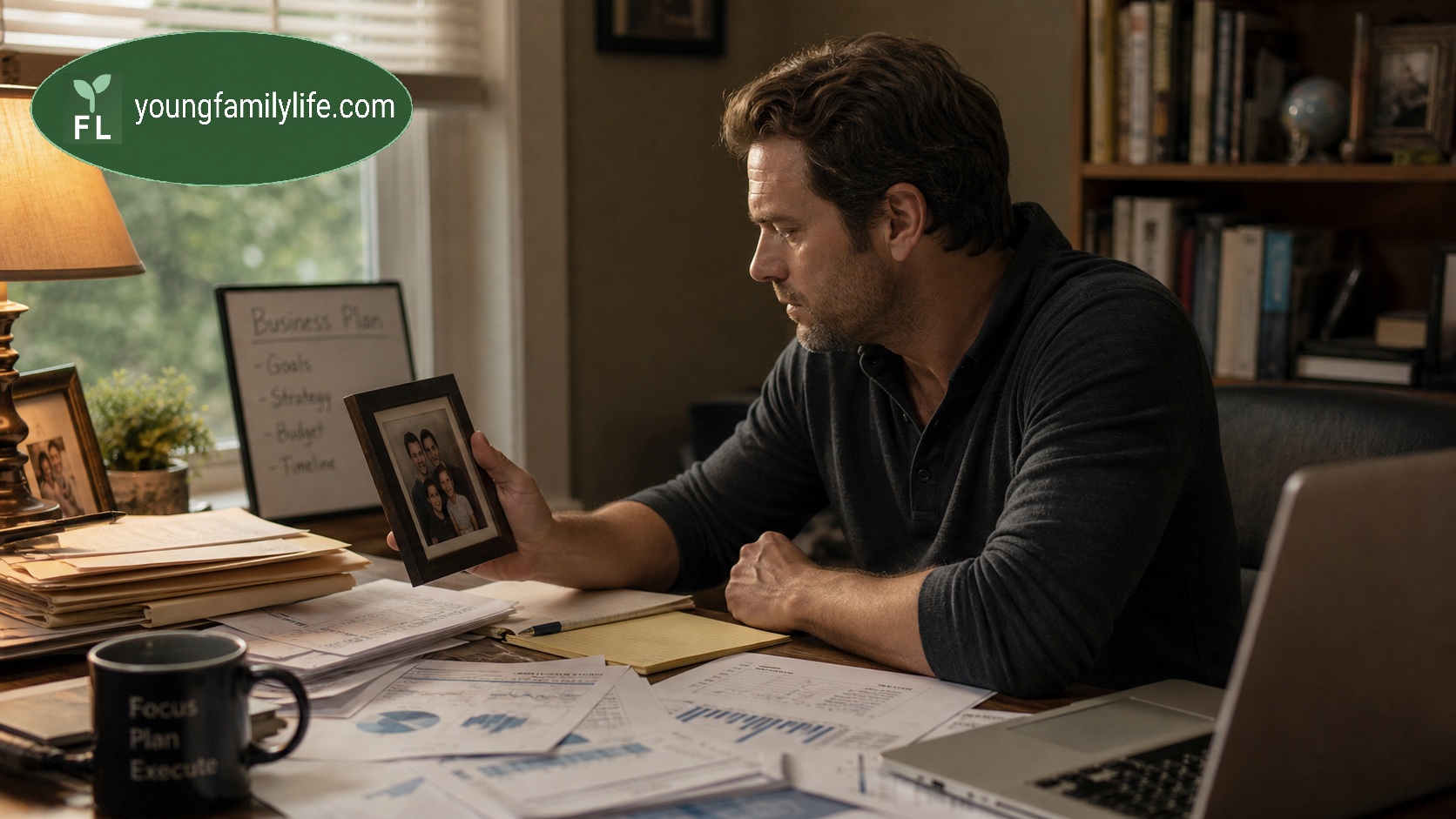
When someone is thinking seriously about a big career change — leaving their job, starting a business, taking a risk with no guaranteed outcome — they are usually thinking about it quietly and alone. But the decision they are turning over affects people who are not part of the conversation.
The partner whose income plans are built around the assumption that things stay stable. The children whose school, friendships, and sense of security depend on a mortgage getting paid each month. The parent who relies on support that would be harder to provide if things went wrong. These are real people. Real lives that sit downstream of a decision being made at a kitchen table or on a morning commute.
This does not mean the decision should not be made. It means that whoever makes it is not jumping alone. If it goes well, the benefits spread. If it goes badly, so do the costs — across a household, sometimes across years.
The books and posts about career courage almost never say this. That is worth noticing. Naming it makes the decision feel heavier. And heavy does not sell.
Three things that are really at stake
When a career decision is looked at honestly, there are three things on the line — not one.
Money. The most obvious one, but often underestimated. Bills do not pause while a new venture finds its feet. A mortgage does not wait. Most people think they have more financial runway than they do, and expect things to move faster than they will. The question is not just whether there is enough money — it is whether there is enough time for the money to work out.
Reputation. A professional reputation takes years to build. It is built through doing good work, consistently, in a way that other people notice and trust. A high-profile move that goes wrong can damage that. Not permanently, for most people. But the damage is real. Getting back to where you were takes time — and the willingness to try again, which is its own kind of resource, does not always come back quickly.
Identity. This is the one that catches people most off guard. A job is not just a job. It is part of how a person thinks of themselves — what they talk about at parties, what they get up in the morning for, how they explain themselves to the world. When that goes, even by choice, it can feel disorienting in a way that is hard to predict beforehand. The person who says I don't quite know who I am right now after a big career change is not being dramatic. They are describing something real.
Feeling the weight is not the same as being weak
A person who sits with a career decision and feels the pull of responsibility — who thinks about the mortgage, the family, the reputation, what a mistake might cost — is not being a coward. They are being accurate. They are seeing the situation clearly.
Saying I can't just think about myself is not holding back. It is recognising that the leap has a landing that other people share.
The cheetah looks as though it hunts purely for itself. But the cheetah carries consequences too. If it has cubs, they depend on its kills. Even without cubs, it carries a biological drive to survive, to breed, to keep its line going. A bad sprint — a torn muscle, a failed chase — does not just mean hunger for one day. It can put the whole animal at risk for weeks. The careful reading of conditions before every chase is not timidity. It is the result of carrying more than just one animal's hunger into every decision.
The difference between the cheetah and the professional is not whether consequences exist. It is what kind of consequences they are. The cheetah's are biological. The professional's are financial, relational, and tied to identity. Both matter. Neither can be ignored.
Staying put has its own weight too. The cost of not growing, not trying, not becoming what a person is capable of — that is real as well, and it spreads in its own way, quietly, over a longer time.
Thinking it through with others
If the leap belongs to more than one person, thinking it through should probably involve more than one person too.
Not every conversation, and not before any decision has been reached — bringing others in too early can muddy the thinking. But once it becomes real, the people who will feel the outcome have a genuine stake in knowing what is being considered.
People who have made a big career move and landed well often say, looking back, that the conversations they had beforehand did not talk them out of it. They helped them see it more clearly. They found out which worries were real and which were not, where the timing could be better, what they had not thought through.
Sharing the weight of a decision does not always make it lighter. But it often makes it clearer. And being clear — about what is real, what is possible, and what is being asked of the people who are not sitting in the room — is what makes a big career move something more than a leap into the dark.
It makes it a step taken with open eyes.
This piece is an In Other Words companion to the Repositorium essay Poised: Ambition, Risk, and the Nervous System That Gets There First, which looks at the full psychology of career threshold decisions — including the body's readiness signal, the conditions-reading that precedes action, and what happens when the sprint does not land where it was aimed.
Related reading: In Other Words: Your Body Has Already Decided
Topics: #InOtherWords #Psychology #CareerDecisions #Ambition #Risk #ProfessionalIdentity #CareerTransition #DecisionMaking #Responsibility #WorkAndFamily #ProfessionalDevelopment
Related YFL Content
In Other Words: Your Body Has Already Decided — what the physical sensation that precedes a major decision actually is, and why it is not anxiety.
Want vs Need, Shame vs Guilt: When Precision Matters — how the conflation of these four states complicates career decisions in ways that rarely surface in rational analysis.
Influence and Adaptation: What Darwin Actually Taught Us — adaptation rather than change as the operating principle, and what that means when a career decision does not land where it was aimed.
IOW: The Science of 'Feed the Solution, Starve the Problem' — the YFL principle that underpins the conditions-reading at the heart of every genuine career leap.
Copyright Notice
© 2026 Steve Young and YoungFamilyLife Ltd. All rights reserved.
"In Other Words" is a copyrighted content format of YoungFamilyLife Ltd.
The information in this piece is based on established research and theory. Full academic sources, references, and evidential detail are available in the linked YoungFamilyLife essays.
This essay was developed collaboratively using AI assistance to research academic sources and refine content structure, while maintaining the author's original voice, insights, and "Information Without Instruction" philosophy. No part of this essay may be reproduced, distributed, or transmitted in any form or by any means, including photocopying, recording, or other electronic or mechanical methods, without the prior written permission of the copyright holders, except in the case of brief quotations embodied in critical reviews and certain other noncommercial uses permitted by copyright law.
For permission requests, contact: info@youngfamilylife.com