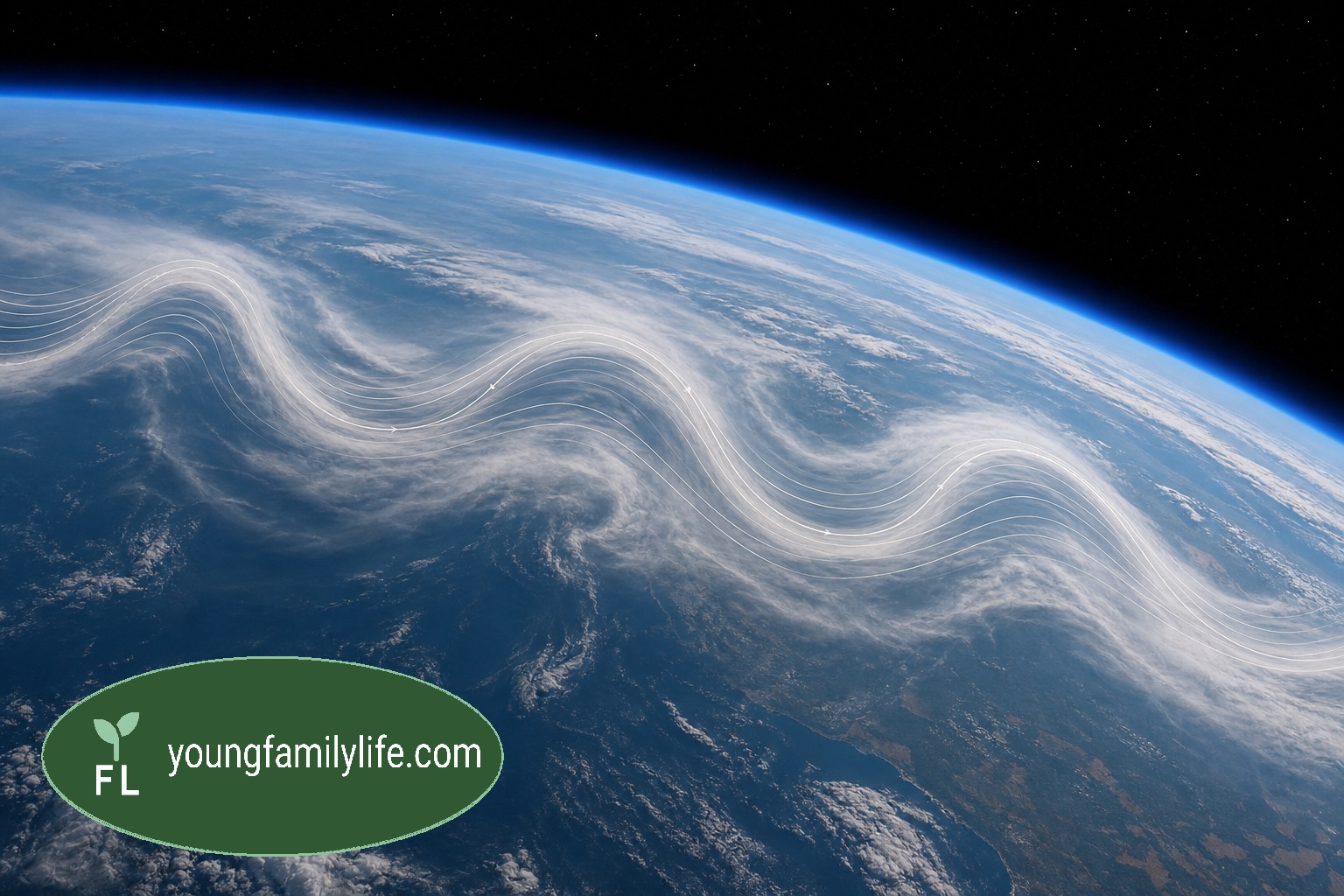
Same Fluid, Same Maths, Different Depth
The atmosphere and the ocean are the same category of physical system: rotating fluids on a spinning planet, governed by the same equations. Meteorologists and oceanographers actually use closely related mathematics for both.
The shared feature has a name: the Rossby wave, or planetary wave, first identified by the meteorologist Carl-Gustaf Rossby, produced by the Coriolis effect and the conservation of potential vorticity as fluid moves across latitudes. High pressure is a crest and low pressure is its trough — literally, in the same technical sense as an ocean swell, not as a figure of speech. When a Rossby wave amplifies enough, meteorologists genuinely describe it as breaking — the same word used for a wave collapsing on a beach — and that breaking produces the features on a weather map: blocking highs, cut-off lows, the kind of stalled pattern behind major heatwaves.
Jet streams are the atmosphere's version of ocean currents like the Gulf Stream — fast channels steering the larger wave pattern. A storm, in this frame, is simply the atmosphere doing what the ocean does in a gale: amplitude building until the fluid can't hold its shape anymore.
What Actually Builds The Charge
Once that instability gets going, something specific has to happen inside the storm for lightning to form at all. The process is called non-inductive charging, first demonstrated in the lab in 1957 by the physicists Reynolds, Brook, and Gourley.
High in a storm, in a zone typically between about -10°C and -20°C, two kinds of ice collide: graupel — dense pellets built up as supercooled water freezes onto a falling ice nucleus — and much smaller, lighter ice crystals still forming from water vapour. Each collision briefly transfers charge between the two particles, and laboratory work since has shown the direction of that transfer depends closely on temperature and how much liquid water is around. Below roughly -15°C, the small crystal usually ends up positive and the graupel negative. In warmer parts of the same cloud, it can flip entirely.
Gravity then does the sorting: the denser graupel sinks toward the middle of the cloud while the lighter crystals get swept upward by the storm's own updraft, physically separating the two charges until the voltage difference is big enough to break down as a lightning strike.
The Same Physics, Running On Three Other Worlds
Here's where it gets properly strange. That mechanism — water condensing, ice colliding, charge separating — is thought to drive the deep lightning long detected on Jupiter and Saturn, tens of kilometres below their visible cloud tops, using essentially the same water-cloud physics as Earth's storms — first confirmed when Voyager 1 detected lightning-generated radio signals from Jupiter back in 1979.
But NASA's Juno spacecraft, flying closer to Jupiter's cloud tops than any earlier mission, found something with no Earth equivalent at all: a second, shallower kind of lightning. High above the water clouds, rising ice crystals meet ammonia gas cold enough that the ammonia acts as an antifreeze, turning the ice into a liquid ammonia-water mixture rather than letting it refreeze — and it's that exotic liquid, colliding with ordinary ice, that charges Jupiter's "shallow lightning", according to research led by the planetary scientist Tristan Guillot. The droplets grow into slushy hailstones nicknamed "mushballs," which fall deep into the planet, dragging ammonia with them — conveniently solving a separate mystery about why so much of Jupiter's ammonia seemed to be missing.
Venus breaks the pattern entirely, and stays unsolved. Its clouds are sulfuric acid, not water, and while sulfuric acid droplets can hold a charge, the surrounding atmosphere may simply be too electrically conductive to let that charge build up into a strike. Radio signals resembling lightning have been detected there for decades, but a 2023 study using NASA's Parker Solar Probe proposed an entirely different, non-lightning explanation for at least some of them — reopening a genuine forty-year scientific argument with no confirmed answer yet.
The Pattern Underneath The Pattern
Put together, this is what the ocean-sky comparison is really pointing at: weather isn't a separate category of thing from tides and currents, and Earth's storms aren't a separate category of thing from Jupiter's ammonia hailstorms or Venus's still-mysterious flashes. They're the same underlying fluid physics, playing out with whatever ingredients a given world happens to have on hand — water here, ammonia there, sulfuric acid somewhere else entirely, and, on at least one occasion, no clear answer at all.
Topics: #InOtherWords #Weather #Meteorology #RossbyWaves #PlanetaryScience #Jupiter #Venus #Science #YoungFamilyLife #InformationWithoutInstruction
Related YFL Content
In Other Words: The Elephants That Can Hear a Storm From 100 Miles Away — the storm this piece explains how to build, and the animals that can hear it coming long before any human could
In Other Words: What Does Space Actually Sound Like? — from Earth's own weather out to the edge of what "atmosphere" even means, and a black hole that sings