The Lean-In Moment
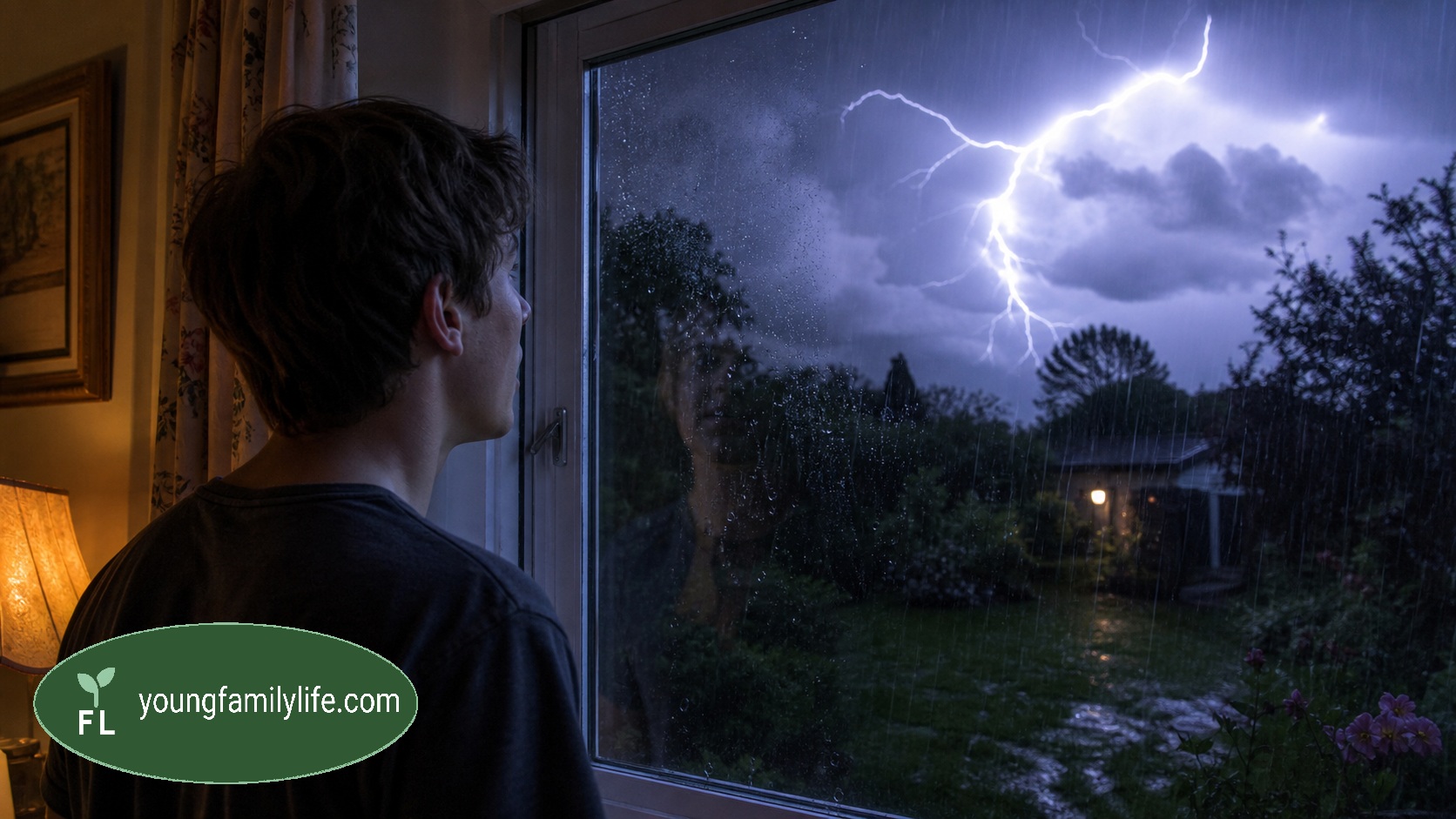
The storm has been building for an hour — that particular held-breath quality the air gets right before it breaks. You're indoors, the door is shut, the kettle's on. Nothing about this evening is actually dangerous.
And then it comes: the flash, the gap, the crack — and your whole body flinches before a single conscious thought has caught up with it. Heart thudding. Skin prickled.
And underneath the jolt, something else is there too — something that, if you're honest, feels closer to a grin than a flinch. You're not cowering under the table. You've drifted toward the window.
The Jolt Before You Even Know What Happened
That flinch is not a choice, and it isn't really "in your head" in the way people usually mean that phrase. It runs through one of the fastest circuits in the human nervous system: sound reaches the inner ear, passes to a cluster of neurons called the cochlear root neurons, and from there almost directly to the muscles of the body — a pathway fast enough to trigger a full-body jump before the brain's higher regions have finished working out what the sound even was.
It is a genuinely ancient reflex, shared with virtually every mammal studied, and its whole purpose is speed over accuracy: better to flinch at a falling branch that turns out to be harmless than to calmly assess a genuine threat. The amygdala — the brain's rapid alarm-processing hub — can amplify the reflex once it's underway, but the initial jump happens lower down, in the brainstem, faster than conscious thought.
Thunder didn't have to be genuinely threatening to trigger it. It only had to be loud and sudden.
One Sound, or Actually Many?
It's tempting to think of thunder as a single sound, arriving as one continuous rumble. It isn't. What reaches an ear during a storm is several genuinely distinct physical events overlapping in time, each contributing its own layer to the total sound.
The lightning channel itself is a jagged line, not a point, zigzagging for kilometres through the sky — every segment along that path counts as its own small sound source, arriving at a slightly different moment depending on distance, which is what smears a single instant of electrical discharge into a rolling boom rather than one flat crack. A single flash is rarely one discharge either: most are three to seven separate return strokes within a second or two, each producing its own shockwave, stacked on top of the others.
Terrain and cloud cover then add genuine echo, bouncing the same sound back and forth between hills, buildings, and the underside of the storm itself. And underneath all of that sits a layer that isn't heard so much as felt: genuine infrasound, below 20 Hz, generated separately by the storm's own internal turbulence, sitting below the pitch a human ear can even register as tone.
What arrives at a listener, in other words, is not one bandwidth of sound. It is several different physical processes, spread across a huge range of frequencies from sub-audible rumble to sharp crack, all compressed into the same few seconds.
Why Some People Sleep Right Through It
And yet plenty of people manage to sleep straight through all of it. Part of the explanation lives in the sleeping brain's own filtering system.
During deep sleep, the brain produces brief bursts of electrical activity called K-complexes — first described in 1937, in the private laboratory of the American scientist Alfred Lee Loomis — that fire in direct response to a sound or touch, and whose job appears to be almost the opposite of the startle reflex covered earlier: rather than jolting the body awake, a K-complex suppresses cortical arousal, effectively telling the sleeping brain this isn't a threat, stay under. Sleep spindles, a related burst of fast brain-wave oscillation, do similar gating work alongside them.
Not everyone produces these at the same rate or density, and the research is fairly consistent that how effectively a sleeper filters out background sound genuinely varies from person to person — a real biological difference, not simply a matter of being "a heavy sleeper" by choice or habit.
There's a second reason thunder specifically tends to be forgiving, separate from the brain's own filtering. By the time a storm's sound has travelled any real distance and passed through walls and glass, most of what survives is the deep, low-frequency rumble — the sharp high-frequency crack gets absorbed first, as covered earlier.
That surviving rumble sits in roughly the same territory as "brown noise," a deep, steady, low-frequency-weighted sound increasingly sold commercially as a sleep aid, on the theory that steady broadband noise masks sudden disruptive sounds and may help stabilise deep sleep. The evidence here is genuinely mixed rather than settled — an often-cited 2012 study found that steady pink noise (brown noise's slightly higher-pitched cousin) improved slow-wave sleep and next-day memory, while a more recent, more tightly controlled study found the opposite effect, or none at all.
What does hold up fairly consistently across the research is that a steady, familiar, low-frequency sound is far less likely to trigger an arousal than a sharp, unpredictable one — and a storm heard from a warm bed, muffled down to its rumble, is about as steady and low as sound gets.
When It Stops Being Fun
For the great majority of people, this is exactly where it stops: a startle, a grin, a good story to tell afterwards. But the same reflex that produces a thrill in one person can, in another, refuse to resolve into anything but fear — and that's worth naming honestly rather than waved off as a phase.
An intense and persistent fear of thunder and lightning is one of the more common specific phobias, and it disproportionately affects children. The clinical line isn't how startled someone looks during a single storm — most children look startled. It's whether the fear persists for six months or more, causes real distress, and starts limiting what someone is willing to do: refusing to leave the house, being unable to sleep for weeks at a stretch, needing constant reassurance that never quite lands.
Where that pattern shows up, it's worth talking to a GP or a mental health professional rather than waiting for it to pass on its own.
Topics: #WhyThunder #StartleReflex #Amygdala #ArousalMisattribution #Astraphobia #SleepScience #KComplex #PinkNoise #HeyWantToKnow #YoungFamilyLife #InformationWithoutInstruction
Further Reading
These links dig deeper into the topics covered here:
The Science of the Jolt:
- Startle Response (Wikipedia) — an overview of the acoustic startle reflex and the neural pathway behind it
- The Amygdala: A Small Part of Your Brain's Biggest Abilities (Cleveland Clinic) — an overview of the amygdala's role in fear and rapid-alarm processing
If It's More Than a Thrill:
- Astraphobia: Diagnosis, Causes and Treatment (Cleveland Clinic) — a clinical overview of astraphobia, including when to seek help
- Two-Factor Theory of Emotion (Wikipedia) — the Schachter-Singer theory behind why arousal from fear and excitement can be relabelled
Why the Rumble Can Send You to Sleep:
- K-Complex (Wikipedia) — an overview of the sleep-protective brain wave that gates out non-threatening sounds during deep sleep
- Pink Noise for Sleep: Benefits and How It Works (Sleep Foundation) — an overview of the research on broadband low-frequency sound and sleep quality
How This Essay Reflects YFL Values
This piece isn't trying to talk anyone out of enjoying a storm, or telling them their flinch is wrong, or their thrill is silly. Information Without Instruction means laying out what's actually happening in the body and the brain — the ancient reflex, the shared chemistry of fear and excitement, the one clear line where an ordinary reaction becomes something worth professional support — and leaving the reader to recognise their own experience inside it, rather than being told what to feel about a thunderstorm.
Related YFL Essays and Resources
Why Thunder — of all things? — the full Repositorium essay this piece is drawn from — the physics, the mythology, and everything else thunder turns out to be, followed all the way down
In Other Words: What Does Space Actually Sound Like? — the vacuum myth-busting and the black hole that genuinely sings, 250 million light-years away
In Other Words: The Elephants That Can Hear a Storm From 100 Miles Away — a different angle on hearing thunder: the animals whose ears reach ten times further than a human's ever could
In Other Words: Why the Sky Behaves Like the Sea — how a storm actually builds its charge, and why the same physics plays out strangely on Jupiter, Saturn, and Venus