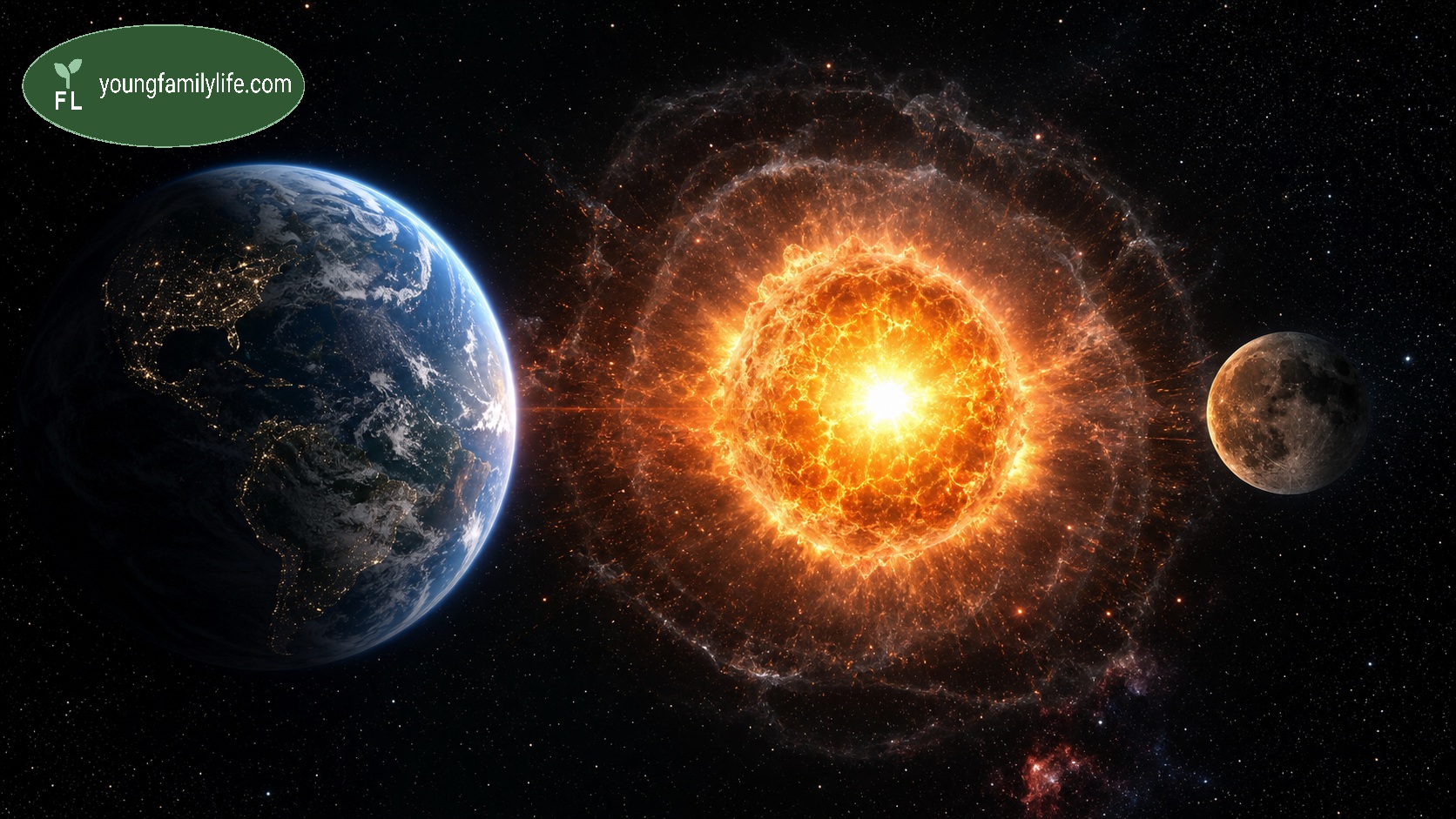
Space Isn't Actually Empty
Start with the "empty" part. Between the Earth and the Moon sits something called the solar wind — a thin stream of particles, mostly protons and electrons, blown off the Sun. It isn't dense, roughly five to ten particles in every cubic centimetre, tracked continuously by spacecraft instruments and logged in NASA's long-running solar wind dataset. Go further out, into the space between entire star systems, and there's still something there: on average, about one atom in every cubic centimetre.
A perfect vacuum — genuinely nothing, anywhere — doesn't actually exist. Not between the planets, not between the stars. Space is real thin. It's never fully empty.
So Why Is It Silent, Then?
Because sound isn't really about whether anything is there. It's about whether there's enough of it, packed closely enough, to pass a pressure wave along.
Sound travels by collision — one particle bumps into the next, which bumps the next, and so on, fast enough to carry a wave. Down here at sea level, air molecules are colliding roughly a billion times a second, which is easily fast enough to carry anything from a deep rumble to a dog whistle. Out in the solar wind, particles are so spread out that the average distance one travels before it even meets another particle can run into millions of kilometres. There's no way for a sound wave to hop across gaps that size. The stuff is there. It's just too thin and too disconnected to carry a wave at any pitch a human ear could register.
Except Sound In Space Isn't Just A Thought Experiment — It's Been Found
This is where it stops being a technicality and starts being genuinely wild.
In 2003, using NASA's Chandra X-ray Observatory, a team led by the astrophysicist Andrew Fabian found real pressure waves — actual sound — rippling outward from the supermassive black hole at the centre of the Perseus galaxy cluster, 250 million light-years away. The gas surrounding that black hole is dense enough, and the disturbance from the black hole big enough, for genuine sound waves to propagate through it.
The pitch of that sound works out to a B-flat — 57 octaves below middle C. That's a frequency roughly a million billion times lower than the deepest note a human ear can detect. Nothing built by human hands could ever hear it. But it's real, it's been there for an estimated 2.5 billion years, and it may be one of the reasons the gas around that black hole hasn't cooled down in all that time.
It isn't a metaphor. It's an actual sound wave, sitting in the recorded data, at a scale nothing human-built was ever designed to catch.
The Old Idea This Quietly Proves Right
More than two thousand years ago, followers of Pythagoras proposed something called the musica universalis — the "music of the spheres" — the idea that the motion of the planets and stars produced real harmonic tones, inaudible to human ears but genuinely there. For most of history, that was treated as either mysticism or poetry.
The Perseus black hole is that old idea, true in fact rather than metaphor. The sound wasn't waiting to be imagined. It was already there, in the plasma, and Chandra simply found it.
Where Does That Leave Thunder?
Right in the middle, as it happens. Thunder is the one register where "cosmic" sound — governed by exactly the same density-and-medium physics that lets a black hole sing — happens to land inside the narrow band a human ear can actually hear. An explosion set off in the empty-looking space between the Earth and the Moon wouldn't be silent because there's nothing there. It would be silent because whatever sound could exist there is shaped completely wrong for a human ear: the wrong density, the wrong scale, the wrong register entirely.
Not absent. Just somewhere else on a very, very long dial — the same dial thunder sits on, just tuned to a different notch.
Topics: #InOtherWords #Space #Astrophysics #BlackHoles #Vacuum #Physics #Science #YoungFamilyLife #InformationWithoutInstruction
Related YFL Content
In Other Words: The Elephants That Can Hear a Storm From 100 Miles Away — a different register entirely, but the same underlying idea: ears built to reach a range of the world most of us never notice
In Other Words: Why the Sky Behaves Like the Sea — from the vacuum of deep space back down to Earth's own atmosphere, and the strange lightning on three other worlds