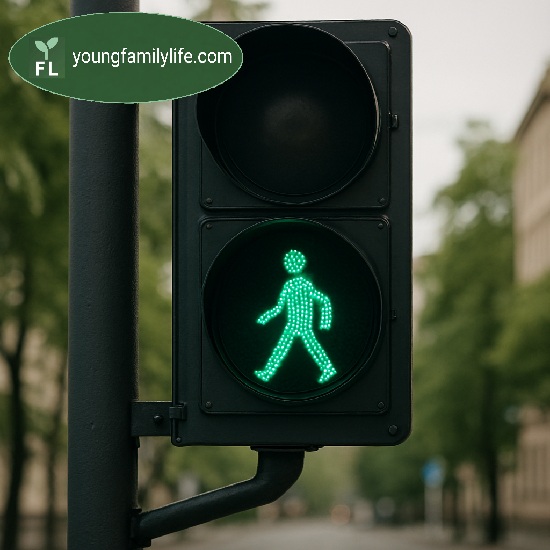
The world didn’t have to be green
The Earth didn’t start out green. Around three and a half billion years ago, the oceans were full of tiny living things — but they weren’t green. They were purple. Not metaphorically. Literally purple — because the molecule they used to catch sunlight absorbed green light and reflected back red and violet.
Those purple microbes were eventually beaten out by a different type of organism, one that used a completely different molecule to capture light energy. That molecule — chlorophyll — absorbed red and blue light instead. And it reflected green. When chlorophyll-based life spread across the planet’s oceans, something else happened as a side effect: it pumped oxygen into the atmosphere. That oxygen eventually built up to the levels needed for animals, brains, and ultimately humans to exist.
So green is the colour of the world because chlorophyll can’t use green light. It’s not the chosen colour of life. It’s the colour life throws away. The planet wears it because the molecule at the centre of photosynthesis finds it useless.
What chlorophyll is doing
Inside every leaf is a molecule that works a bit like a tiny antenna. It has a ring shape in the middle — held together by a single atom of magnesium — and that ring is what absorbs light. The ring’s chemistry means it can only capture light from the red and blue parts of the colour spectrum. Green light hits it and bounces straight off.
That’s it. That’s why grass is green. That’s why forests are green. That’s why the living surface of the land looks the colour it does. Not because nature chose green, but because the molecule that powers most life on Earth is colour-blind to it.
Green made the air
Before plants, before animals, before anything with a backbone or a brain, photosynthesis was quietly doing something enormous. Every time chlorophyll captured light and produced energy, it released oxygen as a waste product. Over hundreds of millions of years, that oxygen built up in the atmosphere.
Most of the life on Earth at that time couldn’t survive in oxygen — it was toxic to them. So the rise of chlorophyll-based life was also one of the biggest extinction events in history. The survivors were the ones that could handle oxygen. Eventually, they learned to use it. Oxygen-breathing life — which includes everything from insects to elephants to humans — only exists because green plants spent billions of years filling the air with what, to them, is exhaust.
The oxygen in the air right now, in every breath, is the long-term consequence of a colour that chlorophyll found useless.
Why the human eye responds so strongly to green
Human eyes have three types of colour-sensing cells. One type picks up blue light. One picks up red. One picks up green — and that green-sensing type is the most sensitive of the three.
This isn’t random. It’s the result of millions of years of evolution. Early primates developed the ability to distinguish red from green because it gave them a huge advantage in finding food. A red berry against green leaves is much easier to spot if the eye is tuned to notice the difference between them. Animals without this ability — like dogs and cats — see the world more like a human with red-green colour blindness does. They can still get around. They just miss things that primates don’t.
The human eye is, in a very literal sense, built for a green world. It’s calibrated to the colour that covers most of the living surface of the planet — because the ancestors of every person alive evolved in exactly that environment.
Why colour blindness is rarer in women — and what that tells us
The genes that control the green-sensing and red-sensing cells in the eye sit on the X chromosome. Men have one X chromosome. If the relevant gene on it is faulty, they’re colour blind — there’s no backup copy. Women have two X chromosomes, so they’d need faulty genes on both to be affected.
The result is striking. Around 8% of men have some form of red-green colour blindness. For women, it’s closer to 0.5%. A doctor noticed this pattern as far back as 1853 and correctly worked out that the railway’s red and green signal colours were exactly the ones most likely to cause problems for colour-blind drivers. Testing for colour vision became — and still is — a standard part of train driver recruitment.
There’s also an unexpected flip side. Some women who carry a faulty copy of one of these genes on one X chromosome and a working copy on the other may end up with four different types of colour-sensing cell instead of the usual three. Researchers at Newcastle University have been investigating whether these women can see colour distinctions that no one else can. The evidence is contested, but real.
How green ended up on traffic lights — and why it wasn’t a deliberate choice
The use of green to mean proceed on traffic lights is often assumed to be obvious — but it was arrived at by accident, over about a century, through a series of disasters.
It started on the railways. The Liverpool and Manchester Railway, which opened in 1830, was the first proper railway in the world and the first to need a signalling system. The signals were mechanical arms — semaphores — that could be read by day. At night they were useless, so coloured lenses were fitted in front of oil lamps. The colours settled on were red for danger, green for caution, and white for all clear.
Green did not mean go. It meant slow down.
White meant go — and white turned out to be a catastrophic choice. As gas lamps and electric lights spread, white signals became impossible to tell apart from every other light in the environment. In one incident, a red lens fell out of its holder, leaving the white lamp exposed behind it. A driver read it as clear and ran the signal. The collision made the case that couldn’t be argued with: white had to go. By the 1890s, British railways had replaced white with green for the all-clear.
The first road traffic signal in the world was installed in London in 1868 — a gas-lit version of a railway semaphore, designed by a railway engineer, using the same red and green lenses. It lasted thirty-five days before the gas exploded and injured the constable operating it. Road signals disappeared in Britain for sixty years.
When they came back, they came back from America. A Detroit police officer added amber to the system in 1920 — the colour that had been missing all along, giving drivers a moment’s warning before the signal changed. An inventor called Garrett Morgan patented the automated version in 1923 and sold it to General Electric. The US government standardised the red-amber-green system nationally in 1935. The rest of the world followed.
None of the people involved in any of this — the railway engineers, the police officer in Detroit, the committee in Birmingham in 1841 — were thinking about evolution or primate biology. They were solving practical problems. And yet the system they built settled naturally into green for proceed, in every culture that adopted it, without resistance. The human eye has been calibrated to green as a signal of safety and life for thirty to forty million years. The engineers, without knowing it, built a convention that already felt right.
The ordinary moment
The next time a person glances out of a window and sees a tree, or walks across a lawn, or stops at a green light, the whole of this is present in that moment — the molecular accident that made the world green, the atmospheric consequence that made complex life possible, the cone cells shaped by millions of years of foraging in green environments, the railway disasters that made green the colour of go.
None of it visible. All of it there.
Topics: #InOtherWords #WhyGreen #Photosynthesis #ColourVision #Evolution #TrafficLights #Science #IndependentEnquiry #YoungFamilyLife
Copyright Notice
© 2026 Steve Young and YoungFamilyLife Ltd. All rights reserved.
“In Other Words” is a copyrighted content format of YoungFamilyLife Ltd.
The information in this piece is based on established research and theory. Full academic sources, references, and evidential detail are available in the linked YoungFamilyLife essays.
This essay was developed collaboratively using AI assistance to research academic sources and refine content structure, while maintaining the author’s original voice, insights, and “Information Without Instruction” philosophy. No part of this essay may be reproduced, distributed, or transmitted in any form or by any means, including photocopying, recording, or other electronic or mechanical methods, without the prior written permission of the copyright holders, except in the case of brief quotations embodied in critical reviews and certain other noncommercial uses permitted by copyright law.
For permission requests, contact: info@youngfamilylife.com