A different lever entirely
Some mechanisms of control and belonging work through content — a story told, believed, and internalised, whether a founding national myth, a censored curriculum, or a rewritten historical record (a fuller treatment of this mechanism sits in the YFL essay on narrative content-control, The Noble Lie and the Ministry of Truth). This essay examines a mechanism that can succeed with no content at all, and can also work alongside content. A national anthem’s lyrics are rarely remarkable as poetry. A battlefield chant may consist of a single repeated syllable. A football terrace chant can be four words, sung a hundred times. None of these succeed because of what they say. They succeed because of what singing them, together, in time, does to the people singing.
This is control and bonding by unison rather than by narrative — a different lever on the same underlying problem: how does a group, or a state, get a mind to comply, believe, or belong, without that mind feeling coerced into it. The same lever also serves the opposite purpose. People with little formal power use it to hold together and to feel their own strength. The sections below move from unison at its purest, in anthem, drill, and terrace chant, to unison combined with content, in worship and popular song.
The anthem: identity made audible
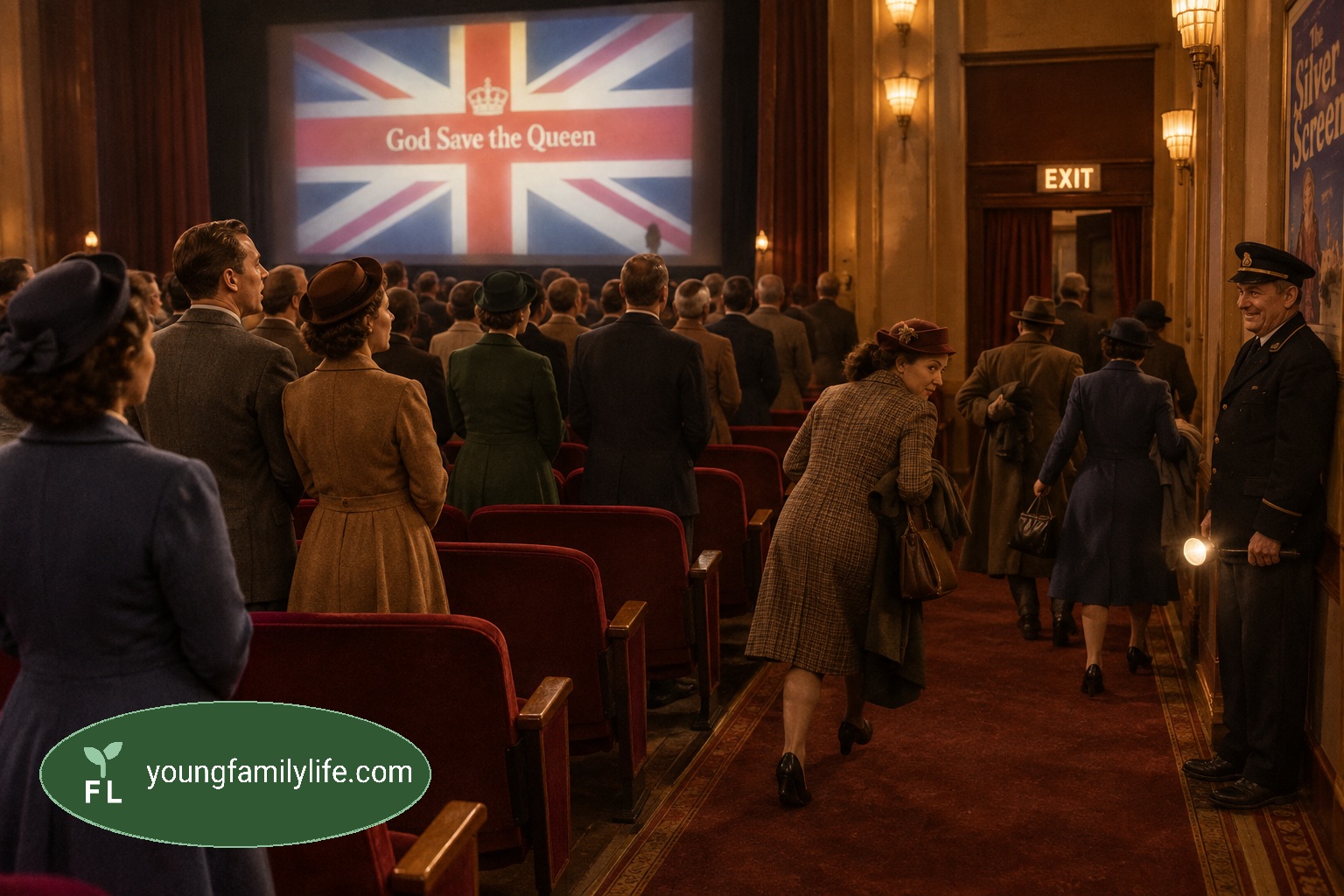
Benedict Anderson, examining how modern nations manage to feel like real communities despite being composed of millions of people who will never meet, coined the term “unisonance” for a specific experience: singing a national anthem in physical synchrony with strangers (Anderson, 1983/2006). Reading the same words silently produces nothing like this effect. Singing them, at the same tempo, in the same breath pattern, with the same strangers doing the same thing at the same moment, produces a felt sense of simultaneous shared belonging that argument or explanation cannot manufacture. Anderson’s point is precise: the anthem’s content is almost irrelevant to this effect. Its performance is the mechanism.
This distinction matters. Content-control mechanisms — a founding myth, a censored curriculum, a rewritten historical record, examined in full elsewhere in YFL essays — work by shaping what a mind holds to be true. An anthem does not require its singer to believe anything about the lyrics at all — it produces belonging through the physical act of singing, independent of assent.
Drill and chant: solidarity manufactured through the body
William McNeill, a historian, pushed this further by examining close-order drill — the marching, in step, that has trained soldiers for millennia. McNeill’s term for what drill produces is “muscular bonding”: a felt solidarity, verifiable in his own experience as a wartime recruit, that arises from sustained rhythmic movement performed together, and that appears to operate independently of, and often prior to, any ideological commitment to the cause being served (McNeill, 1995). McNeill traces this mechanism from Spartan drill and the war-chants of the Zulu impi through to twentieth-century basic training, arguing it is one of the oldest and most reliable techniques militaries have ever possessed for turning a collection of individuals into a cohesive, obedient unit — often more reliable than persuasion, because it does not depend on the recruit accepting any particular argument.
Battlefield chants belong to this same family. Their content is frequently minimal — a repeated word, a rhythm, a call-and-response requiring no independent thought, only synchronised response. That minimalism is not a limitation of the form. It may be closer to the form’s actual function: the less the chant asks the mind to evaluate, the more completely the body can be recruited instead.
Durkheim’s mechanism, and the evidence behind it
Émile Durkheim, writing on the sociology of religion and drawing largely on ethnographic accounts of Aboriginal Australian ritual, proposed a general mechanism behind this family of effects: “collective effervescence,” a heightened emotional state produced specifically by a group performing the same ritual actions together — chanting, dancing, moving in time — which he argued is the actual force binding people into something larger than themselves, prior to and beneath whatever beliefs the ritual is nominally about (Durkheim, 1912/1995).
This is no longer only a historical or sociological claim. Experimental work by Emma Cohen, Bahar Tunçgenç, and colleagues has found that synchronised movement measurably increases felt closeness, cooperation, and even pain tolerance between people who were strangers minutes earlier, and that singing together has a similar fast bonding effect (Cohen et al., 2010; Pearce et al., 2015; Tunçgenç & Cohen, 2016; Wiltermuth & Heath, 2009). The effect requires no shared belief, no persuasion, and very little time. Whatever anthems, drill, and chant have been doing for millennia, it now has a name in the experimental literature, and a demonstrated, repeatable effect.
The YFL essay Understanding Collective Intelligence traces a related pattern at a still wider scale — termite mounds, human societies, and the brain itself all showing coordinated behaviour emerging from many simple units acting in concert, with no individual directing the whole. Collective effervescence, on this reading, is one particular case of a much more general phenomenon: groups of units, biological or human, achieving something none of them could produce alone, simply by acting together.
The football terrace: unison without a state
Football chanting deserves separate mention because it strips the mechanism down to its rawest form. No government commissions it. No military drills it. A crowd of strangers, bound by nothing more than shared allegiance to a club, produces the same synchronised vocal behaviour — repeated, rhythmic, often wordless or near-wordless — and the same felt surge of collective belonging Durkheim described and experimental work has measured. This is the mechanism operating with no author at all: no Plato, no Bernays, no ministry. Terrace chanting suggests the underlying capacity is not something states or institutions invented and imposed from above, but something they discovered already present in human groups, and then, in the case of the anthem and the drill, formalised and put to their own use.
Worship: unison in the sacred
The cases so far work with little or no content. Worship adds content, which complicates the neat division between the two levers. Religious worship may be the oldest and most widespread setting for the mechanism. Christian monastic communities sang the daily offices in unison plainchant. Martin Luther made congregational singing in the vernacular a centrepiece of Reformation worship, and chorales such as “Ein feste Burg” put theology into the mouths of ordinary congregations (Leaver, 2017). John Wesley’s 1780 Collection of Hymns for the Use of the People Called Methodists, drawn largely from his brother Charles’s hymns, was intended as a compact doctrinal handbook in song (Wesley, 1780). The pattern is not confined to Christianity: Torah cantillation and communal prayer in the synagogue, Sufi dhikr, the call-and-response of Hindu kirtan, Buddhist sutra chanting, and gospel and spiritual singing all rest on voices sounding together.
Unlike an anthem, a hymn or chant usually carries content that matters to those singing, and the words are often learned by heart through the melody — song working as a memory technology of the kind described in the YFL essay Memory’s Oldest Machine. Worship song therefore runs both levers at once: a doctrine carried in the text, and belonging produced by voices moving together. It also differs from the state anthem and the parade ground in one respect: worshippers ordinarily choose to be there.
Field research links regular communal ritual with greater cooperation within religious communities (Sosis & Ruffle, 2003), though how much of that is owed to the singing, as distinct from the prayer, the shared meal, or the shared belief, is difficult to separate out. Describing what unison does says nothing about whether what is sung is true or valuable. It describes what the shared act does alongside the belief.
Popular song and felt empowerment
The mechanism is not confined to religion, the military, or the state. In modern popular culture, songs sung by crowds have carried a sense of political and social empowerment for groups with little formal power. The American civil rights movement drew directly on the church: “We Shall Overcome” was adapted from gospel hymnody, and freedom songs, often existing hymns with new words, were sung at mass meetings, on marches, and in jail cells, holding groups together under pressure (Carawan & Carawan, 1963; Eyerman & Jamison, 1998). Here the unison is plain, and it is used from below rather than imposed from above.
Much of the empowerment in popular music, however, comes through content and identification: a voice saying what listeners could not otherwise say in public. Blues singers of the 1920s such as Ma Rainey and Bessie Smith addressed independence, sexuality, and domestic violence when black women had almost no public platform for them (Davis, 1998). Songs by Sam Cooke, Nina Simone, Aretha Franklin, and the Motown and Stax artists were taken up as expressions of black pride and demands for equality, sometimes explicitly, as when Simone’s “Mississippi Goddam” answered the murder of Medgar Evers and the bombing of a Birmingham church in 1963 (Ward, 1998; Werner, 2004). Unison enters where crowds sing such songs back, at marches and concerts.
A parallel history runs through women’s popular music, in songs of freedom and equality and songs of redress against domination in domestic, social, and cultural life. Helen Reddy’s “I Am Woman” was widely adopted as an anthem of the 1970s women’s movement, and Aretha Franklin’s “Respect” was heard by many as both a civil rights and a feminist statement. Later soul and pop singers, Whitney Houston and Tina Turner among them, sang songs of self-worth and endurance in big, public voices, and for many listeners Turner’s solo career, after she left her marriage and stage partnership, became a story of escape and self-rescue as much as a musical one (Turner & Loder, 1986; Whiteley, 2000).
The evidence for these effects is mostly testimony and cultural history rather than measurement, and studies of music and politics warn that a song’s political power is easier to assert than to demonstrate (Street, 2012). Whether songs have done as much as legislation is also not something the evidence can settle either way. Culture and law appear to influence each other in both directions, and songs give a change a form that can be felt and sung together before, alongside, or after it is written into law. The scholarship on that relationship is summarised in the aside below.
As with worship, both levers work together here: words that say something, sung in a form that binds.
Where this leaves the two levers
A spectrum becomes visible once these mechanisms are placed side by side. At one end sits the football or battlefield chant — unauthored, body-only, requiring no institution to produce it. Next comes the national anthem — formalised, state-composed, but still entirely dependent on the physical act of unison performance to do its work; a citizen who reads the lyrics silently receives none of the effect. Worship song and popular song sit further along, carrying content and unison together. At the far end sits purely textual content control — a rewritten historical record, a narrowed vocabulary (see The Noble Lie and the Ministry of Truth for this end of the spectrum in full) — requiring no body, no breath, no shared room, narrowing what can be thought by narrowing only what can be said.
This is a genuinely different mechanism from state-authored content control, not a restatement of it. Content control needs to govern what people can check and say. Unison needs only a room, a rhythm, and enough voices. It may be the older of the two levers and — on the evidence of the football terrace, which no state built and no ministry maintains — the one that survives most readily without any author at all.
The same capacity serves a state drilling recruits and staging an anthem, and it serves people with little formal power singing at a march. That it works in both directions suggests the mechanism itself is neutral about purpose: it binds, and what it binds people to depends on who supplies the song and who chooses to sing it.
References
Anderson, B. (1983/2006). Imagined communities: Reflections on the origin and spread of nationalism (Rev. ed.). Verso.
Carawan, G., & Carawan, C. (Eds.). (1963). We shall overcome! Songs of the Southern freedom movement. Oak Publications.
Cohen, E. E. A., Ejsmond-Frey, R., Knight, N., & Dunbar, R. I. M. (2010). Rowers’ high: Behavioural synchrony is correlated with elevated pain thresholds. Biology Letters, 6(1), 106–108.
Davis, A. Y. (1998). Blues legacies and Black feminism: Gertrude “Ma” Rainey, Bessie Smith, and Billie Holiday. Pantheon.
Durkheim, É. (1912/1995). The elementary forms of religious life (K. E. Fields, Trans.). Free Press.
Eyerman, R., & Jamison, A. (1998). Music and social movements: Mobilizing traditions in the twentieth century. Cambridge University Press.
Klarman, M. J. (2004). From Jim Crow to civil rights: The Supreme Court and the struggle for racial equality. Oxford University Press.
Leaver, R. A. (2017). The whole church sings: Congregational singing in Luther’s Wittenberg. Eerdmans.
McNeill, W. H. (1995). Keeping together in time: Dance and drill in human history. Harvard University Press.
Pearce, E., Launay, J., & Dunbar, R. I. M. (2015). The ice-breaker effect: Singing mediates fast social bonding. Royal Society Open Science, 2(10), 150221.
Post, R., & Siegel, R. (2007). Roe rage: Democratic constitutionalism and backlash. Harvard Civil Rights-Civil Liberties Law Review, 42(2), 373–434.
Rosenberg, G. N. (1991/2008). The hollow hope: Can courts bring about social change? (2nd ed.). University of Chicago Press.
Schiappa, E., Gregg, P. B., & Hewes, D. E. (2006). Can one TV show make a difference? Will & Grace and the parasocial contact hypothesis. Journal of Homosexuality, 51(4), 15–37.
Sosis, R., & Ruffle, B. J. (2003). Religious ritual and cooperation: Testing for a relationship on Israeli religious and secular kibbutzim. Current Anthropology, 44(5), 713–722.
Street, J. (2012). Music and politics. Polity.
Sunstein, C. R. (1996). Social norms and social roles. Columbia Law Review, 96(4), 903–968.
Tunçgenç, B., & Cohen, E. (2016). Movement synchrony forges social bonds across group divides. Frontiers in Psychology, 7, 782.
Turner, T., & Loder, K. (1986). I, Tina: My life story. William Morrow.
Ward, B. (1998). Just my soul responding: Rhythm and blues, Black consciousness, and race relations. University of California Press.
Werner, C. (2004). A change is gonna come: Music, race and the soul of America (Rev. ed.). Plume.
Wesley, J. (Ed.). (1780). A collection of hymns for the use of the people called Methodists. J. Paramore.
Whiteley, S. (2000). Women and popular music: Sexuality, identity and subjectivity. Routledge.
Wiltermuth, S. S., & Heath, C. (2009). Synchrony and cooperation. Psychological Science, 20(1), 1–5.
Topics: #Unison #Anthems #Worship #Hymns #PopularMusic #Durkheim #CollectiveEffervescence #Belonging #StoryAsMemory #NarrativeAndControl