Nobody’s in charge of the feed
Around 2300 BC, the Akkadian king Sargon rose from obscurity to found what is often described as the world’s first empire. The story that explains how — an unwanted infant, sealed in a basket of reeds, set adrift on a river, and raised by a stranger — survives as the Sargon Birth Legend, a first-person account preserved in later Assyrian copies (Pritchard, 1969); when it was composed is debated. Whoever wrote it, the story did a specific job: it explained why a man with no royal lineage was sitting on a throne, and it was written, deliberately, to do exactly that.
A captor can do the same trick with a whole community instead of a single life story. Patrick McGoohan’s Village, examined in The Village Smiles Back, built an entire cheerful prison designed to make captivity look like a life worth choosing.
A political movement can spend decades fighting over a single word instead of a birth story. Richard Nixon’s 1967–68 campaign did exactly that with “liberal,” a fight later escalated through the Reagan years — also examined in The Village Smiles Back.
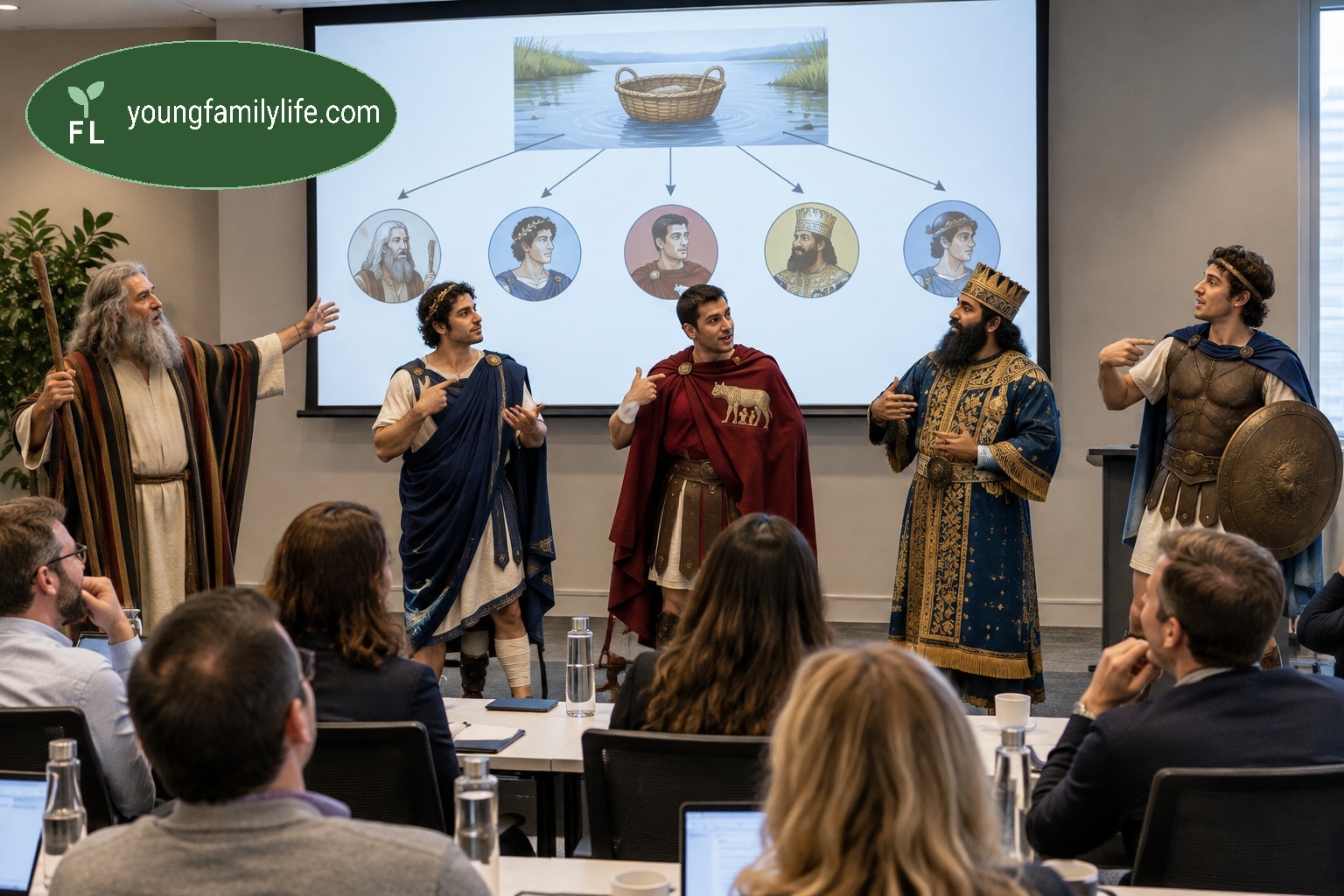
In every one of these cases, someone specific did the writing: a court, a screenwriter, a party machine — named, studied, and answerable for the version of events they put into circulation. Sargon’s own trick, in particular, was not even original to him: the psychoanalyst Otto Rank, in The Myth of the Birth of the Hero (1909/2004), found the same exposed-infant, humble-rescuer, hidden-origin pattern repeated across unrelated cultures, from Moses among the Nile reeds to Oedipus, Romulus, Cyrus, and Perseus — one of the oldest reusable templates a self-authored origin story has ever had.
Social media doesn’t work like that. Any feed carries three different kinds of story running at once, each written by someone different, and none of them fully in control of what actually reaches a given reader.
Story one: the story a person tells about themselves
An individual managing how others see them is not a new behaviour. Long before social media existed, the sociologist Erving Goffman observed that people manage the impression they give others in everyday life — showing a tidied-up “front stage” self while keeping the messier reality backstage (Goffman, 1959). Social media didn’t invent that habit. It gave it a permanent stage, visible to strangers, updated by the minute. Alice Marwick’s research on social media users shows them practising “self-branding” and “micro-celebrity,” using techniques borrowed from marketing to shape a story about who they are for an audience they will mostly never meet (Marwick, 2013).
The self being authored here is rarely built from nothing. The YFL essay The Borrowed Self traces a direct line from the Hollywood studio system’s manufactured stars, through mid-century advertising’s borrowed celebrity glow, to today’s influencer economy — where an ordinary person’s feed is often assembled, consciously or not, from fragments of whoever they admire. Edward Bernays appears in that account too, applying the practice examined in The Noble Lie and the Ministry of Truth as “the engineering of consent” to products rather than politics: attaching desire to an object by borrowing a celebrity’s aspirational shine. The self-story a person writes on social media, in other words, is frequently a story about someone else, worn.
This one has an author in the plainest sense: a single person, writing the story of themselves.
Story two: the story a group tells about itself
A subreddit, a fandom, a comment section with its own in-jokes and enemies — these build a shared story about who “we” are, and no single person is writing it. Henry Jenkins’s research on fan communities found that groups like this don’t just watch a story, they build on top of it together: arguing over what it means, adding their own material, deciding who counts as a real fan and who doesn’t (Jenkins, 2006). Nobody drafted this story and nobody can point to its author. It gets written the way a football chant gets written — through repetition and agreement, not by one voice.
National identity and political identity work the same way, at a far larger and messier scale. A nation’s story of itself — Benedict Anderson’s “imagined community” (Anderson, 1983/2006), examined in One Voice, One Body, on anthems and unison — has no single author either, however often a state tries to claim credit for authoring it. Political identity runs on the same logic: a movement’s shared sense of who “we” are is written collectively by its own members over time, not handed down complete by any one figure. Both are genuinely large, well-known, thoroughly contested territories in their own right, deep enough to swallow an essay each on their own, and neither needs entering here to make the relevant point: they are group-authored stories, exactly like a fandom’s, just larger and higher-stakes.
They also don’t stay whole. The social psychologists Henri Tajfel and John Turner, developing what became known as social identity theory, found that people sort themselves into in-groups and out-groups readily and continuously, and that a group’s sense of “us” keeps refining itself into smaller, more tightly defined “us”es as members who share a more specific view find each other and drift from the wider group that no longer fits them closely enough (Tajfel & Turner, 1979). A fandom splits into factions over what the story really means. A nation splits into movements over what it really stands for. A political party splits into wings over what it actually believes. The mechanism doing the splitting is the same one that built the larger group’s story in the first place — restated at a smaller scale.
What social media has changed is the speed of that sorting, not the mechanism itself. Before it existed, signalling which group a person belonged to, or breaking off to start a new one, ran through slow, physical channels: a pamphlet printed and handed out, a newsletter posted to a mailing list, a membership card carried in a wallet, a particular haircut or style of dress recognised on sight by anyone else wearing it. Each of those took real time and effort to produce and to notice. A social media profile, a bio line, a hashtag, or a follow can do the same identifying work in seconds, visible instantly to thousands rather than to whoever happened to be standing close enough to see the badge or the jacket. The in-group, the out-group, and the new splinter group Tajfel and Turner described still form the same way. They just form, and re-form, considerably faster now.
Story three: the story the algorithm picks for everyone
This one is harder to see, and probably the most powerful of the three: the platform’s own system for deciding which version of a story gets shown to the most people. Research on what actually spreads online has found that posts using moral-emotional language travel further through a network, an effect that depends on emotional pull rather than on whether the content is accurate or fair (Brady et al., 2017). No person at the company sits down and writes “the story” about a given topic. It gets written by whatever the recommendation system rewards, and on this evidence what tends to be rewarded is emotionally charged, morally framed content, which often means outrage and certainty travelling further than nuance and doubt.
The algorithm, in this sense, is doing an old trick rather than a new one. The birth-legend pattern Rank documented recurred across unrelated cultures not because anyone checked it was original or true — nobody could, and plenty of people telling it about their own kings almost certainly knew it wasn’t — but because the shape of it reliably moved an audience. A story doesn’t need to be authentic to keep getting picked up and relabelled for a new claimant; it only needs to work often enough on enough people that using it again is worth the trouble.
The Loch Ness Monster persists on the same basis, and the mechanism has drawn its own academic attention rather than staying an armchair observation. The sociologist James Moir’s analysis of the Loch Ness Monster examines it explicitly as myth-as-marketing, applying Roland Barthes’ theory that a modern myth’s job is not to be true but to naturalise a message so effectively that its constructed origin disappears from view (Moir, 2015). The plausibility of the underlying claim — a surviving plesiosaur in a Scottish loch — is not the variable doing the work: the commercial interest of a local tourist trade built on the monster is, and it actively sustains the story despite the absence of supporting evidence. An environmental-DNA survey sampled in 2018 and reported in 2019 found no trace of a large reptile, though plentiful eel DNA left a giant-eel explanation open (University of Otago, 2019). A recommendation algorithm is simply the modern, mechanised version of that same selection pressure: it has no opinion on whether a story is original, true, or plausible, and rewards whichever version reliably keeps an audience watching, exactly as ruthlessly as a tourist board recycling Nessie always has.
This is a story with no writer at all — heroes, villains, a version widely recognised — but nobody decided any of it on purpose.
Why this is different from the other cases
A myth, an anthem, a cheerful prison, a decades-long fight over a word — all of these have someone behind them who benefits and who could, in principle, be asked to answer for it. None of the three stories above work that way. A person benefits from their own good self-story, but has little control over whether it spreads. Nobody is responsible for a community’s story — it belongs to everyone and no one. And the algorithm doesn’t care who wins; it only cares how long people keep watching.
That makes social media the most open storytelling system ever built — anyone can write their own story, any group can build its own — and, at the same time, the least accountable one, because the part deciding which stories actually reach millions of people isn’t a person making a choice. It’s software optimising for attention.
Old mechanism, new machine
None of this is as new as it looks, even though the technology is. Lynne Kelly’s work on Aboriginal songlines shows a story, a song, and a place fused together and carried by a whole community rather than one storyteller (Kelly, 2015, 2016) — group authorship, much like the subreddit or fandom above. Jan Assmann’s distinction between everyday “communicative memory,” which fades fast, and deliberately built “cultural memory,” meant to last (Assmann, 1992/2011), fits a feed almost exactly: nearly everything posted disappears within days, but a small slice — screenshotted, turned into a meme, reused for years — crosses into something durable, without anyone deciding in advance which posts would make that jump. Both are set out in Memory’s Oldest Machine.
What’s actually new is the third author: a piece of software with no human judgement behind it at all, deciding what wins. No ancient songline, anthem, or founding myth ever had to compete with that.
Where this leaves the pen
Story hasn’t lost its power in the social media age. It’s split into three, running at once — the self, the group, and the machine — and none of them fully controls which version survives. The group story, in particular, doesn’t even stay one story for long: it keeps fracturing into smaller, more tightly defined groups exactly as Tajfel and Turner described, and social media has simply made that fracturing near-instant, where a pamphlet or a membership card once made it take years. Across YFL’s essays on story and control, story keeps turning out to carry more weight than it first appears: biology runs on it, states fight to own it, audiences fight over who gets to write it. Social media hasn’t weakened any of that. It’s just handed the pen to everyone at once, and to no one in particular — and made the pen change hands faster than it ever has before.
References
Anderson, B. (1983/2006). Imagined communities: Reflections on the origin and spread of nationalism (Rev. ed.). Verso.
Assmann, J. (1992/2011). Cultural memory and early civilization: Writing, remembrance, and political imagination (R. Livingstone, Trans.). Cambridge University Press.
Brady, W. J., Wills, J. A., Jost, J. T., Tucker, J. A., & Van Bavel, J. J. (2017). Emotion shapes the diffusion of moralized content in social networks. Proceedings of the National Academy of Sciences, 114(28), 7313–7318.
Goffman, E. (1959). The presentation of self in everyday life. Doubleday.
Jenkins, H. (2006). Convergence culture: Where old and new media collide. New York University Press.
Kelly, L. (2015). Knowledge and power in prehistoric societies: Orality, memory and the transmission of culture. Cambridge University Press.
Kelly, L. (2016). The memory code: The secrets of Stonehenge, Easter Island and other ancient monuments. Allen & Unwin.
Marwick, A. E. (2013). Status update: Celebrity, publicity, and branding in the social media age. Yale University Press.
Moir, J. (2015). Of monsters, myths and marketing: The case of the Loch Ness Monster. Analyses/Rereadings/Theories Journal, 3(1), 12–19.
Pritchard, J. B. (Ed.). (1969). The legend of Sargon. In Ancient Near Eastern texts relating to the Old Testament (3rd ed.). Princeton University Press.
Rank, O. (1909/2004). The myth of the birth of the hero: A psychological interpretation of mythology (G. C. Richter & E. J. Lieberman, Trans.). Johns Hopkins University Press.
Tajfel, H., & Turner, J. C. (1979). An integrative theory of intergroup conflict. In W. G. Austin & S. Worchel (Eds.), The social psychology of intergroup relations (pp. 33–47). Brooks/Cole.
University of Otago. (2019). First eDNA study of Loch Ness points to something fishy.
Topics: #SocialMedia #Algorithms #Identity #Goffman #Narrative #StoryAsMemory #NarrativeAndControl