The Room That Did Not Know It Was Working
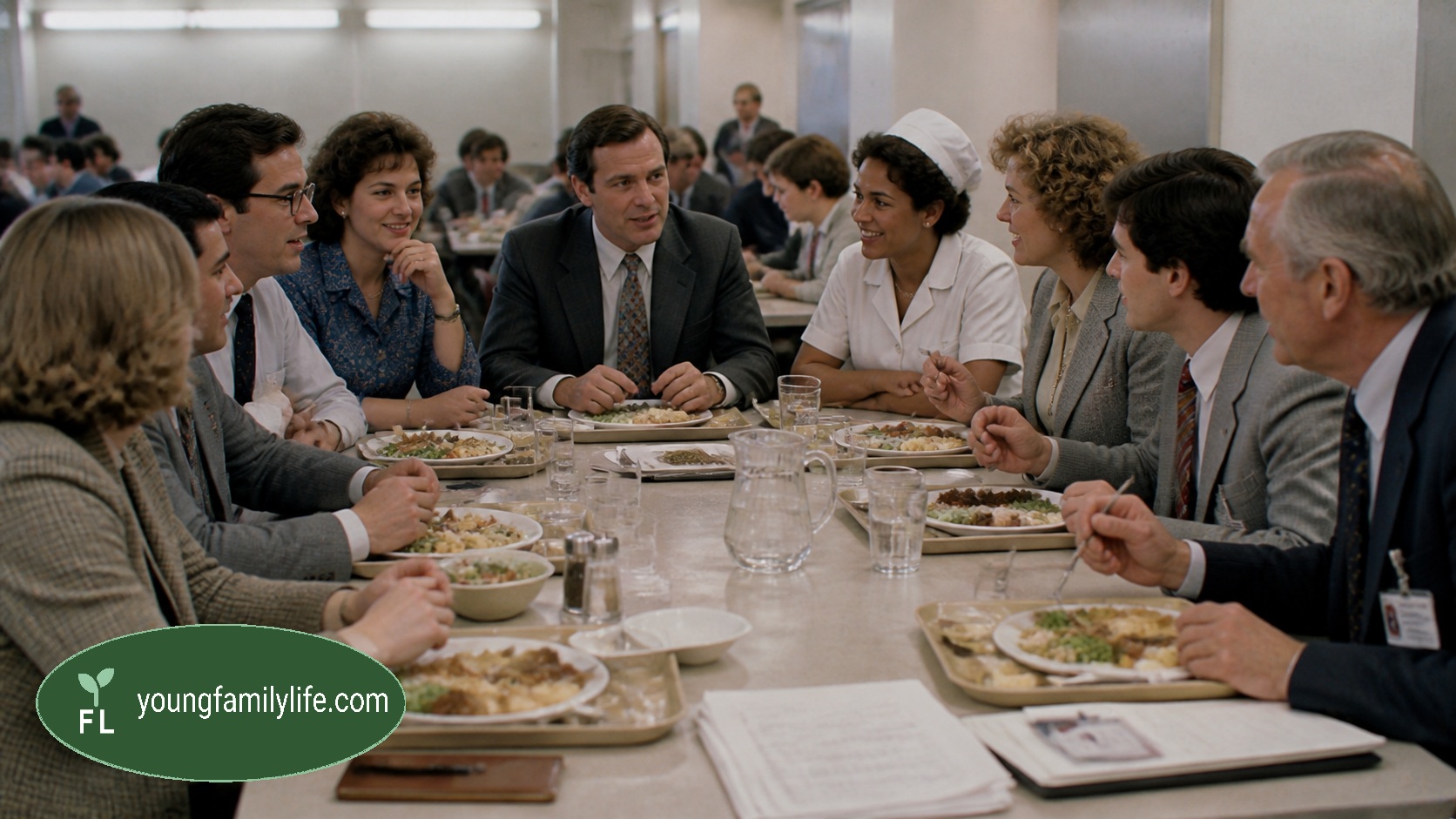
There was a time, within the living memory of most people in working life today, when the lunch hour had a geography. It had a smell — industrial tea, something hot from a bain-marie, a particular acoustics of trays and plastic chairs. The staff canteen was not glamorous. Opinions on the food varied enormously — some found it perfectly adequate; others avoided entire menu items with long-held conviction. But something happened in that room that rarely happens in a performance review, a town hall meeting, or a Microsoft Teams call.
People talked. Not to their line manager. Not to HR. Not in any formal sense at all. A chief executive collected his tray behind a cleaner. A middle manager waited for the urn alongside someone she had never spoken to from the floor below. A new recruit, uncertain of himself, found that the person sitting opposite him had once been new too. Whether the meal was good, indifferent, or resolutely avoided in favour of the soup, the encounter mattered.
This essay does not argue that the staff canteen was a golden age, nor that its loss explains everything wrong with modern workplaces. It argues something more specific and more discomfiting: that when the canteen closed — and it has been closing, steadily, across British industry and public life for three decades — an uncosted piece of social infrastructure went with it. And that the bill for its absence may be arriving now, in forms that are proving expensive and difficult to name.
The Scale of the Loss
The figures are unambiguous. In 1995, 82% of UK workplaces surveyed by union representatives had a staff canteen. By 2000, that figure had dropped to 66%. By 2010, it was 56%. By 2015, fewer than half — 47% — could report the same (Workplace Report, 2015). That trajectory represents a near-halving in twenty years, and the pattern of what replaced provision is as telling as the decline itself. Where canteens survived, many were transferred from in-house management to commercial contractors, with the gap in cost to the employee — for something as basic as a cup of tea — running to almost 90% higher in contractor-run than in subsidised in-house provision (Workplace Report, 2015).
What drove this? In the private sector, the logic was primarily economic: the canteen was a cost that could be externalised, offloaded to the employee's own lunchtime pound coin, or dissolved entirely in favour of the high street sandwich chain. In the public sector, something different was at work, and it is worth examining with some care.
The Trap of Scrutiny
Large public sector organisations — county councils, NHS trusts, government departments — have long operated under a particular kind of political and media pressure. Every line of expenditure is, in principle, answerable to the public. Every benefit extended to staff becomes, in certain press framings, a potential story about profligacy: the civil servant on a cushioned deal, the council worker with benefits the private sector worker cannot imagine.
The subsidised works canteen was vulnerable to exactly this framing. It was visible. It was, in the formal sense, a benefit — the employer bearing some of the cost of an employee's meal. And in an environment of sustained austerity pressure from 2010 onwards, in which local government funding was cut significantly in real terms (NAO, 2014), any expenditure that could be characterised as non-essential was at risk. Not necessarily because a cost-benefit analysis had been done and found it wanting. But because the optics of a subsidised canteen, once placed in a headline, become almost impossible to defend in the court of public opinion.
The tragedy of this particular trap is that it is epistemically self-defeating. Even if a well-managed statutory organisation had good evidence that its canteen generated value — in staff retention, team cohesion, managerial intelligence, or wellbeing — the moment that evidence was deployed in defence of the canteen, the story became the subsidy, not the return on it. The critique of “civil servants getting a free ride at taxpayers' expense” is not a critique that responds to evidence. It is a moral frame, and moral frames win against economic arguments because they do not require the same evidentiary standard.
So the canteen closed. Not everywhere, not all at once. But the direction of travel was clear and consistent. And almost no one counted the cost of what left with it.
What the Canteen Actually Did
This requires some care, because it is easy to romanticise. The post-war era of large-scale employer canteens was also the era of chronic industrial unrest, of the 1970s disputes that crippled the nationalised industries, of a labour relations climate so hostile that the simple act of eating together demonstrably failed to prevent some of the most damaging workplace conflicts in modern British history. The canteen was not a cure-all. It was never a substitute for fair pay, genuine representation, or well-managed employment relations. No one who queued behind their gaffer for shepherd's pie thereby became reconciled to wage suppression.
But it did something that is now the subject of considerable research attention: it created conditions for what might be called the encounter without agenda.
Kevin Kniffin and colleagues at Cornell University studied firefighter platoons across more than fifty firehouses over fifteen months, finding that the platoons who ate communally performed better as teams — and that when firefighters were embarrassed about not eating together in their house, that embarrassment was “basically a signal that something deeper was wrong with the way the group worked” (Kniffin, Wansink, Devine, & Sobal, 2015). Kniffin observed that “eating together is a more intimate act than looking over an Excel spreadsheet together. That intimacy spills back over into work.” He recommended explicitly that organisations consider expenditure on cafeterias not as an overhead but as investment in employee performance.
The mechanism at work here is not complicated. It is, in fact, ancient. Sociologist Eric Klinenberg, in his foundational work on social infrastructure, defines that term as “the physical places and organisations that shape the way people interact” and argues that a community's resilience correlates strongly with the robustness of its social infrastructure (Klinenberg, 2018). His research demonstrates that when public places are set up to promote social connection — through regularly scheduled markets, shared dining spaces, common rooms — strangers become familiar faces, and networks of friendship and mutual support develop. This is not a soft claim. It carries measurable consequences for health, resilience, and collective functioning.
The staff canteen was, in this framework, workplace social infrastructure. It did what libraries and playgrounds do in the civic sphere: it created a space where the encounter was not pre-arranged, not hierarchically scripted, and not evaluated. The manager collecting a tray was no longer the manager. The new recruit was not performing for assessment. For perhaps twenty minutes, the workplace suspended its own formality, and people met as people.
What crossed in those twenty minutes was not nothing. It was information — about mood, about pressure, about emerging difficulties that had not yet reached any formal channel. It was familiarity — the slow accumulation of small recognitions that makes a team something more than a collection of job descriptions. And it was, in the language of MIT's Human Dynamics Laboratory, exactly the kind of unstructured face-to-face contact that their research identifies as a “highly efficient means of propagating information that can increase worker productivity” (Pentland, 2014).
Sandy Pentland's group at MIT, using wearable sensors to map organisational communication in real-world settings — banks, military installations, IT consultancies — found consistently that creating opportunities for employees to interact face to face through synchronised break times increased productivity. In a bank call centre study, the researchers estimated that simply aligning coffee break times to allow more informal contact generated savings of approximately $15 million per year in productivity improvement from enhanced face-to-face network cohesion (Pentland, 2014). The formal meeting, they found, was far less efficient at propagating the information that organisations actually need to function well.
The Mug Was the Same
There is a particular kind of workplace performance that the canteen made difficult to sustain. It involves the deliberate curation of professional identity through visible consumption: the branded coffee cup carried through the open-plan office, the premium lunch photographed alongside a motivational caption, the LinkedIn post about leadership values that happens to coincide with the announcement of a senior appointment. None of this is dishonest, and none of it should be mocked. It is simply what human beings do when status is available to be performed and the audience is watching.
The canteen interrupted that performance for an hour. Not because it promoted equality in any formal sense — glass ceilings were real in the canteen era and remain real today, and proximity to leadership over institutional tea did not dissolve structural barriers that were built into pay grades, promotion panels, and organisational culture. But because the mug was the same mug. The tea was the same over-brewed tea. The sugar was in the same encrusted bowl, and the teaspoon presented the same limited options to the finance director as it did to the post room clerk. The apparatus of levelling was not ideological. It was catering.
In that temporary suspension of choice, something followed. When the visible markers of status are stripped away — not by policy, but by the simple fact that everyone gets the same thing — conversations happen that would not happen otherwise. The junior employee sitting opposite someone three grades above them is not being measured against a visible marker of professional aspiration. The senior manager is not performing her seniority through the quality of her lunch. Both of them are just eating.
This matters particularly when the glass ceiling is still present — as it is. The unscripted proximity of the canteen was not a solution to structural inequality, but it was one of the few institutional mechanisms that briefly dissolved the visible markers of it. The person who might never be admitted to a formal meeting with a senior leader might sit opposite one in the canteen queue. That encounter would not guarantee a career, and it would not dismantle the structural forces arrayed against certain kinds of people. But it created a possibility — the possibility of being seen, as a person rather than a grade, by someone who had the organisational power to see and remember.
Modern workplaces are, by contrast, very readable — legible at a glance for signals about ambition, identity, and aspiration. The branded coffee cup, the artisan lunch, the well-placed comment on a Director's LinkedIn post: these are all ways of being noticed by those with the power to advance a career, and there is nothing new about the instinct behind them. The canteen had its own version. The ambitious worker who made a point of sitting near the gaffer, steering the conversation, ensuring they were remembered — that game is entirely timeless.
What changed is not the game but what management lost in the playing of it. The employee who engineered a canteen conversation with their line manager still delivered something real alongside their career manoeuvring: ground-level information, operational texture, a sense of what was actually happening on the floor. The information might have been angled, but it was grounded. The well-crafted LinkedIn comment tells leadership nothing except that the commenter is watching their feed. The channel shifted. The listening opportunity went with it.
What Twelve Years Knows
The canteen was also a repository, of a kind that no knowledge management system has yet managed to replicate. The repository was not digital, not searchable, and not formally maintained. It lived in people — specifically in the people who had been there long enough to know things that were nowhere written down.
The long-serving employee is a category that has fallen somewhat from organisational fashion. The dominant cultural narrative around career development prizes mobility: the idea that ambition manifests as movement, that growth requires changing employers, that staying in one place for a decade or more signals stagnation rather than depth. LinkedIn profiles are structured to show progression and transition. The person who joined in 2008 and is still there in 2026 requires a different kind of reading — one that the culture has become less practised at performing.
This is a significant loss, because what that person holds is not nothing. It is the accumulated, informal, longitudinal knowledge of how the organisation actually works as distinct from how it is described in its own documentation. They know why the procedure was introduced, not just what it says. They know which patterns repeat annually without anyone naming them as patterns. They know the colleague who will rise to a crisis and the colleague who will quietly step back from one. They know what kind of pressure a particular team can absorb and what will tip it past the edge of function. They know, in short, the gap between the map and the territory — and in organisations of any complexity, that gap is where most of the actual management challenge lives.
This knowledge circulated through the canteen. Not in formal transfer, not through mentoring schemes or knowledge capture exercises, but through the incidental proximity of the lunch queue and the shared table. The newer employee who sat with someone twenty years their senior in the same organisation absorbed things that no induction programme would have offered — context, proportion, the kind of institutional pattern recognition that only time and sustained observation can develop. The long-server, equally, was kept current by that contact: knowing who the new people were, what they were working on, what they were finding difficult. The informal network was mutual.
When it worked well, this informal knowledge functioned as the oil in the organisation's machinery — reducing friction at the points where formal systems alone would generate unnecessary heat. A colleague struggling with a process difficulty could be guided around it by someone who remembered when the same difficulty had arisen before and how it was resolved. A manager dealing with a team dynamic could be quietly informed by a peer who had seen the same dynamic play out three years earlier under different circumstances. None of this required a meeting. Much of it required a conversation over lunch.
The same informal knowledge could also serve a diagnostic function. The long-server who had watched a colleague's performance, attitude, and engagement across several years was often the first to recognise when something had shifted irrecoverably — when the person who had once been a capable and committed contributor had become, in the colloquial but precise phrase, a problem without a solution in the company — something that formal processes would eventually catch, but catch late. Formal performance management systems are triggered by documented events and measured against stated criteria. Informal knowledge catches difficulty early, in the texture of daily interaction, in the thousand small signals that circulate through the relationships that people who have worked alongside each other for years have developed.
Recruitment, meanwhile, is expensive in ways that the canteen-era assumption of longevity naturally constrained. The CIPD estimates the average cost of replacing an employee in the UK at several thousand pounds before considering the depletion of institutional knowledge that leaves with each departure. Every person who goes takes with them the informal knowledge they held, the relationships they maintained, and the pattern recognition they had developed. The organisation then recruits someone who must build all of it from the beginning — with no guarantee that the informal networks exist in which that rebuilding can happen.
The canteen was not the cause of organisational longevity, and longevity was not always a virtue — organisations also need renewal, challenge, and the perspectives that external experience brings. But the canteen was one of the spaces in which the value of staying was made socially visible and practically functional. The person who had been there fifteen years was, in the canteen, recognisably someone — not by formal title alone but by the informal esteem of colleagues who had watched them accumulate knowledge and apply it quietly and usefully over time. That recognition does not appear on a performance appraisal form. It lived in the room where everyone got the same tea.
Walking the Floor
The canteen had a management counterpart: the practice that Tom Peters and Robert Waterman identified in their landmark 1982 study of high-performing companies and named Management by Walking the Floor (MBWA). Peters and Waterman found, across their examination of organisations widely recognised as successful, that the managers who led them did not typically manage from their offices. They were visible. They moved through the workplace, engaged in informal conversation, listened without a specific agenda, and were known to their people not as a name on a memo but as a presence in the corridor (Peters & Waterman, 1982).
The origins of this practice at Hewlett-Packard — where the founders Bill Hewlett and Dave Packard were known for their regular floor walks and their open-door culture — illustrates its practical logic. MBWA involves managers engaging with the work at the point where it is done, rather than receiving reports about it at a remove. It allows early detection of difficulty before it compounds. It provides the team with evidence that leadership is not insulated from operational reality. And it distributes what Eric Berne, in his transactional analysis framework, called positive strokes — units of social recognition — freely and without a formal occasion: the simple acknowledgement that a person's presence, effort, and existence within the organisation is noticed (Berne, 1964).
Tom Peters captured this with characteristic directness: “The simple act of paying positive attention to people has a great deal to do with productivity” (Peters, cited in Leading Sapiens, 2022).
MBWA and the staff canteen were not the same thing, but they served complementary functions within the same ecosystem. Walking the floor gave management visibility and ground-level intelligence. The canteen gave everyone — including management — a neutral space in which the visit could happen without it being an inspection. Between them, they created the conditions for what might be called organic organisational communication: the kind that does not require a meeting request, a formal agenda, or a performance management framework to trigger it.
Walking the Floor became a named practice because walking the floor had become unusual enough to require a name. That is the measure of the distance travelled. When managers walked through their organisations and ate lunch with their staff, no one called it a methodology. It was simply what happened.
The YFL humility framework offers a precise lens for what is lost when that stops. Its central concern is the dangerous mismatch between an adopted position and reality — specifically, the individual or organisation that is experienced but closed off, whose expertise is already becoming outdated without their awareness. This is not necessarily a matter of individual character. It can be a structural condition: produced not by arrogance of personality but by the removal of the channels through which correction naturally arrives.
The manager who no longer walks the floor, whose organisation has closed its canteen, who receives information only through formal reports and scheduled meetings, is in exactly this position. Their experience remains genuine. Their commitment to good management may be equally genuine. But the informal corrective mechanisms — the chance comment in the queue, the conversation at an adjacent table that revealed something no report would have captured — are no longer operating. The mental model of the organisation that leadership carries is no longer being updated by the daily small corrections that informal contact once provided. The result is a humility deficit that is structural rather than personal: not a failure of character but a failure of architecture.
This matters because it means the cost of losing the canteen is not simply a reduction in staff morale or team cohesion — though the research suggests it is that too. It is a reduction in organisational self-knowledge. The organisation that has removed its informal contact mechanisms is an organisation that is, in a precise and measurable sense, less accurately aware of itself than it was. Problems that would once have surfaced early in casual conversation reach the formal layer later, larger, and more expensive to address. The closed-off organisation does not know what it does not know — which is, as the humility framework observes, the most dangerous position of all.
Tools Down
There is one further dimension of the staff canteen that tends to go unremarked, because it was simply a structural fact of its era: it was a tools-down space by default, not by policy. The worker who left their workstation to go to the canteen left their work behind, because their work could not follow them. The lathe, the ledger, the telephone switchboard, the typewriter — none of it was portable. The canteen was, therefore, a total break in a way that no modern equivalent can quite replicate.
This is not straightforwardly a loss. The workplace coffee shop — whether an internal franchise or the high street chain — offers something that the canteen never could: a portable focus environment. The employee who takes a laptop to a café corner table, away from the social obligations of the open-plan floor, can sometimes concentrate on a report or a complex piece of thinking more effectively than at their designated desk. A change of scenery, caffeine, and a degree of ambient noise can serve genuine cognitive function. The technology that made tools portable has also made focus portable — and that is a real gain.
But the two functions are not interchangeable. The laptop in the coffee shop is primarily a productivity tool — a deliberate change of environment to concentrate on a specific piece of work. The person who takes a report there is not seeking connection; they are seeking focus, and the coffee shop delivers it effectively. That is a different purpose entirely from what the canteen served. The canteen was not a place to concentrate on anything in particular. It was a place to stop — and in stopping, to encounter other people without any task in view.
The presence of the screen also quietly restores the hierarchy that the canteen suspended. Visible work signals visible commitment; the person with a laptop is demonstrably productive in a way that the person simply eating is not. The markers of status and professional identity that the canteen queue briefly made impossible to display return through the door of the coffee shop. The canteen, by having nothing to display, allowed people to stop displaying.
The tools-down condition was not incidental to the canteen's social function. It was its precondition. When the break was complete — when the encounter was genuinely without agenda because no agenda could be carried in — the informal contact that followed was qualitatively different from anything that happens in a room where half the people are half-working.
What Replaced It
The Pret A Manger meal deal is not a sociological villain. Neither is the sandwich shop, the supermarket lunch run, or the hot-desking culture that has redistributed workers across shared spaces without dedicated break rooms. What these replacements have in common is that they are individual solutions to a collective need. The worker steps outside, makes a purchase, perhaps eats at their desk, and returns. The lunch break has been disaggregated into a million private transactions, each efficient in its own terms, and collectively amounting to the dissolution of the encounter without agenda.
Hybrid and remote working has extended this logic across the working week. As of October 2025, 27% of workers in Great Britain were in hybrid roles and a further 13% were fully remote — making the UK the second-highest adopter of hybrid working globally after Canada (Modern CV, 2026). Parliamentary research confirms that among the challenges of this model are decreased social interactions, reduced engagement and connection, and, for some sectors, productivity losses, with more employers citing decreased productivity than increased (POST, 2022).
What is striking in the research is not the debate about self-reported productivity — workers and employers tend to see that picture differently — but the consistent finding about what is lost. In a UK survey, 58% of workers identified the main benefit of in-person collaboration as creating a sense of belonging within the team (TravelPerk, 2024). A further 36% of managers of remote and hybrid teams reported in 2024 that their teams were missing out on impromptu or informal feedback — down from 55% expressing the same concern in 2023 (Owl Labs, 2024). That the figure is falling may indicate improving adaptation to hybrid working; it may equally reflect a gradual lowering of expectations about what informal feedback should look like.
The organisational response to the loss of informal contact has been to engineer connection formally. Staff engagement surveys. Wellbeing initiatives. Virtual team-building sessions. Away days designed to recreate what once happened incidentally over a subsidised plate of chips. This is the feedback paradox made structural: organisations are spending money to manufacture the connection that the canteen provided for nothing, without ever counting what the canteen cost them to close.
Gallup data consistently finds that highly engaged teams are 21% more productive and show markedly lower absenteeism than their disengaged counterparts (Gallup, cited in Engagedly, 2026). The National Institute for Health Research synthesis for the NHS found robust associations between staff engagement and performance outcomes including productivity, retention, and organisational citizenship behaviour (Bailey et al., 2015). In neither body of research was the subsidised lunch break examined as a potential mechanism for delivering that engagement. It was already gone.
The Uncosted Hypothesis
What this essay cannot prove — and will not pretend to — is the precise causal pathway from canteen closure to measurable productivity loss. That specific research does not yet exist in the form that would allow a clean assertion. What does exist is a convergence of evidence from adjacent fields that, taken together, makes a testable proposition.
The proposition runs as follows. Informal face-to-face interaction in workplaces demonstrably improves team performance, information flow, and employee engagement. Employee engagement demonstrably correlates with productivity. The staff canteen was a primary structural mechanism for generating that informal interaction in mixed-hierarchy groups. It has been removed from nearly half of UK workplaces since 1995 — the removal driven not by evidence of its lack of value but by cost pressure and, in the public sector specifically, by political and media scrutiny that made its defence structurally impossible regardless of merit. The gap left by its removal has been addressed through engineered interventions that are, at best, partial substitutes and, at worst, formal performances of the connection they are meant to restore.
If this chain holds — and the research reviewed here suggests it is at minimum plausible — then the cost of closing the canteen was not zero. It was real, distributed across reduced cohesion, slower informal information flow, reduced managerial presence at the operational level, and the replacement expenditure on engagement initiatives. It has simply never been itemised, because the decision to close was made on political rather than evidential grounds, and because the costs materialised diffusely, across the organisation, in forms that no single budget line ever captured.
The public sector organisations under the most intense scrutiny to justify every pound spent may have been, in the act of closing their canteens, spending considerably more than they saved — just across different budget lines, in different financial years, and without any mechanism for connecting the dots.
Social Infrastructure Is Not a Luxury
Eric Klinenberg is explicit on this point: social infrastructure generates inequalities in health, education, crime, climate vulnerability, and social networks when it is absent (Klinenberg, 2018). His argument was made primarily about civic and community spaces — libraries, parks, childcare centres. But the workplace is also a community, and the research consistently treats it as one. Nourish Scotland's likening of canteen-type spaces to other familiar public infrastructures — libraries, leisure centres, parks — as places delivering social value rather than merely a food service, captures something important: that shared eating space is not a perk but a function (Big Issue, 2025).
The lesson from MBWA, from Pentland's face-to-face network studies, from Kniffin's firehouses and Klinenberg's social infrastructure framework, is consistent. What looks incidental — the queue at a bain-marie, the conversation at an adjacent table, the manager who appears in the corridor rather than communicating via email — is doing organisational work that no formal system can replicate. It is doing it cheaply, invisibly, and without requiring anyone to attend a workshop about it.
When it disappears, the work does not disappear. It goes undone, or it gets attempted through expensive formal substitutes, or it simply accumulates as the kind of organisational friction that shows up in retention figures, in sickness absence data, in the quiet withdrawal of discretionary effort that Gallup measures and finds wanting.
A Note on the 1970s
Any essay that draws on the era of the works canteen must acknowledge what else that era contained. The post-war settlement that built large public canteens also presided, by the 1970s, over industrial relations so fractured that entire nationalised sectors were periodically paralysed. The miners' strike, the Winter of Discontent, the chronic adversarialism of British labour relations in that period — none of it was resolved by the fact that workers and managers occasionally shared a dining room.
This is not a minor caveat. It is a serious qualification. The encounter without agenda is not a substitute for fair pay, honest employment contracts, genuine representation, or organisations that treat their people well in the ways that actually matter to them. A well-managed canteen in a badly managed organisation is a pleasant room in a difficult building. The informal contact it enables cannot overcome structural distrust, systemic inequality, or a management culture that uses visibility for surveillance rather than genuine connection.
What the canteen offered was possibility: the conditions under which the informal encounter could happen, and under which the information that travels only through informal channels could move. Whether organisations made use of that possibility, whether they combined it with the other elements of a functioning employment relationship, was always a separate question. The research suggests the possibility mattered. The 1970s suggests the possibility, alone, was never enough.
Conclusion: Naming What Was Lost
The staff canteen was about more than food, whatever one thought of it. It was about the physical place that shaped the way people interacted — which is precisely how Klinenberg defines social infrastructure. Its closure was rarely decided on evidence. It was decided on cost, on scrutiny, on the political vulnerability of any benefit that could be framed as a perk. The evidence for its value was never marshalled convincingly — partly because the value was diffuse and hard to isolate, and partly because, in the public sector especially, the frame of the debate made evidence irrelevant.
What replaced it has not replaced it. The meal deal does not generate the encounter without agenda. The hybrid rota does not synchronise the coffee break. The staff engagement survey does not do what happened when the chief executive queued at the same counter as the cleaner. The formal substitutes cost more and deliver less, because they are designed to perform connection rather than to create the conditions in which connection happens naturally.
The organisations now spending on engagement programmes, wellbeing initiatives, and away-day workshops are, in many cases, paying to recover something they once had for the cost of a subsidised hot meal. The bill is longer, the return less certain, and the connection between the two is rarely named.
Nourish Scotland called shared dining spaces “palaces for the people” — a phrase originally Andrew Carnegie's, applied to the libraries he built, on the principle that shared space is not an overhead but an investment in the people who use it (Big Issue, 2025; Klinenberg, 2018). The works canteen was, in its unlovely way, a palace. It nourished more than it fed.
References
Bailey, C., Madden, A., Alfes, K., et al. (2015). Evaluating the evidence on employee engagement and its potential benefits to NHS staff: A narrative synthesis of the literature. Health Services and Delivery Research, 3(26). NIHR Journals Library.
Berne, E. (1964). Games people play: The psychology of human relationships. Grove Press.
Big Issue. (2025, May). How bringing back Churchill's wartime canteen culture could help tackle food poverty. bigissue.com.
Engagedly. (2026). The impact of employee engagement on productivity. engagedly.com.
Institute for Government. (2026). Local government funding in England. instituteforgovernment.org.uk.
Klinenberg, E. (2018). Palaces for the people: How social infrastructure can help fight inequality, polarization, and the decline of civic life. Crown.
Kniffin, K. M., Wansink, B., Devine, C., & Sobal, J. (2015). Eating together at the firehouse: How workplace commensality relates to the performance of firefighters. Human Performance, 28(4), 281–306.
Modern CV. (2026). UK remote work statistics 2026. moderncv.co.uk.
Owl Labs. (2024). State of hybrid work 2024: UK report. owllabs.co.uk.
Parliamentary Office of Science and Technology (POST). (2022). The impact of remote and hybrid working on workers and organisations. post.parliament.uk.
Pentland, A. (2014). Social physics: How social networks can make us smarter. Penguin Press.
Peters, T., & Waterman, R. H. (1982). In Search of excellence: Lessons from America's best-run companies. Harper & Row.
TravelPerk. (2024). Top hybrid work trend stats from companies in the UK for 2024. travelperk.com.
Workplace Report. (2015, January). Where they survive, workplace canteens keep staff well fed. LRD Publications.
Young, S. (2024). Humility check-in: Awareness card and manual. YoungFamilyLife Ltd. youngfamilylife.com.
Topics: #StaffCanteen #WorkplaceWellbeing #OrganisationalCulture #InformalCommunication #ManagementByWalkingTheFloor #SocialInfrastructure #EmployeeEngagement #PublicSector #InstitutionalMemory #WorkplaceProductivity #EncounterWithoutAgenda #YoungFamilyLife
Copyright Notice
© 2026 Steve Young and YoungFamilyLife Ltd. All rights reserved.
This essay was developed collaboratively using AI assistance to research academic sources and refine content structure, while maintaining the author's original voice, insights, and “Information Without Instruction” philosophy. No part of this essay may be reproduced, distributed, or transmitted in any form or by any means, including photocopying, recording, or other electronic or mechanical methods, without the prior written permission of the copyright holders, except in the case of brief quotations embodied in critical reviews and certain other noncommercial uses permitted by copyright law.
For permission requests, contact: [email protected]