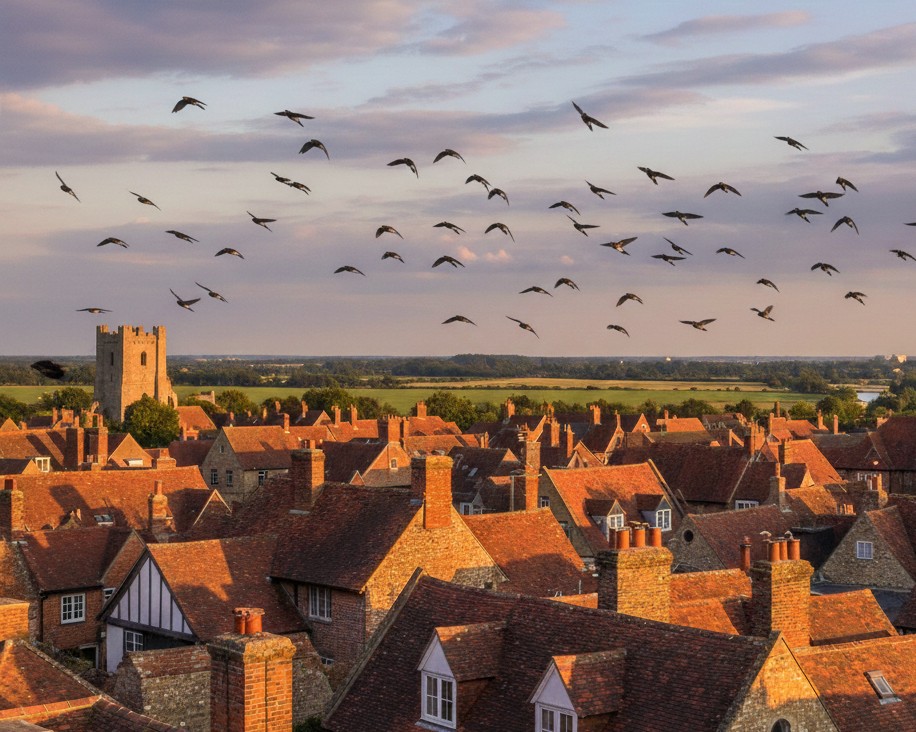
Every May, something extraordinary happens in Bungay. As the second week arrives, small dark shapes begin carving through our skies at breathtaking speed, their high-pitched screams announcing their return from Africa (Bird Migration Atlas; BTO). These are swifts — and they are, by almost any measure, among the most remarkable creatures on Earth. For a few brief weeks each summer, they make their home above Nethergate Street, Wingfield Street, and the Staithe (Bungay Community), raising their young in gaps beneath tiles and cracks behind downpipes before vanishing again into the southern hemisphere. What makes them so astonishing is not merely their arrival, but the phenomenal biology that brings them here — and that keeps them airborne for almost their entire lives.
A Life Almost Entirely Airborne
Swifts spend over ninety-nine per cent of their lives in the air. Outside the breeding season, individuals remain aloft for ten months straight — feeding, drinking, and even sleeping on the wing (Åkesson et al., 2016; Hedenström et al., 2019). No other bird spends as much of its life in flight. They drink by skimming the surface of water bodies or catching raindrops. They mate in the air. At dusk, they ascend to altitudes of up to three thousand metres to rest, gliding through thin air using a remarkable process called unihemispheric slow-wave sleep, in which one half of the brain rests while the other remains alert (Rattenborg et al., 2016; Gulbenkian Garden). They alternate bursts of wingbeats with smooth glides lasting several seconds, half-asleep and half-awake, drifting on the gentle zephyrs of the short summer night. Over a lifetime, a swift may cover millions of kilometres without once voluntarily touching the ground.
Their energy efficiency is extraordinary. Research suggests that swifts can save up to fifteen per cent of their energy through intermittent flight — alternating between flapping and gliding at around sixty-four per cent gliding proportion (Muijres et al., 2012). Despite flying almost constantly, they burn roughly the same energy as many land-based songbirds (Lund University, 2019). Their bodies efficiently balance fat, carbohydrate, and protein as fuel sources, with lipids providing eight times more chemical energy per unit than protein (Jenni-Eiermann & Jenni, 1998). This metabolic efficiency is what makes their aerial existence possible: they are not fighting physics but working with it, their bodies exquisitely tuned to the demands of perpetual flight.
Built for the Sky
The swift's body is a masterpiece of aerodynamic engineering. Their long, swept-back wings resemble a crescent or boomerang — sometimes described as scimitar-shaped, evoking weapons rather than feathers (Lack, 1956). The secret of their speed lies in a very short innermost bone, the humerus, which allows for a distinctive twisting movement during flight (Kaiser, 1997). Capable of speeds approaching seventy miles per hour, they are among the fastest birds in level flight (Woodland Trust). Their streamlined bodies, weighing only forty to fifty grams, reduce drag to almost nothing.
Their wide gape — their mouths open extraordinarily large — allows them to trawl for insects through the air rather than targeting individual prey (RSPB). They sweep up aerial plankton: flies, aphids, small beetles, and spiders drifting on the wind. Their large eyes provide exceptional vision, fine-tuned for tracking tiny targets at high speed against the bright sky (Martin, 2017). A swift does not hunt so much as harvest.
Perhaps most curious are their feet. The scientific name Apus comes from the Greek meaning 'without feet' — the ancients believed these birds had no legs at all. In truth, swifts have an unusual toe arrangement called pamprodactyly, where all four toes can swing forward together (Collins, 1983; Chantler & Driessens, 2000). This allows them to hook onto vertical surfaces like tiny grappling hooks. Anyone who has handled a grounded swift knows their grip is remarkably strong; those small claws leave lasting marks (Lack, 1956). But their legs are short and their feet are not built for walking. A swift on flat ground is vulnerable and awkward. Their feet evolved not for the earth but for clinging to the walls and eaves of buildings — or, in earlier millennia, to cliff faces and the bark of ancient trees.
Navigation Masters
When Bungay's swifts return each May, they have travelled thousands of miles. One tracked bird completed its migration from West Africa to Britain in only five days (BTO). Most use stopover zones like Liberia's humid forests before crossing the Sahara (Bird Migration Atlas; BTO). How they navigate remains one of nature's most elegant mysteries.
Young swifts, researchers have discovered, carry genetically encoded migration programmes — magnetic-field 'maps' stored in their brains that guide them towards Africa and back even without experienced adults to follow (Thorup et al., 2025; Bauer et al., 2022). Like crofting sheep that know their home hills without being taught, first-time migrants already possess an innate compass. They then combine this inherited blueprint with celestial cues and learned experience, gradually refining their routes over years (Berdahl et al., 2018). It is instinct and intelligence working together: biology providing the framework, experience sharpening the detail.
This capacity for spatial memory extends to their breeding sites. Swifts return not merely to the same town but to the same crack under the same tile, year after year, to meet the same mate (SongBird Survival; Majkusiak, 2023). Breeding pairs often remain together for life, reuniting each spring at a location they may have used for a decade or more. The same birds — or their descendants — have likely been returning to the rooftops along Wingfield Street for years, perhaps generations.
The Social Lives of Swifts
Few sounds capture summer in Bungay like the screaming of swifts circling rooftops at dusk. These 'screaming parties' — groups of ten to twenty birds darting through streets at extraordinary speed — still puzzle ornithologists (Suffolk Bird Group; Pomroy, 2021). They may be social assemblies, courtship displays, or ways for young birds to locate future nesting sites. What we know is that they are not random noise.
Breeding pairs engage in antiphonal duetting — the male and female rapidly calling and responding to each other, cementing their pair bond and defending their nest site (Kaiser, 1997). This duetting happens both at the nest and on the wing. The swift's scream, slowed down, reveals a complexity comparable to blackbird song; we hear only the slurred version, compressed by speed (Bretagnolle, 1993). The 'fuzzy' quality of their calls contains amplitude modulation that may encode individual identity — each swift recognisable to its mate by the particular pattern of its voice (Kaiser, 1997).
Radar tracking has shown that swifts flock together during their evening ascent and dawn descent, but fly separately at other times (Rattenborg et al., 2016). This suggests the gatherings serve a purpose beyond mere coincidence — perhaps information exchange about feeding conditions, or social bonding that maintains the colony's cohesion across the thousands of miles they travel apart.
Young swifts prospecting for future nest sites behave quite differently from the established breeders. The mature birds approach confidently, calling loudly. But the solitary prospectors — those who have not yet found a site — arrive silently, alone, at quiet times when the 'bangers' are elsewhere. They observe. They wait. Something 'switches' when a swift becomes sexually mature: a behavioural change that transforms cautious watching into committed action (Pomroy, 2021). Until that switch is flicked, no amount of encouragement will persuade them to settle.
A Fragile Cycle
Swifts are long-lived for such small creatures — averaging seven to ten years, though some reach eighteen, and rare individuals surpass twenty (Ealing Wildlife Group, 2023; Wildlife Trusts; BTO). This longevity comes with a slow, steady breeding strategy. Most do not attempt to breed until at least their fourth year (Ealing Wildlife Group, 2023). They raise a single brood annually, typically two to three eggs, with both parents sharing incubation and feeding duties (SongBird Survival; Majkusiak, 2023). Over a nine-year life, a typical swift might raise only five successful broods and produce just seven to ten living offspring.
Their nests are simple platforms of whatever they can catch on the wing — an itinerant piece of hay, a feather, other flying flotsam — compacted together with copious amounts of saliva (Lack, 1956; Medway, 1962). During the nesting season, their salivary glands enlarge dramatically to produce this sticky cement; afterwards, the glands shrink. It is a biological system exquisitely calibrated to their brief time on solid surfaces.
Swift chicks possess their own remarkable adaptation: when cool, wet weather prevents their parents from catching insects, the young can enter a low-energy torpor, slowing their metabolism and surviving for ten to fifteen days on very little food (Norfolk Biodiversity Action Plan, 2020). They are born with resilience built into their biology — a buffer against the uncertainties of an English summer.
The Brief Bungay Season
They arrive in Bungay by mid-May, and by early August, they are gone (Suffolk Biodiversity Information Service, 2020). Sometimes they depart sooner if persistent rain grounds aerial insects — their sole food source. The season is astonishingly brief: barely three months from first scream to last. In that time, they must find their mate, reclaim their nest site, lay and incubate eggs, raise their young to independence, and prepare for a journey of thousands of miles.
Feeding parties can be very large in insect-rich areas. Reports of two thousand swifts feeding over flooded gravel pits or marshy river deltas are not uncommon, the birds converging from within a hundred-kilometre radius when conditions are right (Rattenborg et al., 2016). Swifts nesting in western Scotland have been tracked venturing to Lough Neagh in Northern Ireland to feed on the abundant 'Lough Neagh Fly'. For a bird that lives on the wing, distance is simply not the obstacle it would be for earthbound creatures.
Bungay's Privilege
To watch the swifts of Nethergate Street is to witness mastery of air and instinct. Each bird screaming overhead has travelled thousands of miles with only an inherited memory of where to go and when to return. Each has slept on the wing at three thousand metres, drifted across the Sahara, navigated by magnetic field and starlight, and found its way back to the same crack in the same wall to meet the same partner. Their lives trace the connection between hemispheres — threads of migration linking Suffolk to the Congo basin and back again.
They are small — barely forty grams. They are smart — remembering places and partners across years and continents. They are resilient — their chicks born with the capacity to survive adversity, their bodies tuned for a life that would exhaust any other creature. And for a few brief weeks each summer, they honour Bungay with their presence.
When August comes and the skies fall silent, the wonder remains. Somewhere over Africa, half-asleep and half-awake, they are still flying.
Addendum: Swift Research Across Two Hemispheres
The swifts that summer in Bungay belong to both hemispheres — and so does the science that studies them. Understanding these remarkable birds requires collaboration across continents, with researchers in Africa and Europe working together to piece together the full picture of swift lives.
Northern Hemisphere: Breeding Ground Research
European research institutions — particularly those in Britain, Sweden, and the Netherlands — have pioneered modern swift study. The British Trust for Ornithology's Bird Migration Atlas remains the most comprehensive tracking of swift movements across Europe and into Africa. Lund University in Sweden has produced ground-breaking work on swift energy expenditure during flight, and Swedish researchers were among the first to document swifts' ten-month aerial existence outside breeding season (Hedenström et al., 2019).
The use of geolocators — tiny GPS-style tags weighing less than a gram — has allowed researchers to track individual swifts across entire migratory cycles. These devices have revealed that swifts travel thousands of kilometres even within their African wintering grounds, frequently shifting location in response to food availability rather than staying put (Åkesson et al., 2016).
Northern European ornithologists have also documented breeding behaviour in remarkable detail. Work by Kaiser (1997) in Germany and Lack (1956) in Britain established the foundations of our understanding of swift courtship and nest-site fidelity. More recently, Swift Conservation Ireland (Majkusiak, 2023) has built on this work to clarify how swifts select and defend breeding territories in both natural and built environments.
Southern Hemisphere: Wintering Ground Studies
African researchers have contributed equally vital insights, often under much more challenging logistical conditions. The Percy FitzPatrick Institute of African Ornithology at the University of Cape Town has led much of southern Africa's research into Palaearctic migrants — birds that breed in Europe and winter south of the Sahara. Their African Bird Atlas Project systematically maps bird distributions across the continent, providing critical baseline data on swift abundance and habitat use (Lee et al., 2022).
In East Africa, Nature Kenya coordinates the Ngulia Ringing Programme, one of the world's longest-running bird-ringing operations. Tens of thousands of migratory birds pass through Ngulia annually, and the data collected there since the 1960s has illuminated migration timing, stopover ecology, and population trends for species including swifts.
West African scientists have documented swift behaviour during the critical Sahel stopover period. Research shows that swifts spend weeks refuelling in the humid forests of Liberia, Guinea, and Sierra Leone before crossing the Sahara (Moreau, 1972; Moreau, 2014). These forests provide essential insect abundance when swifts most need it — a reminder that habitat protection thousands of miles from British breeding grounds directly affects our summer visitors.
Collaboration and Challenges
Much swift research depends on international cooperation. European tracking studies rely on African colleagues to recover geolocators when birds are re-trapped during subsequent breeding seasons. African biodiversity surveys benefit from northern funding and expertise. But collaboration is not without obstacles: differences in resources, infrastructure, and research priorities can create imbalances.
Increasingly, research institutions recognise the need for genuinely equitable partnerships. Citizen science initiatives like the Kenya Bird Map allow local communities to contribute directly to scientific knowledge, whilst capacity-building programmes train African ornithologists in advanced tracking technologies. The goal is not merely to study swifts but to ensure that those who share their landscapes — whether in Suffolk or the Congo Basin — have the tools and knowledge to protect them.
References
Åkesson, S. et al. (2016). 'Arctic terns' annual journey reveals extraordinary flight endurance'. Current Biology. Available at: cell.com
Bauer, S. et al. (2022). 'Avian migration: Proximate mechanisms'. Encyclopedia of Life Sciences. Wiley Online Library. doi:10.1002/9780470015902.a0003220.pub2
Berdahl, A.M. et al. (2018). 'Collective animal navigation and migratory culture: from theoretical models to empirical evidence'. Philosophical Transactions of the Royal Society B, 373(1746), 20170009.
Bird Migration Atlas. 'Swift Migration Patterns'. British Trust for Ornithology. Available at: migrationatlas.org
Bretagnolle, V. (1993). 'Adaptive significance of seabird coloration: the case of procellariiforms'. American Naturalist, 142(1), pp.141–173.
British Trust for Ornithology (BTO). 'Common Swift Species Guide'. Available at: bto.org/understanding-birds/species-focus/common-swift
Bungay Community. 'Local Wildlife - Swift Colonies'. Available at: bungaytown.com
Chantler, P. & Driessens, G. (2000). Swifts: A Guide to the Swifts and Treeswifts of the World. (2nd ed.). Pica Press.
Collins, C.T. (1983). 'A reinterpretation of pamprodactyly in swifts'. The Auk, 100(2), pp.288–294.
Couzens, D. (2024). 'Swift'. Bird Watching Magazine. Available at: birdwatching.co.uk
Ealing Wildlife Group (2023). 'Species Focus: Common Swift'. Available at: ealingwildlifegroup.com/2023/07/24/species-focus-common-swift/
Gulbenkian Garden. 'How can swifts sleep in flight?' Available at: gulbenkian.pt/jardim/en/read-watch-listen/how-can-swifts-sleep-in-flight/
Hedenström, A. et al. (2019). 'Annual 10-Month Aerial Life Phase in the Common Swift: Flight Behaviour and Energy Expenditure'. Lund University Research. Available at: lunduniversity.lu.se
Home & Roost. 'The Main Differences Between A Swift and Swallow'. Available at: homeandroost.co.uk/blogs/latestnews/blog-swift-and-swallow
Jenni-Eiermann, S. & Jenni, L. (1998). 'Fuel supply and metabolic constraints in migrating birds'. Journal of Avian Biology, 29(4), pp.521–528.
Kaiser, E. (1997). 'Courtship behaviour of the Common Swift Apus apus'. Bird Study, 44(2), pp.159–174.
Lack, D. (1956). Swifts in a Tower. London: Methuen.
Lee, A.T.K. et al. (2022). 'The African Bird Atlas Project: a description of the project and BirdMap data-collection protocol'. Ostrich, 93(4), pp.223–232. doi:10.2989/00306525.2022.2125097
Lund University (2019). 'Swifts are born to eat and sleep in the air'. Available at: lunduniversity.lu.se/article/swifts-are-born-eat-and-sleep-air
Majkusiak, J. (2023). Breeding Biology of the Common Swift in Ireland. Swift Conservation Ireland. Available at: swiftconservation.ie
Martin, G.R. (2017). The Sensory Ecology of Birds. Oxford: Oxford University Press.
Medway, Lord (1962). 'The swiftlets (Collocalia) of Niah Cave, Sarawak'. Ibis, 104(2), pp.228–245.
Moreau, R.E. (1972). The Palaearctic-African Bird Migration Systems. Academic Press.
Moreau, W. (2014). 'Migratory connectivity of Palaearctic–African migratory birds and their responses to environmental change: the serial residency hypothesis'. Ibis, 156, pp.493–510.
Muijres, F.T. et al. (2012). 'Comparing aerodynamic efficiency in birds and bats suggests better flight performance in birds'. PLoS ONE, 7(5), e37335.
Nature Kenya / East Africa Natural History Society. 'Kenya Bird Map' and 'Ngulia Ringing Programme'. Available at: naturekenya.org
NE Scotland Biodiversity Partnership. 'Swifts Are On Their Way - A Non-Stop Journey'. Available at: nesbiodiversity.org.uk/news/swifts-are-on-their-way/
Norfolk Biodiversity Action Plan (2020). Swift Species Action Plan. Available at: norfolkbiodiversity.org/assets/Uploads/Swift2.pdf
Percy FitzPatrick Institute of African Ornithology, University of Cape Town, South Africa. Available at: fitzpatrick.uct.ac.za
Pomroy, J. (2021). 'Swift Diary: Forming a New Colony'. Available at: jonathanpomroy.wordpress.com
Rattenborg, N.C. et al. (2016). 'Evidence that birds sleep in mid-flight'. Nature Communications, 7, 12468.
RSPB. 'Swift Apus apus: Species Guide'. Available at: rspb.org.uk/birds-and-wildlife/swift
SongBird Survival. 'SWIFT (Apus apus) - songbird factfile'. Available at: songbird-survival.org.uk/songbirds/swift
Suffolk Biodiversity Information Service (2020). Swift Factsheet. Available at: suffolkbis.org.uk
Suffolk Bird Group. 'SOS Swifts Project'. Available at: suffolkbirdgroup.org/sos-swifts
Swift Conservation Ireland. 'The Common Swift - High Intensity Lighting'. Available at: swiftconservation.ie
The Wildlife Trusts. 'Swift Awareness Week'. Available at: wildlifetrusts.org/blog/guest/swift-awareness-week
Thorup, K. et al. (2025). 'Do first-time avian migrants know where they are going'. PMC. Available at: pmc.ncbi.nlm.nih.gov/articles/PMC12037376/
Waveney Bird Club. 'Programme of Events 2026'. Available at: waveneybirdclub.com/programme-of-events/
Wild Echoes. 'Common Swift: Vocalisations and Behaviour'. Available at: wildechoes.org
Woodland Trust. 'Swift Apus apus: Facts and Identification'. Available at: woodlandtrust.org.uk
Topics: #Swifts #Ornithology #BirdMigration #Bungay #Suffolk #Wildlife #Ecology #BirdBehaviour #Conservation #NaturalHistory #BritishWildlife #Migration #Adaptation #Biology
Copyright Notice
© 2026 Steve Young and YoungFamilyLife Ltd. All rights reserved.
This essay was developed collaboratively using AI assistance to research academic sources and refine content structure, while maintaining the author's original voice, insights, and "Information Without Instruction" philosophy. No part of this essay may be reproduced, distributed, or transmitted in any form or by any means, including photocopying, recording, or other electronic or mechanical methods, without the prior written permission of the copyright holders, except in the case of brief quotations embodied in critical reviews and certain other noncommercial uses permitted by copyright law.
For permission requests, contact: info@youngfamilylife.com