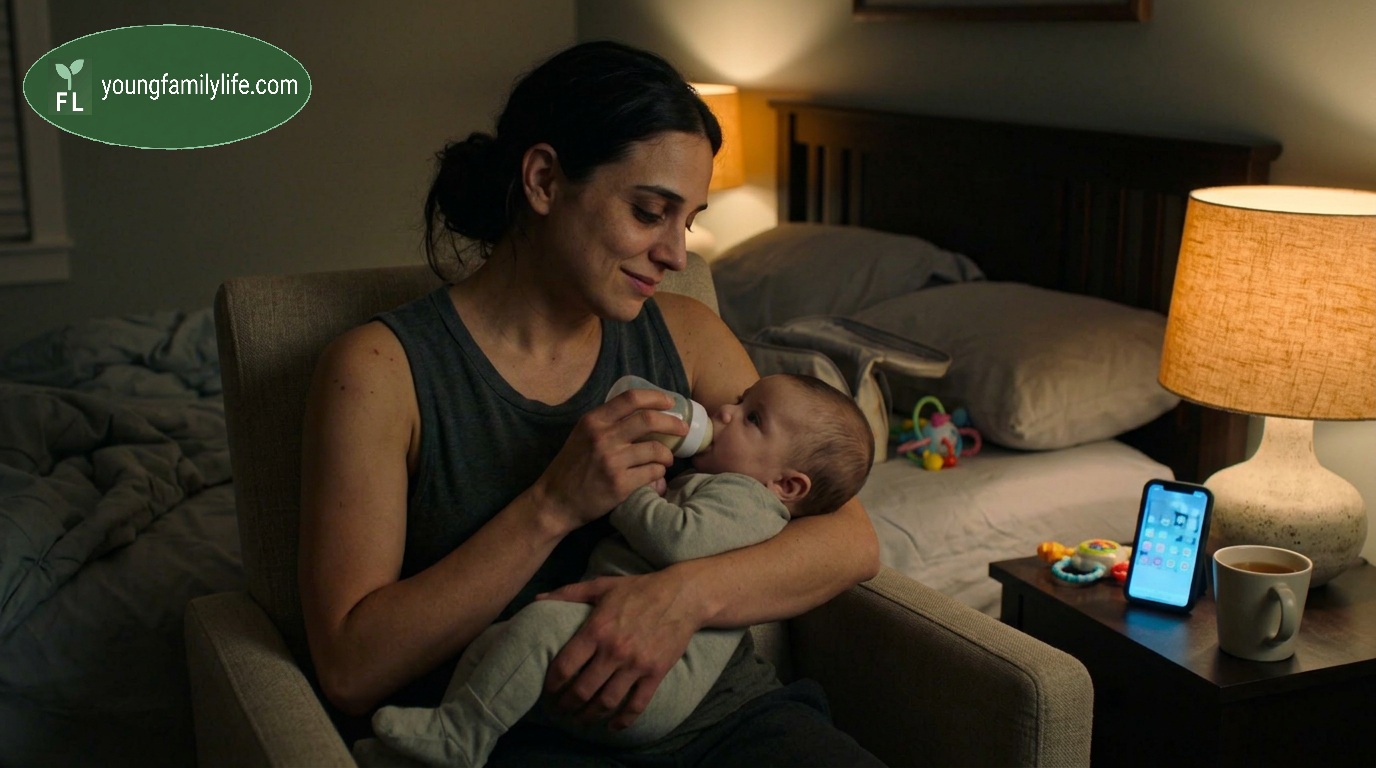
The 3am Question
Somewhere in the small hours, a parent is up with their baby. The baby isn't ill. They're just awake — hungry, or unsettled, or simply wanting to be close to someone. And somewhere in the back of the parent's tired mind, a question is forming: why won't my baby just sleep?
Under that question is usually a harder one: what am I doing wrong?
It's easy to see where that second question comes from. Health apps track night wakings and ask whether the baby has managed a five-hour stretch yet. Relatives mention that their children slept through by eight weeks. Articles appear in search results warning that poor infant sleep is linked to all sorts of problems. The message, from a lot of directions at once, seems to be that a baby who wakes through the night is a problem — and that it's somehow the parent's fault.
The research tells a very different story. A baby waking through the night isn't a sign that something has gone wrong. It's the body doing exactly what millions of years of evolution shaped it to do. Parents who are up at 3am aren't failing. They're adapting. Understanding why that's true changes the way the whole picture looks.
What Sleep Actually Is
Most people think of sleep as something the body needs to repair itself — like charging a phone. Run it too low, and things start to break down. But sleep researchers have a different way of looking at it, and it changes the picture quite a lot.
Jerome Siegel, a researcher at the University of California, Los Angeles, published a study in 2009 arguing that sleep is really about saving energy. When there's nothing useful to be done — no food to find, no predators to watch for, nothing to gain from being awake — the body cuts its energy use right down and rests. Sleep isn't the body broken and needing repairs. It's the body being sensible about when to be active and when not to be (Siegel, 2009).
What this means is that sleep is flexible, not fixed. And the animal world makes this very clear. Wild African elephants sleep for about two hours a day — but the same species in captivity, where there's nothing to watch out for, sleeps much more (Gravett et al., 2017). Great frigatebirds, studied during long ocean crossings, manage on around forty minutes of sleep a day for flights lasting up to ten days — and they're fine (Rattenborg et al., 2016). Dolphins sleep with one half of their brain at a time, so the other half can keep them swimming and breathing. None of these animals are following a rule about eight hours. They're doing what their situation needs.
The same basic principle applies to humans. Sleep isn't a fixed daily target that has to be hit in one go overnight. It's a system that responds to what's going on. A baby who wakes several times through the night isn't broken. A parent whose sleep is all over the place isn't in danger. Both are living in a body that is doing what bodies are designed to do — responding to the actual situation rather than a chart.
Where the Eight-Hour Night Came From
The idea that people should sleep for eight hours, all in one go, overnight, turns out to be surprisingly new. For most of human history, people didn't sleep that way at all.
A historian called Roger Ekirch spent years going through old diaries, letters, court records and medical texts from across Europe — going back to the Middle Ages — and found the same pattern appearing again and again. People slept in two separate chunks, with a quiet wakeful period in the middle of the night (Ekirch, 2005). They called it the "first sleep" and the "second sleep," and nobody seemed to think it was odd. It was just how nights worked.
A scientist called Thomas Wehr tested this in a laboratory. He took a group of people and removed artificial lighting from their lives for several weeks — just natural light, like people would have had before gas lamps and electricity. Within a few weeks, most of them had drifted back to the same two-sleep pattern Ekirch found in the history books (Wehr, 1992). Their bodies seemed to know what to do when the lights weren't keeping them up.
The eight-hour block came later. When factories started running day and night, they needed workers to show up at fixed times. Shifts meant regular sleep schedules. Electric light meant people could be productive late into the evening. Over time, the two-sleep pattern disappeared — not because scientists discovered it was bad for people, but because it didn't fit the factory clock. And gradually, the single overnight sleep became so normal that people forgot it had ever been any different.
Sleep is still real and still important. But the specific idea of eight hours in one go — the standard that parents are often measured against — is a fairly recent invention. It was built around the needs of industry, not around the way human bodies had been sleeping for thousands of years before that.
Why Babies Wake Up — And Why That Makes Sense
Human babies are born quite early, compared to most other animals. A foal can walk within hours of being born. A baby can't do anything like that. The reason is brain size — human brains are so large relative to the birth canal that babies have to be born before their development is complete, and they finish growing on the outside, close to a carer. This isn't a design flaw. It's the whole plan.
What that means is that a newborn baby is built to expect constant closeness — to be fed often, held often, and responded to when they wake. Waking through the night isn't the baby doing something wrong. It's the baby doing exactly what its biology expects of it, in an environment shaped for that.
Helen Ball, a professor at Durham University who has spent over twenty years studying how babies sleep, has found that the actual range of normal sleep in babies is far wider than most parenting guides suggest. The charts and milestones that tell parents their baby should be sleeping through by a certain age are based on averages — not on what babies naturally do when no one is trying to change their behaviour (Ball, 2003; Ball, Tomori and McKenna, 2019). The gap between those averages and the full range of normal is a big one.
Ball's research also points out something that gets missed in a lot of parenting advice: the standard that parents are being measured against was shaped by a society that needed parents back at work quickly. It wasn't arrived at by looking at how babies actually sleep across different cultures and across history. When researchers study hunter-gatherer communities — populations where people live closer to the way humans lived for most of their existence — infant sleep looks very different from what Western parenting guides describe as normal.
The Sleep Worry Industry
A big part of why parents feel so anxious about sleep comes down to one book. In 2017 a scientist called Matthew Walker published Why We Sleep, and it was everywhere. The message was blunt: not sleeping enough causes cancer, dementia, heart disease, obesity, and mental illness. The NHS and health charities ran with it. Sleep became a health emergency.
The research Walker drew on is real — sleep does matter. But a researcher called Alexey Guzey went through the book line by line in 2019 and found a string of problems: studies described wrong, statistics that didn't stack up, findings stretched well beyond what the original research actually said (Guzey, 2019). Other sleep scientists said the same. This isn't one person with a grudge — it's a genuine argument inside the scientific community about whether the alarm bells are warranted.
The best challenge to the whole picture comes from communities that never got swept up in any of it. Researchers studied three groups of hunter-gatherers — the Hadza in Tanzania, the San in Namibia, and the Tsimane in Bolivia (Yetish et al., 2015). These are people living roughly the way humans have always lived, with no shift patterns, no sleep apps, no electric light. None of them sleep eight hours. Their average is between 5.7 and 7.1 hours. And none of them have the health problems the Walker picture says they should.
Researchers at Loughborough University also looked at new parents specifically. They found the body does adjust to broken nights — it doesn't just fall apart (Filtness et al., 2014). The tiredness is real. But the extra layer of panic — the idea that the baby is broken, the parent is failing, that permanent damage is being done — that's not coming from the biology. It's coming from an industry that has found a very effective way to sell the problem before selling the solution.
When It's Worth Mentioning to Someone
Most of what grinds parents down in the early months is just normal. Hard, exhausting, relentless — but normal. That said, a few things are worth a quick mention to a GP or health visitor, not because they're alarming, just because they're easier to look at with someone who knows the baby.
In babies, the things worth flagging are: crying that sounds different — not the usual hungry or overtired cry but something more distressed, or combined with back arching; a baby who was starting to settle reasonably well and then suddenly isn't, without any obvious reason like a new tooth or a cold; or waking that seems to go alongside the baby not feeding well or not putting on weight. None of those are causes to panic. They're just worth a conversation.
For parents the key question is whether the tiredness is creating a safety risk — particularly around driving or anything that needs proper concentration. BASIS, the Baby Sleep Information Source from Helen Ball's team at Durham University, has practical, research-backed information about sleep arrangements that give parents more rest without any single approach being pushed as the answer.
But the main picture is this: most of what parents are told is wrong with their baby's sleep is just normal variation — labelled as a problem by standards that were never really designed around how babies or parents actually work.
Topics: #infantsleep #parentalexhaustion #sleepscience #adaptiveinactivity #sleepculturehistory #normalisingsleepwaking #biologicalflexibility #HeyWantToKnow #YoungFamilyLife #informationwithoutinstruction #newparent #parentingresearch #HelenBall #sleepdeprivation
Further Reading
These links dig deeper into the topics covered here:
Infant sleep research:
- BASIS — Baby Sleep Information Source — Helen Ball's Durham University resource; evidence-based information on normal infant sleep, safe sleep arrangements, and the research behind parenting guidance. Peer-reviewed, NHS-adjacent, and genuinely useful at 3am.
- Durham Infancy and Sleep Centre — The research hub behind BASIS; access to Ball's academic work on the biological and cultural dimensions of infant sleep.
The history and culture of sleep:
- Matthew Walker's Why We Sleep Is Riddled with Scientific and Factual Errors — Alexey Guzey (2019) — A detailed, sourced critique of the popular sleep science book most responsible for amplifying sleep anxiety. Not a dismissal of sleep research — a precise challenge to specific claims.
- Natural sleep and its seasonal variations in three pre-industrial societies — Yetish et al. (2015), Current Biology — The hunter-gatherer sleep data: Hadza, San, and Tsimane populations averaging 5.7–7.1 hours, with no evidence of the health deficits the Walker orthodoxy predicts.
How This Essay Reflects YFL Values
This piece pulls together research from sleep biology, history, anthropology and cross-cultural studies — and puts it in one place that parenting guidance rarely does. The stuff about sleep flexibility, the two-sleep history, the problems with Walker's claims, the hunter-gatherer data — it's all out there. It just doesn't usually reach the parent who's searching at 3am wondering what they're doing wrong.
YoungFamilyLife puts the evidence out there and leaves what to make of it entirely to the reader. This piece doesn't tell parents how to manage their nights or what to change. That's nobody's call but their own.
Informed parents make better decisions for their own families. That is the only assumption this platform makes.
Related YFL Essays and Resources
Sleep as Culture — The full essay behind this piece: the history of the two-sleep pattern, how the factory era changed human nights, the Walker debate, and Helen Ball's research. For anyone who wants the complete argument with all the sources.
Sleep as Biology — The companion essay on what sleep actually is: the energy-saving argument from Siegel, the animal evidence, and why the flexibility of sleep is a feature rather than a fault.
Natural Healing — The YFL essay on how the body deals with stress and recovers from load. Useful reading for any parent wondering whether their exhausted body is coping as well as it is.
IOW — Where the Idea of Eight Hours Sleep Actually Came From — A shorter, plain-language read on the history of the eight-hour norm, for anyone who wants the headline version.
Copyright Notice
© 2026 Steve Young and YoungFamilyLife Ltd. All rights reserved.
"Hey!, Want To Know" is a copyrighted content format of YoungFamilyLife Ltd.
This essay was developed collaboratively using AI assistance to research academic sources and refine content structure, while maintaining the author's original voice, insights, and "Information Without Instruction" philosophy. No part of this essay may be reproduced, distributed, or transmitted in any form or by any means, including photocopying, recording, or other electronic or mechanical methods, without the prior written permission of the copyright holders, except in the case of brief quotations embodied in critical reviews and certain other noncommercial uses permitted by copyright law.
For permission requests, contact: info@youngfamilylife.com