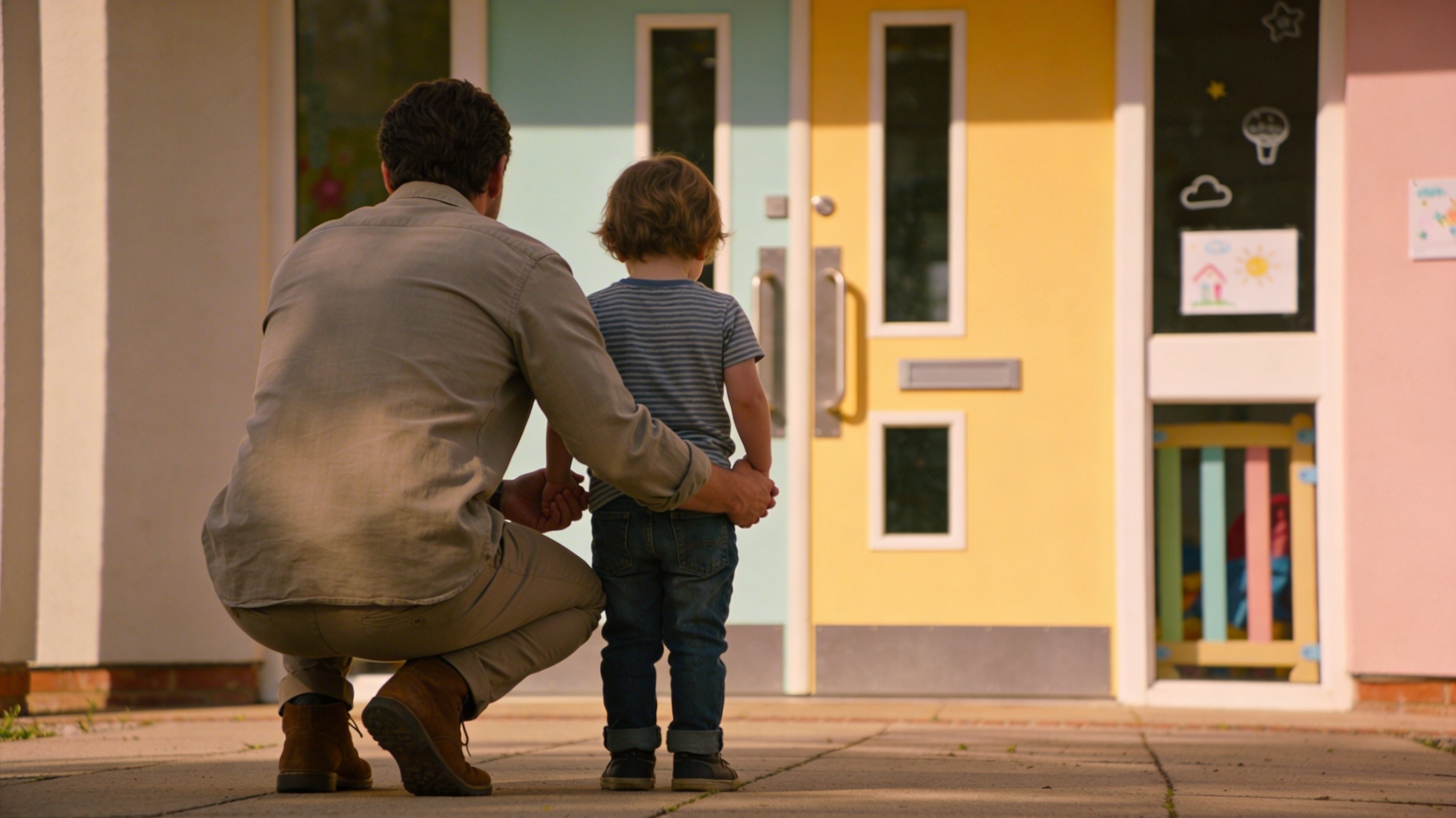
A Scene That Plays Out Every Morning
The nursery door is right there. So is the child's key worker, familiar and friendly. The other children are already inside, already playing. By any reasonable measure, everything is fine.
And yet.
Your child has both arms locked around your leg. Or they're frozen in the doorway, silent. Or they're crying in a way that doesn't sound like a tantrum — it sounds like something genuinely frightening is happening. You peel them gently away. You hand them to the key worker. You walk to the car. You sit there for a moment wondering what you just did, and whether you should have done it, and whether they stopped crying after you left, and whether they've stopped now.
You probably did everything right. And the clinginess isn't evidence that you didn't.
Understanding what's actually driving that behaviour — what's happening in your child's brain and nervous system in that doorway — doesn't resolve every morning, but it does change what the morning means.
The Attachment System: What It Was Built For
Somewhere around six to nine months of age, something shifts in how babies relate to the people who care for them. Before that point, most babies are pretty easy-going about being held by strangers, passed between adults, left in unfamiliar places. After that point, most are not — and this is not a step backwards or a problem. It is a built-in system switching on exactly when it should.
Researchers call it the attachment system, and its original job was simple: keep the young child close to the person most likely to keep it safe. In the world humans evolved in — where real dangers were everywhere — a toddler who happily wandered away from their carer was a toddler in trouble. The attachment system exists because, across millions of years, the young who stayed close lived longer.
In practice, this means young children come with a finely tuned alarm — and that alarm is triggered by one thing above all others: the person they depend on disappearing. Not hunger. Not pain. Not cold. Those cause discomfort. But losing sight of the person they feel safe with triggers something closer to genuine fear.
So the child clinging at the nursery door is not being awkward or difficult. Their nervous system is doing exactly what it was built to do. It has clocked that the safe person is leaving — and it is responding accordingly.
What the Research Tells Us About Separation Distress
The clearest research into how children handle separation came from Mary Ainsworth's work in the 1970s — a study called the Strange Situation. The setup was simple. A toddler was brought into an unfamiliar room with their carer. A stranger came in. The carer briefly left. The carer came back. The whole thing was filmed.
What Ainsworth found was that children's reactions to the separation — and especially to the reunion — fell into clear patterns. And those patterns matched the kind of care the child had received in their first year. Children whose carers had been reliably responsive tended to be upset when left, but settled fairly quickly when their carer returned. Children whose carers had been less reliably available either seemed oddly unbothered by the separation (later research showed they were actually suppressing their distress, not free of it), or became very distressed — in a way that didn't fully ease even when their carer came back.
These patterns — labelled secure, avoidant, and anxious — weren't meant to be permanent labels. They were snapshots of where a child was in their relationship with a particular person at a particular time. And they told researchers a lot about what that child had learned to expect from the people closest to them.
The child at the nursery door is not just being difficult. They are communicating — through the only language their body has — something about how safe they feel, and how confident they are that the person they need will come back.
Out of Sight, Out of Mind — Kind Of
There's another piece of the puzzle here, and it's called object permanence — the understanding that things keep existing even when you can't see them.
For very young children, this is still being worked out. A baby under about eight months who watches a toy disappear under a cloth won't look for it. As far as their brain is concerned, the toy is just gone. That's why peek-a-boo is genuinely astonishing to a young baby — the reappearing face is a small miracle every single time.
By nursery age, children have mostly got this figured out. They know, in their head, that people continue to exist when they can't be seen. But — and this is the important bit — under stress, what you know in your head and what your body is feeling can come completely apart. The toddler at the nursery door knows, somewhere, that their parent will come back. But their nervous system — switched on, alarmed, overwhelmed — isn't working from that knowledge. It's working from the feeling: the safe person is gone, and I don't know if they're coming back.
This is why telling a two or three year old "I'll be back at three o'clock" rarely helps much. Holding a time in mind, trusting a future promise, staying calm enough to let that promise land — that's a big ask when their whole system is telling them something is wrong.
Why Some Mornings Are Harder Than Others
If you've been doing this for a few weeks or months, you've probably noticed it isn't consistent. Some mornings your child walks straight in. Others — sometimes after a run of good days — they cling as if it's the first time all over again.
This makes more sense when you know that the alarm system described above isn't set at a fixed level. It turns up or down depending on what's going on for the child right now. Several things are known to make it more sensitive:
- Illness, or having been ill recently — when a child's body has been under stress, they need the safe person more, not less
- Anything that's disrupted the routine — a holiday, a change at home, a different drop-off time, even you looking tired or distracted
- Not enough sleep — a child who hasn't slept well has much less capacity to cope with the feelings that separation brings up
- Big changes in their life — a new baby, a house move, anything that's shifted the landscape of their everyday world
- Your own mood at drop-off — children pick up on how their parent is feeling with remarkable accuracy. If you're rushed, anxious, or feeling guilty about leaving, they read that — through your voice, your posture, the pace of the goodbye — and their alarm system takes it as evidence that something really is wrong
None of this is a cause for alarm. These are just conditions that temporarily lower a child's threshold for distress. The child who was fine for three weeks and then had a hard Monday hasn't gone backwards — they're reacting to something specific going on for them right now.
What Happens After You Leave
Here's the research finding that surprises most parents: how distressed a child is at drop-off is not a reliable guide to how they are once you've gone.
Studies that have tracked children's stress hormone levels — cortisol, the main stress hormone — across the nursery day have found something unexpected. Some children who seem calm at the door actually show raised stress levels throughout the day. Some children who cry hard at drop-off settle within minutes and are completely fine after that. What you see at the door and what's happening inside the child don't always match — in either direction.
What makes more difference to how the child actually experiences the nursery day is the relationship waiting for them inside. Specifically, whether there's a familiar adult they feel some confidence in. Nursery key workers can, over time, become a real source of safety for a child — not replacing the parent, but providing enough of a sense of security that the child can relax, explore, and get on with the day.
This is why the relationship between a child and their key worker is so central to drop-off distress — not a nice extra, but the thing that makes the difference. A child who trusts their key worker has a bridge. A child who hasn't yet built that relationship, or whose key worker has just changed, is stepping into the unknown without one.
The Parent's Experience Is Part of the Picture Too
Drop-off distress is rarely a one-person experience. Most parents find it stays with them — the guilt, the worry, a low-level unease that's hard to shake even when, rationally, there's nothing to worry about.
This isn't weakness. It's the same system running in the other direction. The bond between parent and child goes both ways, and a parent's brain is just as wired to respond to a child's distress as the child's brain is to respond to separation. Walking away from a crying child is hard on a physical level — it goes against something deeply built in.
What research on how adults handle relationships suggests is that the way a parent experiences drop-off distress is shaped, at least in part, by their own early experiences of being left and returned to. A parent whose early separations were unpredictable or frightening may find the nursery door particularly difficult — not because they're doing anything wrong, but because the scene is touching something old. The morning isn't just about this child and this nursery. It's carrying a bit of history too.
And a parent who looks calm at drop-off isn't necessarily less affected. They may simply be holding it in rather than letting it through — which works in the short term but has its own costs over time.
None of this is fixed. Getting to know your own patterns is, for most people, the start of having some choice about them.
What the Research Suggests About the Drop-off Moment Itself
Research on what actually helps at the door points pretty consistently in one direction, though what works will vary by child, by age, and by nursery.
The biggest thing seems to be predictability. Children who settle most readily tend to be children who've come to trust that the goodbye follows a known pattern — the same ritual, the same handover, the same words, reliable enough that their nervous system starts to recognise how the sequence ends. Drawn-out goodbyes — where a parent leaves, comes back because the child cried, leaves again, checks again — tend to make things harder rather than easier. Not because the parent is doing something wrong, but because the unpredictability keeps the alarm system switched on.
The quality of the handover also matters — whether the child is being received into a real connection or just delivered into a room. A key worker who genuinely engages the child in something at the moment of handover is doing something important. They're creating a bridge from one safe relationship into another.
And what research consistently finds is that children who show drop-off distress almost always settle — most within a few minutes, virtually all within a short time. What feels catastrophic in that doorway is, for the large majority of children, genuinely temporary.
The Evening Before the Morning
There's something else the research on child development points toward — something many parents stumble on without being told, and which is worth understanding properly.
Young children's sense that their parent still exists when they can't see them — that the parent is real, safe, and coming back — isn't something they can just hold onto automatically. It needs topping up. Especially at an age when the brain is still building the capacity to hold people in mind when they're not there. A child who goes to bed with a strong, settled feeling of where their parent is in the world is carrying something different into the nursery morning than a child who doesn't.
Many parents find that what works well is a quiet conversation at the end of the day — often at bedtime, before or after the story — where the day gets talked through together. Not a debrief or a review. Just a telling: what happened today, for the child, for the parent, for the family. Many parents find that gently smoothing over the small tensions of the day within this — "you were really upset that there wasn't time for a snack before supper, and I managed to get supper a bit earlier, didn't I" — gives the child a sense that problems can be sorted, that the parent noticed, that the day had a shape that made sense.
The understanding of how children this age experience time and tomorrow is that "tomorrow" isn't really a solid concept yet — it's a word that points toward something fuzzy. What the bedtime chat can do is start to build a picture: who is doing what the next day, where the parent will be while the child is at nursery, what the day ahead looks like. Not as a schedule — as a story. One that includes both of them, moving through a day they can both picture.
Many parents find that children who've had this kind of regular talk — day reviewed, next day sketched in — arrive at the nursery door with something like a map of where their parent is going. The parent has been made real and findable in the child's imagination, not just absent. That's a different experience to carry through the door.
Researchers working on how children develop emotional resilience — particularly Daniel Siegel and Mary Main — have found that the ability to hold a coherent story about your own experience is one of the foundations of being able to manage feelings. The bedtime conversation is, among other things, a rehearsal of exactly that — practised together, in the safest possible moment of the day.
There's one more thing worth knowing — something that happens not at home but at the nursery door itself. Many parents find that passing on something brief and specific about their own day to the key worker at drop-off — "I've got work meetings all morning" or "I'm doing the shopping then meeting a friend" — gives the key worker something real to offer the child later in the day if they get unsettled. The key worker can then say: "Your mummy is in her important meetings right now — she'll be finished later and then she's coming to get you." The understanding of how children this age experience absence is that a picture of what their parent is actually doing — something concrete and nameable — is very different from a vague "they'll be back soon." The parent stops being simply gone. They're somewhere, doing something, and coming back. That's a small but meaningful difference.
When to Take It Seriously
Routine drop-off distress — even when it's intense, long-running, or keeps coming back — is not in itself a sign that something is wrong, either with the child or with the nursery. It's a normal, developmentally expected response to separation.
The picture that's worth looking at more closely is a different one. It's a child who seems distressed throughout the nursery day, not just at the door. A child whose distress is getting worse over time rather than gradually becoming more manageable. A child who is struggling in other areas of their life too, not just at nursery. Or a child who still hasn't connected with their key worker after a reasonable time of settling in.
It also includes a parent whose own distress around drop-off is getting in the way of their day — their work, their functioning, their general sense of being okay. The child's experience matters. So does the parent's.
In those circumstances, a conversation with the nursery is worth having. And if needed, a conversation with a health visitor or GP too. Not because something has necessarily gone wrong, but because more information is available — and more support may be possible.
Topics: #AttachmentTheory #SeparationAnxiety #NurseryDropOff #ChildDevelopment #ObjectPermanence #ParentingScience #KeyWorker #SecureBase #NarrativeCoherence #BedtimeRoutine #HoldingInMind #DanielSiegel #HWTK #YoungFamilyLife
Further Reading
These links dig deeper into the topics covered here:
Attachment Theory — foundational research:
- Introduction to Children's Attachment — NCBI Bookshelf overview of attachment patterns and what they mean for development, including the Strange Situation research.
- Early Childhood Attachment Styles — Zero to Three's accessible overview of the four attachment patterns and their significance.
Separation and nursery transitions:
- Impact of Attachment, Temperament and Parenting on Human Development — peer-reviewed overview of how attachment and parental responsiveness shape early development.
- Attachment-Based Parenting Interventions and Evidence of Changes in Toddler Attachment Patterns — research review on what actually supports secure attachment in the toddler years.
How This Essay Reflects YFL Values
This piece follows YoungFamilyLife's "Information Without Instruction" approach. The research on drop-off distress is solid and consistent — and it points in directions most parents who've lived with this experience will recognise. What you do with that is yours. Some will find it changes how they feel about the morning even if nothing else changes. Some will find it prompts a conversation with the nursery. Some will find it confirms what they already sensed. All of those are fine responses to the same information.
The aim here isn't to tell you how to manage drop-off. It's to offer what the research actually shows is happening — in the child, in you, in the transition itself. Parents who understand what they're dealing with make better decisions for their own families. That's the only assumption this platform makes.
Related YFL Essays and Resources
How People Handle Life and Relationships — the full introduction to attachment styles across the lifespan, including where they come from and how they play out in adult relationships as well as parenting.
Why Children Can Melt Down After Really Fun Playtime — the seven-stage model of interaction that explains what children need at transitions, and what happens when the winding-down stage is missed.
Fearful Attachment Check-in Card — if drop-off distress is touching something in the parent as well as the child, this eight-position scale for reflecting on where the fearful attachment pattern currently sits may be worth exploring.
Enmeshed Attachment Check-in Card — for parents who find separation from their child genuinely difficult in ways that go beyond the child's distress, this card offers a framework for reflecting on what might be driving that.
Copyright Notice
© 2026 Steve Young and YoungFamilyLife Ltd. All rights reserved.
"Hey!, Want To Know" is a copyrighted content format of YoungFamilyLife Ltd.
This essay was developed collaboratively using AI assistance to research academic sources and refine content structure, while maintaining the author's original voice, insights, and "Information Without Instruction" philosophy. No part of this essay may be reproduced, distributed, or transmitted in any form or by any means, including photocopying, recording, or other electronic or mechanical methods, without the prior written permission of the copyright holders, except in the case of brief quotations embodied in critical reviews and certain other noncommercial uses permitted by copyright law.
For permission requests, contact: info@youngfamilylife.com