Attachment theory is about the ways of getting on with other people that people develop as young children — and carry around with them for the rest of their lives. A lot of the research goes back to John Bowlby, who spent decades from the 1940s onwards showing that the relationships people have with their early caregivers shape how the brain handles safety, connection, and risk. Researchers since then — including Mary Ainsworth, Mary Main, and Antonella Bifulco — have built on that work and come up with their own ways of describing the same basic patterns. This series uses four recognisable styles drawn mainly from Bifulco’s work: Fearful, Enmeshed, Withdrawn, and Angry-dismissive. Each has its own HWTK essay and check-in card. This piece covers the Enmeshed style.
Start Here
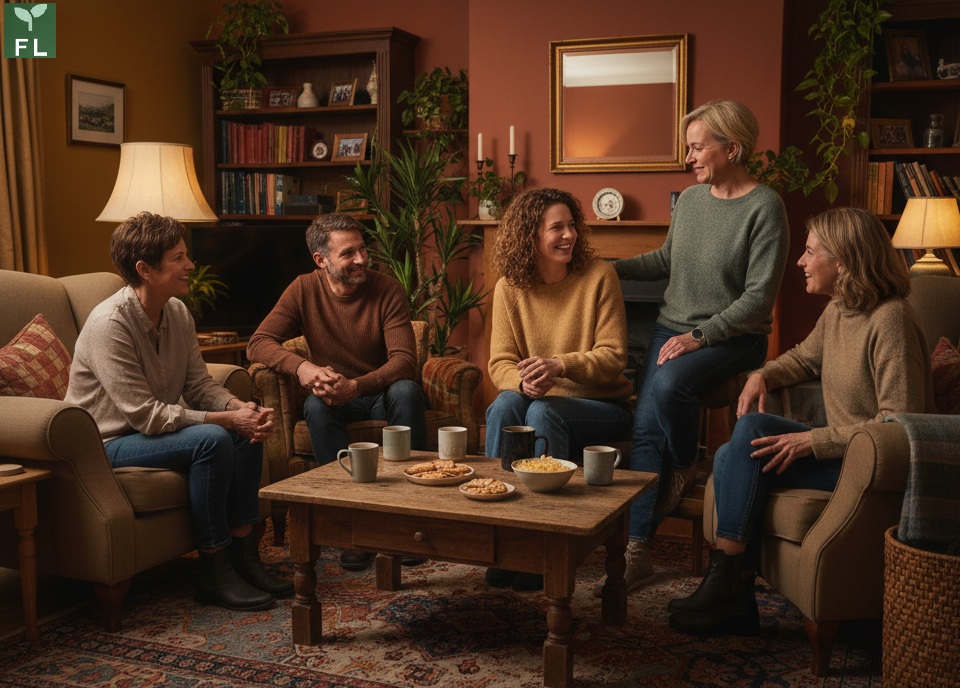
Think about someone who makes group activities actually work. The person who, when a gathering is going a bit flat, does something almost invisible — adjusts the conversation, brings the quiet one in, picks up on what the room actually needs rather than what they want to say next. Not because they are trying to manage things. Just because they seem to feel it naturally and go with it.
Or think about the friend whose enthusiasm is catching when someone mentions an idea. Suggest a gig, an afternoon out, something a bit spontaneous — and they are in straight away. Not to please people, but because they genuinely want to be part of it. Their enjoyment of other people’s plans is real. They add something rather than just turning up.
That ability to read the room, adapt to what people around them need, and make others feel included is often just called being sociable or easy going. But there is something more specific going on underneath. It is a particular sensitivity to other people that shapes not just how someone gets along at a party, but how they relate to the world more broadly. Researchers call it enmeshed attachment.
The word enmeshed can sound negative — tangled up, too involved. At its best, though, this pattern is none of those things. It describes someone who is genuinely in tune with other people in a way that makes them good to be around, good to work with, and the kind of person who keeps groups together rather than letting them fall apart.
Where This Comes From
Every attachment pattern starts in early childhood, when the brain is doing its most urgent job: working out what kind of world it has landed in and how to get through it safely. The enmeshed pattern develops in environments where being closely tuned in to the caregiver was essential — where reading the mood, adapting quickly, and staying alert to the people around them was what kept the child safe and connected. The caregiver might have been loving but unpredictable — meaning the child’s brain learned to pay close attention to how other people were feeling and use that to navigate the relationship.
That heightened awareness of other people stays with the person. It does not switch off when things get easier. What changes — what the scale in this piece is actually measuring — is not how sensitive the person is to others, but how much resilience they have available to hold that sensitivity without it taking over. At the good end, the attunement is real and the person carries it lightly. It comes out as warmth, social skill, and the ability to make other people feel genuinely seen. The sensitivity is doing something useful. It is being held with confidence.
This is also where the enmeshed pattern shows up in relationships at its most valuable. The person who reads someone’s mood and responds to it before the other person has quite put it into words. The friend who spots the one at the edge of the group who is starting to feel left out, and quietly does something about it. The colleague who adjusts how a conversation is going when it is not working for everyone, without making a big deal of it. These are not performances of social skill. They are genuine responses from someone whose attunement to others is both real and well practised.
When Resilience Starts to Run Low
The enmeshed pattern is a strength when the person has enough resilience to hold the sensitivity it generates. What changes as the scale moves down is not the attunement to others — that underlying sensitivity may stay pretty constant — but the ability to hold it without getting lost in it. When resilience runs low, the attunement that was once the basis for genuine connection starts to run the person instead. The easy-going quality becomes anxious people-pleasing. The warmth becomes a need for reassurance. The natural reading of the room becomes constant monitoring of it.
Something else happens at the lower end of the scale that is worth naming. As resilience thins, the enmeshed person’s attunement starts to miscalibrate — but in a specific direction. Rather than detecting threats in the outside world, the enmeshed pattern increasingly loses track of where the person ends and others begin. Other people’s emotional states are not just noticed — they are absorbed. Someone close is anxious and the enmeshed person becomes anxious too, not in sympathy but almost like a direct transfer. Someone in the group is unhappy and the enmeshed person cannot just acknowledge it — they feel it, carry it, and try to fix it, whether or not it is theirs to fix.
In relationships, this is particularly visible. At mild levels, the person’s attunement makes them a valued partner, friend, and colleague — someone who notices and responds. As resilience thins, that same quality tips toward a kind of relational merging where the person’s own needs become harder to reach and harder to act on. Not because the needs have gone. But because other people’s needs have become so present there is no room left for their own. What was warmth has become self-erasure, and what was flexibility has become an inability to hold any position of their own when it might conflict with what others want.
What moves a person along this scale is not a change in character. It is a change in how much resilience they currently have available to hold the enmeshed attunement — and as that resilience runs out, the line between self and others becomes harder and harder to hold, until the person is living inside other people’s emotional worlds rather than their own.
The Best in a Storm
There is a reason the E1 enmeshed person is so valuable when things get difficult — and it is worth saying plainly. When a group is under pressure, when things have gone sideways, when people are starting to fragment or pull in different directions, the enmeshed person at their best is the one who holds things together. Not by taking charge or setting the agenda, but by doing something quieter and harder: reading what everyone needs, finding the common ground, making each person feel that they matter. In a crisis, that is often the thing that keeps a group working when it might otherwise fall apart.
They are the person who, at a difficult family gathering, makes sure everyone feels included without making a performance of it. The colleague who, after a bruising team meeting, knows straight away who needs a quiet word and what kind of word it should be. The friend who shows up in exactly the right way when someone is struggling, because they have been paying close attention all along. This is not people-pleasing. It is genuine social intelligence, and at E1 it makes the enmeshed person one of the most practically valuable people in any group — especially when that group is under strain.
Enmeshed Attachment — Eight Levels
The scale runs from level one — the pattern working as a genuine strength in both the world and in relationships — through to level eight, where resilience to hold the enmeshed pattern has run out to the point where the person no longer has reliable access to their own sense of self. The upper four levels are broadly where the pattern is working well. The lower four are where resilience is thinning and the pattern has started running the person rather than serving them.
What moves a person along this scale is not a change in how attuned they are to others — the underlying sensitivity may stay roughly constant. What changes is how much resilience they currently have to hold that attunement without losing themselves in it. Where someone sits today is not where they have to stay, and a position in the lower four is not a verdict on who they are. It describes where things are right now.
| Level | In the world | In relationships |
|---|---|---|
| E1 | Genuinely easy going and socially switched on. Reads the room naturally and adapts to what the situation needs. Makes others feel included without effort or performance. Adds something real to shared experiences — the enthusiasm is genuine, the warmth is felt. Holds groups together when they might otherwise drift. The most connected person in any room. | Warm, flexible, and genuinely attentive. Listens in a way that makes others feel seen. Responds to what is actually needed rather than what might be expected. Relationships have genuine care on both sides, and a quality of attention others find both rare and sustaining. Their own needs are accessible and can be expressed without difficulty. |
| E2 | Highly socially effective with strong group instincts. Reads social dynamics well and brings real skill to group settings. Naturally includes others and smooths over tensions before they become problems. The easy-going quality is genuine. Confidence is solid. Occasional awareness of other people’s moods shading into their own is manageable and does not get in the way. | Caring and attentive, with good awareness of own needs. Relationships are warm and two-way. Genuine interest in others’ wellbeing sits alongside being broadly comfortable expressing their own. Minor accommodations are made naturally and without resentment. The balance between giving and receiving feels broadly right. |
| E3 | Social strengths still clearly there, with some increasing sensitivity to atmosphere. Still reads the room well and contributes genuinely to group situations. Other people’s emotional states are noticed more readily and carried a little more than before, but this is manageable. The sensitivity is not yet getting in the way — it is still mostly working as an asset, though it takes a little more effort to hold. | Warm and giving, with some softening of the ability to hold their own position. Relationships remain two-way but there is a growing tendency to accommodate rather than express when perspectives differ. This is not dramatic — it shows up mainly in small decisions and minor tensions rather than big issues. The ability to voice own needs is intact but is becoming a bit easier to set aside. |
| E4 | Social attunement still real but beginning to cost more effort. The natural reading of the room is still accurate but now produces more responsibility — a feeling that something needs to be done when the atmosphere is off. Group tensions are felt more personally. The easy-going quality requires more active management than it used to, and there are situations where the person’s own preferences get set aside because the social dynamic feels more pressing. | Genuine care but increasing difficulty separating own feelings from others’. A close person’s mood now registers as something that needs to be addressed rather than simply acknowledged. There is more anxious attunement in important relationships — checking how the other person is, watching for signs of difficulty. Their own needs are present but are increasingly put on the back burner in favour of the relationship’s emotional temperature. |
| — Below here, the enmeshed pattern is running the person rather than serving them — | ||
| E5 | Attunement starting to miscalibrate — safe situations feel emotionally demanding in ways that are not quite proportionate. Other people’s emotions are being absorbed rather than just noticed. The social environment feels heavier and more demanding than the actual evidence warrants. It is becoming difficult to be in a room with someone who is distressed without feeling responsible for sorting it. The line between reading the room and being defined by the room is getting thin. | Own needs increasingly hard to reach in close relationships. A partner’s or friend’s emotional state dominates the texture of shared life. There is anxiety when others seem unhappy or distant — a felt urgency to restore harmony that can override the person’s own sense of whether it actually needs restoring. Expressing a personal need feels risky, as though it might damage the relationship or the other person. |
| E6 | Absorbing others’ emotional states as if they are their own — genuine difficulty functioning in emotionally charged environments. What was attunement is now absorption. Other people’s anxiety becomes their anxiety; others’ distress becomes theirs. It is difficult to be in group settings that involve any tension without becoming personally overwhelmed by it. The social strengths are still present but accessing them requires managing a level of emotional weight that was not there before. | Identity increasingly located in close relationships rather than in themselves. Who the person feels themselves to be shifts significantly depending on how close relationships are going. When a key relationship is difficult, the person finds it very hard to feel settled or effective anywhere else. The ability to locate their own preferences, opinions, and needs independently of the other person’s state is significantly reduced. |
| E7 | Functioning significantly disrupted by others’ emotional states. The person cannot easily be in social settings without being significantly affected by the prevailing emotional atmosphere, regardless of whether that atmosphere is actually directed at them or related to them at all. Ordinary situations — groups, public spaces, workplaces — are navigated with significant effort. The line between self and social environment has become very thin. | Own sense of self very difficult to access independently of others. It has become almost impossible to identify what the person themselves wants, feels, or needs apart from what the close relationships around them are generating. The search for validation and reassurance in close relationships is significant and does not resolve with ordinary reassurance — each moment of doubt or distance triggers renewed anxiety about the relationship and, by extension, about who the person is. |
| E8 | Self largely unreachable — the person’s emotional world is now primarily built from others’ states rather than their own. The attunement that was once a social strength has become a channel through which other people’s emotional lives flood in and take over. Getting through ordinary environments requires managing a level of emotional absorption that is exhausting and sometimes overwhelming. What was once the most connected person in any room has become someone who cannot protect themselves from the room’s emotional content at all. | No reliable sense of where they end and others begin. Close relationships are both desperately needed and deeply difficult. The person needs them in order to have any sense of identity at all, but the closeness that provides that identity also means the other person’s moods, difficulties, and distress are experienced as their own — with no internal space to process them. The warmth and attunement that were once genuine assets are still present but are no longer available as strengths: they have become the means by which the person is consumed. |
What to Do With This
Most people reading this will recognise something — either in themselves, or in someone they know. That recognition is the point. Not to label anyone, but to have a more accurate and more compassionate picture of what is happening and why.
The enmeshed pattern, properly understood, is not a problem to be fixed. At mild levels it is a genuine asset — socially, in relationships, and in any situation where real human attunement is needed. The question worth asking is simply: where on the scale does it currently sit, in a specific situation or relationship, right now? And is that working?
The Enmeshed Attachment Check-in Card is the natural next step. It takes what is in this piece and makes it practical — eight positions for looking honestly at how the enmeshed pattern currently sits in a specific relationship or situation. It is not a test. It is a starting point for some honest reflection and, if it feels right, an honest conversation.
And if this piece has raised wider questions about how different attachment patterns work and compare, the related essays in this series cover the Fearful, Withdrawn, and Angry-dismissive styles — each with its own eight-level framework.
Topics: #EnmeshedAttachment #AttachmentStyles #AttachmentTheory #SocialAttunement #Relationships #ChildDevelopment #EmotionalRegulation #BrainScience #ThinkingBrain #FeelingBrain #SurvivalBrain #Bifulco #Psychology #ParentingInsights #HWTK #YoungFamilyLife
Further Reading
These links dig deeper into the topics covered here:
The research behind attachment styles:
- Simply Psychology: Attachment Theory — accessible overview of Bowlby and Ainsworth’s foundational research on how early relationships shape development across the lifespan.
- Harvard Center on the Developing Child: Serve and Return — explains how responsive early interaction shapes the brain, directly relevant to where attachment patterns come from.
- Wikipedia: Attachment in Adults — a broad overview of how childhood attachment patterns carry into adult relationships and functioning.
Understanding attunement, connection, and the enmeshed pattern:
- NHS: Raising Emotionally Healthy Children — practical UK-based guidance touching on the relational conditions that support emotional security from early childhood.
- Mind: Relationships and Mental Health — how relationship patterns affect wellbeing, and what healthy connection looks like.
Related YFL Content
Enmeshed Attachment Check-in Card — the partner to this piece. Offers an eight-position scale for looking at how the enmeshed pattern currently sits in a specific relationship or situation.
Hey!, Want To Know: Why some people are better at preparing for the worst — the Fearful attachment essay. A finely tuned relationship with risk that, at its best, makes someone the most prepared person in any storm.
Hey!, Want To Know: Why some people can be relied on left to get things sorted — the Withdrawn attachment essay. Quiet self-sufficiency and reliable competence that gets things done without fuss or drama.
Hey!, Want To Know: Why some people can see what has been missed — the Angry-dismissive attachment essay. A sharp eye for what is wrong that, at its best, prevents the plan from failing in ways others did not anticipate.
From Zebras to Ravens — the full professional essay that maps enmeshed attachment (and the other Bifulco styles) to recognisable patterns of how people respond to influence attempts. The source framework this piece draws on.
Learning to Survive — How the Human Brain Navigates Opportunity and Danger — the foundation essay for the three-brain model used throughout this piece, and for understanding how early experience shapes the patterns people carry through life.
Copyright Notice
© 2026 Steve Young and YoungFamilyLife Ltd. All rights reserved.
“Hey!, Want To Know” is a copyrighted content format of YoungFamilyLife Ltd.
This essay was developed collaboratively using AI assistance to research academic sources and refine content structure, while maintaining the author’s original voice, insights, and “Information Without Instruction” philosophy. No part of this essay may be reproduced, distributed, or transmitted in any form or by any means, including photocopying, recording, or other electronic or mechanical methods, without the prior written permission of the copyright holders, except in the case of brief quotations embodied in critical reviews and certain other noncommercial uses permitted by copyright law.
For permission requests, contact: info@youngfamilylife.com