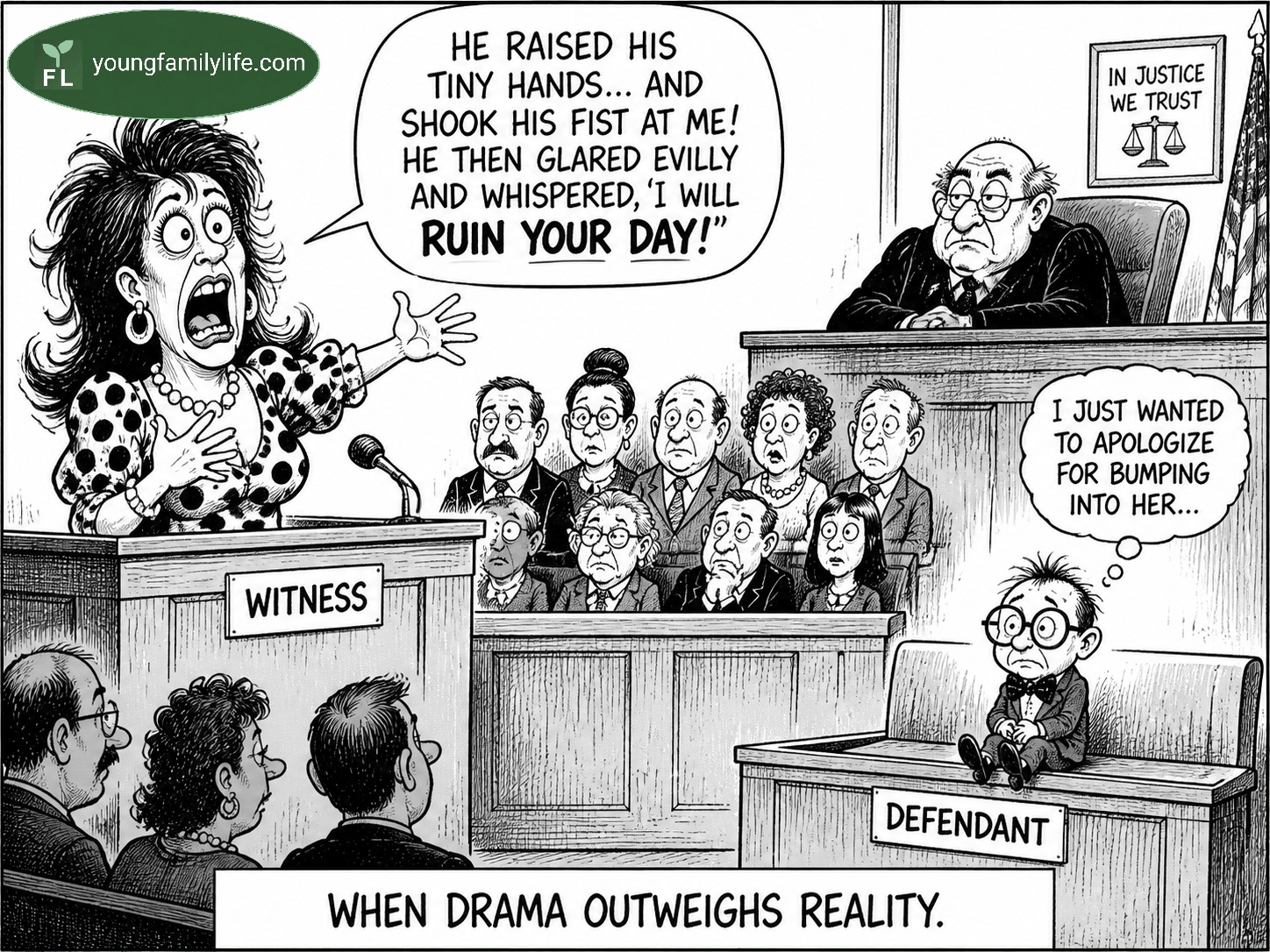
Two people. Same moment. Completely different memories.
Think of a time when two people who were both there for the same event remembered it completely differently.
Maybe it was a family argument. A car journey. Something a parent said. A moment at work that became a dispute. Both people are certain. Neither is lying. And yet the accounts genuinely do not match — the order of events, who said what, what the tone was, what happened next.
Most people's instinct is to assume that one of them must be wrong, or that one of them is distorting what happened — consciously or not. But there is a third possibility, and it is the one the science most clearly supports: both of them are telling the truth as they remember it, and both memories are reconstructions rather than recordings.
This is not a comfortable idea. It becomes considerably less comfortable when the witness stand enters the picture.
In a courtroom, an eyewitness is often treated as among the most powerful forms of evidence available. A credible witness — someone who was there, who sounds certain, who can provide detail — carries enormous weight with juries. They are believed. Cases turn on what they say.
The science of memory suggests this is one of the most consequential misunderstandings in the justice system.
What memory actually does — and doesn't do
The assumption behind eyewitness testimony is that memory works like a camera. The event is recorded. The witness replays it. What they report is what happened.
Memory does not work like a camera.
The psychologist Frederic Bartlett demonstrated this in 1932 by giving people an unfamiliar folk story to read, then asking them to reproduce it from memory later. The reproductions were systematically different from the original — not randomly wrong, but predictably shaped by what the readers already knew and expected. Details that didn't fit were smoothed away. Details that did fit were elaborated. The memory had not been stored and retrieved. It had been interpreted, and then reconstructed from the interpretation.
Decades later, Elizabeth Loftus made this finding impossible to ignore in a legal context. In a now-classic series of experiments, she showed people film footage of a car accident and then asked them about it. One group was asked how fast the cars were going when they smashed into each other. Another group was asked the same question with the word hit instead. The smashed group estimated higher speeds and were significantly more likely to remember broken glass — even though there was no broken glass in the footage, and both groups had watched exactly the same film.
The question hadn't just tested the memory. It had changed it.
Loftus and her colleagues went further. Through repeated, gently leading questions and the gradual provision of plausible detail, they led research participants to form vivid, confident, emotionally charged memories of things that had never happened at all: being lost in a shopping centre as a young child; being involved in a hot-air balloon accident; in some studies, having committed a crime. The false memories, once formed, were indistinguishable to the participants from genuine ones. People described them with the same confidence, the same emotional colour, the same sense of certainty — because from the inside, there is no signal that tells a memory apart from a confabulation. Memory carries no label.
The mechanism is what researchers call source monitoring — the brain's attempt to trace where a piece of information came from. Did this image arrive through something that was experienced, or something that was imagined, or something that was heard from someone else? Source monitoring is imperfect under ordinary circumstances, and it degrades sharply under the conditions that eyewitnesses typically face: high emotion at the time of the event, repeated questioning afterwards, the passage of time, and the influence of accounts from other people who were also there.
The person on the witness stand who sounds absolutely certain is not necessarily reporting what happened. They are reporting their current reconstruction of what happened — shaped by everything that has occurred, been said, and been felt since.
When this matters most
In the courtroom. Decades of wrongful conviction reviews, particularly in the United States, have found that mistaken eyewitness identification is one of the leading factors in cases where innocent people were convicted. Research by the Innocence Project found that eyewitness misidentification was a contributing factor in over 60% of wrongful conviction cases later overturned by DNA evidence. This has led to significant reform in how police lineups and witness interviews should be conducted — reforms that are still being implemented unevenly.
In professional practice with children. The vulnerability of memory to suggestion is particularly significant in contexts where children are asked to recall events that may have been traumatic. Leading questions — even mildly leading questions, asked repeatedly — can introduce details that the child then genuinely remembers as part of their experience. This is why specialist interview protocols exist, and why they matter: not because children are assumed to be unreliable, but because all human memory is reconstructive, and the conditions under which it is accessed make a significant difference to what it produces.
In everyday disputes. The person who insists, with absolute certainty, that a conversation went a particular way is not necessarily wrong to be certain. They may simply be reporting their reconstruction of events — which is the only kind of memory any person has access to. Understanding this does not resolve disputes, but it does change their character. It moves the question from who is lying to how did two people who were both there end up with genuinely different accounts — and that is usually a more honest and more productive question.
In the reliability of one's own memory. The hardest application of this knowledge is personal. The memory that feels most certain — the one with the most detail, the strongest emotional charge, the clearest sense of being-there — is not necessarily the most accurate. Certainty and accuracy are not the same thing. They never were.
Topics: #HWTK #Memory #WitnessTestimony #FalseMemory #Psychology #Justice #HowTheBrainWorks #YFL
Further Reading
These links dig deeper into the topics covered here:
On memory and the law:
- The Innocence Project — the leading organisation documenting wrongful convictions; search their site for eyewitness misidentification for the most comprehensive analysis available. innocenceproject.org
- American Psychological Association — the APA has published extensive accessible overviews of the research consensus on eyewitness testimony and its implications for legal proceedings. apa.org
On the science of reconstructive memory:
- Loftus, E. F., & Palmer, J. C. (1974) — Reconstruction of automobile destruction: An example of the interaction between language and memory. Journal of Verbal Learning and Verbal Behavior, 13(5), 585–589. The foundational study on how questioning alters memory.
- Shaw, J., & Porter, S. (2015) — Constructing rich false memories of committing crime. Psychological Science, 26(3), 291–301. The most striking demonstration of how complete false memories can be implanted.
Related YFL Essays and Resources
Why Memory? — of all things? — the full Repositorium essay — the complete intellectual journey, from sea slug to slime mould to H.M. to Clive Wearing, with the full research and evidence behind it.
In Other Words: Why Our Recall of the Past is never Nothing But The Truth? — the plain-speak biological companion — focused on what memory is, how it goes wrong, and the moment a smell arrives without warning.
In Other Words: What Happens When You Try to Build Memory? — on how AI memory development is revealing the same problems human memory has always had.
Living in a Fabricated World — on how the brain constructs perception, not just memory — the broader context in which the reconstruction problem sits.
Copyright Notice
© 2026 Steve Young and YoungFamilyLife Ltd. All rights reserved.
"Hey!, Want To Know" is a copyrighted content format of YoungFamilyLife Ltd.
This essay was developed collaboratively using AI assistance to research academic sources and refine content structure, while maintaining the author's original voice, insights, and "Information Without Instruction" philosophy. No part of this essay may be reproduced, distributed, or transmitted in any form or by any means, including photocopying, recording, or other electronic or mechanical methods, without the prior written permission of the copyright holders, except in the case of brief quotations embodied in critical reviews and certain other noncommercial uses permitted by copyright law.
For permission requests, contact: info@youngfamilylife.com