Before reading this essay
Domestic violence takes many forms. It can be physical, sexual, emotional, or psychological. It can involve coercive control, financial abuse, stalking, or threats. It can happen in any kind of relationship — between partners of any gender, in same-sex relationships, between people of any background or age. No two experiences of domestic violence are identical.
This essay explores one specific pattern — the way early trauma can shape a person's nervous system in ways that affect how they experience and respond to violence in an adult relationship. It is a real and important pattern, and it is not well understood. But it is one pattern among many. It does not describe every experience of domestic violence, and it does not describe every person who has been harmed.
If you are in a relationship where you are being hurt, controlled, or frightened — that is domestic violence, regardless of whether what is described in this essay matches your experience. The pattern explored here is not a threshold that an experience has to meet. The absence of this pattern does not mean harm is not happening.
This essay is offered as a piece of understanding — not as a framework for deciding whether something counts.
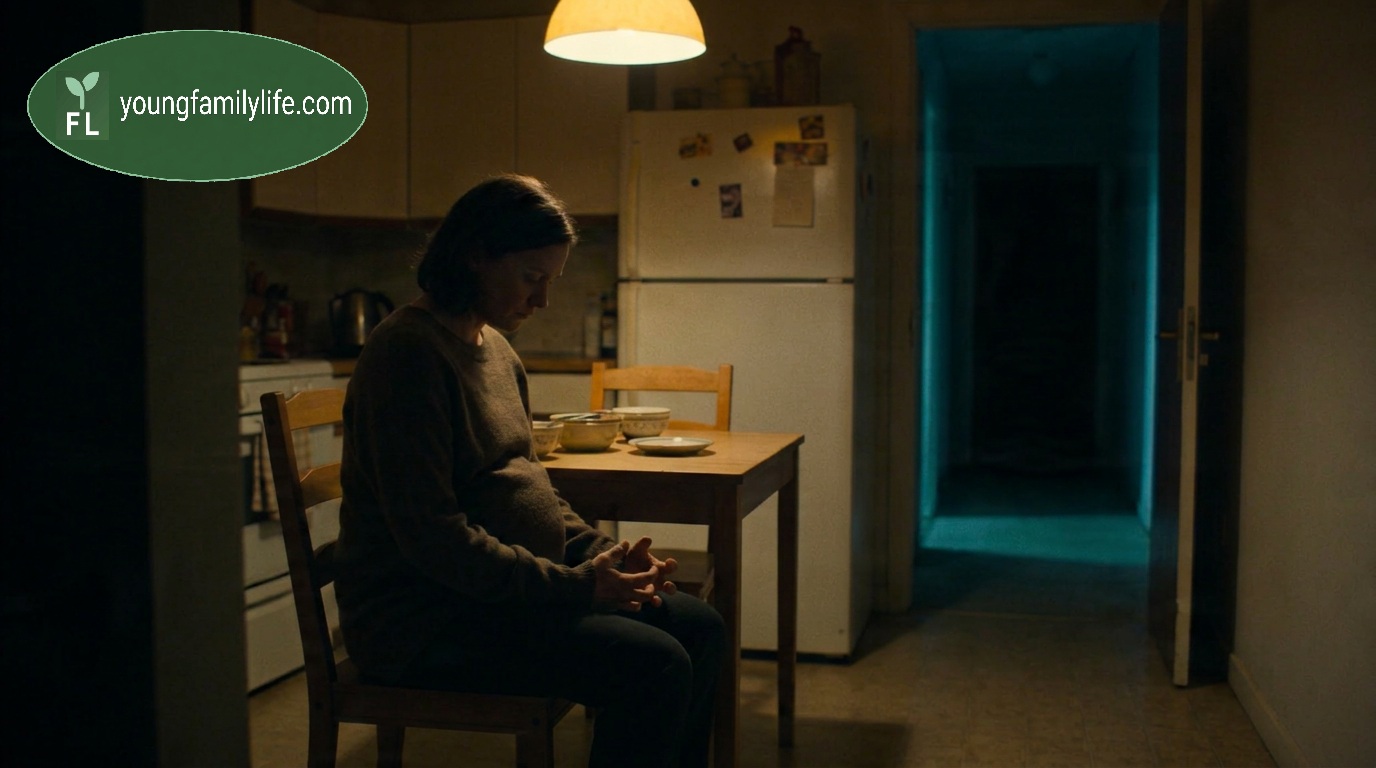
Something happens in the evening
It is not always possible to say when it starts. But for many people living inside a relationship where violence is present, there is a pattern to when things go wrong. A particular time of day. A particular feeling that builds — not always traceable to anything that happened, not always connected to what was said or done. Just a sense, growing through the hours, of something tightening.
For people on the outside, the sequence that follows is often the most baffling part. Why would someone do something that makes the situation worse? Why escalate when de-escalation is possible? Why seem, in some cases, to actively push towards the very thing that hurts them?
The answer is not in the choices being made. It is in the body — and in what the body learned, long before any of this began.
What the body remembers
The nervous system is not a neutral observer. From the earliest months of life, it is constantly reading the world for information about what is safe and what is not — and it is filing that information away, not as stories or memories that can be told, but as physical patterns. Ways of responding. Speeds at which the body moves from calm to alert. Levels of tension it considers normal. What the air feels like before something bad happens.
Those patterns, once formed, do not simply disappear when circumstances change. They become the operating system the body runs on. And they run whether the conscious mind is aware of them or not.
For someone who grew up in a home where violence, abuse, or serious threat was a regular part of life, the body built itself around that reality. It learned the sequence. The build-up. The moment things reached their worst. And then — crucially — what came after. The discharge. The settling. The strange, exhausted quiet that followed when the worst had finally happened and the body could stop bracing for it.
For some people, that learning began before birth. Research into prenatal stress has established that the foetus is sensitive to the mother's stress physiology from the second trimester — that the hormonal signature of chronic fear and threat crosses the placental barrier and begins calibrating the developing nervous system before the child has entered the world. A mother living inside a threatening relationship is carrying a child whose body is already being shaped by the same threat environment. The nervous system does not wait for birth to begin its work of deciding what kind of world this is going to be.
That settling was real. It was physiological. The nervous system, having been held at high tension for hours, finally got the signal it had been waiting for: the threat has peaked. It is over. You can rest now.
The problem is that the body learned to associate that rest — that relief — with the violence itself. Not with safety. With the end of the cycle.
The cycle the body is trying to complete
Researchers who study how the body holds and processes threatening experiences have found something that at first seems counterintuitive: the nervous system does not simply endure fear and then move on. It mobilises — physically, chemically, in every system at once — in order to deal with a threat. And once that mobilisation has begun, it needs to complete.
Think of it like a wave. The body rises with it. And a body that rises with a wave needs to come down. When the completion happens — when the threat resolves and the nervous system can discharge — the wave breaks and the body settles. That settling is not just relief. It is a physical process. Tension leaves the muscles. Breathing deepens. The chemical storm of the stress response begins to clear.
But a body that learned its threat cycles in childhood, in a home where danger came on a regular schedule, learned something very specific: this is what completion feels like. This particular sequence — the build, the peak, the aftermath — is how the wave breaks. The body does not just remember fear. It remembers the whole shape of the cycle, including where rest lives inside it.
Decades later, that body is still running the same programme. Not as a decision. Not as something the person is choosing to do. But as the deepest kind of physical memory — the kind that does not need a thought to run, because it was written in before thoughts were possible.
When that person's nervous system begins to build tension — as it will, at the hours it learned to expect it, in the conditions it associates with danger — it is not just building towards fear. It is building towards completion. Towards the only ending it has ever known.
When the body tries to manage itself
Living with that kind of build — evening after evening, the body climbing towards its learned peak whether or not anything in the present warrants it — is exhausting and frightening. Most people who live this way do not have words for what is happening. They know only that something rises in them that they cannot control, and that it needs somewhere to go.
Alcohol is one of the most common ways people try to manage that rising. Not as an indulgence, and not as a simple bad habit. As self-medication — a genuine, if ultimately inadequate, attempt to sedate a nervous system that will not quieten on its own. The alcohol takes the edge off. It slows the climb. For a while.
But it does not resolve the cycle. It numbs the surface while the pattern underneath continues. And for many people, it lowers the threshold at which the body will seek its learned completion — making escalation more likely, not less.
This is not a moral failing. It is a person doing the only thing they know to manage a physiological process they have never been given the language or tools to understand. The body is trying to survive, and finding the closest available means to do it.
Why leaving — or someone else leaving — doesn't always help
A common response to domestic violence, from services and from people who care about those involved, is to encourage distance. Leave. Create space. Remove the situation that leads to harm.
For the person causing harm, physical distance can sometimes interrupt the pattern. A walk. A different room. Somewhere else to be while the tension builds and begins to fall. It is not a solution, but it can be a circuit break — buying time for the immediate crisis to pass.
But for the person whose nervous system is running its own completion cycle, the other person's absence does not interrupt anything. The body is not building towards the partner. It is building towards its learned endpoint. The partner's departure removes one route to that endpoint. It does not remove the build.
And so the tension continues. And the body, following the only map it has, finds other ways to push towards what it needs. Arguments resumed when the person returns. Escalation that seems to come from nowhere. Behaviour that looks, from the outside, like someone determined to make things worse.
It is not determination. It is a body trying to finish what it started — following a programme written so early, and so deeply, that it does not register as a choice at all.
In In Other Words: What Children Carry — Growing Up in a Home Where Violence Is Present, there is a fuller account of what this same pattern looks like through the eyes and nervous system of a child living inside it — what that child's brain is building from the climate of those evenings, and what they carry forward from it.
Why the next partner looks a lot like the last one
When a relationship where violence has been present finally ends — whether through leaving, through separation, or through the other person's departure — there is sometimes an assumption from the outside that the hardest part is over. The person is free. The pattern can stop. A new beginning is possible.
What often happens instead is that the next relationship reproduces the same dynamic. Not immediately, and not always identically. But with enough similarity that people around the person — and sometimes the person themselves — recognise something familiar in the new partner, even if they cannot name what it is.
This is not coincidence, and it is not poor judgement. It is the nervous system doing what it always does: finding what it recognises.
The same pattern-recognition system that reads the evening air for signs of danger also reads other people for something it knows. A particular kind of energy. A quality of intensity that feels, at the body level, like the tension before the cycle begins. Something that registers — below conscious thought, below any reasoning about whether this person is good or not good — as familiar. And familiar, to a nervous system built around a particular kind of experience, registers as safe. Not because the situation is safe. But because the body knows this territory. It has a map for it. It knows, at some level, how this ends.
This is why the original partner was, in most cases, not an accident. The selection happened through the same process. What felt like chemistry — the pull, the intensity, the sense of recognition — was the nervous system finding someone who could provide what it was built to need. That is not romantic love, though it can feel indistinguishable from it at the start. It is the body selecting for the cycle.
There is a second reason why living without a partner is not always the straightforward solution it might appear to be from the outside. Beyond the cycle need — the body seeking its learned route to completion — there is also a calculation the nervous system makes about safety in a different sense entirely.
A person who grew up in an environment where threat came from other people has learned, at a deep level, that other people are dangerous. Not just one person. The world is a place where predation is possible, where being unattached and unprotected carries its own risk. A partner — even a difficult, controlling, or violent partner — occupies the territory. Their presence, their claim, the visible fact of the relationship, communicates something to the surrounding environment: this person is taken. This person has someone. Approach accordingly.
The calculation — almost never conscious, entirely logical from a survival brain perspective — is something like: this one keeps the flies away. A known and manageable danger is preferable to the unpredictable danger of being entirely without protection. Better the threat you understand and have learned to navigate than the open field of threats you cannot anticipate or prepare for.
This is why removing the partner, without addressing what the partner was providing — in both senses — leaves the person more exposed, not less. The cycle still needs completing. And the territory is now unguarded.
Sanctuary, in this light, is the necessary first step — and only the first step. A place of safety addresses the immediate harm. It does not, by itself, reach the body's need for cycle completion, or its calculation about protection. Without both of those being addressed — slowly, carefully, with specialist support over time — the nervous system will find its way back to what it knows. Not because the person is making a bad choice. Because the body is following its map.
What can change — and how hard that is
This piece has described something heavy, and it is important not to lighten it artificially at the end. The patterns described here are real. They formed early, they run deep, and they do not respond to willpower, good intentions, or simply knowing about them. A person can understand, intellectually, everything written here, and still find their body climbing towards its learned endpoint at ten o'clock in the evening. Understanding is not the same as resolution.
But patterns formed by experience can also be changed by experience. The nervous system that learned one kind of cycle can, under the right conditions, learn another. Not quickly. Not through effort alone. But genuinely — with the right kind of support, sustained over time, that works at the level where the pattern lives: in the body, not just the mind.
The approaches that research has found most useful for this kind of deeply held physical pattern are ones that work directly with the body's own experience rather than asking the thinking brain to override it. Therapeutic work that addresses the body's held tension. Approaches that help the nervous system find completion through routes other than the ones it learned. Steady, safe relationships — with a therapist, over time — that give the nervous system repeated evidence that settling is possible without the cycle having to peak first.
None of that is simple. None of it is fast. And it requires the kind of consistent, specialist support that is not always easy to access.
But the most important thing that can be offered at the end of a piece like this is not a list of steps. It is an honest reframing. What has been described here is not weakness, or self-destruction, or choosing to stay in something harmful. It is a nervous system doing precisely what it was built to do — following the map it was given, before the person had any say in what that map would look like.
Understanding that does not undo the harm. But it changes where the question gets asked from. Not why can't they just stop? — but what does this person's body need in order to find a different ending? That is a harder question. It is also a more useful one.
In Hey!, Want To Know: Why Rational Adults Can Respond With Childish Venom, the same survival brain mechanism is explored from a different angle — the moment an adult's behaviour seems completely out of proportion to what just happened, and why the response belongs to a much earlier time than the present one.
Topics: #InOtherWords #DomesticViolence #TraumaAndTheBody #SurvivalBrain #NervousSystem #TraumaInformedCare #Attachment #SelfMedication #YoungFamilyLife #IWI
Related YFL Content
Learning to Survive — How the Human Brain Navigates Opportunity and Danger — the foundational YFL account of the three-brain model and why the survival brain runs the show when the stakes feel high.
IOW: What Children Carry — Growing Up in a Home Where Violence Is Present — the companion piece on what this same domestic climate does to the child living inside it.
IOW: Everyone Has an Attachment Style — and It Started as a Survival Skill — how the relational templates formed in childhood become the operating system for adult relationships, including the ones that cause harm.
Authentic and Inauthentic Behaviour: What Childhood Wires In, and What Adulthood Inherits — the broader Repositorium essay on how survival brain patterns formed in childhood surface in adult behaviour, often without any conscious awareness.
Copyright Notice
© 2026 Steve Young and YoungFamilyLife Ltd. All rights reserved.
"In Other Words" is a copyrighted content format of YoungFamilyLife Ltd.
The information in this piece is based on established research and theory. Full academic sources, references, and evidential detail are available in the linked YoungFamilyLife essays.
This essay was developed collaboratively using AI assistance to research academic sources and refine content structure, while maintaining the author's original voice, insights, and "Information Without Instruction" philosophy. No part of this essay may be reproduced, distributed, or transmitted in any form or by any means, including photocopying, recording, or other electronic or mechanical methods, without the prior written permission of the copyright holders, except in the case of brief quotations embodied in critical reviews and certain other noncommercial uses permitted by copyright law.
For permission requests, contact: info@youngfamilylife.com