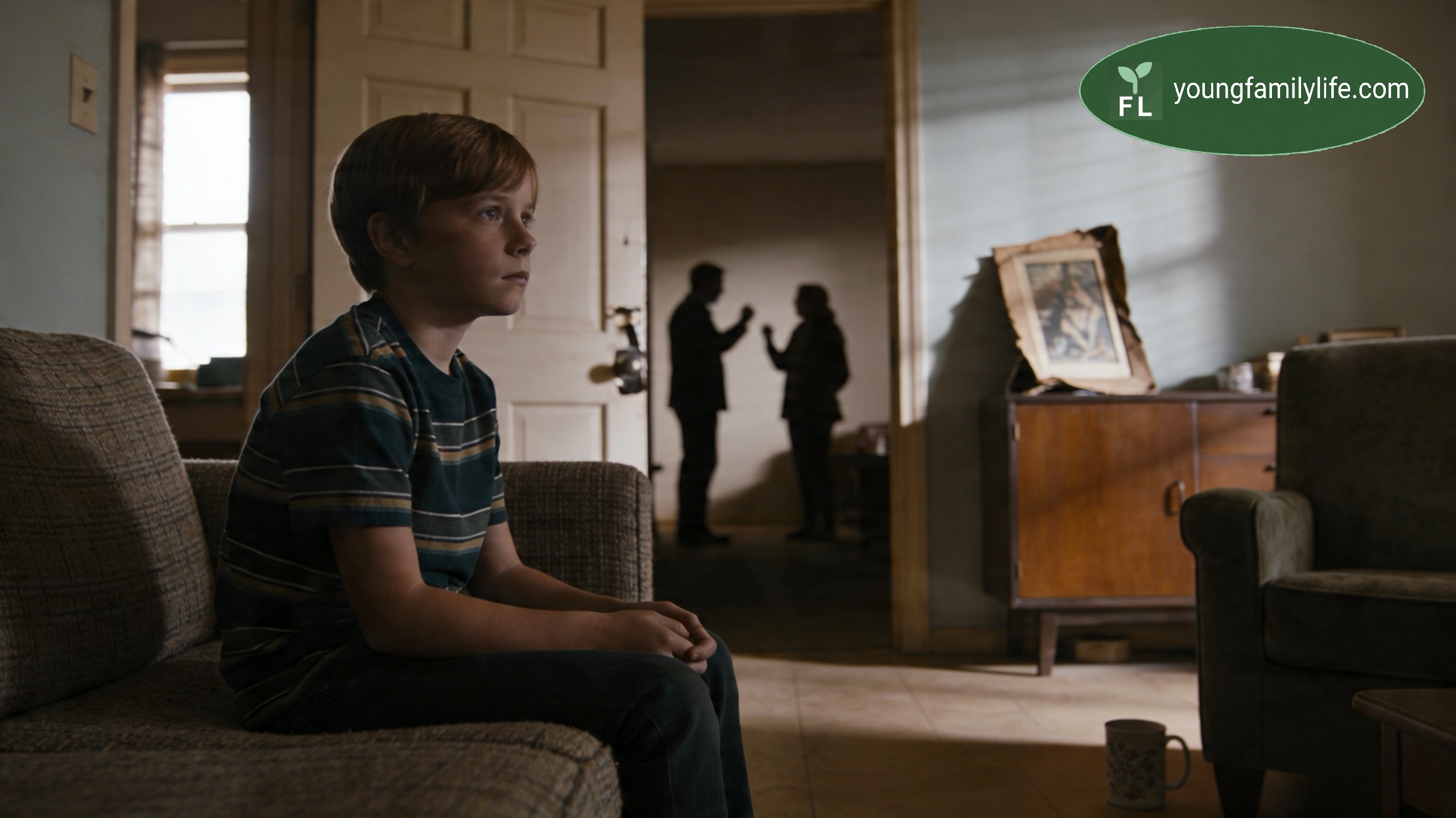
The child already knows
Before anyone says a word. Before a door slams or a voice is raised. Before the moment that either adult would call the start of it — the child already knows.
This is not a way of speaking. From the earliest weeks of life, a baby's nervous system is constantly checking its surroundings for signals of safety and danger. Not through thought — through the body. Through the feeling in the arms that are holding it. Through the tone in a voice, before the words themselves mean anything. Through something in the air of the room that isn't easy to name but is very easy to feel.
Researchers studying how babies develop have found that infants respond physically to stress in the adults caring for them — changes in heart rate, changes in the body's stress chemicals — before the adult has shown any outward sign of being stressed. The child is not waiting for the argument to begin. The child is already inside it.
In In Other Words: The Body Knows Safety Before the Mind Does, there is further explanation of how the nervous system reads the physical environment for safety signals — and why the body's record of what is safe and what is not runs deeper and faster than conscious thought.
This matters more than it might seem, because a child's brain does not develop separately from the world it is born into. It builds itself from that world. And that building begins before birth.
Research into how the prenatal environment shapes the developing nervous system has found that the foetus is sensitive to the mother's physiological state from the second trimester onwards. The body's stress hormones cross the placental barrier. A mother whose nervous system is living under chronic threat — whose body is running at the level of tension and alertness that a threatening home produces — is transmitting the biochemical signature of that threat to the nervous system of the child she is carrying. The voices heard through the wall of the womb. The tension held in the body she is held inside. The sudden surges of fear or adrenaline. The child in the womb is already learning, before they have drawn a first breath, what kind of world they are being born into. The nervous system arrives already oriented — already asking its first questions about how safe and how predictable the world is going to be — against a background that was established before birth. What the environment teaches about how safe things are, how reliable the people in it are, and how alert the child needs to be — all of that gets written directly into the way the nervous system learns to work. Those patterns do not fade when the house goes quiet. They become the way that child — and later, that adult — reads and responds to everything.
A home where domestic violence is present is not simply a home that contains frightening moments. For a child living in it, it is a world where danger is the background — even in the calm times. Because a nervous system that has learned to expect threat does not simply switch off when things appear safe. It stays ready. That state of readiness is not a choice the child is making. It is what the brain has learned to do.
What the brain builds from this
A brain that develops under threat is not a broken brain. It is a brain doing exactly what it is built to do: getting the child ready for the world they are actually living in.
Researchers who have spent decades studying how early stress affects the brain — including Allan Schore and Bessel van der Kolk — have found that growing up with ongoing fear and unpredictability shapes the part of the brain responsible for detecting danger. That system becomes faster, sharper, more easily triggered. It fires at lower levels of threat. It takes longer to calm down once it has fired.
From inside that child's world, this makes complete sense. A child who can pick up tiny changes in an adult's mood — who senses an argument building before it starts, who stays alert in the quiet as well as in the noise — is better prepared for the home they are actually living in. The difficulty is that this sharpened alert system does not stay in that home. It goes with the child into school, into friendships, and eventually into their own adult relationships. It continues working from the same starting assumption: that danger is likely, that people are unpredictable, and that it is safer to stay ready than to relax.
The human brain works in three broad layers — the thinking brain, the feeling brain, and the survival brain. In In Other Words: How a Brain Builds Itself — and What That Has to Do With Relationships, there is a fuller explanation of how these three layers develop and why, under stress, the survival brain takes over before the thinking brain has had time to assess anything. In a child whose survival brain has been on high alert for months or years, that takeover can happen at the smallest trigger — a raised voice somewhere nearby, a sudden change in routine, an expression on someone's face that reminds the nervous system of something it learned to fear.
None of this means the pattern cannot change. But it does mean the pattern formed for a reason — a very good one, from the survival brain's point of view — and understanding that reason is where any genuine change has to start.
Two survival brains — and what each learned about staying safe
Domestic violence is rarely a simple story of one person who is harmful and one who is not. That is not the same as saying both adults are equally responsible for what happens — they are not. The harm is real, and how it falls is not distributed equally. But understanding what is actually happening in both of the adults involved opens something that judgement alone does not reach.
The psychologist Eric Berne spent years watching the way people actually talk to one another, and what he found was that a great deal of human behaviour does not come from a calm, considered adult making deliberate choices. It comes from much older patterns — responses learned early in life that continue to run in the background, shaping how a person reacts even when they are not aware of it. In Hey!, Want To Know: What Eric Berne Discovered About Body Language in the 1950s, there is a closer look at how Berne developed his ideas by watching the way people actually communicate — and what he noticed about the gap between what people say and what they are actually doing.
In a relationship where violence is present, both people are often operating from those older patterns rather than from their present-day selves making present-day choices. The person causing harm — whether that is consistently one partner or something that moves between both — is, in many cases, running a pattern the survival brain learned very early: that dominance and control are how you stay safe. Not as a thought-out belief. Not as something they decided. But as a deep, early lesson from a nervous system that grew up somewhere it was not safe to be small, or soft, or in need. A person whose early world taught them that vulnerability led to harm — that being bigger, louder, and harder was the only reliable way to get through — carries that learning forward. The survival brain does not stop using what once kept the person alive simply because the circumstances have changed. In Hey!, Want To Know: Why Rational Adults Can Respond With Childish Venom, there is further explanation of how this older pattern surfaces in adults — the moment when a present-day situation triggers a response that belongs to a much earlier time.
This is not an excuse. It is an explanation. And the difference between those two things matters. The harm being done is real. The child watching it is being shaped by it in ways that will last. The fact that the person causing harm is, at some level, responding from an old wound of their own does not make the experience of living with them safer. But it does mean that what is happening is not simply malice. It is a survival brain doing what it learned to do, in a situation where those lessons have become badly wrong for everyone around them.
The same lens applies to the adult who stays in the relationship. Research consistently shows that staying is rarely as simple as not seeing the harm, or not caring about it. People remain in relationships where they are being hurt for reasons that go deep into attachment — into the nervous system's long memory of what love has felt like, and what it has come to expect. John Bowlby, whose research shaped much of what is now known about how children and adults form attachments, found that the attachment system does not simply seek safety. It seeks what is familiar. A person whose early experience taught them that love is unreliable, or conditional, or mixed up with fear and hurt, may find that a relationship reproducing those patterns feels, at the level of the nervous system, like something recognisable — not because they want to be harmed, but because the nervous system does not easily separate what it knows from what is good for it. In In Other Words: Everyone Has an Attachment Style — and It Started as a Survival Skill, there is a fuller account of how those early attachment patterns develop and what they look like in adult relationships. And in Hey!, Want To Know: How People Handle Life and Relationships, the same ideas are approached from the inside — what each attachment pattern actually feels like to live with.
Neither adult, in other words, is simply making bad choices in a vacuum. Both are, in different ways and to very different degrees, carrying patterns that formed well before this relationship began. That does not reassign the harm. It places it more accurately.
What the child is carrying
Research into how domestic violence affects children has shifted in recent years away from focusing on individual incidents — the argument the child witnessed, the night the police came — and towards understanding the sustained atmosphere that violence creates in a home. Children do not need to see specific acts of harm to be significantly affected. They need only live inside the climate that those acts produce.
That climate does several things to the developing brain at once. It keeps the survival system in a state of ongoing stress, with real physical costs — disrupted sleep, the body running at a level of readiness it was not designed to maintain for long periods. It disrupts the child's relationship with both of the people they most need: the parent being harmed, who may be emotionally less available because they are managing their own fear; and the parent causing harm, whose presence the child both needs and dreads. And it gives the child a working model — a deep, unspoken sense of what close relationships are like, who holds power in them, and how conflict is handled.
These lessons are not taught in words. They are absorbed through experience, and they settle into the nervous system in a way that outlasts any specific memory of what happened. In Hey!, Want To Know: Why Some People Are Better at Preparing for the Worst, there is further explanation of what that heightened vigilance actually looks and feels like — and why the same sharpened awareness that develops under threat can become a genuine strength in the right circumstances, even as it creates difficulty in others.
There is something in this territory that research on childhood trauma has increasingly recognised as one of its most difficult features. The people who are the source of fear in a child's life are also the people the child most needs. Bowlby's work showed clearly that children maintain their attachment to caregivers even when those caregivers are a source of harm — and that when children are frightened, they reach towards the people they are attached to, even if those people are the source of the fear. This is not a contradiction. It is the attachment system doing the only thing it knows how to do. But it creates a bind that has no clean way out: the child cannot move towards safety without also moving towards danger. In In Other Words: A Parent's Introduction to Circle of Security, there is a fuller account of the attachment system and what children actually need from the adults closest to them — which helps make sense of why this bind is so hard, and why it matters so much that at least one adult in the child's life remains a place of genuine safety. Held over months or years, that bind — of needing the person who also causes fear — is one of the heaviest things a developing nervous system can carry.
What understanding this opens
Understanding what is happening does not tell anyone exactly what to do. That is not what this piece is trying to offer. What it can offer is a different set of questions — ones that tend to get further than the obvious ones.
For the parent who has been harmed — and who may be asking themselves what their child has taken in, and what can be undone — the research offers something that is neither simple reassurance nor a warning. The effects on children are real. They are also not fixed. The most reliable finding across decades of research into children's resilience is this: the single biggest protective factor for a child who has experienced something hard is having at least one adult in their life who is consistently warm, available, and steady. The parent who is asking the question — who wants to understand what their child has been through — is already doing something that matters. Not because asking takes back what happened. But because that kind of care, given consistently over time, is genuinely what the research shows changes things. In Hey!, Want To Know: Why Emotional Warmth Matters to a Child, there is a closer look at what emotional warmth actually means in practice — and why it is the quality of connection, far more than any particular action or decision, that makes the lasting difference.
For the parent who has caused harm — and who may recognise something of their own history in what has been described above — the same understanding that explains the pattern also makes clear that patterns are not permanent. The survival brain learns from experience. Given the right conditions, it can learn something different. That is not a quick process, and it is not one that happens through willpower alone. But the starting point is the same one that matters in every part of this: understanding what is actually driving the behaviour, rather than remaining inside it.
The child at the centre of all of this is not simply a victim of what has happened around them. They are a person whose nervous system has adapted — intelligently, at real cost — to the world they were given. That adaptation is worth understanding. By the adults in their lives, and eventually, when it becomes possible, by the child themselves.
Topics: #InOtherWords #DomesticViolence #ChildDevelopment #SurvivalBrain #Attachment #TraumaInformedCare #TransactionalAnalysis #FamilyLife #ChildrensWellbeing #YoungFamilyLife #IWI
Related YFL Content
Learning to Survive — How the Human Brain Navigates Opportunity and Danger — the foundational YFL account of the three-brain model and how early experience shapes threat response patterns.
IOW: The Body Knows Safety Before the Mind Does — Kate Cairns on how the nervous system reads safety through body signals before conscious thought catches up — directly relevant to what children in threatening homes are experiencing and what they need.
IOW: Everyone Has an Attachment Style — and It Started as a Survival Skill — how the relational templates formed in childhood become the operating system for adult relationships.
Eric Berne's Transactional Analysis: From Freudian Theory to Observable Interaction — the academic essay behind the ego state framework referenced here.
Hey!, Want To Know: Why Caring Parents Get Short Tempered With Their Children — the same survival brain mechanism seen from the inside, in the ordinary parenting moments where the pattern surfaces.
Copyright Notice
© 2026 Steve Young and YoungFamilyLife Ltd. All rights reserved.
"In Other Words" is a copyrighted content format of YoungFamilyLife Ltd.
The information in this piece is based on established research and theory. Full academic sources, references, and evidential detail are available in the linked YoungFamilyLife essays.
This essay was developed collaboratively using AI assistance to research academic sources and refine content structure, while maintaining the author's original voice, insights, and "Information Without Instruction" philosophy. No part of this essay may be reproduced, distributed, or transmitted in any form or by any means, including photocopying, recording, or other electronic or mechanical methods, without the prior written permission of the copyright holders, except in the case of brief quotations embodied in critical reviews and certain other noncommercial uses permitted by copyright law.
For permission requests, contact: info@youngfamilylife.com