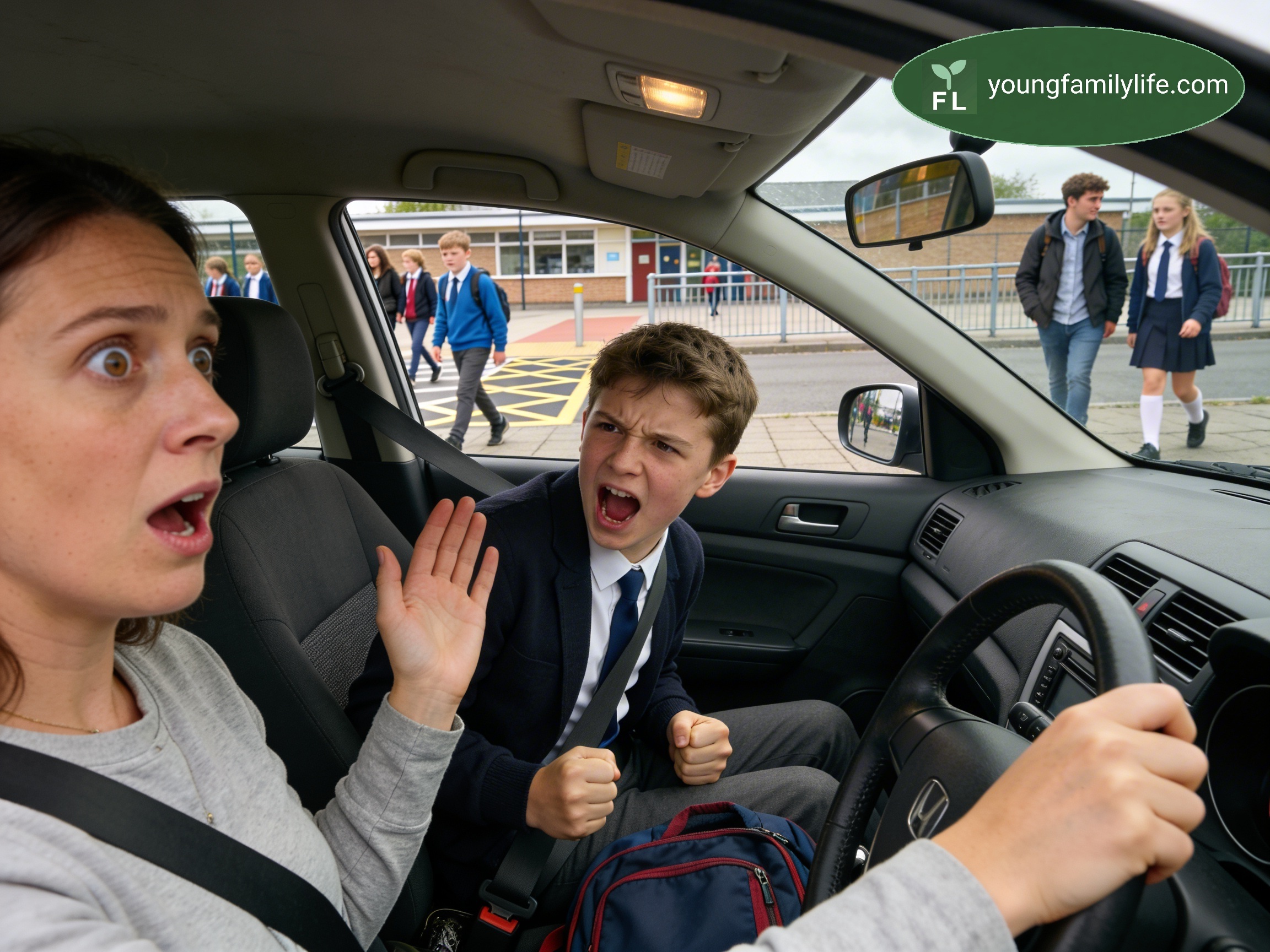
A Scene That Plays Out Every Day
The school run home. Five o'clock. The car has barely left the car park when it starts.
It's nothing dramatic at first — just a silence that has an edge to it. And then the parent asks a perfectly ordinary question. Something practical. Something that needed asking. "Have you got homework tonight?"
"Don't fucking patronise me."
Or a single syllable delivered like a weapon. Or a ten-minute lecture on everything the parent has ever done wrong. Or silence — the kind that radiates. Or a grunt. Or a stare. Or the school bag hitting the floor hard enough to make a point. Or a shove at a sibling that comes from nowhere. The form varies. The force of it does not.
The parent's jaw tightens. Something shifts. And what comes out of their mouth next is not quite the response a perfectly rested, perfectly patient person would have given. Not because they're a bad parent. Not because they don't love their child. But because something happened in that car that neither of them could stop — even though, an hour later, both of them probably could have explained it perfectly well.
There are other versions of this scene. The supermarket, where the child has been sulking solidly since the parent realised there was nothing in for dinner — not crying, not asking for anything, just a low, grinding presence of disappointment that has been running for forty minutes without stopping. The family visit, where the children make it obvious they are bored in a way that feels, somehow, like a comment on the parent. The back seat, ten minutes from home, where a sibling argument erupts over who gets to sit in the front — full volume, apparently deadly serious — over something that means nothing and everything at the same time.
In every version of this scene, a caring parent reaches a point where their response is bigger than the moment seems to warrant. And then often comes the second wave: the confusion, the guilt, the quiet question of what just happened to me?
There is a clear answer to that question. It has nothing to do with being a bad parent.
Two Alarm Systems in the Same Room
Every human brain has a built-in alarm system. It is fast, automatic, and it fires before the Thinking Brain gets a look in. Its job is to detect threat and respond to it — immediately, without waiting for instructions. And it does not only respond to physical danger. It responds to stress, conflict, tension, and feeling out of control in much the same way.
When a child is sulking, snapping, or screaming at a sibling, their Feeling Brain is almost certainly already running the show. Children are not choosing to be difficult. The Thinking Brain — the part that manages strong feelings, weighs up consequences, and chooses responses — is still being built, right through the teenage years. When things get too much, the Thinking Brain steps back and the Feeling Brain takes over. What comes out is not a decision. It is a young nervous system doing exactly what it was built to do.
The problem is that it doesn't stay contained to the child. The tone, the tension, the unpredictability — it fills the car. And the parent's brain picks it up. Their own alarm system starts to fire.
This is not weakness. It is biology. Two alarm systems, both doing their job, in the same small space.
The Tank That Was Already Running Low
There is a second piece to this. The parent in that car is not starting the journey home from a full tank.
Patience is not a personality trait. Research into self-regulation — the ability to stay calm, make good decisions, and keep a lid on reactions — shows clearly that it is a resource. It runs down across the day, the same way physical energy does. Every frustration absorbed, every difficult moment navigated, every time a parent held it together when they didn't feel like it — all of it draws from the same reserve. By early evening, that reserve is often close to empty. Not because the parent is weak. Because it has been used.
The car service bill that arrived this afternoon. The conversation at work that needed careful handling. The dinner scraped together from almost nothing without making a fuss of it. These things are not separate from what happens in the car. They are why it happens. By the time the child's attack lands, the parent has very little left.
The question is never only why did that bother me so much? It is also: what was already there before that question was ever asked?
Why It's the People We Love Most
Many parents are caught off guard by this: the people who trigger their strongest reactions are often the people they love most. Not strangers. Not colleagues. Their own children.
There is a straightforward reason for this. With people we are close to, the guard is down. It has to be — that is what closeness means. The same openness that makes a real relationship possible also means that their distress, their anger, their disappointment lands much harder than it would from someone further away.
There is also the weight of it. A parent's reaction to their child is never just a reaction to right now. It carries everything — the love, the worry, the history, the hope. When a child is struggling, a parent's brain is not simply noting "my child is grumpy in the car." Underneath that, it is asking: is my child all right? Am I doing this right? Is something wrong? Those are not small questions. And they land with real force.
The child who unloads the full weight of their day the moment they get in the car is, in one sense, paying their parent a compliment. Home is safe enough for the feelings to come out. Many parents find that when they see it that way, what felt like an attack looks quite different.
What the Feeling Brain Is Actually Saying
When a child — especially a teenager — fires back at a reasonable question with something cutting or explosive, it is easy to read it as disrespect. Sometimes, an hour later, even the child describes it that way.
But the Thinking Brain — the part that handles perspective, consequences, and choosing words carefully — is still developing through the teenage years. During adolescence it is, quite literally, being taken apart and rebuilt in a better configuration. And while that rebuild is happening, it is less reliable than it was, not more. When emotional pressure is high, the Feeling Brain surges and the Thinking Brain loses its footing. What comes out is not a considered response. It is the Feeling Brain finding the nearest available words for an overwhelming internal state.
There is a gap at this age between knowing what the right thing to do is and actually being able to do it when emotional — and that gap is in the brain, not in character. A teenager can see clearly, in a calm moment, exactly what happens when things get hard. And still not be able to stop it in the moment. That is not weakness. That is what it looks like when a brain is doing two very difficult things at the same time.
"Don't fucking patronise me" — is rarely about the homework question. It is more often a young nervous system saying: I have been holding it together all day and I cannot manage one more thing right now. The word "patronise" tends to come up because the Feeling Brain reads the question as a challenge — and protecting a sense of competence is exactly what it prioritises when it is already under strain.
None of this makes the response acceptable. Most families find their own way to address that, in their own time. But knowing what is actually behind it — not as an excuse, but as information — changes what the parent is actually dealing with.
When Two Systems Collide
Put it all together and what the research describes is a collision, not a failure. A child arrives already loaded. Their alarm system fires. The parent's alarm system fires back. The parent is already running low. The result is a response that surprises even the parent.
This is not poor parenting. It is two nervous systems doing exactly what nervous systems do — under pressure, in a small space, at the end of a long day. The collision was always likely. Seeing it as a collision — two people responding, rather than one person failing — changes what can happen next.
Many parents find that talking about it later, once things have settled — not to explain it away, not to turn it into a lesson, just to name that something happened and that both people were caught up in it — does something quietly useful for the relationship.
Coming Back Together
What happens after the collision matters. Not to undo it — nothing can change what was said or felt earlier — but because the repair is where the relationship re-establishes itself. Researchers and practitioners working in this area, including those within the Solihull Approach to parenting, describe this as the natural rhythm of close relationships: rupture and repair. It is not the rupture that defines the relationship. It is whether repair follows.
The idea of the dance of reciprocity — the back-and-forth, the attunement between parent and child — captures something important here. The dance doesn't end because there was a collision. It pauses. And then, when both people are ready, it starts again. That restart is not a formal event. It rarely involves a speech. It is often something much simpler.
For younger children, experts in this area point to the bedtime routine as one of the most reliable repair mechanisms in family life — not because anything is resolved in words, but because the warmth of it does the work. The story. The settling. The physical closeness. The day ends together, and the body registers that as safety. Nothing needs to be said for that to be real. Though sometimes "sorry" — from either direction — is exactly the right thing, and both people know it.
For older children and teenagers, the bedtime story is long gone. But the function it served has not disappeared — it has just changed form. Experts in adolescent development note that shared, low-pressure activity tends to do what words alone often cannot. A hot chocolate. A film on the sofa. Walking the dog. These are not trivial. They are the repair in a different shape — the moment where parent and child are simply together again, without the weight of what happened still sitting between them.
What the child's Feeling Brain is learning in that moment — perhaps without either of them realising it — is something fundamental: disconnection isn't permanent. Things can go wrong and then get better. People come back. That learning, built from repeated experiences of rupture followed by repair, is part of what emotional resilience is actually made of. The memory being made now is not of the earlier collision. It is of this.
What the Pattern Looks Like When It Repeats
A flash of short temper after a genuinely hard day is something most families recognise and absorb. It is part of normal family life. The picture is different when it becomes a regular pattern — when it is happening most days, when it is the response to a wide range of ordinary situations, or when it tips into something that leaves a mark.
Research is clear on the distinction here. Occasional frustration, within an otherwise warm and safe relationship, has no meaningful long-term effect on children. It is not the occasional flash that matters — it is the overall temperature of the relationship. A parent who loses patience sometimes, repairs the moment, and remains fundamentally safe and loving is doing something entirely different from a parent whose anger becomes the thing their child organises themselves around.
If short temper is becoming persistent — if it is there most days, or across a wide range of situations, or if a parent notices their child becoming anxious, quiet, or careful around them — that is worth paying attention to. Not as proof of failure, but as information. Persistent depletion, unresolved stress, and difficulty managing anger all respond well to support. Seeking that support is itself a caring act.
Topics: #parentingreality #shorttempered #parentalstress #threatresponse #selfregulation #egopletion #adolescentbrain #familylife #parentingscience #hwtk #youngfamilylife #IWI #emotionalregulation #parentguilt
Further Reading
These links dig deeper into the topics covered here:
Parental stress and self-regulation:
- Baumeister et al. — Ego Depletion: A Resource Model of Self-Control — the foundational research on how self-regulation draws on a finite resource across the day.
- Zero to Three — How to Handle Parenting Stress — evidence-based overview of how chronic stress affects parenting responses.
Child and adolescent brain development:
- Casey et al. — The Adolescent Brain — peer-reviewed overview of prefrontal cortex development and its implications for emotional regulation.
- Harvard Center on the Developing Child — Brain Architecture — accessible explanation of how early and ongoing experience shapes the developing brain's stress response systems.
How This Essay Reflects YFL Values
This piece has set out what research in neuroscience and developmental psychology shows about why caring parents sometimes respond to their children with more heat than they intended. The science points in one direction: this is a story about two alarm systems, a resource that runs down across the day, and the particular intensity of the relationships that matter most. It is not a story about bad parenting.
Nothing here has told a parent what to do differently. That is not what this platform does. The information belongs to the reader. What they make of it is entirely theirs.
Informed parents make better decisions for their own families. That is the only assumption this platform makes.
Related YFL Essays and Resources
Learning to Survive — How the Human Brain Navigates Opportunity and Danger — the full Repositorium essay behind the three-brain model used here. Covers how the Thinking Brain, Feeling Brain and Survival Brain develop from birth to adulthood, the six threat responses, and how early patterns shape relationships later in life.
No Time for Goodbyes: The Dance of Reciprocity — the Solihull Approach, the dance of reciprocity, and why the rhythm of the parent-child relationship matters so much. The framework behind the rupture and repair idea explored here.
Hey!, Want To Know: Why Emotional Warmth Matters to a Child — warmth as the relational context that makes repair possible. The piece that sits alongside this one in the HWTK parenting series.
Hey!, Want To Know: Why Children Get Clingy at Nursery Drop-Off? — another piece in the HWTK parenting series examining the gap between how a child's behaviour looks and what is actually driving it.
Copyright Notice
© 2026 Steve Young and YoungFamilyLife Ltd. All rights reserved.
"Hey!, Want To Know" is a copyrighted content format of YoungFamilyLife Ltd.
This essay was developed collaboratively using AI assistance to research academic sources and refine content structure, while maintaining the author's original voice, insights, and "Information Without Instruction" philosophy. No part of this essay may be reproduced, distributed, or transmitted in any form or by any means, including photocopying, recording, or other electronic or mechanical methods, without the prior written permission of the copyright holders, except in the case of brief quotations embodied in critical reviews and certain other noncommercial uses permitted by copyright law.
For permission requests, contact: info@youngfamilylife.com