What this is about
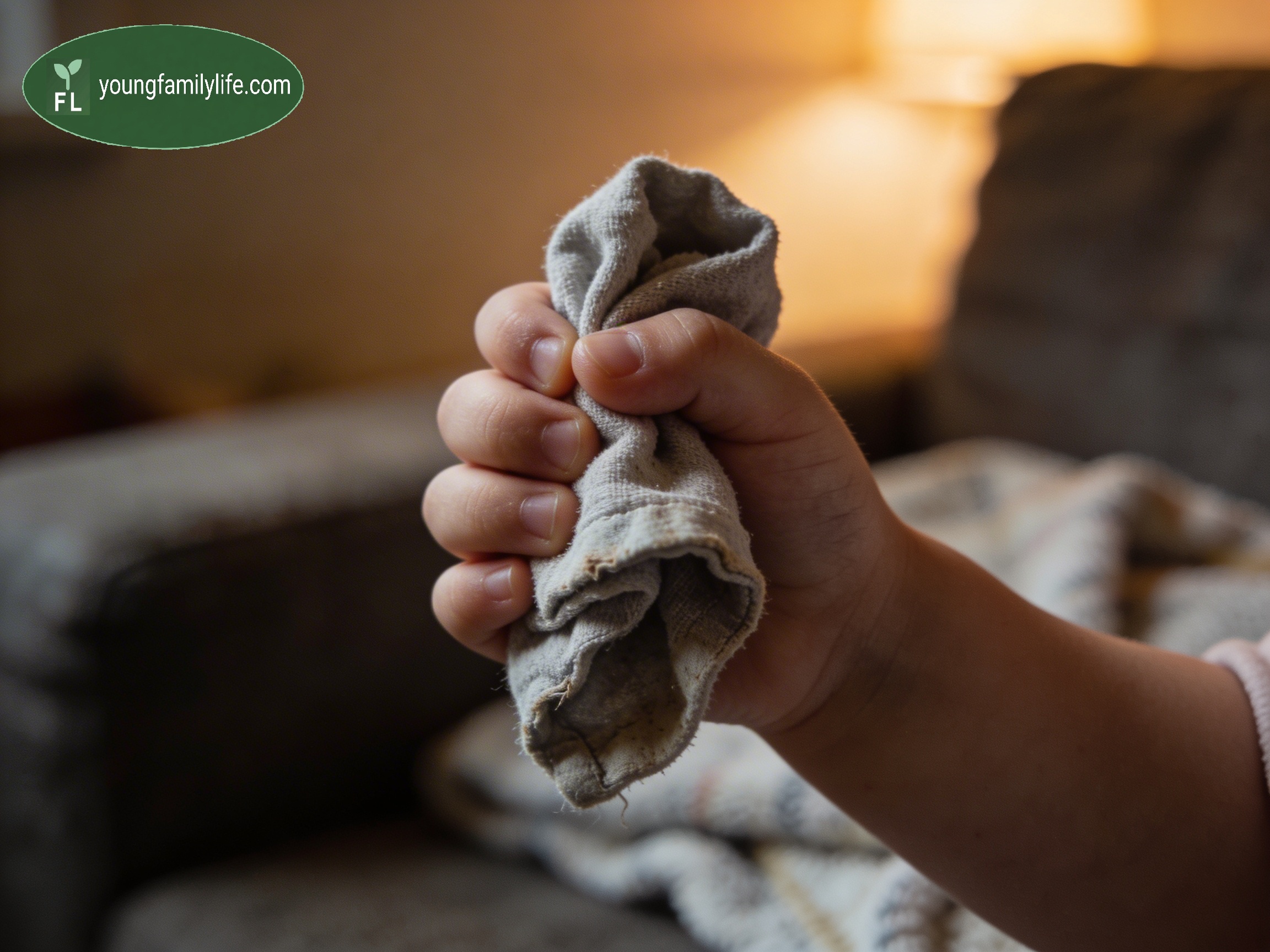
A UK social worker spent twenty-five years fostering children who had experienced serious trauma. One of the most effective tools she developed was a small square of fabric — cut from a child’s old pyjamas, or sometimes her own — that a child could carry to school in their pocket.
When a child became overwhelmed in the classroom, they might wipe their nose on it. The familiar scent helped settle them. Not through any conscious process. Not because the child told themselves “this smells like home, therefore I am safe.” The smell reached a part of the nervous system that operates before thought, before language, before any of that. And something shifted.
Kate Cairns documented this and related approaches across decades of practice. What she discovered by doing it, research has since confirmed by studying it. The body has ways of knowing safety — and registering threat — that have nothing to do with words. The full Beyond Words essay on this platform covers the research in depth. This piece covers the same ground in plainer language.
The part of the brain that smell talks to directly
Most sensory information takes a detour on the way to the brain’s emotional centres. Vision and hearing pass through a relay station called the thalamus before reaching the structures that process feeling and memory. Smell is different. Olfactory signals connect directly to the amygdala and hippocampus — the regions involved in emotional response and memory formation — without that relay.
This means a familiar scent can trigger an emotional state before the thinking brain has registered anything at all. The process is not symbolic. It is not about meaning. It is direct neural wiring, operating faster than conscious thought.
This also explains something most people have noticed without having a name for it: smell memories are often more emotionally vivid than other kinds of memory, and they tend not to fade in the same way. The writer Marcel Proust described it famously — a single scent transporting him back to childhood with a completeness and emotional force that deliberate recollection never achieved. Research on memory consistently confirms the pattern. Smell and emotional memory are bound together in ways that other sensory experiences are not.
Smell is not alone in this. Taste shares much of the same direct wiring — the tongue and nose evolved together as the body’s frontline defence against poison, scanning everything that enters the body before it can cause harm. Both operate below conscious thought and both carry emotional memory with unusual force. Touch, too, connects to the limbic system in ways that sight and hearing do not. These three — smell, taste, and touch — are sometimes called the proximal senses: they require closeness, they are harder to consciously filter, and they are more deeply entangled with the body’s survival systems than the senses that operate at a distance. Comfort foods work through this same mechanism — not through any stimulant effect, which is a different thing entirely, but through sensory associations built up over repeated experiences of warmth and safety. The taste and smell of a particular food, encountered often enough in secure and comforting circumstances, becomes a signal the nervous system learns to read as safe.
The same mechanism explains why a traumatic episode can leave a lasting aversion to a food or odour that happened to be present at the time. A person who became seriously ill, or was in a significant accident, in close proximity to a strong smell or taste can find themselves repulsed by it long afterwards — sometimes for years. The nervous system is not being irrational. It recorded the association accurately and continues to treat the signal as a warning, exactly as it was designed to. The pathway that makes familiar smells a source of comfort is the same pathway that makes an odour or taste present during danger a source of lasting unease. Cairns’ handkerchief works precisely because this system is so reliable — and so automatic.
Why this matters under stress
When a person becomes frightened or overwhelmed, the nervous system shifts into a defensive state. Blood flow reduces to the parts of the brain involved in language, reasoning, and reflection. The body prioritises rapid response over careful thought.
This is why asking a distressed child to “use your words” often does not work — not because the child is being uncooperative, but because the stress response itself has temporarily compromised the systems that words require. The language centre is, in a real sense, offline.
But smell does not need the language centre. The olfactory pathway to the emotional centres of the brain remains open. A familiar, safe-associated scent can reach the nervous system and begin registering “safe” through a route that stress has not closed off. Cairns’ handkerchief was not a comfort object in the conventional sense. It was, in effect, a sensory signal sent along a channel that a dysregulated nervous system can still receive.
How the association forms in the first place
The reason this works depends on how the nervous system learns. Familiar scents become associated with particular emotional states through repeated experience. A carer’s distinctive scent — present during feeding, during soothing, during moments of warmth and safety — becomes part of the sensory signature of security. Over time, that scent alone begins to carry the signal.
This is the same mechanism behind the comfort of a parent’s unwashed jumper left with a baby at nursery, or the specific smell of a grandparent’s house that can stop an adult in their tracks decades later. The nervous system learned the association through accumulated experience. The scent activates it automatically.
For children in foster care, building this association with a new carer takes time — it accumulates through repeated sensory experiences of safety in that person’s presence. The handkerchief works once that association has been established. It carries the carer’s presence into situations where the carer cannot be physically there.
The wider picture this belongs to
The handkerchief is a specific and practical example of something broader. Human beings communicate and regulate through multiple channels simultaneously, most of them operating outside conscious awareness. Tone of voice, facial expression, posture, proximity, touch — all of these continuously broadcast information that other nervous systems read and respond to automatically.
For children who have experienced complex trauma, this continuous nonverbal dimension often carries more weight than verbal communication. Their nervous systems learned, through experience, to read the environment for threat. That reading happens through sensory channels, not through words. A calm voice matters. A relaxed body matters. A familiar smell matters. The continuous, sensory reality of interactions shapes felt safety — not the words spoken within them.
Research in this area, including work reviewed by Miles Patterson and colleagues in 2023, consistently shows that verbal and nonverbal communication operate through different systems that evolved for different purposes. What a nervous system registers as safe or threatening is built largely from nonverbal information, processed largely below awareness. Cairns’ contribution was recognising that supporting traumatised children means working through those channels — not replacing verbal approaches, but understanding that felt safety has to be established at the level where the nervous system actually operates.
What the research leaves us with
A piece of fabric. A familiar smell. A nervous system that calms before the child can explain why.
The simplicity of the handkerchief is, in a sense, the point. The most ancient communication systems in the brain do not require complexity. They require the right signal, delivered through the right channel, at the right moment. Smell — connecting directly to emotion and memory, bypassing language entirely — is one of those channels.
Practitioners and carers who understand what is driving this are better placed to respond with awareness rather than reflex — and to recognise the sensory dimensions of safety that continue operating whether or not anyone is paying attention to them.
Topics: #InOtherWords #TraumaInformedCare #ChildDevelopment #Neuroscience #Attachment #FosterCare #NervousSystem #SensoryProcessing #NonverbalCommunication #YoungFamilyLife
Related YFL Content
Hey!, Want To Know how bodies tell the truth when words lie? — The automatic, below-awareness dimension of body signals — why the nervous system trusts what it sees over what it hears.
Hey!, Want To Know how your body talks 24/7? — The continuous nature of nonverbal communication — why it never stops, even in silence.
Eric Berne’s Transactional Analysis: From Freudian Theory to Observable Interaction — How Berne recognised that the full meaning of an exchange is never in the words alone — the same insight from a different starting point.
Learning to Survive — The broader framework for understanding how threat responses develop and why they shape behaviour long after the original threat has passed.
Copyright Notice
© 2026 Steve Young and YoungFamilyLife Ltd. All rights reserved.
“In Other Words” is a copyrighted content format of YoungFamilyLife Ltd.
The information in this piece is based on established research and theory. Full academic sources, references, and evidential detail are available in the linked YoungFamilyLife essays.
This essay was developed collaboratively using AI assistance to research academic sources and refine content structure, while maintaining the author’s original voice, insights, and “Information Without Instruction” philosophy. No part of this essay may be reproduced, distributed, or transmitted in any form or by any means, including photocopying, recording, or other electronic or mechanical methods, without the prior written permission of the copyright holders, except in the case of brief quotations embodied in critical reviews and certain other noncommercial uses permitted by copyright law.
For permission requests, contact: info@youngfamilylife.com