What Circle of Security is
Circle of Security is a way of understanding what children need from the adults who look after them. It was developed by three American researchers — Kent Hoffman, Glen Cooper, and Bert Powell — and has been used in parenting programmes around the world since the late 1990s. It is one of the most well-researched frameworks in this area, and it is built on decades of earlier work on how children attach to their caregivers.
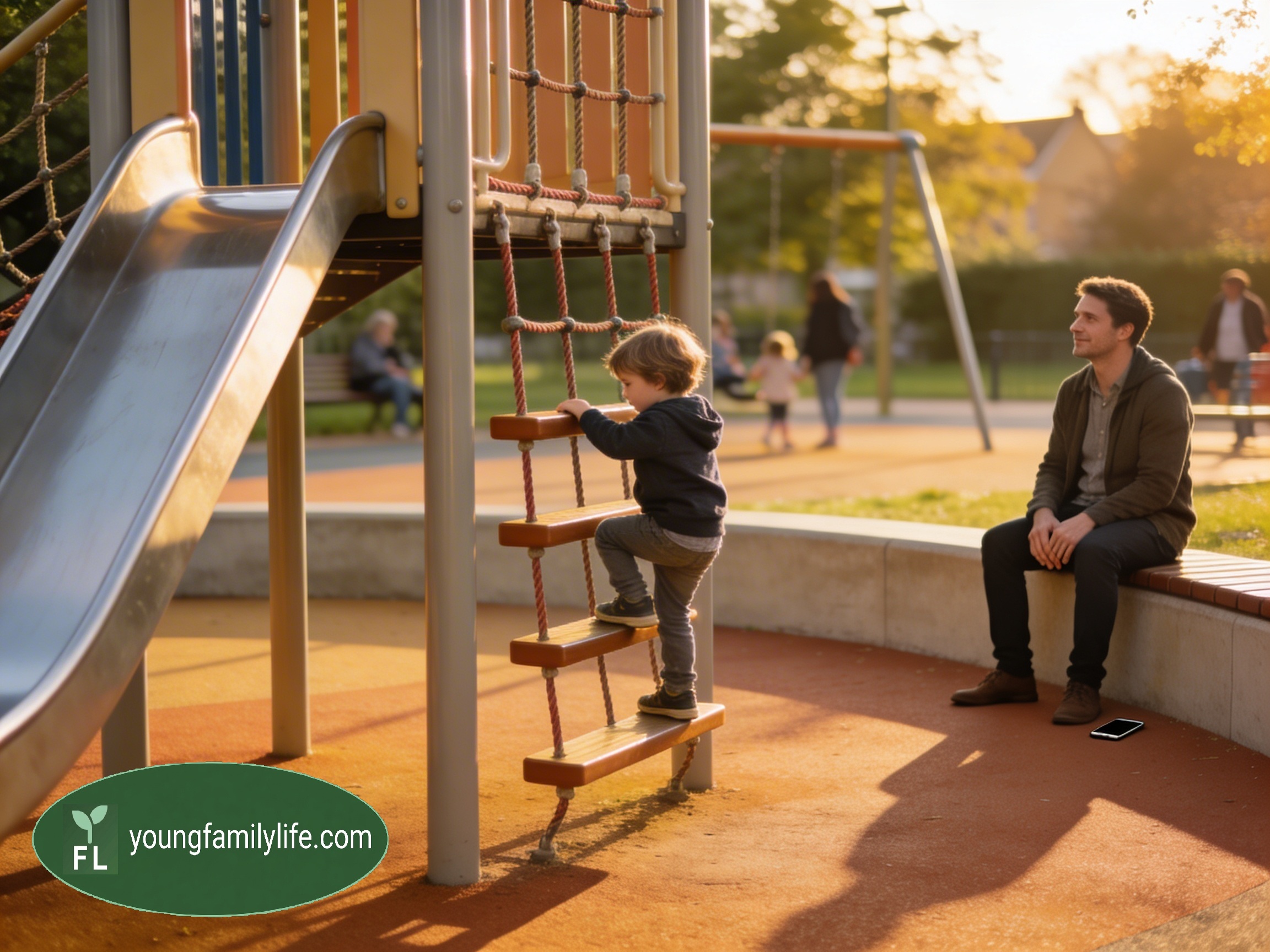
The core idea is simple. Children need two things from a parent, and they need them in balance. They need to be able to go out and explore the world — and they need to know they can always come back. The parent's job is to make both of those things possible.
That is the whole circle. Everything else is detail about how it works, what gets in the way, and what good enough looks like in real family life.
The two halves of the circle
The top half of the circle is about going out. A child who feels safe uses their parent as a base to explore from. They move away, try things, take small risks, engage with the world. While they are doing this, what they need from the parent is not to be stopped or pulled back — but to be watched over, supported when they need help, and to have someone who is genuinely interested in what they are doing. The parent is the safe base the child leaves from.
The bottom half of the circle is about coming back. At some point — when the child is tired, frightened, hurt, or just overwhelmed — they need to come back in. What they need when they do is to be welcomed, comforted, and helped to feel okay again. They need the parent to take their feelings seriously and help them settle. The parent is the safe haven the child returns to.
Both halves matter equally. A parent who is great at supporting exploration but unavailable for comfort, and a parent who is warm and comforting but anxious about independence — both leave part of the circle incomplete. Research consistently shows that children thrive when both ends are reliably available.
Bigger, stronger, wiser and kind
Circle of Security describes the parent's role using four words: bigger, stronger, wiser and kind. These are not qualities parents need to perform — they describe what a child's Feeling Brain is actually looking for when it checks whether the parent is a safe base.
Bigger and stronger means the parent is the adult in the relationship. The child needs to know that the person looking after them has the size and the steadiness to handle what comes. This is not about being authoritarian — it is about being reassuring. A child does not feel safe in the hands of someone who seems to be struggling as much as they are.
Wiser means the parent can see what the child needs — sometimes even when the child cannot say it or does not know it themselves. It means being thoughtful rather than reactive, able to read the situation rather than just respond to the surface of it.
Kind means all of the above comes wrapped in warmth and care. Bigger, stronger and wiser without kindness is just authority. It is the combination that makes a parent feel genuinely safe.
Research into what children need from caregivers points consistently toward this combination. Children do not need perfect parents. They need parents who are present, who are trying, and who stay kind even when things are hard.
Shark music — when a parent's history plays in the background
One of the most striking ideas in Circle of Security is called shark music. It describes what happens when a parent's own childhood experiences — what they felt, what they learned about relationships, what felt safe or unsafe when they were small — get triggered by something their own child does.
The name comes from the film Jaws. In the film, the shark music plays before the shark appears. The audience hears the music and feels afraid — even when the water looks perfectly calm. The music creates the threat.
For some parents, certain things their child does play their own version of shark music. A child's distress, neediness, anger, or push for independence can trigger a response in the parent that is not really about the child at all — it is about what those things meant in the parent's own childhood. A parent who grew up in a home where needing comfort was seen as weakness might find their child's distress hard to sit with. A parent whose independence was suppressed might feel anxious when their child pushes away. Neither response is a choice. It is the parent's Feeling Brain responding to the music it learned to listen for long ago.
Circle of Security does not treat shark music as a failure. It treats it as information. Understanding where the music comes from is what allows a parent to hear it — and decide whether to follow it or not.
Rupture and repair — why getting it wrong is part of getting it right
No parent gets the circle right all the time. Every parent misreads their child sometimes — offers comfort when the child needed space, or encourages independence when what was needed was to be held. That is normal. It is part of every relationship.
What Circle of Security research shows is that it is not the misread that matters most — it is what happens next. When a parent notices they got it wrong, comes back, and reconnects, the child learns something important: things can go wrong between us and still be okay. That learning — built up from many small moments of rupture followed by repair — is actually what a secure attachment is made of. Not the absence of difficulty. The repeated experience of difficulty being resolved.
Studies in this area suggest that attuned, responsive care only needs to be present around 30% of the time for a child to build a secure enough base. The rest of the time, parents are getting it slightly wrong — and then repairing. That repair is not the fallback when things go wrong. It is how the circle actually works.
What the circle looks like when children get older
Circle of Security was developed mainly with young children in mind. But the two halves of the circle do not disappear when a child becomes a teenager. They change shape.
The top of the circle — the need to go out, explore, take risks, and have a parent who supports rather than restricts that — becomes more urgent in adolescence, not less. Teenagers are doing the most intense version of going out that childhood has to offer. They are working out who they are, where they belong, and what they think. The parent who can support that without pulling them back is still providing the secure base the circle describes, just in a much larger version of it.
The bottom of the circle — the need to come back and be received — is still there too. It just looks different. The teenager who unloads the weight of their school day the moment they get in the car is, in one sense, at the bottom of the circle. They have come back. What they need in that moment is the same thing a toddler needs after a difficult morning at nursery: to be welcomed, not interrogated. To feel received, not managed.
The collision that can happen in that moment — when a child arrives at the bottom of the circle with a full load and the parent is already depleted — is explored in more detail in the HWTK piece linked below.
What the research says it does
Circle of Security is not just a model — it is also a programme, and it has been studied extensively. Research into families who have taken part in Circle of Security parenting groups consistently finds improvements in the quality of the parent-child relationship, reductions in children's anxiety and behavioural difficulties, and increases in parents' ability to read and respond to their child's needs.
It has been used with families in a wide range of circumstances — including families where the early relationship between parent and child has been difficult, where there is a history of trauma, or where children are showing significant signs of distress. The evidence base is solid, and the framework is used widely in early intervention services across the UK and internationally.
What the research points to most consistently is something straightforward: children do better when they have at least one adult who is reliably available at both ends of the circle. Not perfect. Not always right. Just there — watching over when the child goes out, and ready to receive them when they come back.
Parents who understand the circle have a clearer picture of what their child is actually asking for, even when the asking is hard to read. What they do with that picture is their own.
Topics: #InOtherWords #CircleOfSecurity #AttachmentTheory #Parenting #ChildDevelopment #SharkMusic #RuptureAndRepair #SecureBase #SafeHaven #ParentingScience #FamilyLife #AdolescentParenting #YoungFamilyLife #IWI
Related YFL Content
In Other Words: Attachment Styles — the IOW companion piece on attachment theory and how early experiences shape the patterns people carry into adult relationships. The history behind Circle of Security.
Hey!, Want To Know: Why Emotional Warmth Matters to a Child — warmth is the kindness in bigger, stronger, wiser and kind. This HWTK piece explores why it matters so much, and what happens when it is missing.
In Other Words: Learning to Survive — the IOW version of the three-brain model. How the Thinking Brain, Feeling Brain and Survival Brain develop — and why the Feeling Brain is the one most affected by what happens at the circle.
No Time for Goodbyes: The Dance of Reciprocity — the full essay on the Solihull Approach and the back-and-forth rhythm of parent-child connection. The research tradition Circle of Security sits within.
Copyright Notice
© 2026 Steve Young and YoungFamilyLife Ltd. All rights reserved.
"In Other Words" is a copyrighted content format of YoungFamilyLife Ltd.
The information in this piece is based on established research and theory. Full academic sources, references, and evidential detail are available in the linked YoungFamilyLife essays.
This essay was developed collaboratively using AI assistance to research academic sources and refine content structure, while maintaining the author's original voice, insights, and "Information Without Instruction" philosophy. No part of this essay may be reproduced, distributed, or transmitted in any form or by any means, including photocopying, recording, or other electronic or mechanical methods, without the prior written permission of the copyright holders, except in the case of brief quotations embodied in critical reviews and certain other noncommercial uses permitted by copyright law.
For permission requests, contact: info@youngfamilylife.com