What every brain is trying to do
Every human brain is doing the same job. From the moment a person is born, the brain is trying to work out the world it has landed in, and to keep the person it belongs to as safe as possible. It never really stops doing this.
A brain doesn't arrive complete. It builds itself over time — slowly, steadily, always in the same order — and at every stage, what is happening in the world around it shapes how it builds.
This essay covers the structure of the brain, how it develops from birth to adulthood, how it responds under threat, and how all of that shows up in the relationships people find themselves in. For the full research and academic sources behind these ideas, see Learning to Survive — How the Human Brain Navigates Opportunity and Danger.
Three systems, one head
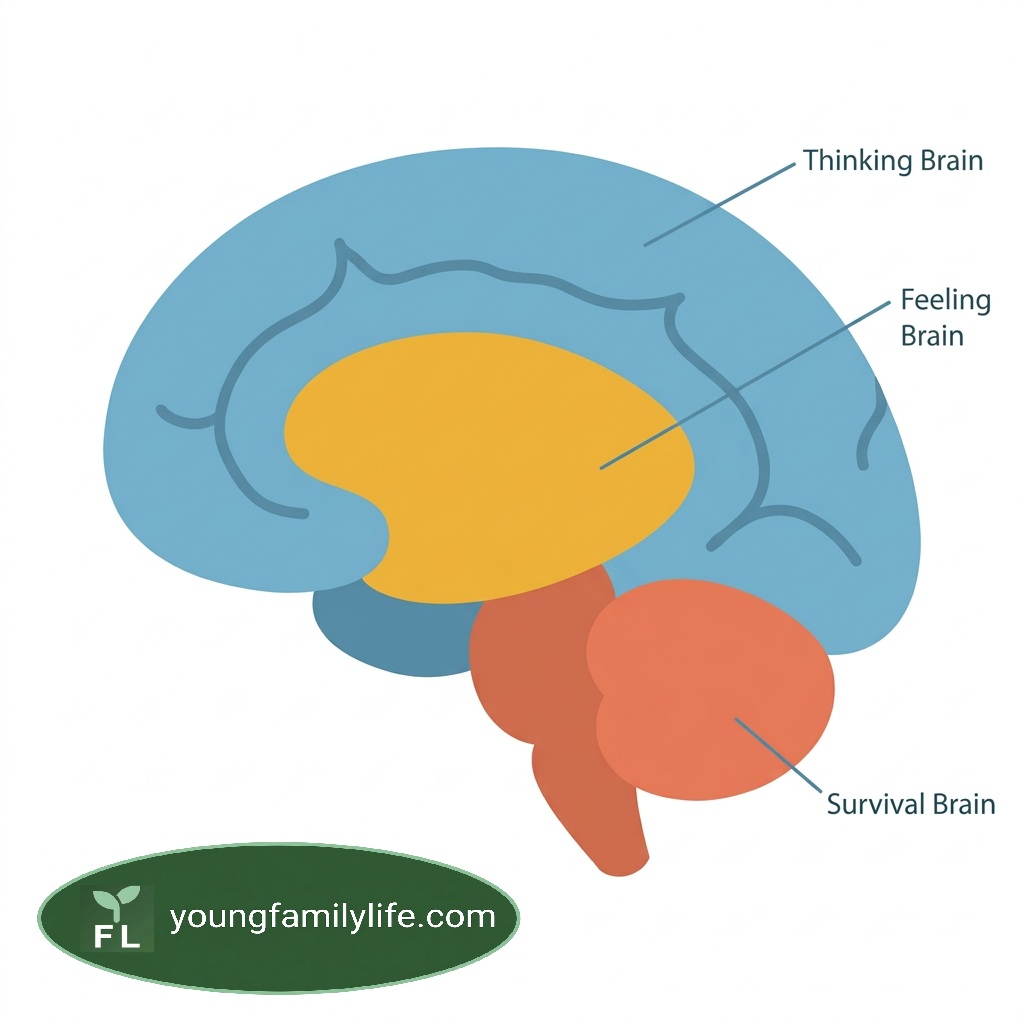
The human brain isn't one thing doing one job. It is more like three separate systems, each with its own role, all running at the same time — and each capable of taking the lead depending on what is happening around them.
The Survival Brain is the oldest part. It keeps breathing going, the heart beating, the body at the right temperature. It runs entirely in the background and most people never notice it — until something feels genuinely threatening, at which point it can take over almost instantly. The Survival Brain doesn't think and doesn't feel. It just acts. Its only priority is keeping the person alive.
The Feeling Brain is where emotions live — fear, love, anger, joy, grief, the need to belong. It is fast, powerful, and it remembers everything that has ever felt safe or threatening. It is always watching for signs that something is wrong. When something feels off — even when it can't be explained — that is the Feeling Brain picking it up. It doesn't use words.
The Thinking Brain is the newest addition and the most sophisticated. It plans ahead, weighs options, understands consequences, and can reflect on its own behaviour. It is the part that can say — wait, let me think about this before I react. The Thinking Brain has a weakness: it works well when things feel calm and safe. Under emotional pressure, it tends to lose its footing. The Feeling Brain can override it. The Survival Brain can take over completely.
Most of the time, the three work together well enough. When the Feeling Brain senses something is wrong, it turns up its volume — and the Thinking Brain struggles to be heard over it. When the Survival Brain decides there is real danger, both of the others step back. This is not a design flaw. It kept human beings alive for a very long time.
How a brain takes shape — from birth to adulthood
A brain builds itself from the bottom up, always in the same sequence. The Survival Brain is built first, then the Feeling Brain, then the Thinking Brain. And at every stage, the world around the developing brain shapes how it builds — just as much as biology does.
Research into child development has found something that surprises many people. A child's brain can develop well even when good, attuned care is only present around 30% of the time. The brain is more robust than most people assume. It doesn't need perfection. What it needs is enough good experience — and repair when things go wrong. A caregiver who misreads the baby, comes back, and reconnects is teaching the Feeling Brain something important: things can go wrong and then get better. People come back. That pattern — things going wrong and being put right again — is what emotional resilience is made of.
The first year is where the Feeling Brain is building faster than it ever will again. It is asking its most important questions: Is the world safe? Do people show up when I need them? Can I trust what is around me? Every time a caregiver responds to a baby's distress — calmly, reliably — the Feeling Brain learns how to settle. That lesson gets built into the brain's structure. When those responses are missing, frightening, or inconsistent, the brain builds differently — not broken, but shaped for a harder world.
Between around three and six months, the brain goes through its first major pruning. This one is mostly in the Survival Brain — the connections that support movement, holding, balance and physical coordination are being sorted and strengthened. At the same time, the Feeling Brain is doing its own early pruning, keeping the connections that are getting the most use: those built around how the people nearby respond to the baby's needs for comfort, feeding, and closeness. The connections that are used most survive. The ones that aren't begin to fade.
By the time a child is two, the Feeling Brain is enormous and in charge. Big feelings arrive with almost nothing to manage them. The Thinking Brain is just beginning to use words to get a foothold on big feelings — but that foothold disappears the moment feelings get big enough. A toddler's meltdown is not difficult behaviour. It is a Feeling Brain in full flow, meeting a feeling that the available equipment cannot yet manage.
Around age seven, the brain goes through a reorganisation that often goes unnoticed. It strengthens the connections that have been used most and prunes back the ones that haven't. For a child who has grown up in a safe, consistent environment, this locks in calm and resilience. For a child who has spent those years in a more difficult world, it locks in vigilance and a readiness to react — because those are the connections that got the most use.
Adolescence brings the biggest reshaping since infancy. The Feeling Brain surges — emotions become more intense, the radar for rejection becomes sharper, the need to belong becomes one of the most pressing things in the world. At the same time, the Thinking Brain is being rebuilt. During that rebuild, it is less reliable than it was — which is why teenagers can see clearly, in a calm moment, exactly what they should do, and still not manage it when feelings are running high. That is not a character flaw. It is what the brain looks like when it is doing two very difficult things at the same time.
The Thinking Brain doesn't finish building until the mid-twenties. That is when the full capacity to plan ahead, manage impulses, reflect on behaviour, and handle emotions is in place for the first time. Having that capacity, though, is not the same as having the habits that go with it. The patterns built across all the years before are still there — but the Thinking Brain is finally properly equipped to work on them.
When danger arrives: the six responses
When the Survival Brain decides something is threatening, it doesn't pause to consult the Thinking Brain. It acts.
These responses are not choices. They fire automatically, as fast as possible. They respond to emotional threat just as readily as physical danger. And for someone whose brain built itself in a difficult environment, they may fire faster and more strongly, in situations that don't actually warrant them — because the brain learned, long ago, that uncertainty usually meant trouble.
Fight — the threat is taken on directly. Confronting it, pushing back, standing ground. The body floods with energy. This is the most active response — going towards the danger.
Flight — getting away from it. Running, hiding, putting distance between the self and the threat. Still active, but moving away rather than towards.
Fawn — making the threat like you. Becoming agreeable, appeasing, helpful. This is where people-pleasing under pressure comes from — because being agreeable and unthreatening can make a threat less likely to cause harm.
Feign — performing something that isn't actually being felt, in order to mislead the threat. Acting more helpless than the situation warrants, putting on a front, performing calm when terrified. Animals do this — a bird faking a broken wing to draw a predator away from its nest. In people, it can look like acting fine when nothing is fine. It is an active, strategic response — the brain using performance as a survival tool.
Freeze — going completely still and waiting. Not shutting down — more like holding breath. The body stays alert underneath the stillness, scanning for a chance to act. The brain is buying time.
Flop — the system powers down entirely. The body goes limp, the mind disconnects, everything goes quiet. This is the furthest the brain goes to protect itself. When there is no way to fight, flee, appease, perform or wait it out, the brain removes a person from the experience as much as it possibly can. The Thinking Brain has gone completely offline. The Survival Brain has made its decision: the safest thing right now is to not be here.
These six sit in a rough order from most active to most passive, but they are not a neat sequence. The brain picks the one that fits fastest, based on what it has learned works. For someone whose brain built itself around difficulty, certain responses will fire more readily than others — not because of who they are, but because of what their brain learned to do to keep them safe.
How this shows up in relationships
Everything described so far shows up most clearly in relationships — because relationships are where the Feeling Brain is most active, and most open to being misread or misused.
The Feeling Brain is where relationships live. It tracks, constantly, whether the people nearby feel safe, whether belonging feels secure, whether warmth is real. What it learned early about relationships becomes what it expects from them — without the person necessarily knowing that is what is happening.
People whose early experience built a Feeling Brain around safety and reliable care tend to find relationships easier. Not because they are better people or more capable, but because their Feeling Brain's starting point is that relationships are broadly safe, that people are broadly trustworthy, and that when something goes wrong it can be sorted out. That makes it easier to trust, easier to settle, easier to hold steady when things get difficult.
People whose early experience built a Feeling Brain around unpredictability, absence, or fear find relationships harder — not because anything is wrong with them, but because their Feeling Brain is working from different expectations. It has learned to stay watchful, to read the room carefully, to react quickly when something shifts. That was useful once. In adult relationships, those same responses can fire in situations that don't need them — because the Feeling Brain is still working from what it learned a long time ago.
One pattern is worth understanding. A Feeling Brain that grew up where love and unpredictability came together — where the people who gave care also caused anxiety — can register uncertainty in a relationship as familiar. And familiar tends to feel like safe, even when it isn't. This is why people sometimes find themselves drawn to relationships that aren't calm, or staying in situations that are hard to explain from the outside. The Feeling Brain is recognising what it knows.
The Thinking Brain can work with these patterns — but the Feeling Brain tends to move first. Knowing why something happens and not being able to stop it in the moment are not the same problem. A person can have a clear picture of what they do and still find it hard to do differently when feelings are running high. That is not weakness. It is what it looks like when the Feeling Brain has had more practice than the Thinking Brain. What changes things, over time, is enough new experience to give the Feeling Brain something different to go on.
What the research leaves us with
The brain builds itself for the world it actually finds. When that world is safe, consistent and good enough, it builds a brain that expects things to be mostly okay, recovers from difficulty, and trusts that other people can help. When that world is unpredictable, frightening, or not enough, it builds a brain that stays watchful, takes longer to settle, and sees uncertainty as something to be wary of. Neither is a broken brain. Both are doing exactly what a brain is supposed to do — adapting to the world it has been given.
There is a hopeful part to all of this: the brain keeps adapting throughout life. The patterns built early are real and they matter — but they are not the final word. New experiences, new relationships, and new understanding don't erase what was built before, but they do build alongside it. Over time, with enough good new experience, the newer patterns can become the ones that run things.
Adults who understand how their own brain built itself, and what it learned to do to stay safe, are better placed to notice when those patterns are happening — and whether the situation actually needs them. That understanding is available to anyone who encounters it. What they do with it is entirely their own.
Topics: #InOtherWords #BrainDevelopment #ChildDevelopment #ThreeBrains #SixFs #AttachmentTheory #EmotionalRegulation #TraumaInformedPractice #HealthyRelationships #RelationshipDynamics #Grooming #Resilience #YoungFamilyLife
Related YFL Content
When Your Brain Has a Mind of Its Own — a closer look at how the Feeling Brain takes over under stress, and what that looks like in everyday adult life. A natural next step from the three-brain framework introduced here.
Narcissist, Misogynist, Misandrist: Positions, Not Pathologies — the eight-step progression applied directly to three commonly misused labels. How the same relational pattern shows up differently depending on who is driving it.
Family Climate — Governance, Warmth, and the Environment Children Grow In — the broader picture of the family environment that surrounds a developing brain. How the balance of structure and warmth shapes what the Feeling Brain learns to expect from the world.
Beyond Words — on what is communicated between people outside of language. The Feeling Brain picks up far more than words carry, and this essay explores what that means in close relationships.
Copyright Notice
© 2026 Steve Young and YoungFamilyLife Ltd. All rights reserved.
"In Other Words" is a copyrighted content format of YoungFamilyLife Ltd.
The information in this piece is based on established research and theory. Full academic sources, references, and evidential detail are available in the linked YoungFamilyLife essays.
This essay was developed collaboratively using AI assistance to research academic sources and refine content structure, while maintaining the author's original voice, insights, and "Information Without Instruction" philosophy. No part of this essay may be reproduced, distributed, or transmitted in any form or by any means, including photocopying, recording, or other electronic or mechanical methods, without the prior written permission of the copyright holders, except in the case of brief quotations embodied in critical reviews and certain other noncommercial uses permitted by copyright law.
For permission requests, contact: info@youngfamilylife.com