What the brain was actually built for
For most of human history, people lived in small groups. Not towns. Not cities. Groups of around 50 people — sometimes a bit more, rarely much less. Everyone knew everyone. People tracked who had helped them, who had let them down, who could be trusted. That kind of close knowledge was how human beings stayed safe and got things done.
The brain developed to handle exactly that kind of world. Research by the British anthropologist Robin Dunbar found that the human brain can comfortably manage about 150 relationships — and starts to struggle beyond that. Below that number, people can track individuals, remember what they know about each person, and feel personal accountability for their actions. Above it, something shifts.
The world most people live in today is nothing like that. Football stadiums hold 50,000. Cities hold millions. Workplaces bring together hundreds of people who barely know each other's names. Online platforms connect thousands. The brain has not caught up. It is still running ancient software in a world that has changed completely around it.
Why it is easier to loot when everyone else is looting
When civil unrest breaks out and looting begins, people who would never steal alone sometimes join in. This is not simply a failure of character. It is the brain responding to a crowd the way it was built to respond — by following the group.
For tens of thousands of years, going against the group was dangerous. People who broke away from the group risked being left out — and being left out, in a world without supermarkets or central heating, could mean dying. So the brain developed powerful pull toward going along with whatever the people around were doing. That pull is not a conscious choice. It happens automatically, below the level of awareness.
The American psychologist Solomon Asch showed this in a simple but striking experiment in the 1950s. Participants were asked to judge which of three lines was the same length as a target line — an easy task with an obvious answer. But when the other people in the room (who were secretly working with the researchers) all gave the wrong answer, around a third of participants went along with them. Intelligent adults denied what their own eyes were telling them, because the pressure of the group was that strong.
People do not need to be stupid or bad for this to happen. They just need to be in a crowd. The biology of belonging — the brain's ancient drive to fit in, to not be cast out — does not care much whether the group is right or wrong.
When a professional team becomes a mob
Mob behaviour is not just something that happens on streets or social media. It shows up in professional settings too — including in systems designed to help families.
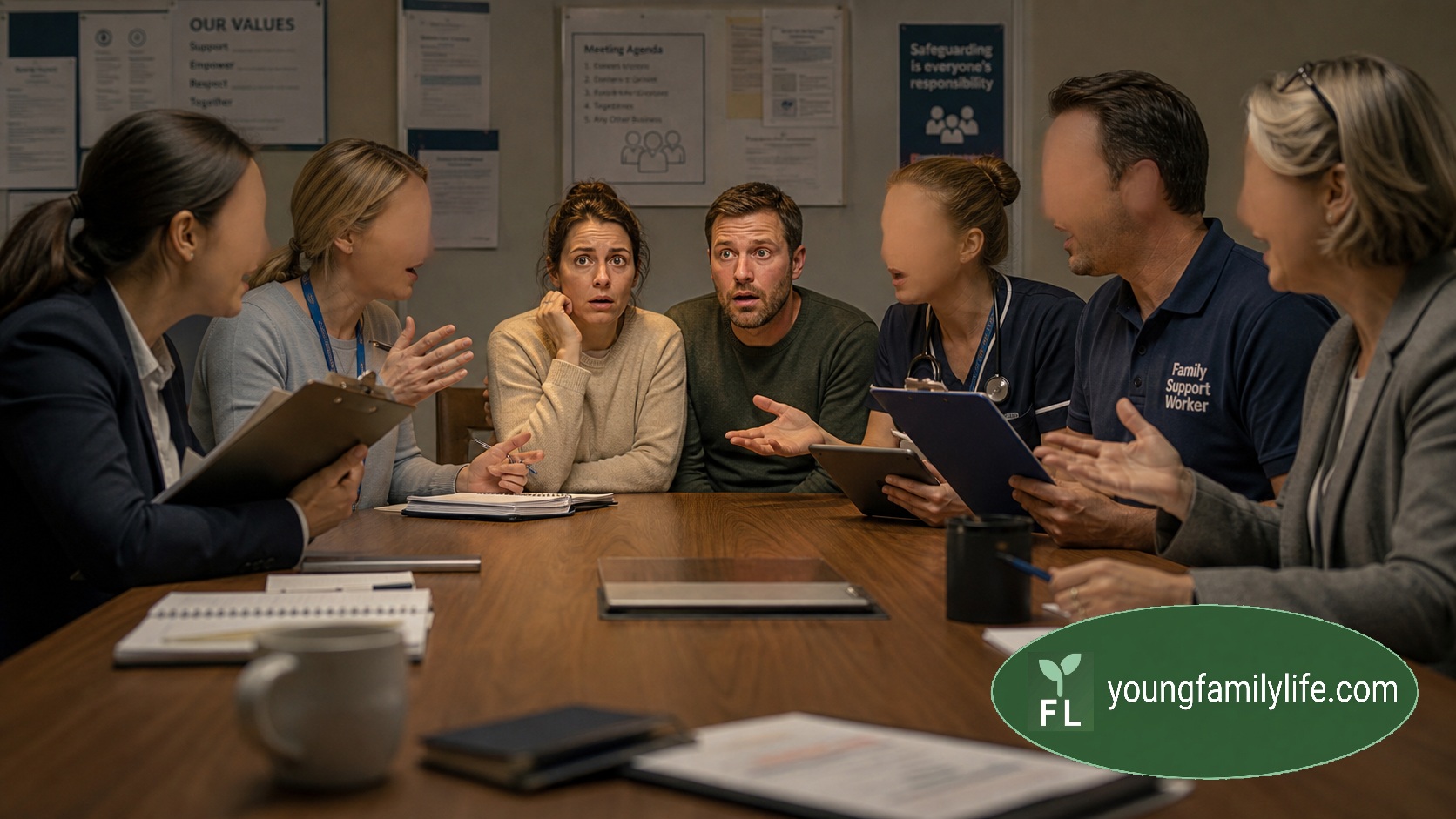
Many families in difficulty will be familiar with what professionals call a "team around the family" — a group of workers from different services all involved with the same household at the same time. A social worker. A family support worker. A school contact. A health visitor. A housing officer. Sometimes more. The idea is that everyone working together produces better outcomes.
There are very good reasons why this model exists. Serious case reviews — independent investigations carried out after a child has been seriously harmed or killed — have repeatedly found that professionals from different services each held a piece of the picture, but never shared it. One worker knew about the domestic violence. Another knew about the missed school attendance. A third knew about the parent's mental health history. None of them told each other. No one connected the dots. Professionals working in complete isolation from each other is not a safe alternative — it has cost children their lives. The multi-agency approach was built directly in response to those findings, and the principle behind it is sound.
What the research on human social capacity suggests, though, is that once a group gets beyond about fifteen people, the brain can no longer track individuals clearly enough for genuine teamwork to happen. And the network around a family is almost always much larger than it first appears. The frontline workers who visit the home are only the visible part. Behind each of them sits a manager who supervises their decisions, a team leader who attends strategy meetings, a safeguarding lead who signs off on risk assessments. Add the head teacher who has concerns about a child's attendance, the school's own designated safeguarding lead, the supervisor who reads case notes, the administrator who takes minutes at every professionals' meeting. By the time the full network is counted, the number of people connected to a single family can reach thirty, forty, or more — most of whom the family has never met, and many of whom have never met each other. People stop being known individuals to each other. They become role-holders — "the social worker", "the health visitor" — and the group starts to function less like a team and more like a crowd. Responsibility becomes spread so thin that no one person feels clearly accountable for what happens.
When that happens, the group develops a shared story — a simple account of the situation that everyone can agree on. "This is a complex family." "These parents are trying but struggling." "The children need protecting." The story gives the group a sense of shared purpose. It also makes it very hard for any individual in the group to say something different, because the same biology that drives looting also drives professional conformity. Standing apart from what everyone else believes is biologically uncomfortable in a way that is hard to overstate.
The problem with rescuing people who need to stay rescued
The psychiatrist Stephen Karpman described what he called the Drama Triangle — a pattern where three roles keep spinning in relation to each other: a victim, a rescuer, and a persecutor. Each role needs the others to keep going. The rescuer needs the victim to be in need. The victim needs the rescuer to stay involved. The persecutor — often a system, a rule, or an institution — provides the injustice that keeps both the other roles in motion.
In professional helping, this triangle often operates without anyone realising it. A family in difficulty receives support from a large network of professionals. The family stays in difficulty. The professionals continue providing support. Everyone in the system gets something from the arrangement — the professionals get purpose and identity, the family gets attention and resources — but nothing fundamental changes. The family's continued struggle is not just a problem. It is also, without anyone intending it, the thing that holds the whole structure together.
This is not a criticism of individual professionals, most of whom are doing their best in genuinely difficult circumstances. It is a description of what can happen when human beings operate in groups that are too large for normal brain processing — when the scale of the system makes honest individual thinking very hard to sustain.
Why people who know something is wrong often say nothing
Eric Berne, the psychiatrist who developed Transactional Analysis, wrote about what he called strokes — the small signals of recognition and approval that people give each other all the time. A nod. A smile. Agreement in a meeting. Being included in a conversation. These small moments of acknowledgment matter to people more than they might think. Berne argued that strokes are as important to emotional wellbeing as food is to physical health.
In a professional group, strokes flow when people agree with the shared story. They stop flowing when someone challenges it. The person who says "I'm not sure this family can change" or "I think we're maintaining this situation rather than improving it" does not get punished outright. They are simply left out. Not invited into the conversation. Not thanked. Not acknowledged. And that quiet withdrawal of recognition is, for a primate brain, a form of exile.
The UK Post Office Horizon scandal showed what this looks like at scale. Hundreds of people were wrongly prosecuted for theft because of a faulty computer system. Many people within the organisation knew something was wrong. Almost none of them said so publicly. When later asked why, most said they did not want to cause trouble, did not want to be seen as difficult, did not want to rock the boat. That is not an excuse. It is an accurate description of how powerful the pull toward group approval actually is — even when lives are at stake.
What understanding this actually changes
Mob behaviour is not a sign of weakness or bad character. It is what happens when primate brains — built for small, close groups — encounter scales they were never designed to handle. The compulsion to follow the group, to stay inside the shared story, to avoid the cost of standing alone is not something people choose. It is wired in.
Understanding this does not make mob behaviour acceptable. It makes it legible. Systems that want to prevent the kinds of failure the Post Office scandal revealed — or the kind of professional drift that keeps families stuck — need to account for this biology rather than assume that good intentions and professional training are enough to override it.
Practitioners who recognise mob dynamics in their own professional settings are better placed to notice when a shared story has stopped being accurate — and to make a conscious choice about what to do with that awareness. That choice will always carry a cost. Understanding why it costs what it does is at least a start.
Topics: #InOtherWords #MobBehaviour #GroupDynamics #ProfessionalPractice #SystemsThinking #EvolutionaryPsychology #DramaTriangle #GroupThink #YoungFamilyLife
Related YFL Content
Living Emergence: How Collective Intelligence Shapes Our Everyday Lives — explores how individual behaviour combines into collective patterns, a direct companion to the mob dynamics described here.
The Evolutionary Roots of Resistance — the biological reasons why people resist change, closely connected to the conformity pressures that drive mob behaviour.
In Other Words: why the body returns to danger — another piece exploring how biology shapes behaviour in ways that can look like choice but often aren't.
Beyond Words: What Is Missed When Parents and Practitioners Focus on What is Spoken — looks at how communication happens on multiple levels at once, relevant to understanding how professional groups maintain shared stories without ever stating them openly.
Copyright Notice
© 2026 Steve Young and YoungFamilyLife Ltd. All rights reserved.
"In Other Words" is a copyrighted content format of YoungFamilyLife Ltd.
The information in this piece is based on established research and theory. Full academic sources, references, and evidential detail are available in the linked YoungFamilyLife essays.
This essay was developed collaboratively using AI assistance to research academic sources and refine content structure, while maintaining the author's original voice, insights, and "Information Without Instruction" philosophy. No part of this essay may be reproduced, distributed, or transmitted in any form or by any means, including photocopying, recording, or other electronic or mechanical methods, without the prior written permission of the copyright holders, except in the case of brief quotations embodied in critical reviews and certain other noncommercial uses permitted by copyright law.
For permission requests, contact: info@youngfamilylife.com