The Unplanned Day
London, April 2026. I had no itinerary — no plan beyond arriving and walking. On the train in from Suffolk I discovered there was a major tube strike, which mattered less than it might have, since I navigate London largely on foot. I had recently acquired an Art Fund card and, looking for free entry options, found that Keats House in Hampstead qualified. Worth the overground journey from Liverpool Street.
There is something quietly fitting about beginning a day that ends with Freud at the home of John Keats. The poet who died at twenty-five, surrounded by loss, still making beauty from the wreckage of a consuming illness. Keats understood, with a clarity most people spend decades arriving at, that suffering and creative life are not opposites. He named it, in a letter, the capacity to remain in uncertainty without an irritable reaching after fact and reason. He called it Negative Capability. It is not a bad description of how grief actually works — and of what good bereavement support asks of those who offer it.
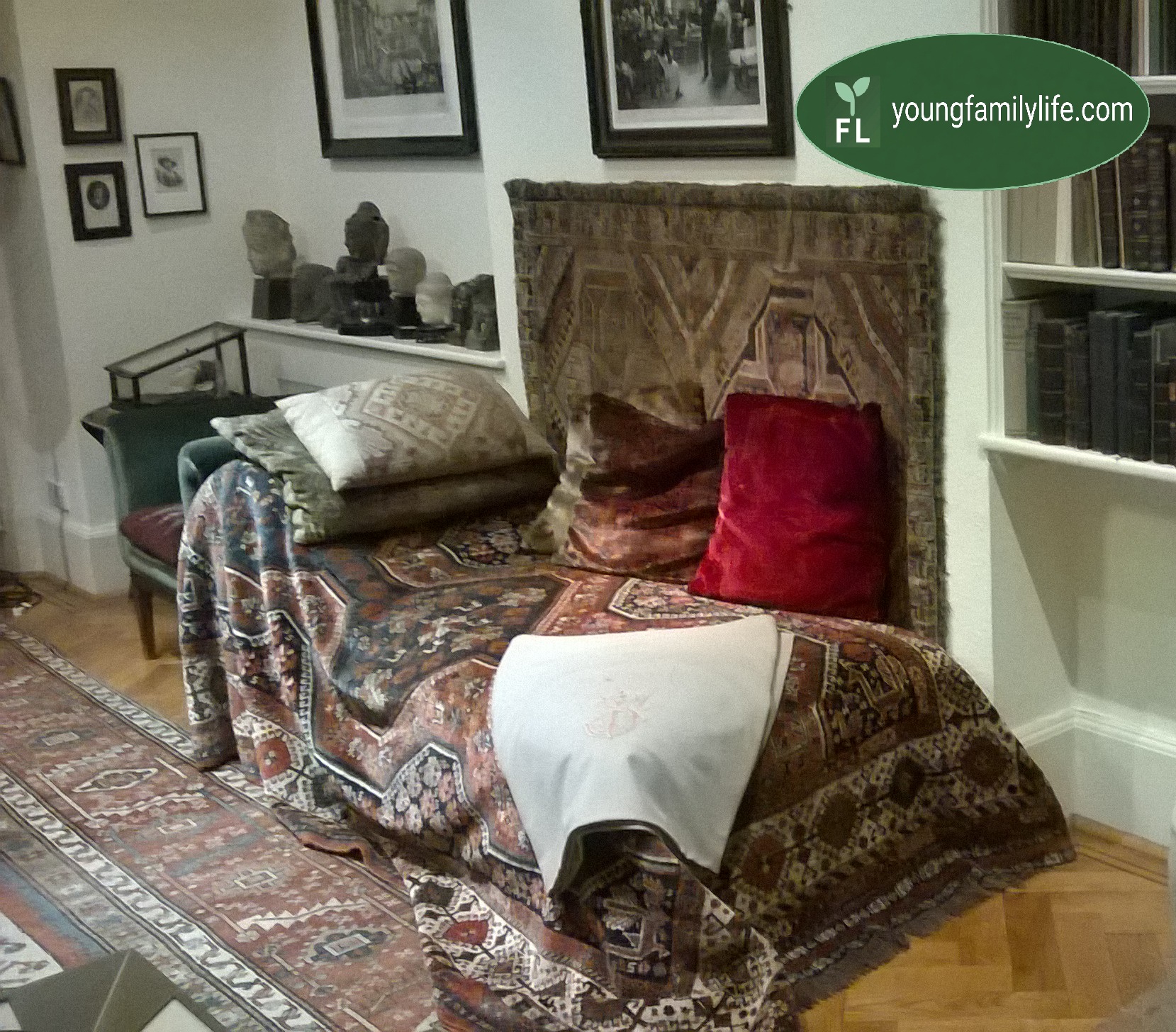
From Keats House, I walked south into London. Finchley Road. The sudden recognition — the Freud Museum is nearby. I knew it well. It had been a supervision venue during my postgraduate Systemic Family training at King's College London and the Anna Freud Centre; I had sat in a room adjacent to the famous study, the couch visible through the doorway. It felt significant then. It feels differently now.
At the museum entrance — relocated to the rear, through the gift shop — I overheard an exchange. A potential visitor was asking the person at the desk what exactly they would see for the entry fee. The fee was in excess of fourteen pounds. The visitor appeared to reconsider. My inner voice, unbidden: Don't pay. This is everything that is wrong with psychoanalysis — overblown, overpriced, and self-declared precious. The thought stayed internal. I walked on.
Sigmund Freud lived in the house at 20 Maresfield Gardens for approximately ten months before his death in 1939, having fled Vienna following the Nazi annexation of Austria. The museum presents it as a sanctuary and theoretical foundation. It is neither, quite. The ideas that matter were not born there. They were carried there, and then they moved on — to the Tavistock, to the consulting rooms of colleagues, to the books that outlasted their author by almost a century.
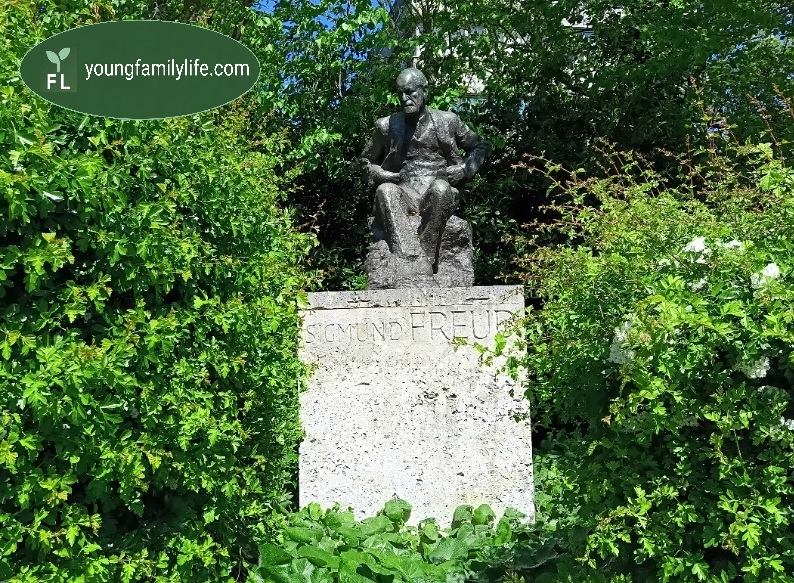
A few streets away, outside the Tavistock Centre, there is a statue. Bronze, seated, contemplative, half-swallowed by green shrubbery as if the surrounding city has been slowly reclaiming it. Sigmund Freud, inscribed on the stone plinth. I found it by accident on a walk between Keats and a Wetherspoon's near Baker Street. As good a metaphor as any for how psychoanalytic ideas tend to arrive: not sought, half-hidden, and more interesting than the institution that guards them.
The Last Taboo
The year was approximately 1985. I was in my second significant job, working for Invicta Radio in Kent — arrived at in my mid-twenties with a great deal of energy and no particular plan. The role began as a part-time helpline worker at the launch of a new listener service: an off-air telephone resource for people who had heard something on air and wanted to follow it up. Local hobby groups. Community events. And, as the brief acknowledged almost in passing — "I'm lonely and want someone to talk to."
That phrase deserved more weight than it received in the job description.
The helpline had not yet gone live. My first task was to build the information database it would run on. My approach was practical and lateral: I liaised with the library service, borrowed their existing catalogue system, and applied it to the incoming information. A working framework built from an existing one, rather than invented from nothing. The presenters also needed material — identified subjects, researched, with an expert willing to go live on air and answer questions. My working method with organisations was consistent: here is ten minutes of radio time. Write it for us. A genuine exchange. Most organisations responded well to the invitation.
One week the subject was garden pond construction — specifically, encouraging listeners to build ponds for amphibians rather than fish. The item was presented by Dave Cash on his Saturday morning show. It worked well.
My instinct was to swing as far as possible in the opposite direction for the next subject. I chose bereavement.
In 1985, death was the last social taboo in Britain. People spoke more openly about sex than they did about dying. Grief was managed through silence, through the stiff-backed carrying-on that passed for resilience, through an unspoken agreement that the bereaved should return to normal within a period that was never specified but was always shorter than it needed to be. The radio item would be an attempt to open the subject into the air.
My first call was to Cruse.
Cruse Bereavement Care had only recently expanded its remit. Founded in 1959 to support widows — the name derived from a biblical image of a widow's inexhaustible jar of oil — it had just changed to offer bereavement support to anyone who had experienced loss. That shift mattered. Grief had been quietly reclassified from a widows' problem to a human one.
The call yielded the information I needed for the radio item. It also yielded something more lasting: a clear-eyed description of what Cruse actually did. There was no elaborate theory on offer. No stages, no clinical framework, no institutional language. The Cruse model, as explained in that initial conversation, was simple to the point of elegance.
Counsellors would identify whether someone had become blocked in their grieving process. If they had, the counselling intervention was designed to unblock it. That was the work. Not to manage grief, not to process it on a timeline, not to move someone through prescribed stages. Simply to identify where the natural movement of grief had stalled, and to help it find its way through again.
The simplicity was striking. It still is.
What the Theorists Understood
The Cruse model did not emerge from nowhere. It rested, whether its practitioners named it or not, on a body of theoretical work that had been quietly reshaping how bereavement was understood since the late 1950s.
The most widely known framework — then as now — was Elisabeth Kübler-Ross's five stages of grief, introduced in her 1969 book On Death and Dying. Kübler-Ross had developed the model from her clinical work with terminally ill patients, describing the stages she observed: denial, anger, bargaining, depression, and acceptance. The framework entered popular consciousness with remarkable speed and has never quite left it. It became the shorthand for grief in medical training, in counselling courses, in sympathy cards, in newspaper features.
The problem is that Kübler-Ross herself did not intend it as a rigid sequence. She noted that most patients exhibited two or three stages simultaneously, and in no fixed order. She later expressed regret that the model had been misread in exactly the way it was most widely taught. The five stages were an observation, not a prescription. They described what she saw, not what should happen. That distinction was comprehensively lost in translation.
Into this landscape came Colin Murray Parkes. Working alongside John Bowlby at the Tavistock Institute, Parkes developed a four-phase model of grief that was both more precise and more honest about its own limitations. He identified four phases of bereavement — explicitly described as phases rather than stages, and not intended as a sequence:
- Shock and Numbness — the initial period of disbelief and emotional anaesthesia; functioning may be impaired and concentration brief
- Yearning and Searching — intense pining for the person who has died; the attachment system activating, looking for what it has lost
- Disorientation and Disorganisation — the collapse of the assumptive world; the person the bereaved were, and the life they understood, no longer coheres
- Reorganisation and Resolution — a gradual rebuilding; not a return to what was, but a new configuration around the reality of permanent loss
People may experience several phases at once, revisit earlier ones, or remain in one phase for far longer than another. The framework was a map of the territory, not a route through it.
What distinguished Parkes's framework was its theoretical foundation in attachment theory. Bowlby had argued, from the 1950s onwards, that the human need for attachment — for close emotional bonds with specific others — is not secondary to physical needs but primary. It is wired in. The infant's distress when separated from a caregiver is not a learned behaviour; it is the attachment system activating in response to perceived threat. The protest, the searching, the despair — these are not failures of regulation. They are the attachment system doing exactly what it was designed to do.
Grief, in Bowlby and Parkes's framework, is what the attachment system does when a bond is severed by death. The yearning, the disorientation, the searching behaviour — the sense of catching a glimpse of the person in a crowd, or turning to tell them something before the reality reasserts itself — these are not symptoms of dysfunction. They are the proportionate response of an attachment system that has lost its anchor. Grief is separation anxiety in its most profound and permanent form.
This reframing changes everything about how support should be offered. It means grief is not a problem to be solved but a process to be accompanied. It means the supporter's role is not to accelerate movement through stages but to remain present whilst the attachment system gradually, painfully, reorganises itself around the reality of permanent loss.
That is, in essence, what Cruse was doing. The language was different. The theory was implicit rather than explicit. But the practice mapped directly onto what Bowlby and Parkes were describing: grief has its own momentum, and the task of support is to identify where that momentum has been interrupted, and to help it move again.
Also in this period, and connected through the Tavistock, Dora Black was developing the third dimension of this theoretical inheritance: what grief looks like in children, and how it moves through families. Black, who held a joint academic chair between the Tavistock Clinic and the Royal Free Hospital, had observed that when bereaved mothers were being supported, their children were largely invisible. She brought the family into the frame — grief not as an individual journey but as something carried and expressed differently at each developmental stage within a household.
The bereaved child does not grieve as the bereaved adult does, but they grieve. And the family system contains and transmits grief in ways that individual models do not capture. This would matter considerably, some years later, in my own work with families in crisis.
Rosemary Pearce and the Medway Branch
The radio item on bereavement was made and broadcast. The helpline continued. Several years passed. Then the station changed ownership. The new owners made operational cuts. The helpline was among them.
Unemployment followed. This was the mid-1980s; jobs were not plentiful. I had time to fill, and no particular plan for filling it.
My call to Rosemary Pearce, the Southern Region organiser for Cruse, was not a grand decision. It was a practical one: I had time available, Cruse had made an impression, and it seemed worth offering. Rosemary explained that Cruse was considering opening a new branch in Medway — the cluster of towns in North Kent that included Rainham, where I then lived. Would I be interested in being involved in establishing it?
I was.
What followed was several years of committed involvement. Deputy chair of the new Medway branch. Involvement in recruiting and training volunteers. Undertaking the Cruse counsellor training myself. And then active practice as a Cruse counsellor — sitting with people in the early, raw, disorienting territory of bereavement. Not directing them through stages, not offering a map, but being present whilst the attachment system did its difficult work of reorganising around an absence.
The Cruse experience confirmed something that the radio call had suggested: the most effective bereavement support is often the simplest. A calm, reliable, non-anxious presence. The capacity to sit with distress without needing to resolve it. The ability to hear what is actually being said, rather than what it would be more comfortable to hear. These are not dramatic interventions. They are, in Parkes's terms, the conditions under which grief can complete its natural movement.
My involvement with Cruse eventually came to a natural close. A relationship, a move to Norwich, a shift in the centre of gravity of daily life. A brief period with Norwich Cruse that never gathered the same energy. A resignation that felt honest rather than reluctant.
But somewhere in those years, I attended two meetings with Colin Murray Parkes himself. One in particular: a presentation by Parkes, followed by discussion. A member of the audience put it to him that bereavement should not be regarded as a problem.
Parkes paused. He considered the statement — genuinely, not for effect.
— Colin Murray Parkes
That pause contained everything. The refusal to pathologise. The return of the experience to the person living it. The implicit argument that grief does not need to be reclassified as a clinical problem in order to receive support — it needs to be taken seriously, on its own terms, as the most significant difficulty in a person's life.
It is, perhaps, the most useful thing I have heard in a professional career spanning several decades and many rooms of theoretical discussion.
The Ambivalent Inheritance
My secondary school grades did not suggest an academic future. The route to formal study was long and non-linear — counselling certificates in my late thirties, a diploma, years of practice between each, and eventually a BSc (Hons) in Integrative Counselling awarded by Middlesex University in 2008, which pulled two decades of experiential learning into a coherent theoretical framework. It was that degree, and the integrative foundation it formalised, that made the next step possible.
Systemic family training at King's College London came later — a full postgraduate year at KCL, UCL, and the Anna Freud Centre. Lectures and seminars at the Tavistock. Supervision at the Freud Museum — in a room next to the study, the couch visible through the doorway. The psychoanalytic and attachment frameworks I encountered in that training were not alien territory by that point. They were retrospective explanations for something I already understood through practice — including, more than two decades earlier, a church hall in Medway.
My theoretical encounter with psychoanalysis in formal training was, and remains, genuinely mixed.
What it offered was real and remains valuable: a language for the interior life, for the way early experience shapes relational patterns, for the unconscious processes that families enact without awareness. Object relations theory, attachment theory, the concept of the assumptive world that Parkes placed at the centre of his grief framework — these are not decorative additions to clinical practice. They illuminate things that behavioural and cognitive frameworks sometimes miss entirely. I have written in more detail about what psychoanalytic approaches genuinely offer — particularly regarding environmental and generational influence — in the YFL essay Natural Healing: Understanding Recovery Across Physical, Psychological, and Therapeutic Domains.
What the institution around them sometimes offers is something else. The preciousness. The mystique. The fourteen-pound entry fee to view ten months of a dying man's relocated furniture. The tendency of psychoanalytic culture to mistake the elaborateness of its language for the depth of its insight. My inner voice outside the Freud Museum was not anti-intellectual. It was the accumulated scepticism of someone who had seen what simple, clear, boundaried, attachment-informed support could actually do — and who was standing outside a gift shop being asked to pay for the privilege of venerating the brand.
The ambivalence is not a contradiction. It is, I think, the most honest position available: to hold the theoretical inheritance seriously whilst remaining critical of the institution that curates it. To recognise that Bowlby and Parkes did their most important work not by building a mystique but by observing — Bowlby watching children separated from caregivers and drawing careful conclusions about what their distress was actually telling us; Parkes bringing the same rigour to bereavement through psychiatric practice and longitudinal research. The insight came from looking closely at what was in front of them, not from the elaborateness of the framework they built around it.
That is what Cruse understood, long before the theoretical framework had a name.
Back to the Statue
The photograph at the top of this essay was taken at the Tavistock, not the Freud Museum. The distinction matters.
The Tavistock statue shows Freud as the theorists who followed him needed him — seated, contemplative, half-absorbed into the surrounding green. Present but receding. The ideas moving on without him, carried forward by Bowlby, Parkes, Black, and the countless practitioners who took the attachment framework into consulting rooms, bereavement services, family support teams, and a radio station helpline in Kent in 1985.
The ideas that survive do so because they are true to something. Not because they are expensive to visit.
What Cruse understood in its simplest formulation — identify the block, unblock the grief — was an operationalisation of everything Bowlby and Parkes had spent careers articulating. Grief has momentum of its own. It moves, when allowed to. It stalls, when something interrupts the movement. The task of support is not to manage the process but to be a reliable, non-anxious presence alongside it — and to notice, gently, where the movement has stopped.
For families, this matters in ways that individual grief models do not always capture. Grief travels through a household. It is expressed differently by a seven-year-old than by their surviving parent. It is sometimes silenced by one member of a family in an attempt to protect another. It reappears, years later, in places and forms that seem unrelated to the original loss. Dora Black saw this clearly. A family does not grieve as a unit; it grieves as a collection of individuals who must somehow go on living together, and the ways in which it does or does not manage that process leave marks that can last for generations.
This is not a theoretical observation for me. It is something I encountered repeatedly across twenty years of family safeguarding and early help work. Loss — of a parent, a relationship, a sense of safety, a version of a future — sits inside families in ways that require exactly what Cruse, at its best, provided. A calm presence. An honest acknowledgement of the magnitude of what has been lost. No instructions. No stages. No timeline.
Just the patient work of being alongside.
The Foundation That Holds
What Bowlby and Parkes built was not a mystique. It was not a brand, a school of institutional prestige, or a set of ideas that required an expensive threshold to cross before they could be accessed. It was a framework grounded in careful observation — Bowlby watching children in separation and trauma and drawing rigorous conclusions about what their distress was telling us about human need; Parkes applying that same clarity through psychiatric practice and longitudinal research to the specific territory of bereavement. Between them they produced something that has lasted not because it was elaborately constructed but because it was true.
That is the test that good theory passes. It holds when you put weight on it. It explains what you are seeing in the room before you have found the words for it. It survives contact with real people in real distress — the father whose grief was being read as abandonment, the child sitting perfectly still whilst being described as dangerous, the widow in a church hall in Medway who had stopped moving through her loss and needed, simply, someone to sit with her whilst it began to move again.
The framework Bowlby and Parkes left is of that kind. Grief is the attachment system doing what it was designed to do. It has momentum of its own. It does not require instruction or management or a timeline. It requires honest acknowledgement of its magnitude, and a reliable human presence alongside it — one that can notice, without anxiety, where the movement has stalled.
That understanding has served families, practitioners, and bereavement services across seven decades. It continues to do so. The statue in the shrubbery outside the Tavistock is a reasonable symbol for how ideas of this quality endure — not because they are venerated behind an entry fee, but because they keep proving themselves useful in the places where it matters most: in consulting rooms, in church halls, in family support services, in the quiet moment when someone who has been stopped in their grief begins, tentatively, to move again.
Grief does not resolve. It reorganises. And the theoretical inheritance that helps us understand why — and what good support therefore looks like — is one of the more solid foundations the human sciences have produced. It deserves to be known, and used, and passed on. Not preserved. Used.
When there is none to heal it
Nor numbed sense to steel it,
Was never said in rhyme.
— John Keats, In Drear-Nighted December (written December 1817, aged 22)
References
Black, D. (1996). Childhood bereavement. BMJ, 312, 1496.
Bowlby, J. (1969). Attachment and Loss, Vol. 1: Attachment. Basic Books.
Bowlby, J. (1973). Attachment and Loss, Vol. 2: Separation — Anxiety and Anger. Basic Books.
Bowlby, J. (1980). Attachment and Loss, Vol. 3: Loss — Sadness and Depression. Basic Books.
Harris-Hendriks, J., Black, D., & Kaplan, T. (1993). When Father Kills Mother: Guiding Children through Trauma and Grief. Routledge.
Kübler-Ross, E. (1969). On Death and Dying. Macmillan.
Kübler-Ross, E., & Kessler, D. (2005). On Grief and Grieving. Scribner.
Parkes, C.M. (1972). Bereavement: Studies of Grief in Adult Life. Tavistock Publications.
Parkes, C.M., & Prigerson, H.G. (2010). Bereavement: Studies of Grief in Adult Life (4th ed.). Penguin.
Keats, J. (1817). In Drear-Nighted December. [Written December 1817; first published posthumously in The Literary Gazette, 1829.] Public domain.
Young, S. (2026). Natural Healing: Understanding Recovery Across Physical, Psychological, and Therapeutic Domains. YoungFamilyLife Ltd.
Topics: #Bereavement #Grief #AttachmentTheory #Bowlby #ColinMurrayParkes #CruseBereavement #Psychoanalysis #FamilyLoss #ChildhoodBereavement #DoraBlack #KüblerRoss #ProfessionalReflection #TherapeuticPractice #FamilySafeguarding #MentalHealth #LossAndRecovery
Copyright Notice
© 2026 Steve Young and YoungFamilyLife Ltd. All rights reserved.
This essay was developed collaboratively using AI assistance to research academic sources and refine content structure, while maintaining the author's original voice, insights, and "Information Without Instruction" philosophy. No part of this essay may be reproduced, distributed, or transmitted in any form or by any means, including photocopying, recording, or other electronic or mechanical methods, without the prior written permission of the copyright holders, except in the case of brief quotations embodied in critical reviews and certain other noncommercial uses permitted by copyright law.
For permission requests, contact: info@youngfamilylife.com