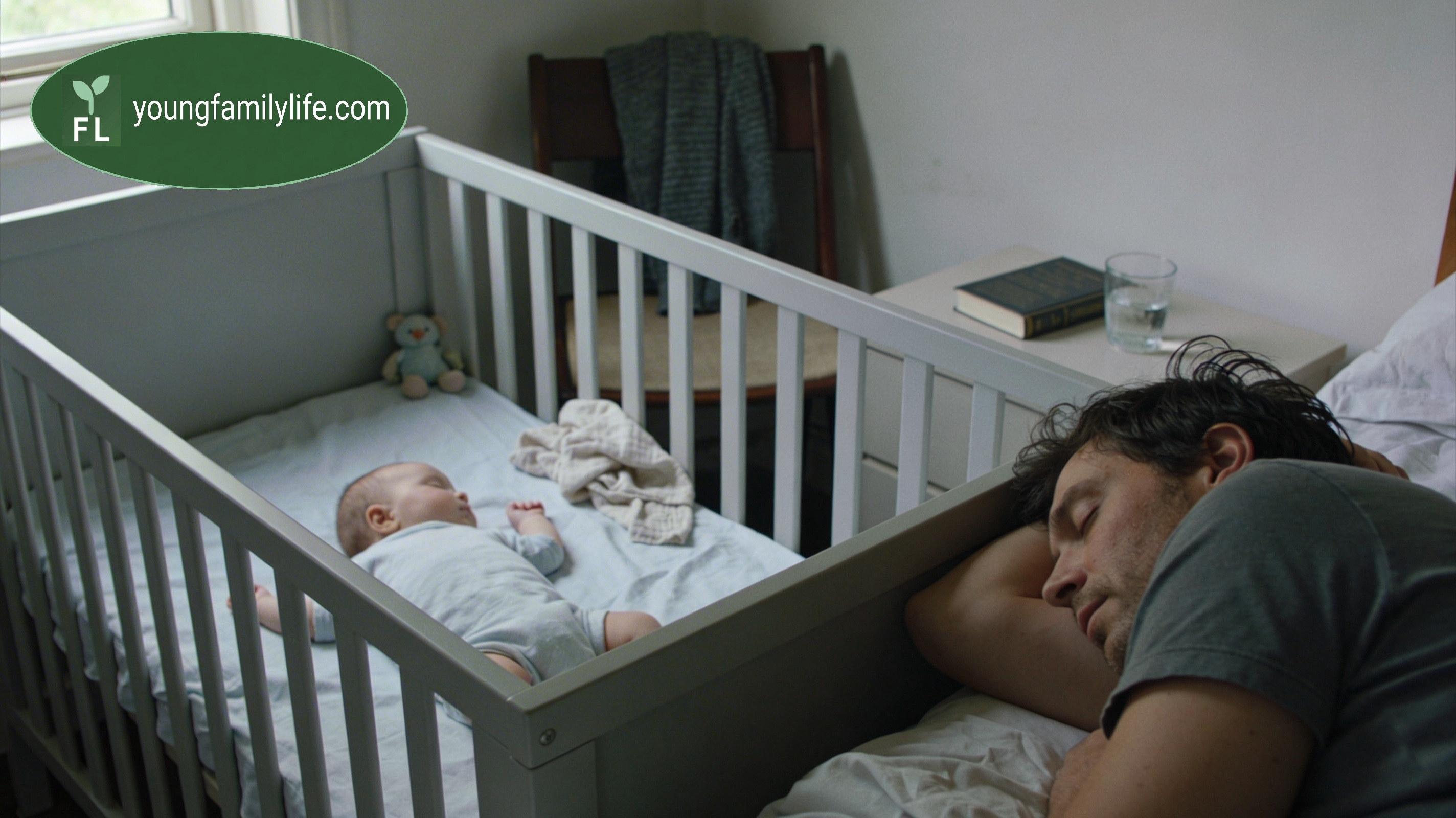
The Question That Keeps Coming Up
One of the most common things parents search for online — at all hours, but especially in the middle of the night — is some version of the same question: why won't my baby sleep through? When will it happen? Is something wrong?
The answers that usually come back are about routines, feeds, sleep associations, and settling techniques. What they tend not to include is the more fundamental question sitting underneath all of that: why do babies wake through the night in the first place? Not what to do about it — but why it happens at all, and what it actually means about the baby doing it.
The biology turns out to be genuinely interesting. And once it's understood, the picture of a waking baby looks quite different from the one that most parenting guidance tends to paint.
Sleep Is About Energy, Not Just Rest
The most common way of thinking about sleep is that the body needs it to recover — like recharging a battery. That's partly true. But sleep researchers have found that the more fundamental reason animals sleep is something simpler: saving energy.
A researcher called Jerome Siegel at the University of California, Los Angeles, has argued that sleep is best understood as the body's way of doing nothing useful — on purpose (Siegel, 2009). When there's no food to find, no threat to respond to, nothing to gain from being active, the most sensible thing a body can do is cut its energy use right down and wait. Sleep is that waiting state. It's not passive or accidental. It's a deliberate energy-saving strategy that evolution has been refining for hundreds of millions of years.
This matters because it changes what "normal" sleep looks like. If sleep is a flexible strategy rather than a fixed daily requirement, then it makes sense that different animals — and different stages of the same animal's life — would sleep in very different ways depending on what their situation needs.
What Other Animals Tell Us
The animal world makes the flexibility of sleep very clear. Wild African elephants sleep for roughly two hours a day. They have large areas to cover, constant predator awareness, and young to protect — so extended sleep isn't something their situation allows (Gravett et al., 2017). Put the same species in a zoo, with food delivered and no threats to watch for, and they sleep considerably more. The biology hasn't changed. The situation has.
Great frigatebirds — large ocean-going seabirds — have been studied during non-stop flights lasting up to ten days over the Pacific. During those flights, they sleep for an average of around forty minutes a day, sometimes with both halves of the brain at once and sometimes with just one half while the other stays alert (Rattenborg et al., 2016). They arrive having functioned perfectly well on a fraction of what anyone would call a proper night's sleep.
Bottlenose dolphins take this even further. Because they're mammals living in water, they can't afford to lose consciousness — they'd stop breathing. So they sleep with one half of the brain at a time, the other half keeping them swimming and surfacing (Lyamin et al., 2008). The eye connected to the sleeping half closes. The other stays open. It's not a workaround or a compromise. It's the sleep system doing exactly what the dolphin's situation requires.
The pattern across all of these animals is the same: the body takes the sleep it can, in the form that fits its circumstances, without following a fixed rule about how much or in what shape it must come. The rule is flexible. The principle — save energy when activity isn't needed — is what stays constant.
Why Babies Sleep the Way They Do
Here's something most people don't know. Human babies are born earlier in their development than almost any other mammal. A foal walks within hours. A baby giraffe is up and moving almost immediately. A newborn human can't do any of that. The reason is brain size — the human brain is so big relative to the birth canal that babies have to come out before they're finished. They do the rest of their developing on the outside, tucked up close to a carer.
What that means for sleep is really important. The wiring that produces long, deep, settled overnight sleep — the brain circuits, the hormones, the whole system — isn't in place yet when a baby is born. It takes months to come online, sometimes longer. So a baby waking repeatedly through the night isn't broken. It just isn't finished yet.
There's also an older reason for it. For most of human history, babies who woke up and made noise were more likely to get fed and checked and warmed up. Babies who slept quietly and deeply through the night were less likely to get any of those things. Over thousands of generations, the waking baby had the advantage. The body learned that lesson and kept it. Frequent night waking isn't a fault in the design. It was the whole point.
There's something else worth knowing about newborn sleep. A large portion of it — half or more in very young babies — is light, fidgety sleep with lots of movement and flickering eyes. In adults this is called REM sleep, and it takes up about a quarter of the night. Researchers think this active, light sleep in babies is connected to brain building — the brain is intensely busy during these phases, making new connections at a rate it'll never manage again (Graven and Browne, 2008). The restless nights aren't just an inconvenience. They may be the brain doing some of its most important work.
Sleeping in Bits Is the Normal Setting
The idea that sleep should happen in one long block overnight is pretty specific to modern Western life. Look across the animal world and the pattern is all over the place. Cats sleep in short stretches scattered through the day and night. So do dogs, horses, and lions. Most mammals sleep in pieces, fitting rest in around activity rather than banking it all in one go overnight.
Human babies arrive in this older, more scattered pattern. Their sleep is spread across the full twenty-four hours, and it gradually shifts toward night as their nervous system develops and their body starts to follow the rhythm of light and dark. That shift happens at its own pace — different in every baby — and it doesn't follow the schedule that milestone charts tend to suggest.
Helen Ball, who has spent over twenty years researching baby sleep at Durham University, keeps finding the same thing: the actual range of normal is far, far wider than most guidance implies. Plenty of babies take a year or more to reliably sleep through. Some take longer. That's within the normal range. The milestone tables that say otherwise are based on averages from a particular cultural setting — not on the full picture of what babies naturally do (Ball, 2003; Ball, Tomori and McKenna, 2019).
When Waking Is Worth a Closer Look
Babies waking through the night is normal — really normal. But a few things are worth a quick mention to a GP or health visitor, not as alarm signals but just because they're easier to look at with someone who knows the baby.
The ones worth flagging: crying that sounds different — not the usual hungry or overtired cry but something more distressed, perhaps with back arching or real discomfort that doesn't settle with feeding or closeness; a baby who had been getting a bit more settled and then suddenly isn't, without any obvious reason like a new tooth, a cold, or a change in the household; and waking that seems linked to the baby not feeding well or not gaining weight as expected.
For most babies, though, waking through the night across the first months — and often well beyond — is the body doing exactly what it's built to do. Waiting for it to get easier is a different question from whether something is wrong. For most families, the honest answer to the second question is: it isn't.
Topics: #infantsleep #babysleep #sleepingthrough #nightwaking #infantdevelopment #sleepbiology #adaptiveinactivity #REMsleep #HelenBall #HeyWantToKnow #YoungFamilyLife #informationwithoutinstruction #newparent #normalisingsleepwaking
Further Reading
These links dig deeper into the topics covered here:
Infant sleep research:
- BASIS — Baby Sleep Information Source — Helen Ball's Durham University resource on normal infant sleep patterns, backed by peer-reviewed research. A good place to start for anyone wanting to go further into the biology of how babies actually sleep.
- Sleep and brain development — Graven and Browne (2008), Newborn and Infant Nursing Reviews — Research on the role of active sleep in early brain development: why the restless, light sleep of newborns has a purpose.
The biology of sleep across species:
- Sleep viewed as a state of adaptive inactivity — Siegel (2009), Nature Reviews Neuroscience — The research paper behind the energy-saving account of sleep: what sleep actually is, and why the body does it.
- Evidence that birds sleep in mid-flight — Rattenborg et al. (2016), Nature Communications — The frigatebird study: how a large seabird manages on forty minutes of sleep a day during ten-day ocean crossings.
How This Essay Reflects YFL Values
This piece uses sleep biology, evolutionary science, and infant development research to explain something millions of parents go through but rarely get a straight biological account of. The information here comes from research, not from the parenting industry.
YoungFamilyLife puts the evidence out there and leaves what to make of it entirely to the reader. This piece doesn't tell parents how to manage their baby's sleep or when to expect things to change. That's nobody's call but their own.
Informed parents make better decisions for their own families. That is the only assumption this platform makes.
Related YFL Essays and Resources
Why Exhausted Parents Are Adapting, Not Failing — The companion piece to this one: why the exhaustion of early parenthood is real but the anxiety layered on top of it is largely manufactured, and what the research actually shows about how parents cope.
Sleep as Biology — The full essay behind this piece: the energy-saving argument in depth, the animal evidence from elephants to dolphins, and what the biology of sleep means for how human sleep variation is understood.
Sleep as Culture — The companion essay on where the eight-hour overnight norm came from, why it's a more recent idea than it seems, and how the sleep anxiety industry built itself around it.
Natural Healing — The YFL essay on how the body manages stress and recovers from load: useful background for understanding what the parent's body is doing during months of broken nights.
Copyright Notice
© 2026 Steve Young and YoungFamilyLife Ltd. All rights reserved.
"Hey!, Want To Know" is a copyrighted content format of YoungFamilyLife Ltd.
This essay was developed collaboratively using AI assistance to research academic sources and refine content structure, while maintaining the author's original voice, insights, and "Information Without Instruction" philosophy. No part of this essay may be reproduced, distributed, or transmitted in any form or by any means, including photocopying, recording, or other electronic or mechanical methods, without the prior written permission of the copyright holders, except in the case of brief quotations embodied in critical reviews and certain other noncommercial uses permitted by copyright law.
For permission requests, contact: info@youngfamilylife.com