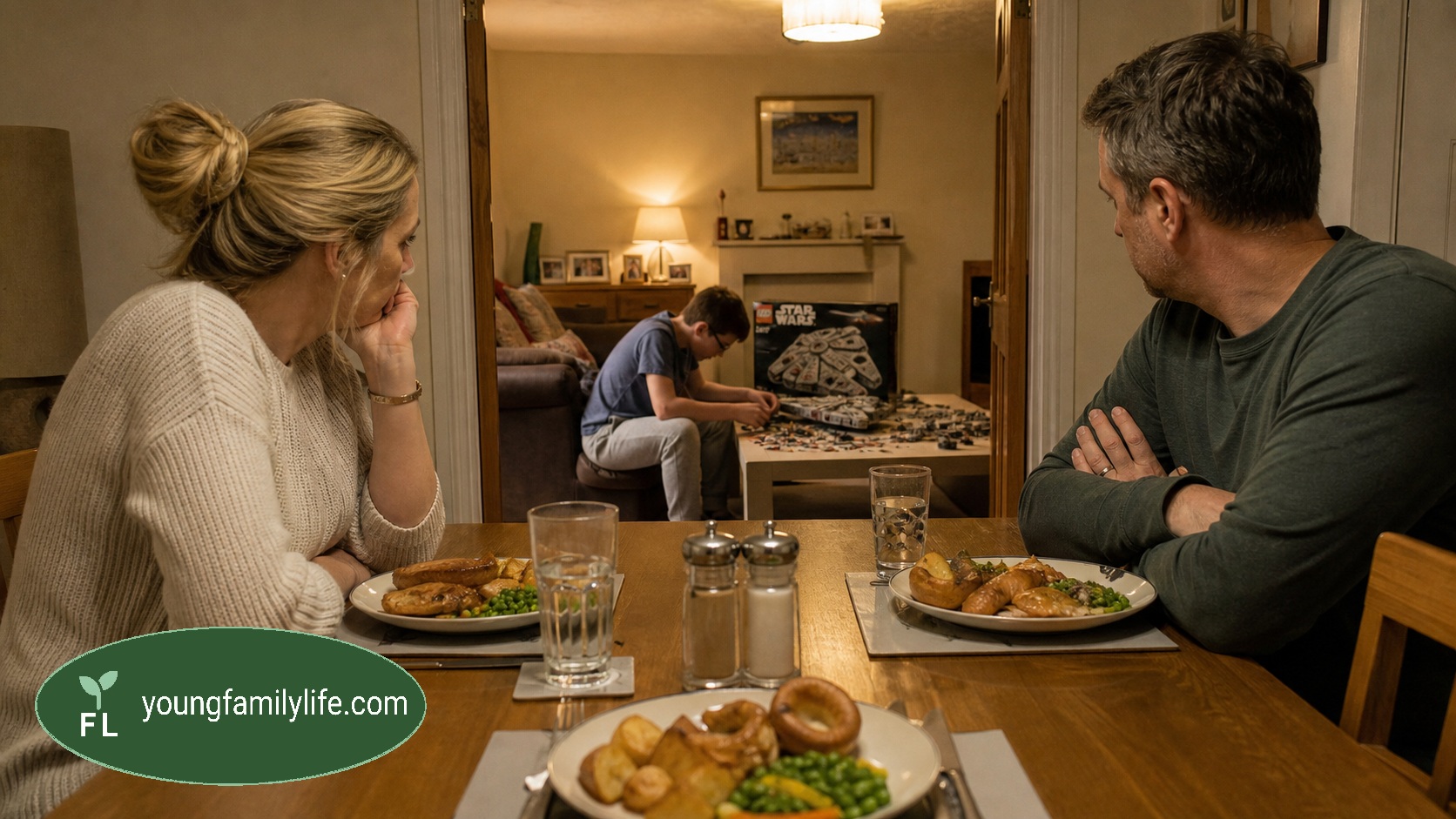
The moment that catches most parents off guard
Dinner's ready. You call through from the kitchen. From the other room comes the reply — "yeah", clear as anything, no ambiguity. They heard. They responded.
And then nothing happens.
A minute passes. You call again. "Yeah, coming." Another minute. A third call, this time with more edge in the voice. And finally — on the fourth or fifth — they appear. Perhaps casually, perhaps mildly surprised at the urgency in your expression.
This is not the same experience as calling a child who is so absorbed in something that they genuinely didn't register the sound. That version is frustrating, but it has an obvious explanation. This version is different. The acknowledgement was there. What was absent was the action that should have followed it.
For many parents, this particular pattern produces something sharper than ordinary irritation. Because the "yeah" closes off the easy explanation. If they heard and responded, the only remaining interpretation feels like choice — that the child chose not to come, that the instruction was received and set aside, that the parent's call was acknowledged and then discounted.
That interpretation, however natural it feels, is one the developmental science complicates considerably.
Between hearing and doing: the gap in the brain
The prefrontal cortex — the region at the front of the brain responsible for what researchers call executive functions — handles planning, decision-making, impulse control, and critically, the initiation of action in response to an instruction (Diamond, 2013). It is the part of the brain that translates I know I should into I am now doing.
In adults, this pathway is largely consolidated. In children, it is still being built — and the construction extends further than most people realise. Research on brain development shows that the prefrontal cortex is one of the last regions to reach maturity, with development continuing into the mid-twenties (Blakemore & Choudhury, 2006).
What this means in practice is that children can genuinely register and acknowledge an instruction while the executive mechanism that would convert that acknowledgement into immediate action does not reliably fire. Neuropsychologists call this a gap in response inhibition — or more precisely, its inverse: the failure of the initiative pathway (Zelazo & Müller, 2002). The child who says "yeah" is not, in most cases, making a strategic decision to delay. They have received the instruction. The signal that would translate receipt into movement is simply not yet running with adult efficiency.
The "yeah" and the arrival at the table are not yet wired together as a single, automatic sequence. They are two separate events in a brain that is still learning to connect them.
The other piece: how children experience time
There is a second mechanism at work alongside the executive function gap, and it is equally significant.
Children's subjective experience of time — particularly what psychologists call prospective time, the felt sense of how soon something is — is markedly less calibrated than adults' (Droit-Volet, 2013). The development of accurate time perception is a gradual process that continues through middle childhood and into adolescence. A child aged six or seven has a genuinely different internal clock from the adult calling them from the kitchen.
When a parent says "dinner's ready", the adult's sense of imminence is precise: now means within the next sixty seconds. The child's "yeah" may be entirely genuine — a real intention to come — expressed from within a time frame that feels considerably less urgent. They are not experiencing themselves as late. They are not experiencing the delay at all, in the way the parent is.
This does not make the repeated calling any less wearing. But it does reframe what is happening: the child who says "yeah" and takes four calls to arrive is not, in most instances, testing the parent's patience. They are operating a time-perception system that is developmentally behind the adult's, in the same way that their reading or their maths is developmentally behind an adult's. It is expected. It is normal. And it is temporary.
What Piaget adds: the view from inside a child's mind
The developmental psychologist Jean Piaget offers a further layer. Piaget described how children's thinking evolves through distinct stages — and one of the defining features of the early childhood years (roughly two to seven) is what he called egocentrism: not selfishness, but a genuine cognitive limitation in which the child's mind does not yet reliably hold another person's perspective alongside their own (Piaget & Inhelder, 1969).
For a young child, the parent in the kitchen is not yet — in the way the parent experiences it — a person who has cooked, who is tired, who would like the family to sit together, who is now on their third call and feeling the edges of their patience. The parent is present in the child's awareness, but not present as a full interior life running alongside the child's own. The call is heard. The weight behind it — what it means to the person making it — is not yet fully available.
This begins to shift from around seven as the child moves into what Piaget called the concrete operational stage and the capacity for decentration — holding multiple perspectives simultaneously — consolidates. The child who doesn't come at five and the child who doesn't come at nine are not doing the same thing, even if the behaviour looks identical. Different cognitive architectures are running underneath.
Where parenting style meets this moment
This pattern — heard, acknowledged, not acted upon — lands differently depending on what a parent brings to it. Research on parenting has long identified two distinct dimensions that shape how parents experience and respond to their children's behaviour: warmth, the emotional responsiveness and connection a parent offers, and control, the expectations around compliance, structure, and authority (Baumrind, 1966; Maccoby & Martin, 1983).
For a parent with strong control investment, the "yeah-and-then-nothing" reads primarily as defiance — a challenge to authority, a failure to respect the parent's instruction, a child getting away with something they shouldn't. The feeling it produces has an edge of assertiveness to it: this needs addressing.
For a parent whose primary investment is in warmth and connection, the same behaviour can read differently — as dismissal, as a signal that the child doesn't particularly value the parent's call, as a small but pointed reminder that they are not the most important thing in their child's world at that moment. The feeling it produces is quieter and more personal.
Neither reading is the behaviour's only meaning. The developmental evidence points to something considerably more ordinary: a brain that hasn't yet finished building the circuitry between hearing and doing, running on a clock that doesn't match the adult's. Understanding which lens is being brought to the moment does not change the child's behaviour — but it can change what the parent does with the feeling it produces.
As this changes over time
The same family dynamic will look different at eight than it did at five, and different again at twelve. The prefrontal cortex matures, time perception calibrates, and decentration consolidates — the child becomes increasingly capable of holding the parent's experience alongside their own, of understanding that "now" means now, and of closing the gap between acknowledgement and action.
It does not happen cleanly or in a straight line. Adolescence introduces its own complications, as a different set of developmental pressures takes hold. But the underlying trajectory is towards a young person who can hear, assent, and act — in closer sequence, with greater reliability, and with more awareness of what the delay costs the person who called.
Many parents find that the years of repeated calling are considerably less wearing once the developmental picture is clear — not because the calling stops, but because the meaning of it shifts. The child who says "yeah" and takes four requests to arrive is not, in most cases, signalling anything about the parent or the relationship. They are demonstrating, quite faithfully, exactly the brain they are supposed to have at this age.
Topics: #ChildDevelopment #ExecutiveFunction #AttentionalInertia #PrefrontalCortex #Piaget #TimePerception #ParentingScience #ChildBehaviour #FamilyLife #YoungFamilyLife #InformationWithoutInstruction #HWTK
Further Reading
These links dig deeper into the topics covered here:
Brain development and executive function:
- Diamond, A. (2013) — Executive Functions, Annual Review of Psychology — the authoritative review of what executive functions are and how they develop across childhood
- Zero to Three — Supporting Executive Function in Young Children — accessible overview of how executive skills develop in the early years
Time perception and child development:
- Droit-Volet (2013) — Time Perception in Children: A Neurodevelopmental Approach — the peer-reviewed paper on how children's sense of time differs from adults'
- NCBI — Cognitive Development in Children — overview of Piaget's stages and their practical implications
How This Essay Reflects YFL Values
This piece offers the developmental science behind a pattern that many parents find genuinely wearing — the "heard and then nothing" moment that is easy to read as defiance or dismissal. What the research shows is something considerably more ordinary: a brain doing exactly what a brain at this stage of development does, running on a clock that hasn't yet been calibrated to adult time.
The information here belongs to the parent. It does not prescribe what they should feel, or what they should do differently. Many parents find that understanding the neurological gap between acknowledgement and action changes the weight of the moment without changing the moment itself — which is, in the end, what information is for.
Informed parents make better decisions for their own families. That is the only assumption this platform makes.
Related YFL Essays and Resources
Children Who Ignore or Show No Care for Their Parents — the full essay: attachment theory, the hormone system, the age-by-age account, and what the adult's own experience of feeling ignored may be telling them
Hey!, Want To Know: why your child can be so moody after school? — the companion HWTK on what the school day costs a child, why home is where it comes out, and why that is not evidence of a problem
In Other Words: what the sting of being ignored is actually about — for the parent whose experience of the repeated call carries more weight than the situation alone would warrant
Learning to Survive — How the Human Brain Navigates Opportunity and Danger — the stress-response framework and the neurology of a brain still finding its way
Copyright Notice
© 2026 Steve Young and YoungFamilyLife Ltd. All rights reserved.
"Hey!, Want To Know" is a copyrighted content format of YoungFamilyLife Ltd.
This essay was developed collaboratively using AI assistance to research academic sources and refine content structure, while maintaining the author's original voice, insights, and "Information Without Instruction" philosophy. No part of this essay may be reproduced, distributed, or transmitted in any form or by any means, including photocopying, recording, or other electronic or mechanical methods, without the prior written permission of the copyright holders, except in the case of brief quotations embodied in critical reviews and certain other noncommercial uses permitted by copyright law.
For permission requests, contact: info@youngfamilylife.com