A worry more parents share than admit
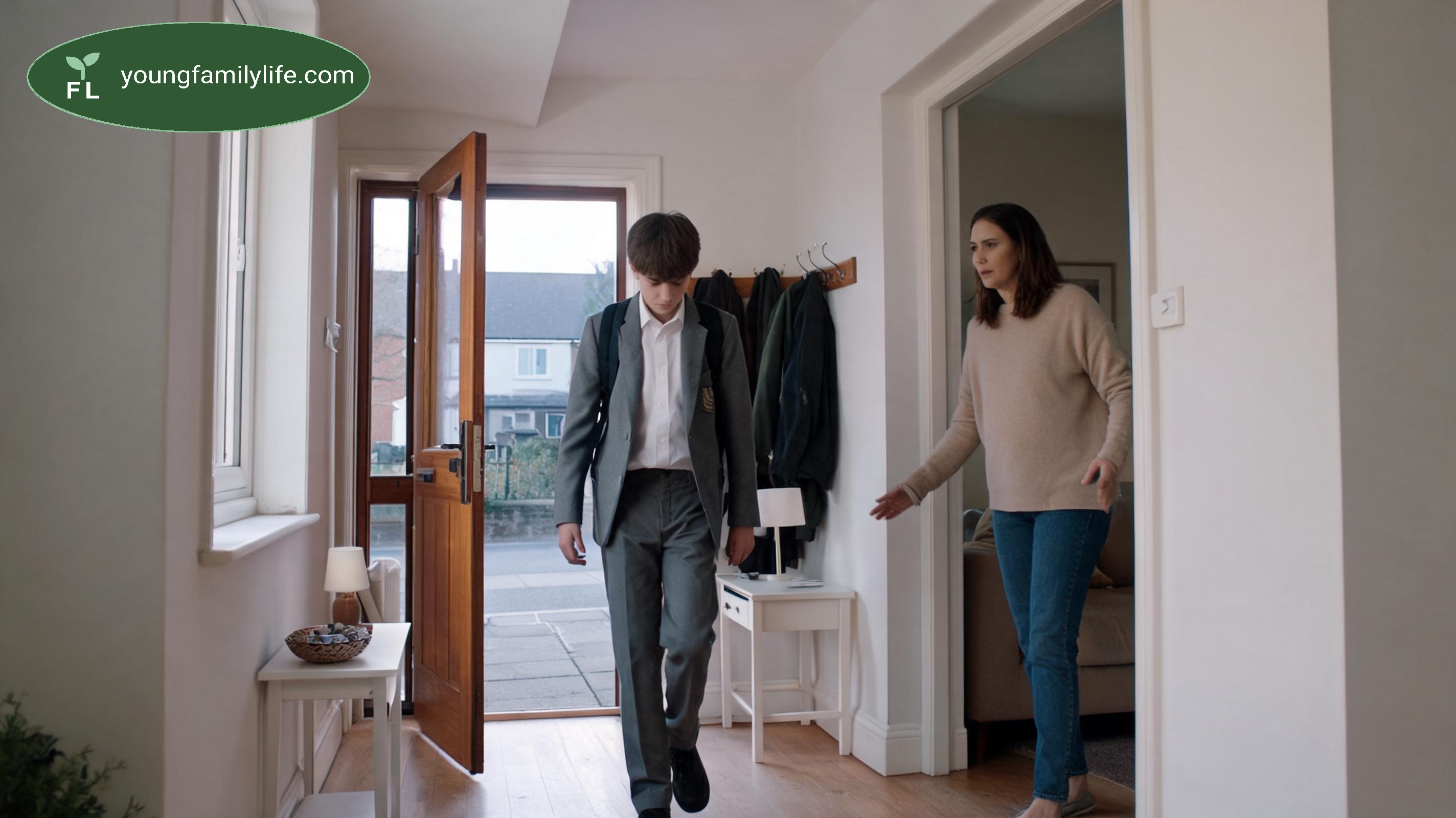
The school run ends. The child gets in the car, or walks through the gate, and something has shifted. They're flat, snappy, or just somewhere else. A question about their day gets a one-word answer. A small thing at home — the wrong snack, a sibling in the wrong spot, a simple request — turns into a big deal. Or they disappear: screen on, door closed, gone.
So the parent goes through the options. Something happened at school. A fall-out with a friend. A difficult moment with a teacher. Something came home with the child like a piece of bad weather.
Some parents ring the school. The answer goes something like this: actually, the child is doing really well. Popular. Teachers love having them in class. Nothing to worry about.
The parent puts the phone down with nowhere to put that information. If school is fine, then the moodiness must be about home. It must be about me.
That's a fair conclusion. It's also, most of the time, the wrong one. The research suggests that the moody child the parent sees after school and the child the school describes are not two different stories. They're two parts of the same one.
What school actually costs a child
School isn't a neutral place. For most children, it's a place of sustained performance — and performance is the right word, because it takes real effort to manage how you come across on the outside when something else is happening on the inside.
All day, a child is regulating: keeping impulses in check, managing friendships, getting on with work, dealing with the unpredictability of other children. For many kids, this is hard work — and the effort is invisible to the adults watching from outside.
Stuart Shanker, a developmental psychologist working in self-regulation, calls this the hidden cost of the school day (Shanker, 2016). A child can look perfectly fine all day while the internal energy needed to keep that going is running down. The child who seems okay at the school gate may be running on empty — holding it together for the walk home, the car ride, the handover — and then, once the requirement to perform finally lifts, something releases.
The moodiness isn't the problem arriving. It's the problem that was already there, finally finding the door.
Why home is where it comes out
This raises the question the school's reassurance actually makes harder: if something was costing the child all day, why didn't it show there?
Because home — and specifically the parent — is where the child's nervous system feels safe enough to let its guard down. This isn't a failure of the school, and it isn't evidence that something is wrong at home. It's the opposite.
John Bowlby described what he called the secure base (Bowlby, 1988) — the attachment figure a child goes out from to explore the world, and returns to when the day has taken its toll. The return isn't just physical. It's neurological: being near a trusted person signals to the child's stress system that the sustained vigilance of the school day can finally relax. When it does, what was being held beneath it becomes visible.
The child who saves their moodiness for home — who manages beautifully at school and then releases into flatness or irritability at home — is showing something important about where they feel safe. The parent is the person it's safe enough to stop performing for. In developmental terms, that's a sign of secure attachment — not a sign the parent is the problem.
This is precisely why the school's reassurance, though accurate, can feel disorienting. The school is describing the performance. The parent is receiving what comes after it. Both are real. They're just describing different moments in the same child's day.
What's happening in the body
The physical mechanism behind this pattern involves cortisol — the body's main stress hormone. When a child is in a demanding social environment all day, cortisol builds up. Research shows it's often at its highest right at the end of the school day — not dropping off, but peaking (Dettling et al., 1999).
What the parent and home provide — in a secure relationship — is what researchers call cortisol buffering: being close to a trusted person helps the body's stress chemistry start to settle (Gunnar & Donzella, 2002). The decompression isn't just emotional. It's physical.
So the moodiness, in part, is the cortisol coming down. The flatness, the tears, the irritability — these are the outward signs of a nervous system moving from high alert back to baseline. School said everything was fine. And it was fine — at school, where the cortisol was held in place by the demands of the day. At home, it's releasing.
The Circle of Security — a simple map of what's happening
One of the most useful ways to picture this is the Circle of Security, a framework developed from attachment research by Cooper, Hoffman, Powell, and Marvin (2005).
The idea is straightforward. The child goes out from the parent — the secure base — to explore. School is that exploration, full and demanding. Across the day, the child accumulates the cost of it. Then they return to the parent — now acting as a safe haven — needing to be received, not fixed. What the child needs at that point isn't a parent who solves their mood or redirects them. It's a parent who can simply be with them while the day's weight settles.
This is where the "it must be me" conclusion does real damage. A parent who reads the child's moodiness as a sign that something is wrong in the relationship may — without meaning to — pull back or communicate hurt at exactly the moment the child's nervous system is looking for the opposite. What the research on Circle of Security shows is that the safe haven phase needs a parent who can hold what the child is feeling without needing it to be different (Hoffman et al., 2017). The YFL piece In Other Words: A Parent's Introduction to Circle of Security covers this in full.
Why a good day is no guarantee
The thing that confuses parents most is that a good day at school doesn't protect against the after-school moodiness. In some cases, a brilliantly full, rewarding day produces an even bigger release than a quiet difficult one.
A day with a performance, a sports event, a resolved friendship drama, a test the child worked hard for — these all require sustained emotional regulation across a wide range. Keeping it together through excitement, pride, anxiety, and complicated social moments can be just as draining as managing a bad day. The child who comes home flushed with success may have a nervous system that's been running at high intensity for six hours.
Shanker describes the difference between being regulated and being calm (Shanker, 2016). A regulated child isn't necessarily a calm one — they can be energised, excited, fully engaged. Regulation is the capacity to manage an emotional state within the demands of a situation. When that capacity is exceeded by the intensity of the day — even a brilliant one — something has to give. Home is where it gives.
So when the school reports a brilliant day and the child walks through the door and something falls apart — both of these things are true. They're not competing accounts of the same child. They're sequential moments in the same story.
How this changes with age
The after-school pattern shows up across a wide range of ages, but it looks different at different stages.
In younger children — early primary years — the emotional release is usually immediate and obvious: tears, a meltdown triggered by something small, physical collapse. These children can't yet modulate what becomes visible once the performance stops.
In middle childhood, it diversifies. Some children still show the classic after-school release. Others develop a buffer — a period of screen absorption, flat responses, quiet withdrawal — before the emotional content of the day surfaces later in the evening or at bedtime.
In adolescence, social media changes things significantly. The school day doesn't end at the school gate. A teenager who seems moody at home while on their phone may still be fully inside the school social world — the group chat, the feed, the unresolved tensions of the day carrying straight on through a screen. This is covered in detail in the companion HWTK on why teenagers can reject closeness.
When to take it further
The moodiness that settles over the evening, and sits alongside a child who is broadly connected and communicative at home, is almost always part of this ordinary pattern.
The picture that warrants a closer look is different: persistent unavailability that doesn't resolve, a child who is as tightly regulated at home as at school with no space to decompress, or significant sustained changes in mood or behaviour from what the parent knows as normal. Where there are specific concerns — signs of anxiety or low mood beyond the after-school window, or the child is disclosing difficulties — professionals such as a school SENCO, GP, or family support worker are well placed to help.
Topics: #SelfRegulation #Cortisol #SecureBase #Attachment #SchoolDay #ChildBehaviour #AfterSchool #ParentingScience #Bowlby #CircleOfSecurity #FamilyLife #YoungFamilyLife #InformationWithoutInstruction #HWTK
Further Reading
These links dig deeper into the topics covered here:
Self-regulation and the school day:
- The Mehrit Centre — What is Self-Reg? — Stuart Shanker's self-regulation framework explained accessibly, including the five domains of stress
- Dettling et al. (1999) — Cortisol Levels of Young Children in Full-Day Childcare — the peer-reviewed research on how cortisol peaks at the end of the childcare or school day
Attachment and the secure base:
- Circle of Security International — What Is the Circle of Security? — the framework in the researchers' own words, including the secure base and safe haven concepts
- Gunnar & Donzella (2002) — Social Regulation of Cortisol Levels — the peer-reviewed research on how trusted relationships buffer the stress hormone response
How This Essay Reflects YFL Values
This piece offers the developmental and physiological account behind a pattern that many parents find genuinely distressing — the child who is brilliant at school and falls apart at home, and the conclusion that the parent is therefore the problem. What the research shows is something considerably more reassuring: the moodiness is evidence of safety, not failure.
The information here belongs to the parent. It does not prescribe what they should feel about this, or how they should respond. Many parents find that understanding the cortisol picture, and the Circle of Security framework, changes what the after-school moment means to them — without requiring them to do anything differently. That shift in meaning is itself significant.
Informed parents make better decisions for their own families. That is the only assumption this platform makes.
Related YFL Essays and Resources
Children Who Ignore or Show No Care for Their Parents — the full essay covering the complete developmental science: attachment classifications, hormone systems, age-by-age account, and what the parent's own experience of feeling ignored may be telling them
Hey!, Want To Know: why your child ignores you? — the companion HWTK on the heard-but-not-acting pattern: executive function, time perception, and the brain's wiring gap
Hey!, Want To Know: why your teenager can reject closeness? And it looks like disrespect — the same decompression dynamic in adolescence, with the social media extension and the neurology of the peer-focused brain
In Other Words: what the sting of being ignored is actually about — for the parent whose "it must be me" conclusion carries more personal weight than the situation alone would warrant
Copyright Notice
© 2026 Steve Young and YoungFamilyLife Ltd. All rights reserved.
"Hey!, Want To Know" is a copyrighted content format of YoungFamilyLife Ltd.
This essay was developed collaboratively using AI assistance to research academic sources and refine content structure, while maintaining the author's original voice, insights, and "Information Without Instruction" philosophy. No part of this essay may be reproduced, distributed, or transmitted in any form or by any means, including photocopying, recording, or other electronic or mechanical methods, without the prior written permission of the copyright holders, except in the case of brief quotations embodied in critical reviews and certain other noncommercial uses permitted by copyright law.
For permission requests, contact: info@youngfamilylife.com