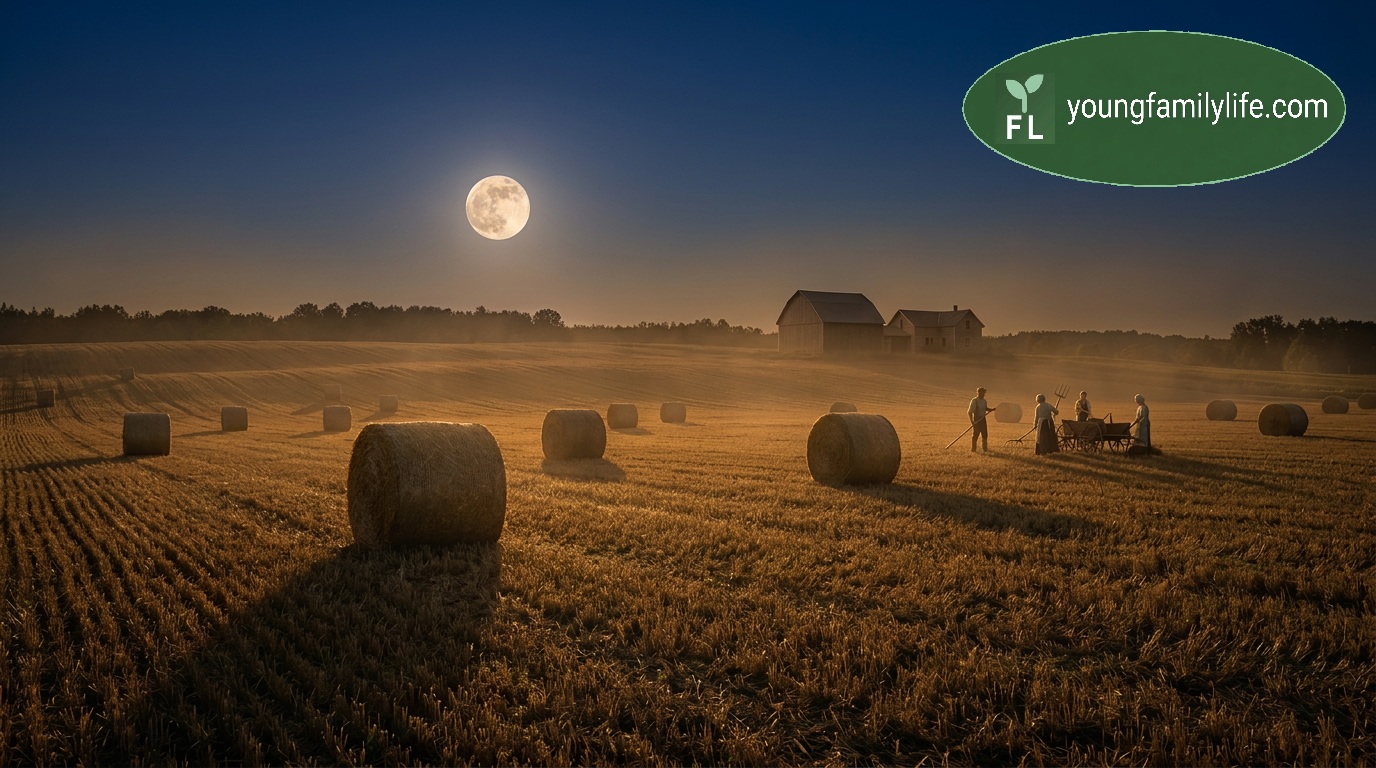
The Moon as a Working Light
Every September, there's a full moon that rises just after sunset for several nights in a row. It hangs low and big in the sky, and it's been called the harvest moon for hundreds of years. The reason it had a name is simple — it had a job.
Before electric light, farmers across Britain and northern Europe needed to get their crops in before the weather turned. And every autumn, this particular moon gave them something they couldn't get any other time of year: several nights of free light to work by. Not daylight — not even close. The harvest moon on a clear night puts out around 0.1 to 0.3 lux of light (Kyba et al., 2017). Daylight on a sunny afternoon is around 50,000 lux. Even twilight — that grey window just after sunset — sits at about 1 lux. So the harvest moon was dim. Really dim. About a third of what twilight gives you.
But it was enough. Enough to see the rows, handle the grain, move around the field. And communities used it — not as a last resort, not in a panic, but as a planned part of the year. They knew it was coming. They stayed up for it. And they did it at the most physically hard point of the farming year, when their bodies were already working flat out.
Here's the thing that should give us pause. We're told now that missing a night's sleep — even one — sets off a chain of health problems. So what does that mean for the people who worked through several nights in a row every September, for their whole lives, and for generations before them? The history doesn't record communities falling apart from exhaustion. They just got on with it. The body, it turns out, could handle a lot more than the modern picture suggests.
Nobody Used to Sleep Like We Do
A historian called Roger Ekirch spent years going through old diaries, letters, court records and medical writing from across Europe — going all the way back to the Middle Ages. And he kept finding the same thing (Ekirch, 2005). People didn't sleep in one long block overnight. They slept in two goes, with a gap in the middle.
They called it the "first sleep" and the "second sleep." The gap between them — maybe an hour, maybe two — was just a normal part of the night. People lay quietly, had a conversation, sometimes got up for a bit, then went back to sleep. Nobody wrote about it like it was a problem. It was just what nights were like.
This wasn't just poor people or one particular country. It showed up across different languages, different social classes, different centuries. For hundreds of years, sleeping in two goes was completely normal.
A scientist called Thomas Wehr later tested what happens when people live without artificial light — no lamps, no screens, just natural daylight and darkness (Wehr, 1992). Within a few weeks, most of them quietly drifted back into the same pattern. Two sleeps, with a gap. Their bodies just started doing it on their own.
That's a striking finding. It suggests the single overnight block — the one we're all told is the only correct way to sleep — might not be what the body actually wants when nobody's forcing a schedule on it. It might be what factories and electric light made normal. Not what biology had in mind.
People Who Never Got the Eight-Hour Memo
There are communities alive today where industrialisation never really arrived. Researchers went and studied how three of them actually sleep — the Hadza in Tanzania, the San in Namibia, and the Tsimane in Bolivia (Yetish et al., 2015). These are hunter-gatherer communities living roughly the way humans have lived for most of history.
None of them sleep eight hours. Their average is somewhere between 5.7 and 7.1 hours. They don't have set bedtimes. They nap when they feel like it. Their sleep shifts around with the seasons. And none of them show the health problems that the books and the NHS warnings say should follow from not hitting eight hours every night.
That's a really important finding. Because the entire framework that tells people their sleep is broken — that they need a specific amount, in one go, at the same time every night — is built around a standard these communities have never followed. And they're fine.
The harvest moon farmers and the Hadza have the same thing going on: bodies that managed disrupted, irregular, sometimes quite short sleep across whole lifetimes. Both groups got on with it. Neither fell apart. The idea that a missed night or a broken sleep is a health crisis turns out to have a lot more to do with what we've been told than with what the body actually does.
How Eight Hours Became the Rule
The eight-hour overnight block didn't come from a scientific discovery. Nobody ran a study, looked at the results, and announced that eight hours in one go is what the human body needs. It came from factories.
When the industrial era got going, factories needed people to show up at a fixed time and work a fixed shift. That required a predictable sleep schedule — something that could be timed, managed, and relied upon. Electric light meant you could be up late and still get to work on time. The old two-sleep pattern, with its wakeful gap in the middle of the night, didn't fit a factory rota. So it quietly disappeared. Not because it was unhealthy. Because it was inconvenient.
By the early twentieth century, waking up in the middle of the night and not getting straight back to sleep had gone from being completely normal to being a medical symptom. A thing called insomnia expanded to cover what had been unremarkable for centuries. And the sleep industry — the apps, the books, the NHS guidance, the mattress companies — built itself around a standard that was really about keeping factories running.
The harvest moon farmers weren't ignoring some biological rule about sleep. There was no rule. There still isn't, really — not the rigid version the modern world promotes. The body is far more flexible than that. It always was.
This Isn't Saying Sleep Doesn't Matter
Sleep is real and it matters. Nobody's arguing otherwise. If someone goes without sleep for days on end, that causes real problems — the evidence for that is solid.
But there's a difference between "sleep matters" and "you need exactly eight consolidated hours every single night or your health is in serious trouble." The first is true. The second is where the evidence gets a lot shakier — and where a lot of unnecessary worry gets generated.
The harvest moon, the two-sleep history, and the hunter-gatherer research all point in the same direction: the human body has been managing variable, disrupted, and sometimes quite short sleep for the entire span of human history. It's built for that. The standard it's now being held to is a recent invention, and the anxiety around not meeting it is largely a product of that invention rather than a biological signal that something's actually wrong.
A bad night, a broken sleep, a few disrupted nights at harvest time — the body has been handling all of that since long before anyone decided eight hours was the rule.
Topics: #harvestmoon #sleephistory #segmentedsleep #twosleep #firstsleep #secondsleep #sleepculture #huntergatherer #Ekirch #Wehr #Yetish #HeyWantToKnow #YoungFamilyLife #informationwithoutinstruction #sleepanxiety #sleepnorm
Further Reading
These links dig deeper into the topics covered here:
The light of the harvest moon:
- How bright is moonlight? — Kyba, Mohar and Posch (2017), Astronomy & Geophysics, Oxford Academic — The research paper establishing accurate illuminance figures for the full moon at temperate latitudes: 0.05–0.1 lux typically, 0.3 lux at the clearest extreme. The basis for understanding what the harvest moon actually provided as working light.
The history of sleep:
- In short photoperiods, human sleep is biphasic — Wehr (1992), Journal of Sleep Research — The laboratory study in which participants without artificial light drifted back to a two-sleep pattern: the biological evidence behind Ekirch's historical findings.
- Roger Ekirch on segmented sleep — History Today — An accessible introduction to Ekirch's research on the first and second sleep: what historical sources show about how people actually slept before the industrial era.
Cross-cultural sleep evidence:
- Natural sleep and its seasonal variations in three pre-industrial societies — Yetish et al. (2015), Current Biology — The hunter-gatherer sleep study: Hadza, San, and Tsimane communities averaging 5.7–7.1 hours, with no evidence of the health deficits that the eight-hour orthodoxy predicts.
How This Essay Reflects YFL Values
This piece brings together three different angles on the same question — what people have done with sleep throughout history, what happens in a lab when artificial light is removed, and what communities who never adopted the industrial sleep pattern actually look like. None of those three on their own quite makes the case. Together they do.
YoungFamilyLife puts the evidence out there and leaves what to make of it entirely to the reader. This piece isn't telling anyone how to sleep or how to feel about their nights. That's nobody's call but their own.
Informed people make better decisions for themselves and their families. That is the only assumption this platform makes.
Related YFL Essays and Resources
Sleep as Culture — The full essay behind this piece: the complete history of segmented sleep and the industrial construction of the overnight norm, alongside the Walker debate, Helen Ball's infant sleep research, and the manufactured nature of parental sleep anxiety.
Why Exhausted Parents Are Adapting, Not Failing — The companion HWTK piece on parental sleep disruption: why the body copes better than the sleep industry suggests, and why the anxiety around infant night waking is largely a cultural product rather than a biological signal.
Sleep as Biology — The essay establishing what sleep actually is: the energy-saving argument, the animal evidence, and the biological case for flexibility as the norm rather than the exception.
IOW — Where the Idea of Eight Hours Sleep Actually Came From — The plain-language companion read: a shorter account of how the eight-hour norm was built, for anyone who wants the history without the full essay treatment.
Copyright Notice
© 2026 Steve Young and YoungFamilyLife Ltd. All rights reserved.
"Hey!, Want To Know" is a copyrighted content format of YoungFamilyLife Ltd.
This essay was developed collaboratively using AI assistance to research academic sources and refine content structure, while maintaining the author's original voice, insights, and "Information Without Instruction" philosophy. No part of this essay may be reproduced, distributed, or transmitted in any form or by any means, including photocopying, recording, or other electronic or mechanical methods, without the prior written permission of the copyright holders, except in the case of brief quotations embodied in critical reviews and certain other noncommercial uses permitted by copyright law.
For permission requests, contact: info@youngfamilylife.com