The moment that carries more information than it seems
In home visits, contact sessions, and family support meetings, practitioners routinely observe the moment when a child and parent come back together after a period of separation. It might be a parent returning from the kitchen, a child coming in from the garden, or a contact session ending. It might be a school collection, observed as part of an assessment. The reunion moment is brief. It is often overlooked. And it carries more diagnostic information than most assessments formally account for.
The challenge is that reunion behaviour is profoundly counter-intuitive. The observable behaviours — which children appear warm at reunion, which appear indifferent, which appear distressed — do not map onto attachment security in the way most people would assume. The research on this is consistent and striking, and it has direct implications for how practitioners interpret what they see.
Ainsworth and the Strange Situation: what the research established
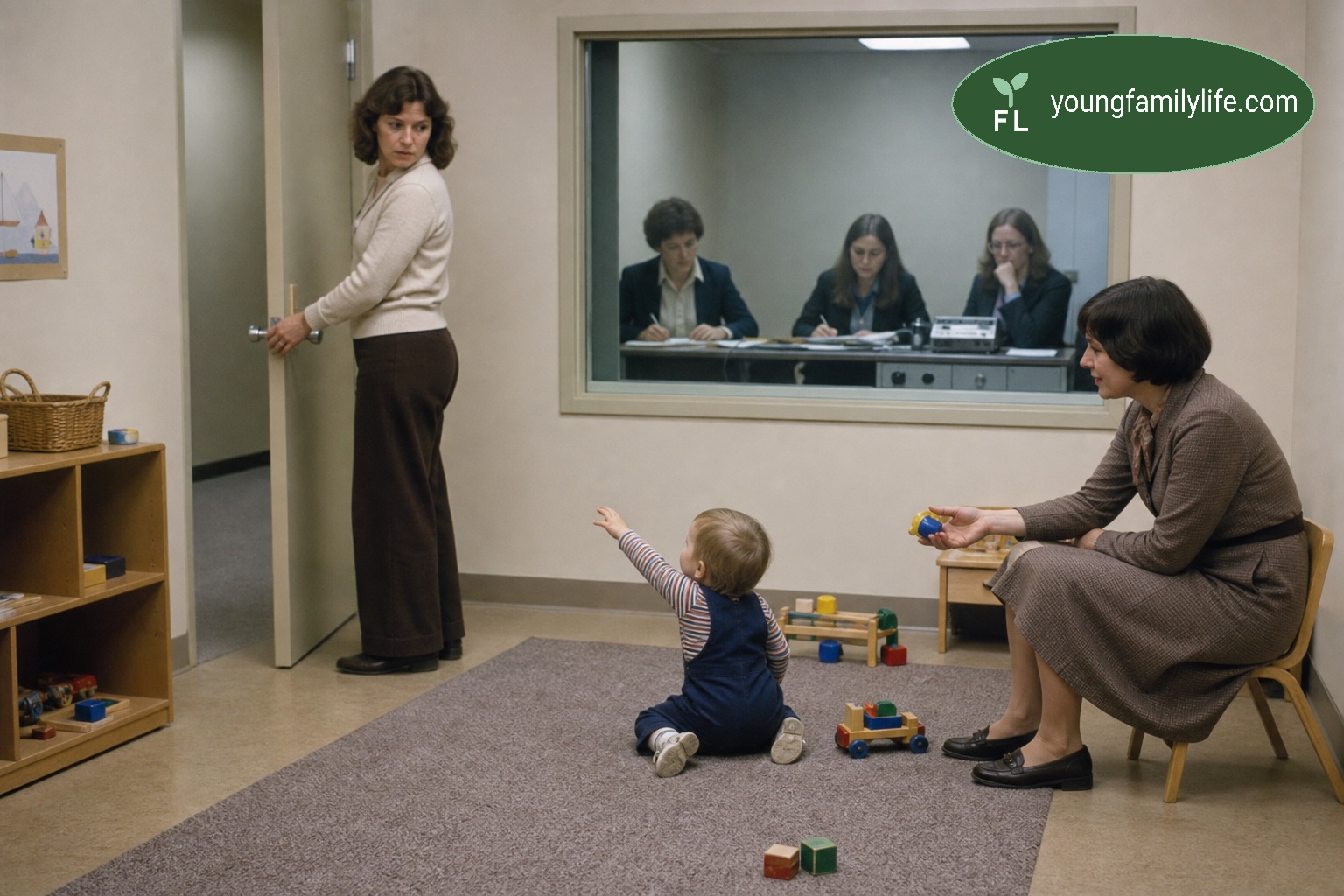
The foundational research on reunion behaviour comes from Mary Ainsworth's landmark Strange Situation studies in the 1970s (Ainsworth et al., 1978). Ainsworth and her colleagues observed infants and toddlers in a laboratory setting: a parent left the room briefly, a stranger was present, and then the parent returned. The reunion — how each child responded to the parent's return — was the primary object of study.
What Ainsworth identified were three distinct patterns of reunion behaviour, each corresponding to a different quality of attachment:
Secure attachment — Children who had experienced consistent, sensitive caregiving greeted the returning parent warmly but briefly, sought comfort if distressed, settled relatively quickly, and returned to play. Their reunion response was proportionate and self-regulating.
Anxious-ambivalent attachment — Children whose caregiving experience had been inconsistent — sometimes available, sometimes not — showed heightened, prolonged distress at reunion. They sought the parent intensely but were difficult to settle. Comfort, when offered, did not fully work. The reunion activated them rather than calming them.
Avoidant attachment — Children whose caregiving experience had involved consistent emotional unavailability — parents who responded to distress with withdrawal, dismissal, or discomfort — showed the behaviour that most directly concerns this piece. These children appeared indifferent at reunion. They did not rush to the parent. They did not cry. They continued with their activity as if the parent had not returned.
The critical finding — and the one that transforms how reunion behaviour should be read — is what happened physiologically to the avoidant children. While their external behaviour appeared calm and indifferent, their cortisol levels and heart rate measures showed stress responses equal to or greater than those of the anxious-ambivalent children (Spangler & Grossmann, 1993). The avoidant child was not unaffected by separation and reunion. They had learned to suppress the visible expression of their attachment need — because the history of that need's reception had taught them that expressing it was not effective, or was actively counterproductive.
The child who appears not to care at reunion is not a child who does not care. They are a child who has learned not to show it.
The secure child's quiet reunion
For practitioners assessing parent-child interaction, the implications of Ainsworth's work are significant. The securely attached child does not necessarily produce the most demonstrative reunion. They may acknowledge the returning parent briefly, accept comfort calmly if they need it, and return to activity with relative ease.
This can, in a professional observation context, read as a child who is emotionally independent of the parent — or, in more concerning framings, as a child who shows little attachment. Neither reading is accurate. The secure child's quiet reunion reflects the internalised confidence that the parent will be there and is reliably available — so the reunion does not need to be dramatised. The connection is already known. It will be available when the child turns toward it.
Mary Main's subsequent development of the Adult Attachment Interview (Main & Goldwyn, 1984) and the elaboration of a fourth attachment pattern — disorganised attachment — added further complexity to the picture. The disorganised child, whose caregiving experience has involved the attachment figure also being a source of fear, may show confused, contradictory, or stilling behaviour at reunion: approaching and then stopping, turning in circles, freezing. These responses reflect the biological impossibility of the situation: the person who is the source of safety is also the source of threat. Reunion activates both the approach system and the flight system simultaneously, producing behaviour that appears bizarre without the attachment framework to interpret it.
What the reunion does — and does not — tell a practitioner
Reunion behaviour is informative, but it is not diagnostic on its own. Several important caveats apply to any professional interpretation:
Context matters profoundly. A child observed in a contact centre, a home visit, or a formal assessment setting is not in a neutral environment. The presence of professionals, the formality of the setting, and the emotional charge of the occasion all alter the dynamics. A child who might show secure reunion behaviour at home may show suppressed or heightened behaviour in an observed setting, because the setting itself has introduced a layer of threat or self-consciousness that the child is managing alongside the reunion.
Age shapes expression significantly. As the main essay — Children Who Ignore or Show No Care for Their Parents — covers in detail, developmental stage modulates how reunion behaviour looks at different ages. Toddler reunion behaviour is more physiologically transparent than school-age reunion behaviour. The adolescent's reunion behaviour is governed by neurological changes that make parental responsiveness a lower-priority signal regardless of attachment security. Practitioners observing reunion behaviour across different ages need a developmentally calibrated frame, not a single template.
A single observation is insufficient. Ainsworth's patterns were identified from multiple observation sessions, not a single moment. A practitioner who sees a child appear indifferent at one reunion cannot, from that alone, conclude avoidant attachment. The pattern needs to be consistent, observed across contexts, and considered alongside other relational data.
The parent's state is also observable. The quality of the reunion is co-produced. A parent who is anxious, distracted, or emotionally unavailable at reunion will shape the child's response in ways that may not reflect the child's underlying attachment pattern. What the practitioner is observing is an interaction, not the child alone.
What tends to concern practitioners most — and why
In professional contexts, the child who appears indifferent at reunion often generates more concern than the child who appears distressed. The dramatic reunion — the clinging, the tearfulness, the difficulty settling — is at least visibly relational. The child who does not look up feels, to the professional observer, like evidence of something absent.
The research persistently challenges this reading. The avoidant child who suppresses reunion behaviour is not demonstrating absence of attachment. They are demonstrating a learned strategy in response to a specific history of caregiving. That strategy has a cost — physiologically documented — and it is clinically significant. But it is not, in itself, evidence that the child does not care about the parent, or that the parent is not important to them.
What is clinically significant is the pattern — particularly where avoidant reunion behaviour is accompanied by other indicators: a child who consistently does not seek the parent when distressed, who is indiscriminately friendly toward strangers, who shows the practitioner or the observer the kind of proximity-seeking that should belong to the parent. These combinations warrant attention. The reunion behaviour alone does not.
The practitioner working within the Circle of Security framework (Cooper et al., 2005) has a useful additional lens here. The child who appears indifferent at reunion may be demonstrating what that framework describes as a shark music response in the parent: the parent's discomfort with the child's expressed need may have shaped the child's suppression of it over time. The reunion behaviour, in this reading, is as much a reflection of the parent's emotional availability as of the child's attachment.
Reflective functioning and what it adds
Peter Fonagy's research on mentalization — or reflective functioning — offers practitioners a further dimension. The capacity of a parent to hold the child's mental state in mind, to interpret the child's behaviour as behaviour (driven by the child's internal state) rather than as a communication directed at the parent personally, is one of the strongest predictors of secure attachment across generations (Fonagy et al., 1991).
A parent whose reflective functioning is strong may be able to read their child's quiet reunion as something other than rejection. A parent with lower reflective functioning — whose own attachment history makes the child's apparent indifference land as a personal affront — may respond to the quiet reunion in ways that inadvertently confirm the child's suppression strategy. The practitioner who can identify this dynamic — who can see both the child's behaviour and the parent's interpretation of it — is in a position to offer something genuinely useful, not by correcting either party, but by introducing the framework that makes both behaviours legible.
Many practitioners find that naming the counter-intuitive finding — that the quieter child at reunion may be the more securely attached one — opens a conversation with parents that the presenting behaviour alone would not have prompted. It reframes the reunion moment without prescribing what either parent or child should do differently.
What this changes in practice
The research does not offer practitioners a formula for interpreting reunion behaviour. What it does offer is a more accurate framework than the intuitive one — which tends to read warmth and drama as evidence of connection, and quiet as evidence of its absence.
The practitioner who holds Ainsworth's patterns in mind, who maintains developmental calibration across ages, who observes the reunion as an interaction rather than a child behaviour, and who situates the moment within a pattern rather than treating it as diagnostic on its own — that practitioner is working with what the research actually shows.
The child who barely looks up at the door may be the most securely attached child in the room. The child who rushes to the parent and cannot settle may be signalling something that deserves careful and patient attention. Neither conclusion follows automatically from the behaviour. Both possibilities deserve to be held.
Topics: #AttachmentTheory #ReunionBehaviour #StrangeSituation #Ainsworth #AvoidantAttachment #SecureAttachment #DisorganisedAttachment #ReflectiveFunctioning #Fonagy #CircleOfSecurity #PractitionerDevelopment #ChildProtection #FamilySupport #YoungFamilyLife #InformationWithoutInstruction #HWTK
Further Reading
These links dig deeper into the topics covered here:
Attachment classifications and the Strange Situation:
- Cassidy & Shaver — Handbook of Attachment (overview) — the authoritative academic reference for attachment theory, including Ainsworth's classification system and subsequent research
- Circle of Security International — the framework in the researchers' own words, including the shark music concept and what a child needs at each point on the circle
Reflective functioning and professional practice:
- Anna Freud National Centre — Reflective Functioning — Fonagy's reflective functioning concept explained and its application to professional work with families
- Spangler & Grossmann (1993) — Biobehavioral Organisation in Securely and Insecurely Attached Infants — the peer-reviewed physiological evidence showing cortisol elevation in avoidant children despite apparent calm
How This Essay Reflects YFL Values
This piece offers the research evidence behind one of the most counter-intuitive findings in developmental psychology — that the quieter child at reunion may be the more securely attached one, and that the child who rushes to the door and cannot settle may be signalling something that warrants careful attention rather than reassurance.
The information here belongs to the practitioner. It does not prescribe how they should assess, what conclusion they should draw, or what they should say to the families they work with. Practitioners who understand what reunion behaviour actually reflects are better placed to respond with intention rather than reflex — and to resist the professional instinct to read warmth and drama as evidence of connection, and quiet as evidence of its absence. That is the only claim being made here.
Related YFL Essays and Resources
Children Who Ignore or Show No Care for Their Parents — the full essay: the complete developmental science including attachment classifications, hormone systems, the age-by-age account, and what the adult's own experience of a child's apparent indifference may be telling them
In Other Words: A Parent's Introduction to Circle of Security — the Circle of Security framework in accessible language, including the secure base, safe haven, and what a child needs at each point on the circle
In Other Words: what the sting of being ignored is actually about — the adult's experience of feeling invisible: internal working models and the social pain system — relevant for understanding what parents bring to the reunion moment
The Epistemology of Safeguarding — on how practitioners reason from observable behaviour to professional judgement, and the limits of what observation alone can establish
Copyright Notice
© 2026 Steve Young and YoungFamilyLife Ltd. All rights reserved.
"Hey!, Want To Know" is a copyrighted content format of YoungFamilyLife Ltd.
This essay was developed collaboratively using AI assistance to research academic sources and refine content structure, while maintaining the author's original voice, insights, and "Information Without Instruction" philosophy. No part of this essay may be reproduced, distributed, or transmitted in any form or by any means, including photocopying, recording, or other electronic or mechanical methods, without the prior written permission of the copyright holders, except in the case of brief quotations embodied in critical reviews and certain other noncommercial uses permitted by copyright law.
For permission requests, contact: info@youngfamilylife.com