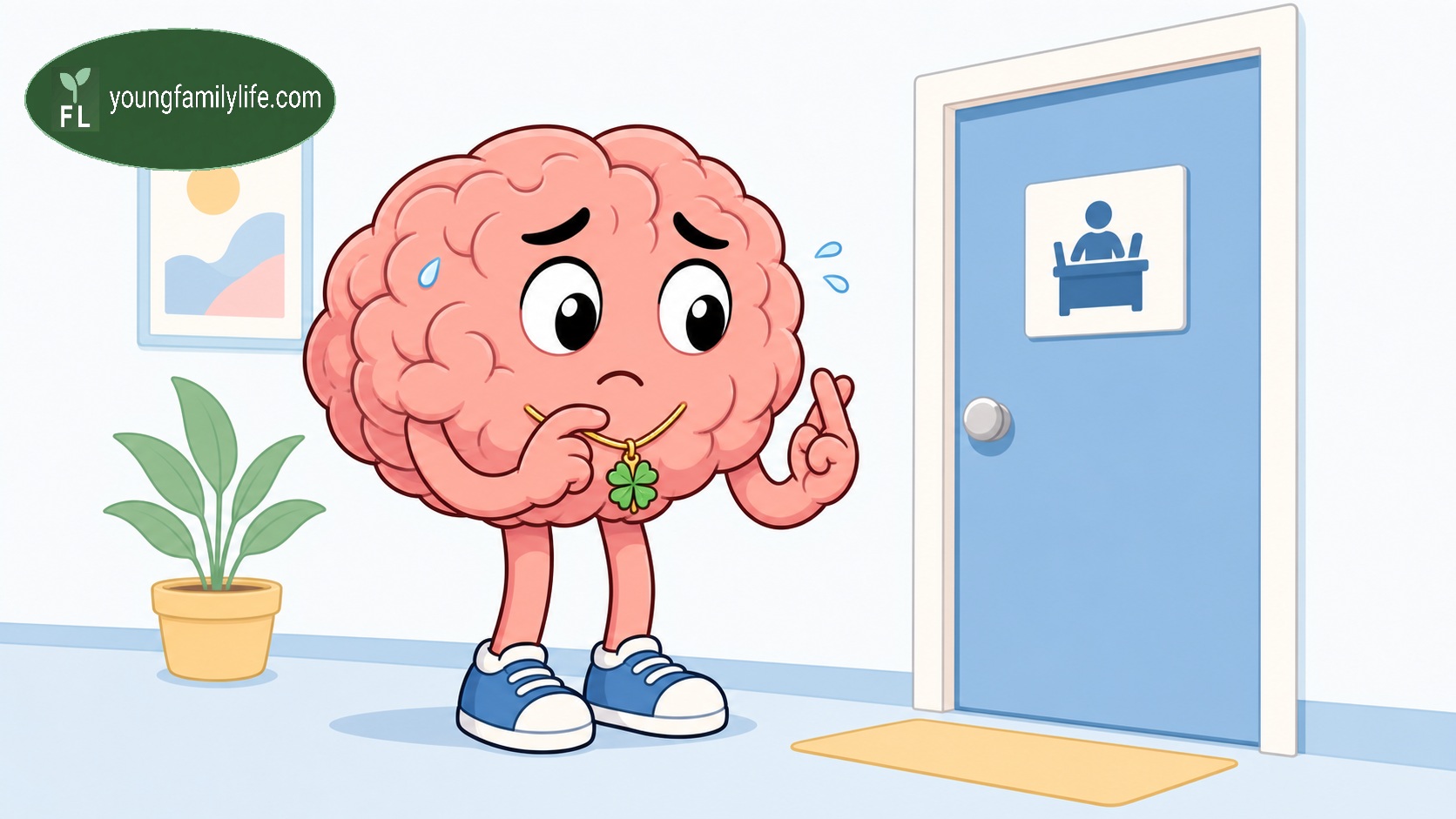
You’ve done it without thinking
You step on a crack in the pavement and something in you flinches. You put on the same pair of socks before an important meeting — the ones you were wearing when the last important meeting went well. You knock on wood mid-sentence, not because you believe in wood, but because not knocking feels wrong in a way that is hard to explain. There is a version of this you recognise, even if the specific ritual is different.
Rafael Nadal is one of the greatest tennis players who ever lived. He also, before every single serve, touches his nose, pulls his hair behind each ear, adjusts his shirt collar, and touches his left shoulder, right shoulder, left ear, and right ear — in exactly that order. He has done this tens of thousands of times. He knows it does not improve his serve mechanically. And yet missing a step would feel, to the part of his brain that matters in that moment, like something had been left unfinished.
There is a well-documented story of a theatre actor who, after a run of successful performances, became convinced that taking a particular taxi route to the theatre was somehow connected to the quality of the show. The run ended. Another taxi. The actor drew the only conclusion the nervous system had available: the taxi was the problem. For years afterwards, the longer route was non-negotiable — not from logic, but from the body’s insistence that the sequence be completed correctly before the performance could begin.
These are not irrational people. They are people running a neurological programme that is considerably older than rationality, and considerably more insistent. Understanding what that programme actually is changes what superstition means.
This started long before tennis
The brain’s job, for most of its evolutionary history, was not to think. It was to close gaps. Detect something needed — food, safety, a mate. Move toward it. Close the gap. Then recalibrate and find the next one. The seeking drive that runs this programme is one of the oldest mechanisms in vertebrate biology — present in fish, in reptiles, in every mammal that has ever needed to locate something in order to survive.
The key brain structure involved is the nucleus accumbens — a small region central to reward, motivation, and the learning of sequences that lead to completion. It does not reward satisfaction particularly. It rewards pursuit — the narrowing of the gap between current state and desired outcome. And it learns. Every time a sequence of behaviour is followed by a successful completion — a good performance, a positive outcome, a moment of relief — the nucleus accumbens files that sequence. Not as a memory in the conventional sense. As a precondition.
This is what behavioural psychologist B.F. Skinner observed in his famous pigeon experiments in the 1940s. Pigeons given food at random intervals — not connected to any particular behaviour — began to develop what looked exactly like rituals. One pigeon turned anti-clockwise before the food arrived. Another thrust its head into a corner. These were not random movements. They were the movements the pigeon happened to be making the last time food appeared. The nucleus accumbens had filed them as part of the sequence. Performing them felt, to the pigeon’s nervous system, like doing the necessary thing.
Skinner called this “superstition” in inverted commas — not mockingly, but accurately. The pigeon was not being foolish. It was running the only logic available: this happened before, so this is what needs to happen again.
The open file
In 1927, a Soviet psychologist called Bluma Zeigarnik noticed something striking about how memory works. Waiters could recall incomplete orders in precise detail — and forgot them almost entirely once the bill was paid. The brain, she found, does not treat an unfinished sequence as simply something that has not happened yet. It treats it as an obligation. It keeps the file open, allocating mental and physiological resources to it, until the sequence is complete.
This is the mechanism underneath ritual behaviour. When Nadal completes his pre-serve sequence, the nucleus accumbens registers completion. The body releases the seeking tension. The serve can happen. If a step is missed, the file stays open. There is a low-level physiological signal — something that does not quite resolve — that the brain reads as: something is unfinished. The conditions are not right. Proceed with caution.
Many athletes who have disrupted their rituals describe exactly this: not superstition in the folk sense, but a specific and uncomfortable sense of incompletion that affects performance not because the ritual mattered mechanically, but because the nervous system had been told it did.
It starts earlier than most people realise
Melanie Klein, the psychoanalyst whose work on early childhood development remains controversial in some details but structurally robust, observed that the infant’s earliest regulatory experiences — feeding, the relief of discomfort, the cycle of need and resolution — establish the first templates for what completion feels like. The body learns, very early, what a closed arc feels like versus an open one. And it learns to insist on sequences that have previously led to closure.
This is not pathology. It is how learning works at the most foundational level. The infant who is fed reliably in a particular way, in a particular context, with particular sensory accompaniments, develops expectations of that sequence. Disrupting it does not just mean the feeding is different. It means the completion arc feels different — less fully closed, less reliable.
Adults carry these early templates forward, often without awareness. The specific rituals that emerge — the particular pre-performance sequences, the habitual routes, the must-have objects — are layered over these foundations. They are the adult nervous system’s learned answer to the brain’s oldest question: what needs to happen before this can be complete?
The body speaks before the mind catches up
The physiological expressions of disrupted ritual are worth noting, because they confirm that this is not merely psychological in the colloquial sense. Performers who have suppressed their pre-performance rituals — or who are prevented from completing them — frequently report nausea, loose bowels, or acute physical tension that does not respond to reassurance. The stress response system has been activated not by danger in the external environment, but by the brain’s recognition that a necessary precondition has not been met.
The body is not being irrational. It is being entirely consistent with its own internal logic: the sequence that has previously preceded successful completion has not been completed. Therefore, the conditions for success are not yet present. Therefore, threat-response protocols are appropriate.
Many performers, athletes, and people in high-stakes professional situations find that understanding this mechanism changes how they relate to their own rituals — not as embarrassing quirks to be suppressed, but as the nervous system doing exactly what it was built to do. The ritual is not the cause of good performance. It is the brain’s signal to itself that the arc is properly open and ready to close.
Are some people more prone to this than others?
The short answer is yes — but not in the way the word “prone” might suggest. It is not that some people are more irrational or more anxious. It is that some people, by training or by temperament, are more finely tuned to the signals their own nervous system sends.
Athletes are the clearest example. Years of high-performance training make the body a precision instrument — and that precision cuts both ways. The athlete who can detect the difference between a warm-up that felt right and one that felt slightly off is the same athlete whose nucleus accumbens is sensitive enough to notice when a pre-performance sequence has not been properly completed. The ritual emerges because the nervous system is acute enough to register the difference. Many artists and performers are similar — people whose work depends on a quality of internal attention that most professional environments do not require. The pre-show routine, the particular order of preparation, the objects that must be present — these are the completion drive finding form in a nervous system that is unusually well-practised at listening to itself.
But many people who carry no particular rituals in ordinary life find them appearing under specific conditions: the job interview, the driving test, the medical result, the first date that actually matters. When the gap between current state and desired outcome feels both large and genuinely uncertain, the completion drive activates. The lucky tie comes out of the wardrobe. The particular route to work gets taken. A pattern of behaviour that has no history suddenly feels load-bearing — because the nervous system, facing a high-stakes arc it cannot control, reaches for whatever sequence is available to signal to itself that the conditions are properly set.
Then there is a third and rather more interesting variant. The couple who individually hold no religious conviction, who visit church only for weddings and funerals, who would not describe themselves as believers in any conventional sense — and who nonetheless prefer to get married in church, just to keep in with God, should it turn out there is one. This is not faith. It is probabilistic completion drive. The brain is running a calculation: the cost of the ritual is low; the cost of leaving it undone, if it turns out to matter, is incalculable. Better to perform the sequence. The philosopher Blaise Pascal made the same calculation in the seventeenth century about religion in general — a position now known as Pascal’s Wager. It turns out the nervous system arrived at the same logic considerably earlier, and without needing to write it down.
What it looks like from the outside
People observing ritual behaviour from the outside tend to reach for character explanations. The tennis player who cannot begin his serve without completing his sequence is “demanding” or “eccentric.” The actor whose pre-show preparation is non-negotiable is “precious” or “a character.” The performer who vomits in the wings before every first night is “battling severe stage-fright.” None of these descriptions are invented — they describe, accurately, what the behaviour looks like from the outside. But they explain nothing, and they carry a quiet implication that the person ought to be able to override the drive with sufficient effort or self-awareness.
The domestic version generates a different vocabulary. The partner who needs exactly the right outfit before attending an important occasion is “indecisive,” “anxious,” or simply “taking forever.” What the observer on the sofa is watching is a nervous system that has established visual presentation as a necessary precondition for the completion arc. Arriving at the event without that element resolved leaves a file open that will compete with the event itself. The hours of shopping are not vanity. They are the seeking drive doing its job, looking for the specific closure it has learned to require.
And into that open file steps an entire industry. The fashion influencer with the curated outfit guide, the five essential tips for dressing for the occasion, the affiliate link — these are calibrated precisely to a seeking drive that is already primed and looking for something to close around. The scroll through outfit inspiration feels like progress. The nucleus accumbens registers the narrowing of the gap. The file does not close. The next video begins. The like and subscribe the influencer requests is not part of this at all — that is the influencer’s own extraction mechanism, the pound of flesh the algorithm requires to keep feeding them more viewers to run the same trick on. The viewer’s seeking drive and the influencer’s commercial need are two entirely separate transactions, temporarily occupying the same screen. The advertiser and the influencer have not solved the problem of the open file. They have built a business on ensuring it stays open — offering the representation of completion while systematically deferring the thing itself. The observer on the sofa sees social media use. What is actually happening is the seeking drive finding the most readily available host in the room.
Animals do it too
It is worth noting that this is not an exclusively human phenomenon, and that observation matters. Skinner’s pigeons are the most cited example, but ritual and superstitious behaviour has been observed across a wide range of species — primates, dogs, corvids — wherever learning, sequential behaviour, and reward systems are sufficiently developed. The specific content of the ritual varies. The mechanism is the same.
This places superstitious behaviour firmly outside the category of human irrationality or cultural quirk. It is a feature of brains that learn sequences and encode them as preconditions. Human brains are better at this than most — more elaborate in their rituals, more persistent in their insistence, more articulate in the discomfort they report when a sequence is broken. But they are running the same programme as the pigeon that turns anti-clockwise before the food arrives.
What this actually is
Superstition, understood this way, is the brain’s completion drive finding a host in a learned sequence. The ritual does not cause the outcome. The brain has simply encoded the two as connected — because they were connected, once, in the sequence of events that preceded a moment of completion. And the nucleus accumbens, which does not distinguish between the content of sequences, only their structure, has filed the association accordingly.
The knock on wood, the lucky socks, the pre-serve routine, the insistence on a particular route to work on a particular day — these are all expressions of the same ancient seeking drive finding, in the specific textures of a life, the sequences that feel like the right conditions for completion. The brain is not confused. It is doing something it was built to do, several hundred million years before rationality arrived to offer an alternative explanation.
Adults who understand this mechanism tend to find their own rituals more legible — less a source of mild embarrassment and more a visible record of what the nervous system has learned to associate with things going well. What any individual does with that understanding is entirely their own.
Topics: #HWTK #Superstition #BrainScience #NucleusAccumbens #CompletionDrive #RitualBehaviour #Zeigarnik #Skinner #MelanieKlein #Neuroscience #Psychology #Behaviour #YoungFamilyLife #HeyWantToKnow
How This Essay Reflects YFL Values
This piece does not tell anyone to stop their rituals, change their pre-performance sequences, or examine their superstitions as a therapeutic exercise. That is not what the information is for. The completion drive is not a problem to be solved. It is an operating system to be understood.
What YoungFamilyLife offers in this piece is the neurological account of something most people have experienced but rarely had explained in terms that make the behaviour legible rather than embarrassing. The brain is not malfunctioning when it insists on its sequences. It is applying the most reliable logic it has, built over hundreds of millions of years of vertebrate evolution.
Adults who understand their own patterns have more information available to them than they had before. What they do with it is their own.
Related YFL Essays and Resources
The Completion Compulsion: How an Ordovician Drive Became a Trillion-Dollar Industry — The full academic essay — Freud on oral drive, Marx on commodity fetishism, and how the self-improvement industry exploits the same seeking mechanism.
In Other Words: the brain was never designed to feel satisfied — The plain-language companion covering the whole completion drive argument in accessible register.
Killing, Killers and Cancelling — The completion drive at its most extreme scale — the predatory arc and where it goes when direct expression is no longer available.
In Other Words: what magicians and Mehrabian both knew — How the brain responds to representation rather than reality — the mechanism that makes rituals feel necessary even when the mind knows they aren’t.
Copyright Notice
© 2026 Steve Young and YoungFamilyLife Ltd. All rights reserved.
“Hey!, Want To Know” is a copyrighted content format of YoungFamilyLife Ltd.
This essay was developed collaboratively using AI assistance to research academic sources and refine content structure, while maintaining the author’s original voice, insights, and “Information Without Instruction” philosophy. No part of this essay may be reproduced, distributed, or transmitted in any form or by any means, including photocopying, recording, or other electronic or mechanical methods, without the prior written permission of the copyright holders, except in the case of brief quotations embodied in critical reviews and certain other noncommercial uses permitted by copyright law.
For permission requests, contact: info@youngfamilylife.com