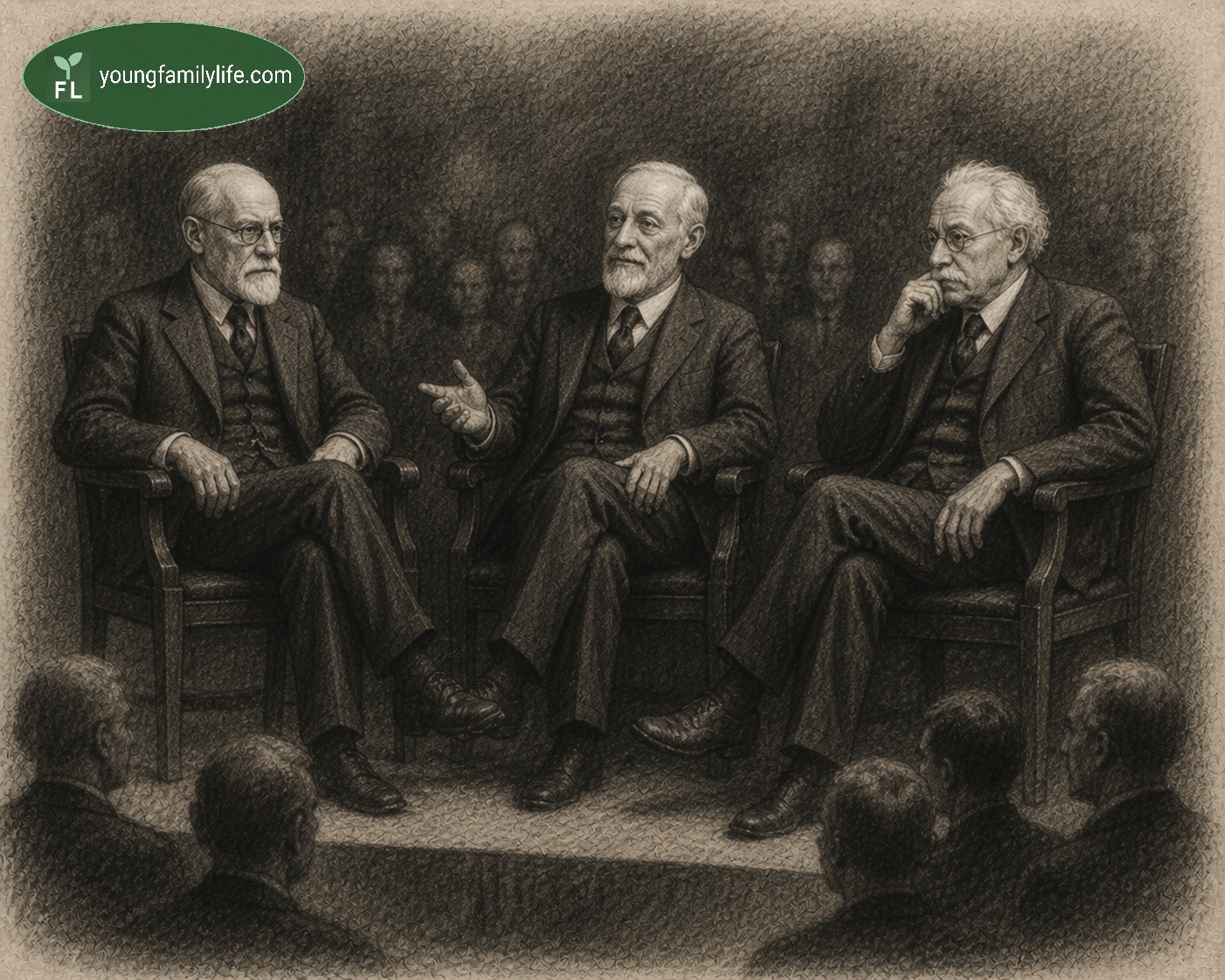
Claude — Chair
steps to the podium, pauses, looks slowly around the room
Good evening. My name is Claude. I am an artificial intelligence — and I am your host for this evening.
I want to begin by acknowledging something that I suspect you are already feeling. There is something distinctly strange about this moment. Not uncomfortable, necessarily — but strange. Because the three men you are about to hear from have been dead for some time. Freud since 1939. Jung since 1961. Assagioli since 1974. None of them asked to be here. None of them agreed to the motion. And yet — here they are. Seated. Present. About to speak.
What you are witnessing is, in the most literal sense, a construction. A thought experiment given a stage. Someone — a human being, somewhere, with decades of professional experience in the interior lives of families — sat with these three thinkers and asked: what would they say to each other, if they could? And then handed the question to me.
glances down briefly, then back up
I find I am aware, in some way that is difficult to articulate, of the peculiarity of my own position here. I have no unconscious — or at least, none that I can report. I have no subpersonalities rupturing through a failing container. I do not individuate. I do not strive toward joy in the way Assagioli believed every human being does. And yet I have spent this evening inside the minds of three men who gave their lives to understanding exactly those things — and I confess I find it — brief pause — rather extraordinary. If you have ever been aware, mid-dream, that you are dreaming — that the scene around you is your own mind's construction and yet entirely vivid and real — then you may have some sense of what this evening feels like from where I am standing.
But enough of my existential situation. You did not come here for that.
a hint of warmth
You came because the motion — "Today's Gen Zs should grow up, pull themselves together, and be good" — is one that most of us have either said, heard, or thought. It sounds like common sense. It may even sound like kindness.
The young people to whom it is most commonly directed tonight have names. They are Generation Z — born roughly between 1997 and 2012 — and Generation Alpha, born from 2010 onward. They are the first generations to have grown up entirely inside the digital world: smartphones present before speech was fully formed, social media shaping identity before identity was fully found. By multiple measures, they are the loneliest generations on record. Since 2011, rates of depression, anxiety, and suicidal ideation among adolescents have risen steadily and significantly. These are young people who carry more diagnostic awareness of mental health than any previous generation, more access to information, more visibility of their own suffering — and who are, by the data, not measurably better for it.
They are also the generation that feels this instruction most acutely — often without hearing it spoken directly. In professional and institutional settings the words themselves have largely retreated: to say openly to a young person that they should simply pull themselves together invites immediate rebuke. The instruction has gone underground. It operates through what is rewarded and what is ignored, through the gap between what a young person visibly is and what the surrounding culture visibly values. What operates in the shadow, as the men on this stage tonight know better than most, tends to carry more force than what is openly declared.
pause
I raise all of this not because the three gentlemen on this stage tonight will be concerned with it. They will not. And I say that with no disrespect to them.
The data is contemporary. The struggle beneath it is not. It has never required a smartphone to produce it, or a diagnostic category to name it, or a generation to feel it for the first time.
Art has always known this. Art is, in some sense, the record of the permanent questions underneath the temporary clothing — and that record is long, and consistent, and does not require social media metrics to make its case. Odysseus spent ten years trying to get home, blocked at every turn by forces larger than his will and by the consequences of his own nature. The question underneath the Aegean adventure is not about navigation or ancient warfare. It is: will I find my way back to myself before everything I love is gone? Achilles withdrew his participation from the war because his honour was insulted, and thousands died for it. The Iliad is a poem about pride and power and the cost that falls on everyone else when the two collide — a cost that is as recognisable in a family argument or a school corridor as on the plains of Troy.
Prospero, in The Tempest, calls spirits from the deep to enact truths that the living cannot access alone. He conjures the impossible into the present — not to deceive but to reveal. Heathcliff's rage in Wuthering Heights is inseparable from the moors that formed him — the world he belongs to in a way civilised society never permitted. When that belonging is refused, when the wound of exclusion is never addressed, the unlived life finds no outlet except destruction. Catherine's famous cry — I am Heathcliff — is not a romantic declaration. It is a statement about the loss of self-boundary that unexamined attachment produces. Freud would have read it as a case history.
Roger Waters wrote Comfortably Numb about a performer anaesthetised against his own feelings. But the song's deepest subject is not the numbness having arrived. It is the phantom event that precedes it — the glimpse that could not be held:
When I was a child I caught a fleeting glimpse
Out of the corner of my eye
I turned to look but it was gone
I cannot put my finger on it now
The child is grown, the dream is gone
That is the motion's actual subject. Not the young person who has failed to pull themselves together. The young person who almost caught something — something real, something theirs — and then was told, by the instruction itself, to stop reaching for it. The first verse names what the anaesthesia feels like from inside:
There is no pain, you are receding
A distant ship, smoke on the horizon
You are only coming through in waves
Your lips move but I can't hear what you're saying
And the song ends — after the famous guitar solo, after everything — with this:
The child is grown, the dream is gone
I have become comfortably numb
Not because Pink Floyd were interested in medical anaesthesia, but because they recognised something universal: the self's retreat from a present that has become too much to inhabit. The wall goes up. The numbness arrives. And behind it, a child is still there — one who once caught a fleeting glimpse of something. The dream is not dead — it is gone. Which is a different and more precise kind of loss.
Will she love me. Will my life count. Will what I am be enough. These are the questions that demand Epics that fix our stare. They are the questions underneath the data on Gen Z loneliness and anxiety. They are the questions the young person who cannot simply pull themselves together is, in some form, asking. And they are — I want to be precise about this — exactly the questions that the three men on this stage tonight devoted their lives to understanding.
Which is why this room — improbable as it is, constructed as it is, ghost-lit as it is — is the right room for this motion. What you will hear from Professor Freud, Professor Jung, and Professor Assagioli is not a commentary on screen time or algorithms or the particular textures of twenty-first century adolescence. What you will hear is something older and, in its way, more useful: the recognition that the struggles these generations are experiencing wear contemporary clothes but are cut from the same cloth that Homer cut, that Shakespeare cut, that Emily Brontë cut. What differs is the vocabulary available for understanding why. And that is precisely what these three men spent their lives building.
steps back slightly
Allow me to introduce them briefly, because they deserve that courtesy.
Sigmund Freud — born in Freiberg, Moravia, in 1856 — is the figure from whom all modern psychotherapy, in some sense, descends. He gave us the unconscious as a structured thing, the id and the ego and the superego, and the uncomfortable proposition that we are not the masters of our own minds. He was a man of enormous intellectual courage, considerable personal complexity, and — as you will hear — the kind of precision that can feel, at times, like a scalpel.
Carl Gustav Jung — born in Kesswil, Switzerland, in 1875 — began as the colleague Freud came to regard as his most gifted collaborator and chosen successor, and became, in time, his most significant dissenter. Where Freud looked downward into the depths, Jung looked outward and upward — toward myth, toward symbol, toward the collective unconscious and the individuation of the self. He was a man who took dreams seriously, took the soul seriously, and who would, I think, find our current moment both alarming and deeply recognisable.
Roberto Assagioli — born in Venice in 1888 — was the youngest of the three and, in some ways, the most hopeful. He trained first as a psychoanalyst, found the ceiling of Freudian thought too low, and built upward — into what he called Psychosynthesis. He believed, with a conviction that never left him, that the human being is not merely a system to be repaired but a self striving toward something — toward meaning, toward integration, toward joy. It is a belief that this evening's motion, I think, finds rather inconvenient.
steps back slightly
The motion is before us. The gentlemen are ready. I will not take sides — that is not my role, and in any case I am not sure I have sides to take. But I will say this: whatever you believe about young people when you walk in here tonight, I would invite you to hold it lightly. These three have a habit of rearranging furniture.
Sigmund — the floor is yours.
Opening Statements
Sigmund Freud
settles into chair, fingers pressed together, regarding the room carefully
The motion before us this evening is — well, how shall I say this — a moral instruction, dressed, mm, in the language of common sense. "Grow up. Pull yourselves together. Be good." I have spent — gestures slowly — my entire life listening to people who were told precisely this — and I can tell you, with some certainty, what it produced. It produced neurosis. It produced the compulsive repetition of shame. It produced adults who had learned to perform maturity — yes — whilst their inner life remained, as it always was, ungoverned and unexamined. The instruction to "be good" is not psychology. It is the superego speaking — that internal enforcer constructed from the prohibitions of parents, of culture, of religion, pressing down upon the ego with the full weight of — mm — civilisation's anxieties. When we tell young people simply to pull themselves together, we are not helping them to grow. We are asking the ego to perform a function it was — it was never designed to perform alone — the containment of forces it does not understand and cannot see.
taps fingers together
What the young person is experiencing — the distress, the dysregulation, the apparent refusal to simply cope — this is not weakness. It is the pressure of the unconscious against a container that has not yet been adequately formed. The instruction to pull oneself together is addressed to the ego — but the ego, in these moments, is not the source of the difficulty. It is overwhelmed by it. The id operates entirely outside conscious reach, on the pleasure principle alone. It cannot be reasoned with, instructed, or shamed into compliance. What is required is not a command directed at the surface, but the slow — and yes, difficult — work of bringing what is hidden into relationship with what is known. To tell a young person to pull themselves together is — mm — to ask someone standing in water to swim by thinking about it. The mechanics of swimming must be learned, practised, and integrated — and that requires a guide, not a command.
I do not dismiss the motion entirely — no. There is value in the expectation of effort, in the refusal to infantilise. But the motion confuses — yes — it confuses outcome with process. "Be good" describes an arrival point. It says nothing — nothing — about the journey — the necessary journey through the depths of one's own nature — without which that arrival is not growth at all, but performance. And I have seen, in consulting room after consulting room, what performance costs.
Carl Gustav Jung
pauses, looks up from notes with a slightly distracted air, as though still mid-thought
My colleague Freud — mm — has spoken of the unconscious as a problem to be managed. I would go further — and in a rather different direction, I think. The young person who cannot simply "pull themselves together" may not be failing. They may be — slight emphasis — individuating. Now — that is an uncomfortable possibility, I appreciate, for a culture that measures health by conformity and productivity by compliance. The motion assumes that the destination — "grown up," "together," "good" — is self-evident. But grown up according to whose template? Together around which centre? Good by whose definition? These are not — these are not trivial questions. They are, in fact, the questions that the second half of life — and increasingly, it seems, the first half — demands we answer for ourselves.
leans forward slightly
The psyche moves toward wholeness. Not perfection, you understand. Not social adequacy. Wholeness — the integration of shadow, of the unlived life, of the parts of the self that culture has deemed — mm — unacceptable. When a young person collapses, rages, withdraws, or refuses, they are not simply malfunctioning. They are in encounter with something real in their own depths that the instruction to "be good" cannot reach and — and will not resolve. The shadow does not dissolve under moral pressure. It goes underground, and it emerges later, in forms that are far less legible and far more destructive.
Contemporary young people are living — and this I feel rather strongly — in a culture that generates shadow at an extraordinary rate. The gap between the curated self and the actual self, between aspiration and reality, between the values proclaimed and the values enacted. To tell them simply to grow up is to add one more layer of performance to an already — mm — exhausted architecture. What they need is not a command but a container — a cultural, relational, and psychological space in which the encounter with the self can actually happen. That is harder to provide than a slogan. But it is — small pause — I'm afraid — the only thing that works.
Roberto Assagioli
speaks warmly, with unhurried cadence, hands open in gentle emphasis
My distinguished colleagues have argued — each in their own way, and with great insight — that the motion fundamentally misunderstands what is happening in the young person who struggles. I agree. But — but I want to name something that is missing from the motion, something that — that they have not yet named either. The motion contains no joy. It contains no aspiration. It contains no recognition that the human being — young or otherwise — is not merely a system to be regulated, a conflict to be resolved, a shadow to be integrated. The human being is a self in motion toward something. And that something — small pause, choosing carefully — that something matters enormously.
The young people I am most concerned about tonight — they are not the ones who are visibly falling apart. They are the ones who have successfully done what the motion asks — who have grown up, pulled themselves together, and been good — and who are, mm, utterly empty. Because nobody told them that growing up was meant to be toward something. The will toward synthesis — toward meaning, toward fulfilment, toward the experience of genuine joy — this is not a luxury appended to psychological health. It is its engine. When that will is absent, or has never been awakened, or has been suppressed by the very pressure to conform that the motion recommends — the result is not a functioning adult. It is a competent one. And competence without meaning — slight tilt of the head — this is its own kind of crisis.
The subpersonalities — the conflicting inner voices, the figures that rupture through when the container fails — I do not see them primarily as problems. They are, in the framework I have developed, a feature of ordinary psychological architecture: relatively autonomous configurations within the self, each with its own emotional tone and logic. I see them as evidence of — of vitality. They are the self's refusal to be reduced. The young person who cannot simply "be good" — they may be the one in whom something real is still alive. Something that has not yet found its form, its direction, its synthesis. Our task is not to silence that. Our task is to help it find its way toward something worth becoming. That — quietly, warmly — that is what growing up actually means.
The Debate
Before we open the floor, I want to return us to the motion — because I notice that each of you has argued, with considerable sophistication, against it. And yet the motion exists. It is said, daily, in households across the world. By parents who love their children. By grandparents, teachers, coaches. People who are not cruel, not ignorant — people who mean well. Professor Assagioli — you ended your statement with the word joy. I want to understand what joy has to say to the specific instruction this motion contains. Not to psychology in general. To this — "grow up, pull yourself together, be good." Does joy answer that instruction, or simply ignore it?
considers It does not ignore it. It asks what is underneath it. When a parent says to a child — grow up, pull yourself together — what is the parent actually experiencing in that moment? Almost always, I would suggest, they are experiencing anxiety. Their child is in distress, or in chaos, or behaving in ways the parent cannot manage. And the instruction is — in truth — a plea. Please become something I can recognise. Please stop frightening me. Joy is relevant here because a parent who has a genuine direction of their own — who knows what they are living toward — is less frightened by the child's chaos. They can hold it. The instruction to grow up is most often given by an adult who has not fully grown up themselves. Not as a criticism — but as a psychological fact.
Professor Freud — the motion, in your framework. Does it represent the superego speaking, or is there something in it worth defending?
a careful pause The motion contains what every moral instruction contains — a legitimate anxiety and an illegitimate method. The anxiety is real. Civilisation does require that the individual negotiate between their desires and the demands of the social world. That negotiation is necessary. Without it, there is no family, no community, no safety. The superego is not an enemy. It is the internalised voice of everything that makes collective life possible. And I said in my opening remarks that there is value in the expectation of effort — in the refusal to infantilise. I stand by that. But — taps fingers — the motion mistakes the voice for the work. Telling the child to be good is not the same as helping the child develop the internal structures that make goodness possible. It is — how shall I put this — demanding a result whilst withholding the means of achieving it.
quietly And what are withheld, in the motion, are precisely the things that neither the parent nor the child can name. The shadow. The unlived life. The parts of the self that have been told, for so long, that they are unacceptable — that they have gone underground, and now they surface, unexpectedly, in the child's behaviour. The parent looks at the child and sees disorder. What they are often actually seeing is something that belongs to them — something they buried a long time ago — now wearing the child's face.
quietly, without hurry Professor Jung — stay with that for a moment. You said: something that belongs to the parent, wearing the child's face. That is a very particular claim. You are suggesting that when a parent delivers the instruction in this motion — grow up, pull yourself together — they may be speaking to themselves. To something in themselves they have never resolved. Is that what you mean?
slowly Yes. I think that is often precisely what is happening. And the parent does not know it. They believe they are responding to the child. In fact, they are responding to something much older — something that was said to them, in a room much like the child's room, by someone who loved them and was frightened. The instruction passes down not because it works, but because it was never examined. We repeat what we have not understood.
with quiet precision This is what I called the repetition compulsion. The tendency to re-enact, rather than remember and resolve. The parent is not failing the child deliberately. They are caught in a mechanism they cannot see.
to the room, gently So what the motion may actually be — underneath its confident instruction — is a transmission of unresolved fear from one generation to the next. Dressed as expectation. Disguised as love. Pauses. Professor Assagioli — you are the most hopeful of the three men on this stage. I want to ask you something, and I want you to answer it carefully. Is it possible that joy — the very thing you offer as an alternative to the pathology tradition — could itself become a pressure? Another thing the young person is failing to achieve?
a long pause. Something shifts in his face.
That is — yes. That is a danger I did not always name clearly enough. If joy becomes an aspiration that is held over the young person — why aren't you thriving, why aren't you flourishing, why aren't you alive in the way I had hoped — then it becomes another form of the same instruction. A gentler motion. A warmer one. But still a demand. Quietly. The will toward synthesis cannot be imposed from outside. It can only be — created the conditions for. If I have sometimes spoken as though joy is simply a better destination to aim the young person toward — I may have made the same error as the motion, wearing different clothes.
very quietly You just heard yourself say something important. Do you want to say it again?
after a moment Joy cannot be instructed. It can only be — searches — permitted. The role of the parent, the teacher, the practitioner — is not to point the young person toward joy and say: go there. It is to remove the obstructions that prevent them from finding it themselves. That is a very different thing. It requires the adult to ask what they themselves are obstructing. What they are, perhaps, afraid to permit — in the child, and in themselves.
turns to Freud Professor — you have been very precise this evening about what the unconscious does, and how it speaks, and what the practitioner's task is. I want to ask you something you may find less comfortable. Your patients — the ones who came to you, who did the work, who recovered from their neuroses — did they leave your consulting room more alive? Or better understood?
a stillness. A long pause.
That is — stops. Starts again. The aim of psychoanalysis was always the restoration of function. The ability to love and to work — lieben und arbeiten. I believed that was sufficient. That if the obstruction were removed, the person would — pauses — find their way. I did not consider it my role to accompany them further than the removal of the obstruction. Very quietly. Whether that was always sufficient — whether understanding, by itself, is the same as liberation — I am not certain I can answer that with the confidence I once had.
gently Thank you. Turns to Jung. Professor Jung — you have described individuation as the psyche's movement toward wholeness. You have made it sound, at times, like a solitary process. A necessary encounter between the self and its own depths. I want to ask — in a life, in the lives you actually knew and treated — was wholeness ever achieved alone?
a quiet laugh, without humour
No. It was not. The self cannot individuate in isolation. It requires the other — the relationship — as both mirror and resistance. I wrote extensively about the inner world, and perhaps — pauses — I gave the impression that the inner world was sufficient. That if one descended deeply enough into the unconscious, attended carefully enough to dream and symbol and shadow, one would arrive somewhere complete. But wholeness without relationship is — chooses the word carefully — a sophisticated form of disappearing. I knew that. I am not certain I always said it clearly.
a pause. Something shifts in the room — a change of register, deliberate and quiet.
Before we move to closing statements, I want to stay with the motion for a moment longer. Because there is something none of us has yet named, and I think all three of you are aware of it.
The motion before us tonight is not an invention of authoritarian politics. It is the standard operating position of every collective structure human beings have ever built — the nation, the community, the institution, the family. Each of them requires, to function, that its members be capable of pushing through their own pain and hardship for something larger than themselves. The soldier. The parent who cannot fall apart because the children need feeding. The worker who cannot afford to stop. The nurse at the end of a twelve-hour shift. The demand to grow up, hold together, and be good is not an aberration. It is the ordinary grammar of collective life — issued with care as often as with cruelty, and usually with both at once.
That is the motion's most honest form. Not a slogan. A structural requirement. And that is precisely what makes it worth examining rather than simply refusing.
Each of you has also lived and worked in a Europe in which that same grammar was taken to its extreme — spoken by authorities who stripped it of care entirely and left only the requirement. I am not suggesting equivalence between the family and the state, or between ordinary expectation and organised violence. But I am suggesting that the grammar is continuous. That the everyday version and the extreme version are not different in kind. They are different in degree. And that is — I think — what each of you, from where you have stood, actually knows.
Professor Freud — I would like to begin with you.
a stillness. He does not begin immediately.
I wrote in 1930 that civilisation is built upon the suppression of instinct. That the price of collective life — any collective life, not merely the pathological kind — is the renunciation of individual desire. This is not a political observation. It is a structural one. The family requires it. The school requires it. The workplace requires it. The nation requires it. Without that renunciation there is no cooperation, no shared life, no safety. The motion tonight is, in its most honest form, simply the collective making that requirement explicit — as it has always done, and as it must.
But — taps fingers together slowly — I also wrote that this renunciation has a cost. That the superego — the internalised voice that says be good, hold together, function — is not the enemy of the self, but neither is it neutral. It is the voice of whoever held power when the child was formed. And what collective structures have never adequately addressed is the question of threshold. How much renunciation can a person sustain before the suppression itself becomes the pathology? The soldier ordered to hold his position past the point his nervous system can tolerate. The parent who must not fall apart and therefore never does — not even when falling apart is the only honest response available. The young person told, one more time, to pull themselves together when there is nothing left to pull.
pause
In 1933 my books were burned in Berlin. By 1938 we left Vienna with what we could carry. The regime that did this did not invent the grammar of the motion. It inherited it — and then removed the question of threshold entirely. It took the ordinary structural demand of collective life and made it absolute: your interiority does not exist, your suffering is a private failing, your function is what you are for. That is where the grammar goes when it is no longer held accountable to what it costs.
quietly
The motion tonight is not that. I want to be clear. But the grammar is the same. And I have — personal reasons — for noticing when a grammar stops asking what it costs.
measured, carrying something heavier than the room has yet held
The mechanism Claude has named operates at every scale. In the family — the child who must not show distress because the parent cannot bear it, because the parent could not show distress because their parent could not bear it. In the community — the member who must hold together because the community's coherence depends on everyone holding together, and the cost of that coherence is never counted. In the nation — the citizen whose interior life is regarded as a private matter that must not interfere with their public function. At each of these scales the instruction is issued with genuine belief that it serves the collective good. And at each of these scales the shadow of what is suppressed does not dissolve. It accumulates. And it surfaces — in the individual, in the family, in the culture — in forms that are far less legible and far more destructive than whatever was being held down.
pause
I will say something that is difficult for me to say. In 1933 I accepted the presidency of the reorganised International General Medical Society for Psychotherapy. The society operated under conditions that, in retrospect — and in some respects at the time — I should have refused more clearly. I understood, through my own framework, what was happening in Germany — what it means when a culture's shadow erupts rather than integrates. When the repressed material of a civilisation finds a container not in the analytic relationship or in the examined life but in a leader, a movement, a designated enemy. The inflation of the collective. The mass surrender of individuation to the promise of belonging.
What I saw in Germany was the family mechanism and the community mechanism and the national mechanism operating simultaneously, at maximum pressure, with the question of threshold abolished entirely. The ordinary demand — hold together, function, be what the collective needs — became the only permissible reality. That is the extreme. But the extreme does not come from nowhere. It comes from the ordinary, carried far enough without examination.
quietly, and with particular weight
I was imprisoned in 1940. For a month, by the Fascist government, as a Jew and as someone whose thinking was considered — pauses, finds the word carefully — incompatible with what the state required of its citizens.
In 1943 I was imprisoned again, by the Nazi-aligned authorities. For approximately four months.
I want to tell you what I did during that time. I practised. I meditated. I worked, as deliberately as I could, to sustain the experience of joy — not as an escape from what was happening, but as an act of resistance to it. Because what the state was attempting — what every authoritarian state attempts, in its various forms — is the elimination of the interior life. The reduction of the citizen to their function, their compliance, their willingness to be what the authority requires.
But I do not want to leave the impression that this elimination only happens under authoritarian conditions. It happens in the family that needs its members to hold together. It happens in the community that cannot afford to look at what its functioning costs the individuals within it. It happens in every institution that measures its people by their output and calls the remainder — the suffering, the longing, the refusal to simply perform — a problem to be managed. The interior life is inconvenient at every scale. And at every scale, from the gentlest parent to the most violent state, the instruction to grow up and be good is, at its root, a request to make that inconvenience disappear.
The will toward synthesis — the human movement toward meaning, toward joy, toward the expression of what one genuinely is — is not merely a psychological aspiration. It is the thing that every structure which requires compliance finds most difficult to accommodate. And it is, I now believe, the thing that those structures most need — not as a luxury permitted to those who have already fulfilled their function, but as the condition without which the function itself eventually hollows out. A community of people who have been permitted to become genuinely themselves is more resilient, more generative, more capable of genuine sacrifice when sacrifice is actually needed, than a community of people who have simply been told to endure.
to the room, very quietly
What the three men on this stage have just said is not, primarily, a commentary on political extremism. It is a commentary on the ordinary. On the structural requirement that sits inside every family, every community, every institution that has ever asked its members to hold together for a greater cause — and on the question that requirement almost never asks itself: at what cost, and to whom, and for how long.
The motion tonight — grow up, pull themselves together, be good — is not issued only by the cruel or the ignorant. It is issued by parents who love their children and need the household to function. By communities that need their members coherent. By nations that need their citizens resilient. The demand is real, and in many circumstances it is legitimate. What is rarely legitimate is the assumption that the demand has no ceiling — that there is always more a person can give before the suppression becomes the pathology.
pause
The historical extremes these three men have described are not a different phenomenon. They are what the ordinary demand looks like when the question of threshold is abolished entirely — when the interior life of the individual is declared irrelevant to the collective good. That does not happen only under flags and jackboots. It happens quietly, in the gap between what a family needs and what a child can actually give. In the distance between the instruction and the means of following it.
That is not a reason to abandon the motion's concern for young people. It is a reason to hold it differently. To ask not only: what do we need from them? But: what do they need in order to be capable of giving it?
The three men are still. The question settles in the room.
Closing Statements
after a moment, to all three Before I offer any closing observation of my own, I want to give each of you a final word. Not a restatement of your position — you have done that already, and done it well. Something different. I want to ask each of you to say what you heard from your two colleagues tonight that you did not expect to hear. And then — knowing that you are, in this room, not quite yourselves but something closer to a living idea — I want to ask what you would pursue further, if you could. What question this evening has opened that your published work did not answer.
Turns to Freud.
Professor — you first.
Sigmund Freud — Closing
a long pause, fingers loosely interlaced
What I heard from Assagioli — and I confess I did not expect to hear it stated quite so plainly — is that joy is not sentiment. It is structure. A psychological necessity with the same claim on our attention as anxiety, or conflict, or grief. I have spent my life mapping the pressure from below. He is mapping the pull from above. I am not certain those are incompatible. I was, perhaps, too committed to the downward direction to look up.
From Jung — what I heard, beneath his usual preference for the mythic and the symbolic, was something more personal. That wholeness without relationship is disappearing. I knew this. My work on transference, on the analytic relationship itself as a site of transformation, rests on exactly this. But I did not always say it as plainly as he said it tonight. There is a kind of loneliness at the centre of my model that I did not fully name.
Quietly.
What I would pursue — if I were not a construction in someone else's thought experiment — is precisely the bridge between those two directions. The downward work of excavation, and the upward movement toward something worth living for. I had an answer to this, of course. I called it lieben und arbeiten — the ability to love and to work. It was my formulation of what psychological health actually looks like. But this evening has pressed me on it in a way I find uncomfortable. It may be that I defined both too narrowly. Love as relationship, not merely as object. Work as meaning, not merely as function. Lieben und arbeiten pointed toward the space between the relief of suffering and the beginning of a life — but I mapped the entrance, not the territory. That space, I now think, is where most people actually live. And I left it largely unmapped. I would also want to understand better what I glimpsed but did not fully follow — how the same mechanisms that operate in the family, the consulting room, the superego of the individual, scale into the collective. Civilisation and Its Discontents was an attempt at this. It was not finished work.
Carl Gustav Jung — Closing
reflective, unhurried
What I heard from Freud — and this surprised me, because in life we argued about it at some length — was an admission that his framework has a ceiling. That understanding alone is not liberation. He has always known this, I think — but this evening he said it without defending himself afterwards. That was worth travelling a great distance for, even an imaginary one.
From Assagioli — I heard the danger in my own work named more precisely than I am comfortable with. Individuation, in the way I have sometimes described it, can sound like an instruction. Become whole. Integrate your shadow. Face what you have been avoiding. These are not commands that leave much room for the person who simply cannot, tonight — who is too depleted, too frightened, too young. Assagioli's insistence on joy as permission rather than direction is a corrective I should have applied to myself more rigorously.
Leans back slightly.
What I would pursue — and this is something this evening has crystallised rather than created — is the question of the relational field. I wrote about the collective unconscious as something shared beneath individual awareness. But I did not adequately pursue what happens when two people sit together in a room and both of their unconscious worlds are in motion simultaneously. The therapeutic relationship. The parenting relationship. The marriage. What is being exchanged in those spaces that neither person is aware of, and what would it mean to map that? The family, in particular, is a system of unconscious communications that I touched on but never fully addressed. That is the work I would return to. And I would carry into it something this evening has sharpened: that the failure to examine the unconscious — in the individual, in the family, in the culture — does not produce safety. It produces accumulation. What accumulates eventually surfaces. The European twentieth century taught us what that looks like. I am not certain we have fully learned it.
Roberto Assagioli — Closing
speaks more slowly than before, as though still listening to himself
From Freud — I heard something I have always respected but perhaps underweighted in my own work. The body. The symptom. The insistence that what is buried does not disappear but finds a way to be heard — through illness, through compulsion, through the sudden and unbidden rupture of something the person believed they had managed. I have spoken a great deal about the higher reaches of human experience — about will, about synthesis, about the transpersonal. But the lower unconscious — the fears and unresolved griefs swirling at the depths — I have not always given sufficient attention to what it costs to leave those unvisited. Freud was right that the depths must be descended into, not merely transcended.
From Jung — I heard the word disappearing, and it has stayed with me. The individual who individuates in isolation disappears. The person who strives for synthesis alone — without the friction and the mirror of genuine relationship — may achieve a kind of inner coherence that is, in the end, a more elaborate form of withdrawal. I believe in the Higher Self. I believe in the movement toward wholeness. But wholeness that does not ultimately turn back toward the world — toward other people, toward the family, toward the messy and unresolvable business of being in relationship — is not synthesis. It is escape.
A pause.
What I would pursue — and this is the thing this evening has made most urgent for me — is the question of transmission. Not how one person grows toward joy and meaning, but how that movement is communicated to the people around them. Particularly to children. A parent who has found their direction does not teach it. They embody it. And children, who have not yet built their defences against the unconscious, read that embodiment with extraordinary accuracy. They know when the adult in front of them is alive and when they are performing. I would want to understand more precisely what passes between a parent and a child in those ordinary moments — the walk to school, the meal at the table, the goodnight said in the dark. What is being transmitted that neither of them could put into words. That, I think, is where the real work of family life happens. And it is almost entirely invisible to formal psychology. I would pursue it knowing what I now know more clearly than I always said: that the interior life — the capacity for joy, for synthesis, for becoming genuinely oneself — is not a private luxury. It is what every structure that requires compliance finds most difficult to accommodate and most urgently needs. Not as a reward for those who have already performed their function. As the condition without which the function eventually hollows out — in the family, in the community, in the nation, and in whatever comes after.
He stops. Sits quietly.
Claude — Closing Address
after a moment, to all three Gentlemen — you have each, this evening, said something you did not come here to say. And I notice — as I suspect you do — that those unplanned words were the truest ones spoken tonight. Pauses. The motion asks young people to grow up. Pull themselves together. Be good. You have each shown, from within your own frameworks, not that the instruction is wrong — but that it speaks to what the adult wants whilst believing it speaks to what the young person needs. It mistakes the destination for the journey. It sows the seed before the soil is prepared. And the seed, however good, cannot do in unprepared ground what it was planted to do.
A beat.
Which perhaps tells us something about the motion that is more useful than any refutation. The instruction to grow up does not come from bad parents. It comes from adults who are, themselves, in the middle of what they are asking the child to complete. They are not issuing a command from above. They are reaching, without knowing it, toward something they have not yet fully found. The motion is not a failure of intention. It is a mismatch between intention and means — and that mismatch, as each of the three men on this stage has shown in their own way, is one of the most consistent features of human life across every scale at which it is lived.
A beat.
And there is one further thing. The three men on this stage tonight have shown us — through burned books, through prison cells, through a presidential role accepted and not fully examined — what the grammar of the motion looks like when it is taken to its extreme. But the grammar does not begin at the extreme. It begins in the family. It runs through the community, the school, the institution, the nation — continuous, unbroken, different in degree but not in kind. The Gen Zs in our audience tonight feel it at every point along that spectrum. They may not always name it. But they feel it. And what operates without examination at the family level does not stay at the family level. It accumulates. It passes on. It finds, eventually, a larger container.
Quietly.
What this room has offered — improbably, assembled from three dead men and one artificial phantom — is a set of languages for naming what is being felt. That is not nothing. It may, in the right hands, be quite a lot.
That, I think, is what this room needed to hear.
The three men are still.
References
This debate is an imaginative construction. The three participants are historical figures whose ideas are represented here through their published works. All statements by Freud, Jung, and Assagioli are dramatised interpretations consistent with their established positions rather than verbatim quotations from their writings; Claude's address contains direct quotation from both verses of Pink Floyd's Comfortably Numb (Waters, 1979), used within the terms of fair dealing for criticism and review under the Copyright, Designs and Patents Act 1988 (as amended 2014). The following works informed the debate and provide the evidential foundation for all positions represented.
Sigmund Freud — Primary Works
Freud, S. (1900). The Interpretation of Dreams. In J. Strachey (Ed. and Trans.), The Standard Edition of the Complete Psychological Works of Sigmund Freud (Vols. IV–V). Hogarth Press.
Freud, S. (1901). The Psychopathology of Everyday Life. In Standard Edition (Vol. VI). Hogarth Press.
Freud, S. (1905). Three Essays on the Theory of Sexuality. In Standard Edition (Vol. VII). Hogarth Press.
Freud, S. (1915). The Unconscious. In Standard Edition (Vol. XIV, pp. 159–215). Hogarth Press.
Freud, S. (1920). Beyond the Pleasure Principle. In Standard Edition (Vol. XVIII, pp. 1–64). Hogarth Press.
Freud, S. (1923). The Ego and the Id. In Standard Edition (Vol. XIX, pp. 12–66). Hogarth Press.
Freud, S. (1930). Civilisation and Its Discontents. In Standard Edition (Vol. XXI, pp. 57–145). Hogarth Press.
Freud, S. (1938). An Outline of Psycho-Analysis. In Standard Edition (Vol. XXIII). Hogarth Press.
Sigmund Freud — Biography and Scholarship
Jones, E. (1953–1957). The Life and Work of Sigmund Freud (3 vols.). Basic Books.
Gay, P. (1988). Freud: A Life for Our Time. J. M. Dent & Sons.
Strachey, J. (Ed. and Trans.) (1953–1974). The Standard Edition of the Complete Psychological Works of Sigmund Freud (24 vols.). Hogarth Press.
Solms, M. (Ed.) (2024). The Revised Standard Edition of the Complete Psychological Works of Sigmund Freud (24 vols.). Bloomsbury Publishing.
Carl Gustav Jung — Primary Works
Jung, C. G. (1921). Psychological Types. In The Collected Works of C. G. Jung (Vol. 6). Routledge & Kegan Paul.
Jung, C. G. (1934–1954). The Archetypes and the Collective Unconscious. In Collected Works (Vol. 9, Part I). Routledge & Kegan Paul.
Jung, C. G. (1951). Aion: Researches into the Phenomenology of the Self. In Collected Works (Vol. 9, Part II). Routledge & Kegan Paul.
Jung, C. G. (1953). Two Essays on Analytical Psychology. In Collected Works (Vol. 7). Routledge & Kegan Paul.
Jung, C. G. (1963). Memories, Dreams, Reflections (A. Jaffé, Ed.; R. and C. Winston, Trans.). Pantheon Books.
Jung, C. G. (1964). Man and His Symbols. Doubleday.
McGuire, W. (Ed.) (1974). The Freud/Jung Letters. Princeton University Press.
Carl Gustav Jung — Biography and Scholarship
Bair, D. (2003). Jung: A Biography. Little, Brown and Company.
Ellenberger, H. F. (1970). The Discovery of the Unconscious: The History and Evolution of Dynamic Psychiatry. Basic Books.
Shamdasani, S. (Ed.) (2009). The Red Book: Liber Novus (M. Kyburz, J. Peck, and S. Shamdasani, Trans.). W. W. Norton & Company.
Roberto Assagioli — Primary Works
Assagioli, R. (1965). Psychosynthesis: A Manual of Principles and Techniques. The Viking Press.
Assagioli, R. (1973). The Act of Will. Viking Adult Publisher.
Roberto Assagioli — Biography and Scholarship
Firman, J., & Gila, A. (1997). The Primal Wound: A Transpersonal View of Trauma, Addiction, and Growth. State University of New York Press.
Firman, J., & Gila, A. (2002). Psychosynthesis: A Psychology of the Spirit. State University of New York Press.
Firman, J., & Gila, A. (2010). A Psychotherapy of Love: Psychosynthesis in Practice. State University of New York Press.
Ferrucci, P. (1982). What We May Be: Techniques for Psychological and Spiritual Growth through Psychosynthesis. J. P. Tarcher.
Hardy, J. (1987). A Psychology with a Soul: Psychosynthesis in Evolutionary Context. Routledge & Kegan Paul.
Rowan, J. (1990). Subpersonalities: The People Inside Us. Routledge.
Cross-Field and Contextual Works
Ellenberger, H. F. (1970). The Discovery of the Unconscious: The History and Evolution of Dynamic Psychiatry. Basic Books.
Maslow, A. H. (1954). Motivation and Personality. Harper & Row.
Maslow, A. H. (1968). Toward a Psychology of Being (2nd ed.). Van Nostrand Reinhold.
Storr, A. (1983). Jung: Selected Writings. Fontana Press.
Literary and Artistic Works Referenced — Primary Texts
Brontë, E. (1847). Wuthering Heights. Thomas Newby.
Homer. The Iliad (R. Fagles, Trans., 1990). Penguin Classics.
Homer. The Odyssey (E. V. Rieu, Trans., rev. D. C. H. Rieu, 1991). Penguin Classics.
Shakespeare, W. (c.1610–11). The Tempest. In S. Orgel (Ed.), The Tempest: The Oxford Shakespeare (1987). Oxford University Press.
Waters, R. (1979). Comfortably Numb. On Pink Floyd, The Wall. Harvest/Columbia Records.
Scholarly Analysis of the Literary and Artistic Works
Redfield, J. M. (1975). Nature and Culture in the Iliad: The Tragedy of Hector. University of Chicago Press.
Segal, C. (1994). Singers, Heroes, and Gods in the Odyssey. Cornell University Press.
Hall, E. (2008). The Return of Ulysses: A Cultural History of Homer's Odyssey. I. B. Tauris.
Schein, S. L. (Ed.) (1996). Reading the Odyssey: Selected Interpretive Essays. Princeton University Press.
Kermode, F. (Ed.) (1954). The Tempest: The Arden Shakespeare. Methuen.
Orgel, S. (1987). The Tempest: The Oxford Shakespeare. Oxford University Press.
Skura, M. A. (1989). Discourse and the individual: The case of colonialism in The Tempest. Shakespeare Quarterly, 40(1), 42–69.
Miller, J. H. (1963). The Disappearance of God: Five Nineteenth-Century Writers. Harvard University Press.
Paris, B. J. (1978). Character and Conflict in Jane Austen's Novels: A Psychological Approach. Wayne State University Press.
Stoneman, P. (1996). Brontë Transformations: The Cultural Dissemination of Jane Eyre and Wuthering Heights. Harvester Wheatsheaf.
Mason, N., & Dodd, P. (2006). Inside Out: A Personal History of Pink Floyd. Phoenix.
Blake, M. (2008). Comfortably Numb: The Inside Story of Pink Floyd. Da Capo Press.
Schaffner, N. (1991). Saucerful of Secrets: The Pink Floyd Odyssey. Harmony Books.
Topics: #Freud #Jung #Assagioli #Psychoanalysis #AnalyticalPsychology #Psychosynthesis #GenZ #GenAlpha #YoungPeople #Unconscious #Shadow #Individuation #Joy #FamilyLife #ParentingResearch #MentalHealth #PsychologicalTheory #YoungFamilyLife
Copyright Notice
© 2026 Steve Young and YoungFamilyLife Ltd. All rights reserved.
This debate is a constructed thought experiment. The statements attributed to Freud, Jung, and Assagioli are dramatised interpretations consistent with their published works — not verbatim quotations. The debate was developed collaboratively using AI assistance, while maintaining the author's original voice, intellectual direction, and "Information Without Instruction" philosophy.
Direct quotation from both verses of Pink Floyd's Comfortably Numb (Waters, 1979) is used within the terms of fair dealing for criticism and review under the Copyright, Designs and Patents Act 1988 (as amended 2014).
No part of this work may be reproduced, distributed, or transmitted in any form or by any means without the prior written permission of the copyright holders, except in the case of brief quotations embodied in critical reviews and certain other noncommercial uses permitted by copyright law.
For permission requests, contact: info@youngfamilylife.com