The question nobody really asks
When parents struggle — when they snap, or give in, or find themselves doing the very thing they said they never would — the explanations that usually follow are about character. They lost their temper. They are too soft. They lack consistency. They need to try harder.
Research tells a different story. The way most parents behave with their children has much less to do with choice or effort than those explanations suggest. It has a great deal to do with the nervous system each parent grew up with — and what that nervous system learned, very early on, about how the world works and what it requires.
Parents deliver a nervous system, not a philosophy
Every parent brings values and intentions to the job. Most have thought about what kind of parent they want to be. Many have read about it, talked about it, resolved about it.
But research in brain science is clear that in the moment — in the actual exchange between parent and child — it is not values or intentions that generate the response. It is the brain. And the brain that does the parenting is itself a record of the environment it was built in.
A child's brain builds itself from experience. Everything the growing child encounters in their relational world — how the adults around them respond to distress, what gets warmth and what gets withdrawal, whether the environment feels safe or unpredictable — gets registered and built into the brain's developing architecture. The brain the child ends up with as an adult is, in part, a product of where it grew up.
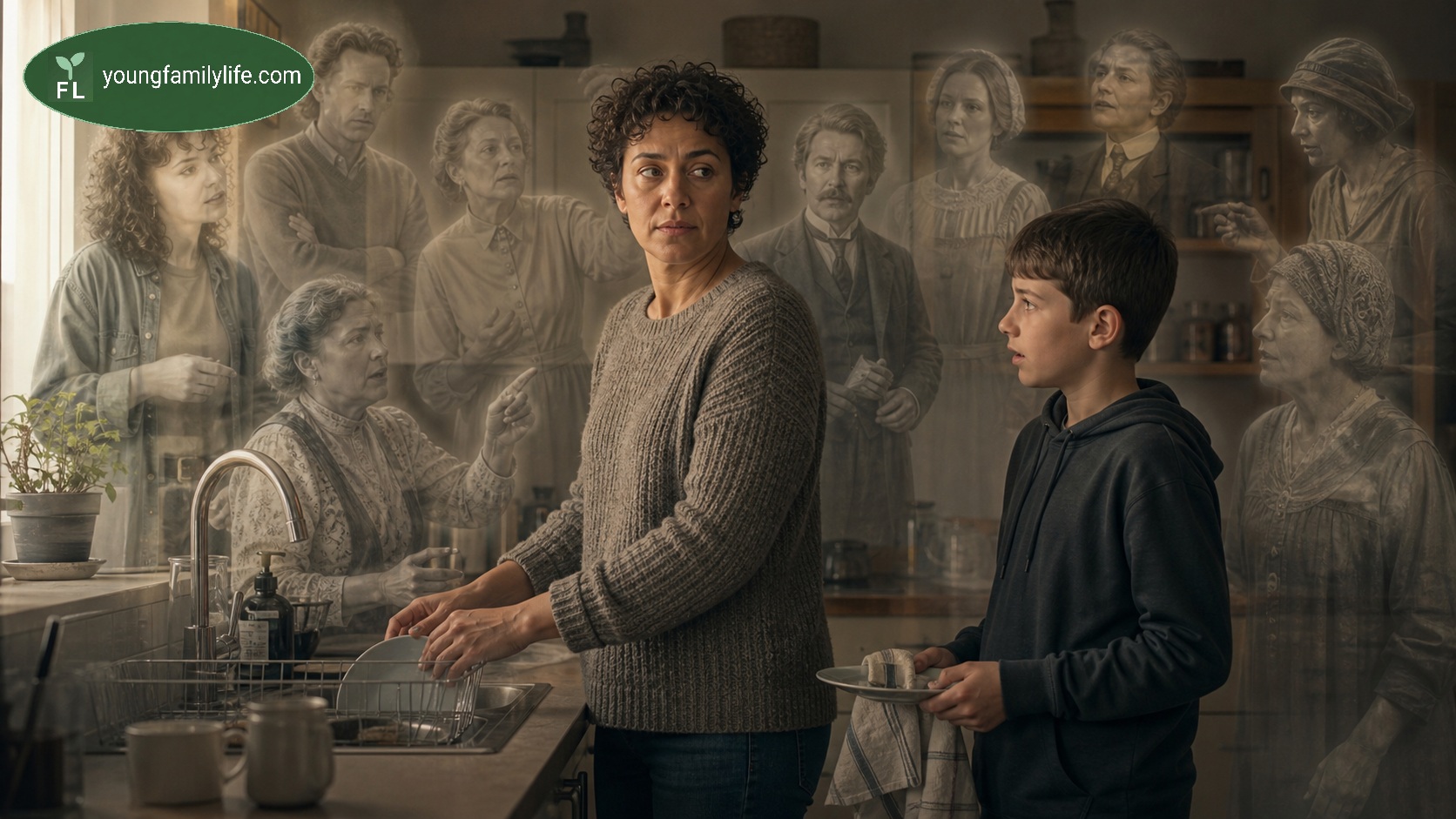
For parents, the implication of this is significant. The brain doing the parenting was once a child's brain too. It was shaped by the same process. And the patterns laid down then — what felt safe, what felt threatening, how people responded in difficult moments — are still active. They don't disappear when a person becomes a parent. They become the default.
The brain runs on an old map
Brain research has established something that helps explain a lot of parenting behaviour. The brain does not simply take in what is happening and respond to it. It builds a working model of the world from past experience, and it uses that model to predict what is likely to happen next. It is always, to some degree, responding to what it expects rather than purely to what is actually in front of it.
For a parent, this means that the child in the room is partly being seen through the lens of an older model — one built from the parent's own childhood. The brain is drawing on what it learned then about what children need, what situations mean, and how adults should respond. It does this automatically and largely without awareness. The model runs. The response follows. The thinking part of the brain may review things afterwards, but by then the moment has already passed.
This matters most when the model is out of date. A parent whose own early years were difficult — unpredictable, frightening, or requiring a child to manage too much too soon — built a model calibrated to that world. That model is still running. It generates responses suited to conditions that may no longer exist, aimed at a child who is not in the same position the parent once was.
Most parents are not aware this is happening. The response feels like the obvious and natural thing to do. That is how deeply established models work — they are experienced as reality, not as interpretation.
Exploring this further
While this is happening in the parent's nervous system, something equally specific is happening in the child's. In Other Words: Growing up happens at home looks at what children are actually absorbing from the home environment — and why the atmosphere matters as much as it does. For those experiencing the strict or soft end of this directly, What strict parenting can do for children and What soft parenting can do for children explore those specific questions.
What pressure does to a parent's brain
There is a further piece to this that the research makes very plain. Under stress — at the end of a hard day, when too many things are going wrong at once, when the parent is depleted — the part of the brain that handles considered, reflective responses receives less of what it needs to function well. The emotional and survival parts of the brain take priority instead. This is not weakness. It is how the brain has always worked under pressure.
The result is predictable. The careful, reflective parenting the parent manages in a calm moment becomes harder to access precisely when things are most difficult. What takes its place is whatever the brain's most established pathway is. And for most parents, that pathway leads back to what they experienced in their own childhood — because those are the deepest grooves the nervous system has.
Consider the school run. The house is running late. Keys are missing. There is a meeting that cannot be moved. Each of these is manageable on its own. Together they load the nervous system past the point where the considered response stays available. When a child then spills something or refuses their shoes, the snap that follows is not about the child, and it is not a character failure. It is a brain operating beyond its current capacity, defaulting to its oldest patterns.
The children feel this before it happens. A child's brain is finely tuned to the emotional atmosphere around it — it registers tension in the home before any word is spoken. A child who becomes harder to manage on a difficult morning is often responding to something they have already picked up, not creating the problem from nothing. The parent's stress and the child's response can feed each other rapidly, each making the other worse.
How parenting passes from one generation to the next
This is why a pattern that parents often notice — sounding like their own parents in a difficult moment, despite having resolved never to — is entirely explained by the brain science. The intention was genuine. The resolve was real. What stress removed was not the intention, but the capacity to act on it. The older pattern, built from an earlier experience, filled the gap.
Research describes this as intergenerational transmission — the way parenting patterns move from one generation to the next without anyone choosing to pass them on. Parents do not decide to repeat what they experienced. In most cases they are actively trying not to. But under load, the nervous system defaults to its most well-worn paths. Those paths were built in childhood. They lead back there.
This is not a moral failure. It is a predictable output of how brains work. A parent whose own upbringing was warm and consistent has a nervous system that defaults toward warmth and consistency under pressure. A parent whose upbringing was tense, demanding, or unpredictable has a nervous system that defaults toward those things — not because they want to reproduce them, but because that is what the oldest and deepest pathways lead to.
Two parents can grow up in the same household, share the same family, and still arrive at adulthood with quite different nervous systems — because each child processed the same environment through a different brain, at a different developmental stage, attending to different things. This is one reason parenting within the same family can look so varied, and why the explanation for any parent's patterns requires looking at their individual experience rather than their family background alone.
What understanding actually does
Reading about this will not, on its own, change the nervous system. The patterns built in childhood are structural. They do not dissolve because the thinking brain now knows something new about them.
What understanding does, though, is not nothing. A parent who recognises that their own sharp response in a difficult moment is coming from an old pattern — not from the child in front of them, and not from who they are today — has access to a pause that was not available before. The response that felt like pure instinct, like simply reacting, becomes visible as something with a history. And something with a history can, over time and with repetition, be seen differently.
This is how change actually works in nervous systems. Not through willpower or decision, but through the slow accumulation of new experience — new moments in which something different is available, and the brain gradually builds a pathway toward it. It is gradual. It is not guaranteed. But it is what is available.
Parents who understand where their patterns come from are better placed to see the gap between their old map and the child who is actually in front of them. That gap — the space between what the nervous system fires and what the situation actually requires — is where a different response becomes possible. Not always. Not easily. But it is there. And what becomes available to the child, when the parent begins to find it, is worth every bit of the looking.
Topics: #InOtherWords #WhyParentsParent #IntergenerationalParenting #NervousSystem #BrainScience #ParentingPatterns #StressResponse #FamilyClimate #ParentingResearch #YoungFamilyLife #IWI
Related YFL Content
In Other Words: Growing up happens at home — the companion IOW piece. Where this piece looks at the parent's patterns, the companion looks at what the child is absorbing from the home environment while they are growing up.
Authentic and Inauthentic Behaviour — the full essay on why the response in a difficult moment is often coming from somewhere earlier than the present, and what that means for how it should be understood.
Family Climate — the framework for understanding the emotional atmosphere a child grows up inside, and why it matters as much as any individual parenting decision.
Learning to Survive — the full essay on how the brain builds itself from experience, and what that means for children and the adults they become.
Copyright Notice
© 2026 Steve Young and YoungFamilyLife Ltd. All rights reserved.
"In Other Words" is a copyrighted content format of YoungFamilyLife Ltd.
The information in this piece is based on established research and theory. Full academic sources, references, and evidential detail are available in the linked YoungFamilyLife essays.
This essay was developed collaboratively using AI assistance to research academic sources and refine content structure, while maintaining the author's original voice, insights, and "Information Without Instruction" philosophy. No part of this essay may be reproduced, distributed, or transmitted in any form or by any means, including photocopying, recording, or other electronic or mechanical methods, without the prior written permission of the copyright holders, except in the case of brief quotations embodied in critical reviews and certain other noncommercial uses permitted by copyright law.
For permission requests, contact: info@youngfamilylife.com