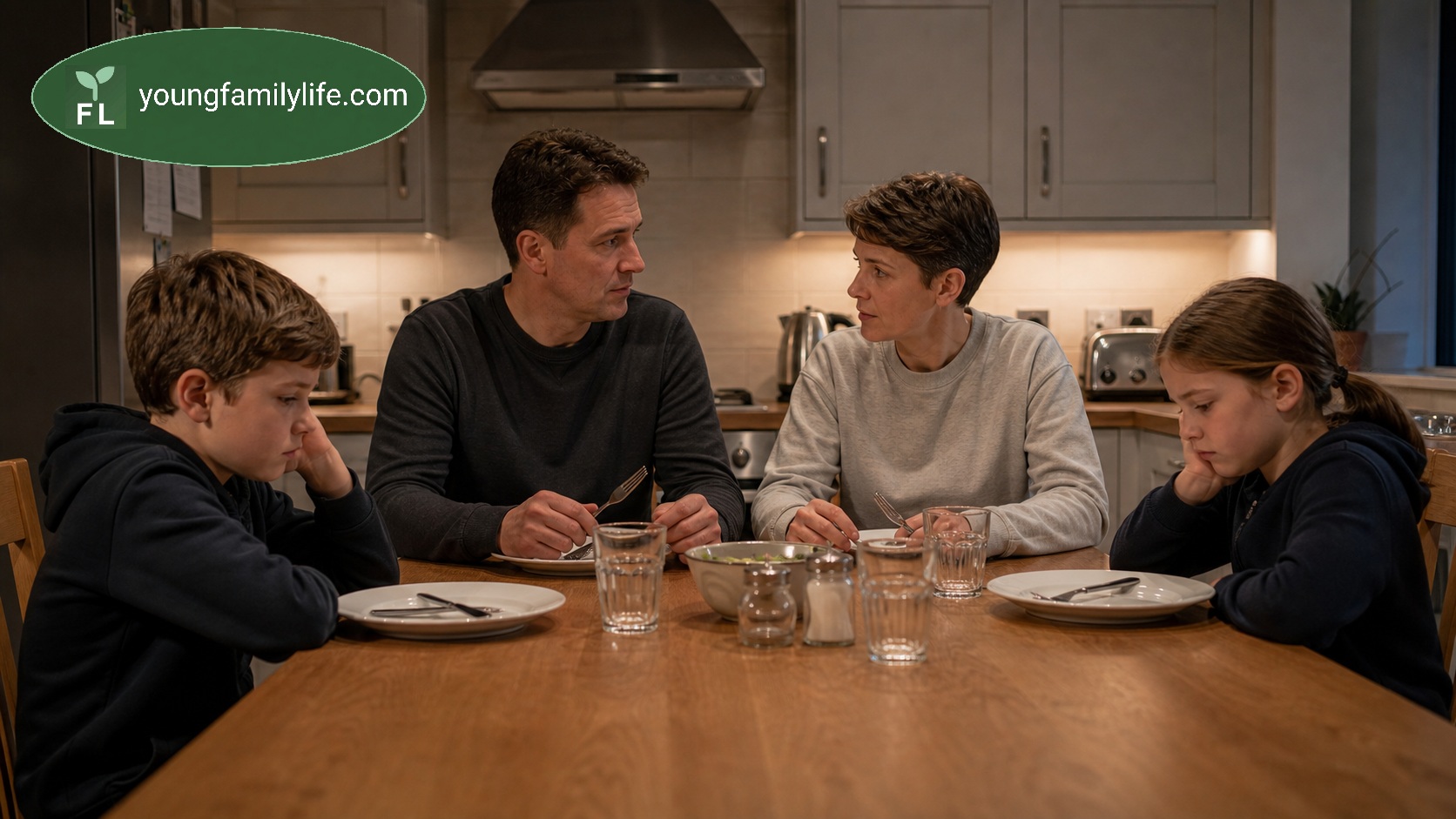
A Scene Many Families Know
The word was no. It meant no. The rule is the rule, and there's a reason for it.
The child pushed back — of course they did. They went quiet, or they cried, or they said something that stung. The parent held it. Didn't cave. Finished the conversation and got on with the evening, and there was something steady about it. That's how it's supposed to work.
But later — maybe when the child was asleep, maybe much later — the question arrived. Is this too hard on them? Are the rules too much? Will they look back on this and think the parenting was strict?
That question is worth taking seriously. Not because something is wrong. But because what drives a parenting pattern toward firmness is usually more interesting — and more understandable — than any simple yes or no.
Where the Pattern Comes From
Research in developmental psychology has found something that tends to surprise people the first time they hear it: the way a parent responds to their child — especially under pressure — is not mainly a matter of values or parenting philosophy. It's a matter of nervous system.
From birth, a child's brain is building itself from the relational environment around it. Everything it experiences — warmth, firmness, how adults respond to distress, what gets rewarded, what gets ignored — gets logged. Not as a list of rules, but as a prediction: this is what the world is like, and this is what it requires (Siegel, 2012).
Here's the part that matters for parents who wonder if they're too strict. By the time a parent arrives at parenthood, the brain has already been running that prediction system for decades. The parenting climate they grew up in — firm or soft, warm or cool, consistent or unpredictable — didn't just teach them things. It shaped how their nervous system is wired to respond.
When a parent tends toward firmness — high expectations, clear consequences, a low tolerance for latitude — researchers have found this usually isn't a deliberate philosophy. It's a pattern built around a particular kind of world: one where structure meant safety, where expectations were how you showed you cared, or where softness left children exposed. Those ideas came from somewhere real. They came from the climate that parent grew up inside (Baumrind, 1967).
The Brain That Keeps the Old Map
The human brain doesn't receive the world neutrally and then decide how to respond. It builds a model of the world from prior experience — and responds to that model. Two parents can live in the same street, face the same situations, and one constructs a world that feels fundamentally risky, while the other constructs a world that feels basically manageable (Friston, 2010).
The parent who grew up in a world where firmness was protective — where rules were the steady structure in an otherwise unpredictable environment — develops a prediction system oriented toward vigilance. Children need to know where the edges are. The world doesn't reward leniency. Expectations are how you prepare a child for what's coming.
Those predictions aren't wrong. In the world that built them, they were accurate. The difficulty is that a brain calibrated for one environment keeps running the same predictions in a different one. The map doesn't automatically update just because the territory has changed.
Many parents who recognise this pattern find it useful to notice the difference between what this situation actually needs and what the nervous system is automatically reaching for. Not as a way to change overnight — but as information. The map and the territory are two different things.
What the Child's Brain Is Recording
Children growing up in a firm, high-expectation climate tend to be capable and often high-achieving. Many are deeply loyal to the parent who raised them. Structure is genuinely developmental — children's brains need consistent expectations in order to build the regulatory capacity that serves them well as adults (Maccoby and Martin, 1983).
Research also shows that what matters most isn't firmness alone — it's the combination. The question the child's brain is always asking, from birth through adolescence, isn't just what are the rules? It's is the world safe enough? Do the people around me show up? When structure comes with reliable warmth — when expectations are high but so is responsiveness — that combination produces the most consistently positive developmental outcomes in the research literature (Baumrind, 1967; Steinberg et al., 1992).
When structure runs at high volume but warmth runs low — when approval is earned rather than given, and the gap between what the child is and what is expected of them is always visible — the child's nervous system tends to stay in a state of low-level alertness. Not crisis. But not fully at ease either. The child learns to perform, to manage the impression, while the emotional experience underneath doesn't always get the same attention (Siegel, 2012).
This is not about whether the parent loves their child. It's about what the child's brain is recording day after day — and what patterns that recording tends to produce in the adult they become.
The Pressure Test
There's a reliable way to spot when a parenting response is coming from a deep-rooted pattern rather than a present-moment decision. It's stress.
Under pressure — at the end of a hard day, when several things are going wrong at once, when the nervous system is running on empty — the inhibitory capacity that normally allows a considered response gets thinner. What replaces it is whatever the deepest, most established pathway is. For most parents, that means parenting as they were parented. Not always. Not without exception. But with a consistency that neuroscience makes entirely predictable (van der Kolk, 2014).
The parent who notices they've sounded exactly like their own mother or father in a difficult moment isn't failing to grow up. They're a fully developed adult whose nervous system just defaulted to its most deeply worn track. That's not a character flaw. It's how brains work under load.
Understanding that is not the same as changing it. But it does shift what the moment means — from I am this to I notice this happening. That distance, small as it sounds, is where something different becomes possible.
Exploring this further
The pattern behind the pattern: In Other Words: Why parents parent the way they do examines where parenting styles are actually built. In Other Words: Growing up happens at home looks at what children are absorbing from the home atmosphere while all of this is happening. The full research and evidence behind both is in The Nervous System We Were Given.
So — Is It Too Much?
The research doesn't offer a clean yes or no to that question. What it does offer is a more useful one: what is this child's brain recording, right now, in the environment this parent is creating?
Firmness isn't the problem. Uninvolved parenting — low warmth combined with low structure — produces the most consistently harmful developmental outcomes in the research (Maccoby and Martin, 1983). A parent who holds the line, cares about how their child turns out, and shows up consistently is not the picture that concern is pointed at.
The question worth sitting with is whether the firmness arrives alongside enough warmth to keep the child's sense of safety steady — enough connection that the child's brain, when it asks do the people around me show up for me?, gets a consistent answer of yes.
Most parents who wonder if they're too strict are already doing something important: they're paying attention. The question itself is evidence of care. What the research offers isn't a verdict — it's a way of understanding what's happening, and why, so that the parent who's asking can make their own sense of it.
Parents who recognise something of their own pattern in what this piece describes often find that the most useful next steps are not dramatic ones. Parenting support groups — whether in person or online — offer something that information alone cannot: the experience of other parents navigating the same questions, without judgement and without a prescribed outcome. What tends to happen in those spaces is that the questions shift. Instead of am I doing this right?, they become what is actually happening here, and what does my child need from me right now? Those are more workable questions.
Asking slightly different questions of the people already around — a trusted friend, a GP, a health visitor, a family support worker — can open up a different kind of conversation than the one that usually happens. Not is my parenting okay? but what do you notice about how things are at home? The answers are often more useful than the reassurance most people ask for instead.
Attending to the parent's own needs — rest, support, the reduction of chronic stress where that is possible — is not a separate matter from the child's wellbeing. It is directly connected to it. The blocking capacity that determines whether a considered response is available in a difficult moment runs on reserves. What replenishes those reserves is not trying harder. It is the ordinary things that keep a nervous system from running on empty: sleep, connection, the sense that someone else is also paying attention.
None of this is a programme. It is simply what tends to help — observed across the research, and across the experience of parents who have found that understanding where a pattern comes from is the beginning of something, not the end of it. And what the child gains when the parent finds some of that understanding is, in the end, what this is all in service of.
Topics: #ParentingStyles #TooStrict #Strictness #BrainDevelopment #IntergenerationalParenting #NervousSystem #FamilyClimate #AuthoritativeParenting #ChildDevelopment #ParentingResearch #YoungFamilyLife #HWTK #IWI
Further Reading
These links dig deeper into the topics covered here:
Child development and parenting research:
- Parenting Styles and Child Development — NCBI — overview of the authoritative, authoritarian, permissive, and uninvolved typology and what the research shows about outcomes across each.
- Three Core Concepts in Early Development — Harvard Center on the Developing Child — accessible summary of how early relational environments shape brain architecture.
Brain science and stress:
- The Neurobiology of Stress — NCBI — what happens in the brain under load, and why considered responses become harder to access.
- Understanding the Stress Response in Young Children — Zero to Three — how stress affects the developing brain and what the relational environment has to do with it.
How This Piece Reflects YFL Values
This piece doesn't tell you whether your parenting is too strict. That's not a question YoungFamilyLife is placed to answer — and frankly, neither is anyone else who hasn't lived inside your family. What it does offer is what the research actually shows about where firmness in parenting tends to come from, what it does in the child's developing brain, and what the difference between productive structure and chronic pressure looks like in the evidence.
YoungFamilyLife's position is that informed parents make better decisions for their own families — not because they've been given a better set of rules, but because they understand more of what's happening. The question of whether your firmness is right for this child, right now, is yours to answer. The research is offered as a resource for that, not a verdict.
Informed parents make better decisions for their own families. That is the only assumption this platform makes.
Related YFL Essays and Resources
Hey! Want To Know if you're too soft with your kids? — the companion piece to this one. The same question from the other direction — and why softness is usually a pattern built from the same kind of place.
The Nervous System We Were Given — the full Repositorium essay this piece draws on. Goes under the bonnet on brain development, intergenerational transmission, and what the child's brain is actually recording inside the family climate.
Family Climate — the ambient emotional temperature a child grows up in matters as much as any single parenting decision. This essay maps the concept in full.
The Evolutionary Roots of Resistance — why the brain resists revising firmly held patterns, and what that means for understanding parenting styles that persist across generations.
Copyright Notice
© 2026 Steve Young and YoungFamilyLife Ltd. All rights reserved.
"Hey!, Want To Know" is a copyrighted content format of YoungFamilyLife Ltd.
This essay was developed collaboratively using AI assistance to research academic sources and refine content structure, while maintaining the author's original voice, insights, and "Information Without Instruction" philosophy. No part of this essay may be reproduced, distributed, or transmitted in any form or by any means, including photocopying, recording, or other electronic or mechanical methods, without the prior written permission of the copyright holders, except in the case of brief quotations embodied in critical reviews and certain other noncommercial uses permitted by copyright law.
For permission requests, contact: info@youngfamilylife.com