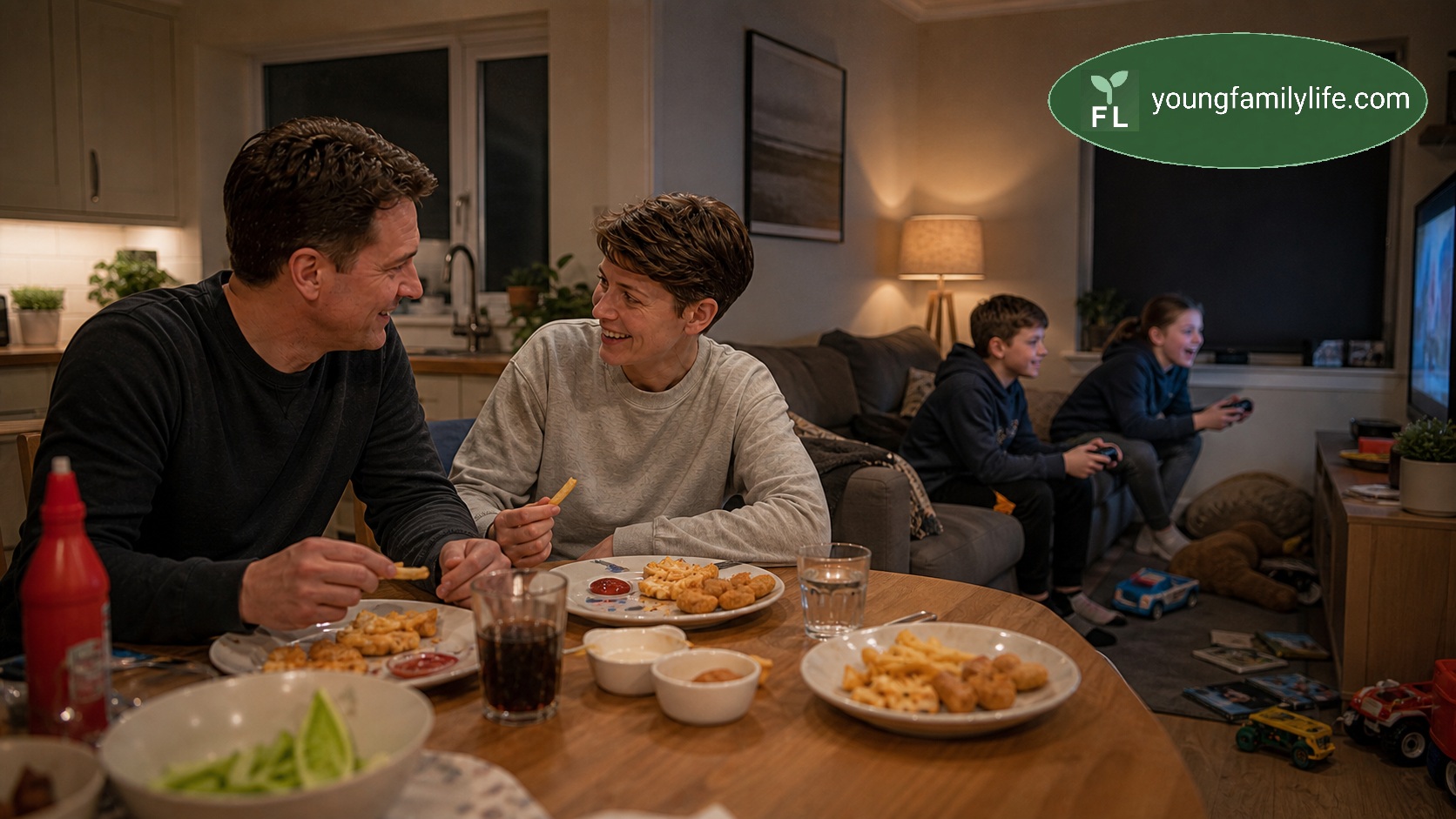
A Scene Many Families Know
The word was no. It meant no. And then the child's face changed — the lip went, the tears started, or they went so quiet and hurt-looking — and the no started to feel impossible to hold.
Maybe a way was found to reframe it so it wasn't quite giving in. Maybe it was just given in to. Either way, the rule didn't hold — and there's a feeling that goes with that. Not pride. Something closer to relief that the distress stopped, mixed with an awareness that it's happened again.
Later the question comes. Is this too soft? Are they going to grow up without any limits? Why is holding the line so hard?
That question deserves a consideration — because what makes holding firm feel almost impossible is almost certainly more understandable than it looks.
What's Actually Happening in That Moment
When a parent finds it hard to hold a boundary — especially when the child shows distress — research in developmental neuroscience points to something specific. The parent's own brain is responding to a threat.
Not the child's distress as a danger to the child. The child's distress as something that feels dangerous to the parent. The Feeling Brain — the part of the nervous system that handles threat detection — doesn't reliably distinguish between a child in genuine suffering and a child in ordinary frustration. What it registers is: distress signal. Relief it. And it fires that response faster than the thinking part of the brain can intercept it (Siegel, 2012).
For many parents who lean toward softness, this response isn't random. It was built from something specific — from a relational environment in which conflict felt dangerous, or in which a child's distress predicted something breaking. The parent's nervous system learned, early, that the fastest way to make that danger go away was to make the distress go away. That learning doesn't disappear in adulthood. It keeps firing (van der Kolk, 2014).
When this happens in a parenting moment, it's not really about the child in front of them. It's about the Feeling Brain pattern-matching against everything it has ever learned about what distress leads to — and acting, urgently, to prevent what it remembers.
The Corrective Pattern
Research has identified a pattern in parents who tend toward softness that developmental psychologists sometimes call the corrective model. Many parents who find it hard to hold firm are — consciously or not — trying to parent differently from how they were parented (Baumrind, 1967).
Where their own childhood was characterised by too much demand, emotional distance, or conditional approval, the response is to move in the opposite direction: warmth without limit, acceptance without condition, the removal of anything that looks like the expectation they experienced as damaging.
This is an act of love. It is also a prediction — the Feeling Brain running a model in which the harm to be avoided is the harm it knows. The difficulty is that corrective models are aimed at the past rather than the present. They're calibrated against the environment that built the parent, not the environment the child is actually growing up in or preparing for.
The corrective model also tends to overshoot. A parent who learned the hard way what too much demand feels like can become so alert to their child's distress that ordinary discomfort — the productive kind, the kind that comes from frustration and disappointment and having to wait — gets the same response as genuine suffering. The brain recognises the signal. It doesn't always read the size of it accurately.
What the Child's Brain Needs From Friction
Children growing up in very warm, low-demand environments tend to feel deeply attached to the parent who raised them. That attachment is real and valuable. The warmth is genuinely protective for the child's developing sense of safety.
What the research also shows, though, is that the developing brain builds resilience through a very specific experience: being uncomfortable, and finding that it was manageable. Not being rescued from it. Getting through it (Dweck, 2006; Siegel, 2012).
The technical term is self-regulation — the brain's capacity to tolerate a difficult feeling without it completely taking over. That capacity isn't something children are born with in full. It develops gradually, through repeated small experiences of being frustrated, disappointed, or denied something, and discovering that the feeling passed and the world stayed intact. When those experiences are consistently removed — when distress is reliably resolved before the child has had any chance to sit with it — the regulatory capacity doesn't get the practice it needs (Siegel, 2012).
The child who grows up rarely sitting with discomfort may find, when the world outside the home eventually introduces it — which it will — that they don't have a good internal map for getting through it. Not because they lack ability. Because the experience wasn't available for long enough to build that map.
Why Holding Firm Feels Wrong
There's a particular feature of this pattern worth naming. For a parent whose own Feeling Brain learned early that conflict and distress are dangerous, holding a limit while a child is unhappy doesn't feel neutral. It feels actively wrong — like causing harm.
That feeling is the Feeling Brain doing its job. It was built to protect. The problem is that the thing it's protecting against — a child's ordinary frustration — is not the same thing as harm. The Feeling Brain doesn't automatically know the difference. It knows what distress looks like. It has a response ready. And it fires it.
Under stress — at the end of a hard day, when several things are going wrong at once, when the nervous system is already stretched — that response gets faster and the thinking brain gets quieter. Many parents who recognise this pattern find that the moments when they most reliably give in are the moments when they are most depleted, not the moments when they have calmly thought it through (van der Kolk, 2014).
Understanding that is not the same as stopping it. But it does mean the giving-in is not a moral failure. It's a predictable output of a nervous system operating beyond its available tolerance — defaulting to its most established pathway, which is: relieve the distress, restore the calm.
Exploring this further
The pattern behind the pattern: In Other Words: Why parents parent the way they do examines where parenting styles are actually built. In Other Words: Growing up happens at home looks at what children are absorbing from the home atmosphere while all of this is happening. The full research and evidence behind both is in The Nervous System We Were Given.
So — Is It Too Much?
The research doesn't hand out verdicts on individual parents. What it does offer is a clearer picture of what the developing child's brain actually needs — and what the absence of it tends to produce.
Warmth matters enormously. It's not softness that's the problem. Uninvolved parenting — low warmth combined with low structure — produces the most consistently harmful developmental outcomes in the research literature (Maccoby and Martin, 1983). A parent who loves their child, shows up, and creates a warm environment is not what concern is pointed at.
What the research consistently shows is that the combination of warmth and structure — genuine responsiveness alongside genuine expectation — produces the most positive developmental outcomes across a very wide range of children and contexts (Baumrind, 1967; Steinberg et al., 1992). Not because structure corrects warmth, but because a child's brain needs both questions answered: am I loved? and is there a shape to the world around me?
Most parents who ask whether they're too soft are already doing something that matters: they're paying attention. The question itself is evidence of care. What the research offers is not a score but a frame — and the parent asking is the one best placed to decide what to do with it.
Parents who recognise something of their own pattern in what this piece describes often find that the most useful next steps are not dramatic ones. Parenting support groups — whether in person or online — offer something that information alone cannot: the experience of other parents navigating the same questions, without judgement and without a prescribed outcome. What tends to happen in those spaces is that the questions shift. Instead of am I doing this right?, they become what is actually happening here, and what does my child need from me right now? Those are more workable questions.
Asking slightly different questions of the people already around — a trusted friend, a GP, a health visitor, a family support worker — can open up a different kind of conversation than the one that usually happens. Not is my parenting okay? but what do you notice about how things are at home? The answers are often more useful than the reassurance most people ask for instead.
Attending to the parent's own needs — rest, support, the reduction of chronic stress where that is possible — is not a separate matter from the child's wellbeing. It is directly connected to it. The blocking capacity that determines whether a considered response is available in a difficult moment runs on reserves. What replenishes those reserves is not trying harder. It is the ordinary things that keep a nervous system from running on empty: sleep, connection, the sense that someone else is also paying attention.
None of this is a programme. It is simply what tends to help — observed across the research, and across the experience of parents who have found that understanding where a pattern comes from is the beginning of something, not the end of it. And what the child gains when the parent finds some of that understanding is, in the end, what this is all in service of.
Topics: #ParentingStyles #TooSoft #Permissive #BrainDevelopment #IntergenerationalParenting #NervousSystem #FamilyClimate #SelfRegulation #ChildDevelopment #ParentingResearch #YoungFamilyLife #HWTK #IWI
Related YFL Essays and Resources
Hey! Want To Know if you're too strict with your kids? — the companion piece to this one. The same question from the other direction — and why strictness is usually a pattern built from the same kind of place.
The Nervous System We Were Given — the full Repositorium essay this piece draws on. Goes under the bonnet on brain development, intergenerational transmission, and what the child's brain is actually recording inside the family climate.
Family Climate — the ambient emotional temperature a child grows up in matters as much as any single parenting decision. This essay maps the concept in full.
Authentic and Inauthentic Behaviour — why the response in the difficult moment is often coming from somewhere considerably earlier than the present — and what that means for how we understand it.
Copyright Notice
© 2026 Steve Young and YoungFamilyLife Ltd. All rights reserved.
"Hey!, Want To Know" is a copyrighted content format of YoungFamilyLife Ltd.
This essay was developed collaboratively using AI assistance to research academic sources and refine content structure, while maintaining the author's original voice, insights, and "Information Without Instruction" philosophy. No part of this essay may be reproduced, distributed, or transmitted in any form or by any means, including photocopying, recording, or other electronic or mechanical methods, without the prior written permission of the copyright holders, except in the case of brief quotations embodied in critical reviews and certain other noncommercial uses permitted by copyright law.
For permission requests, contact: info@youngfamilylife.com