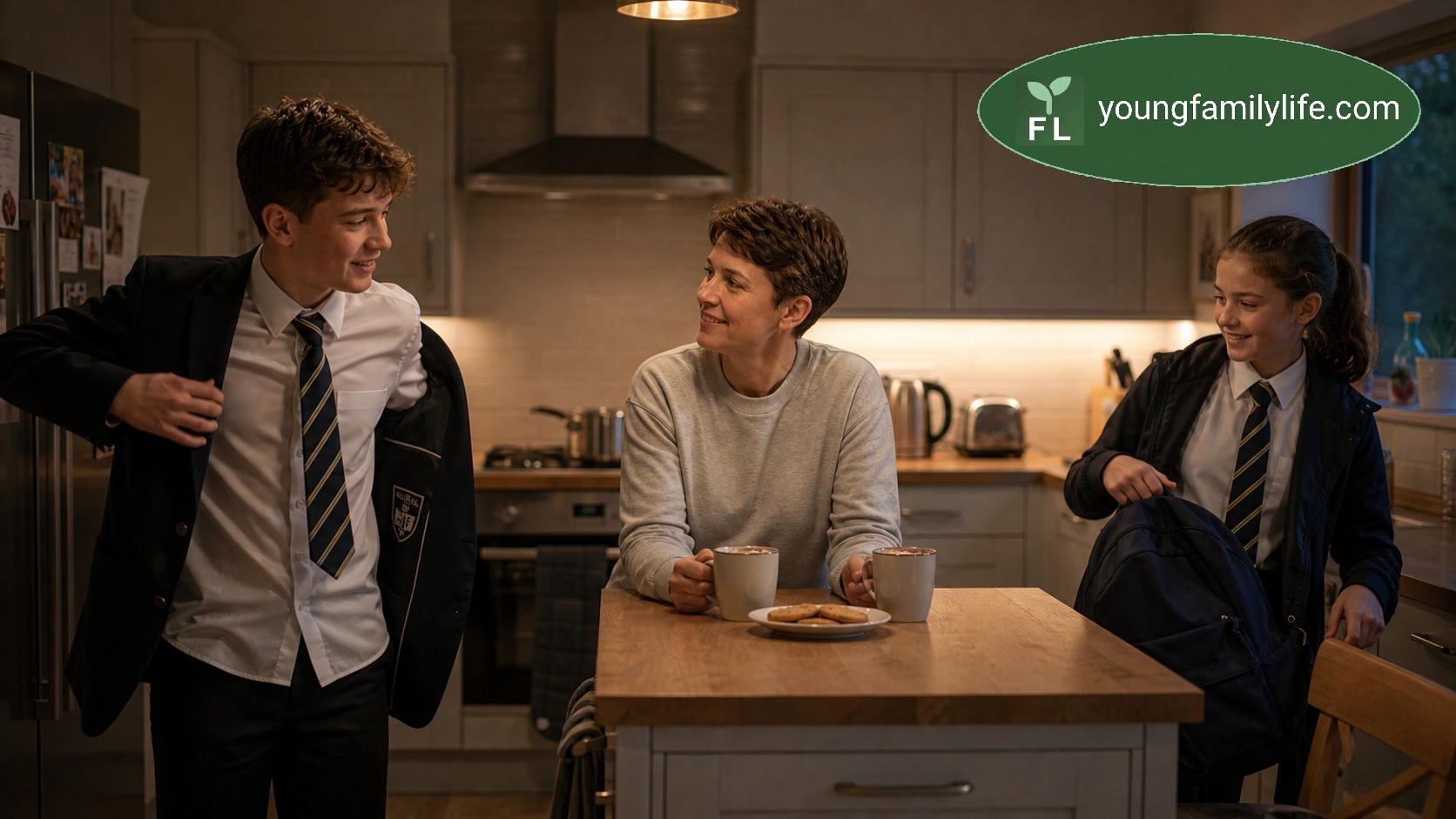
What growing up is actually made of
Most of what shapes a child during the years of growing up is not something anyone planned. It is not the big conversations, the family rules, or the moments parents look back on as significant. It is the atmosphere — the emotional texture of ordinary daily life at home, accumulated across thousands of days that nobody thought to remember.
Research in brain development has established something that is easy to underestimate: the child's brain is not simply receiving information and filing it away. It is building itself from its environment. The relational world the child grows up inside — how the adults around them respond to difficulty, how conflict gets handled, what warmth looks like, whether the home feels predictable or uncertain — all of this becomes part of the structure of the developing brain. Not as memory. As architecture.
The brain that builds itself
A child's brain does not arrive complete. It builds itself steadily over many years, always working from the bottom up — the most basic survival functions first, then the emotional systems, then the thinking and reasoning capacities that develop last of all. The brain the child ends up with in adulthood is genuinely shaped by the environment it built itself inside.
The emotional brain is the one that matters most for understanding what growing up at home does to a child. From birth, it is running a constant quiet inquiry: Is the world safe? Do the people around me show up? Can what is around me be trusted? Every day at home is data. Every response from the adults in the house — or absence of response — is logged. Over time, the answers the emotional brain receives build the child's internal working model of what to expect from the world and from other people. That model goes with them into adulthood. It shapes how they handle relationships, difficulty, and their own emotions long after they have left home.
Climate, not style
A great deal of parenting advice focuses on parenting style — whether a parent is firm or lenient, structured or relaxed, warm or cool. Research has mapped these styles carefully and they are genuinely useful as a framework. But there is something the style categories can miss.
What the child's emotional brain is registering is not the parent's style. It is the climate — the ambient emotional temperature of the home, experienced from the inside, accumulated across years of daily life. Climate is not what parents intend. It is what children feel.
Two families can share very similar parenting approaches and produce quite different climates, because climate is made from things that are harder to see than rules or routines. It is made from the tone that runs underneath conversations. From how quickly tension resolves or how long it sits in the air. From whether warmth is reliably present or arrives unpredictably. From how the adults in the house manage their own difficulties — with each other, with work, with the everyday frustrations of life.
Children do not observe the family climate from outside. They grow up inside it. It is the air they breathe. And because it is so constant and so ordinary, neither children nor parents tend to notice it clearly — any more than anyone notices the temperature of a room they have been sitting in for hours.
Exploring this further
The atmosphere children grow up in is shaped significantly by patterns the parent carries from their own upbringing. In Other Words: Why parents parent the way they do examines where those patterns come from — the other side of the same question. For those exploring what different home climates actually produce in children, What strict parenting can do for children and What soft parenting can do for children look at those specific questions.
What different ages are building
The child's brain develops in stages, and what it is most sensitive to — most shaped by — shifts at each stage. Understanding roughly what is being built at each phase helps make sense of why the same home environment can affect children differently at different ages.
In the first year, the emotional brain is developing faster than it ever will again. The connections it builds during this period — around safety, around trust, around what to expect from the people closest to it — become the foundation everything else is built on. This is not a period during which children need perfect parenting. Research has found that genuinely attuned, responsive care needs to be present only around thirty per cent of the time for a child's emotional development to proceed well. What matters most is not consistency in any strict sense, but repair — that when things go wrong between parent and child, someone comes back, reconnects, and the rupture is mended. Children whose early experience includes repeated rupture and repair learn something important: that disconnection is not permanent, that things can go wrong and then get better, and that the people around them can be relied upon. That is the foundation of emotional resilience.
Through the toddler and preschool years, the emotional brain is large and in full expression. Big feelings arrive before the equipment to manage them has been built. A toddler's meltdown is not defiance — it is an emotional system meeting a feeling it does not yet have the tools to handle. What the home climate provides during this period is either a consistent enough sense of safety to support the slow building of those tools, or a level of unpredictability or tension that keeps the emotional brain too busy managing threat to develop them properly.
Around age seven, the brain consolidates what it has built in the early years — strengthening the connections that got the most use, and pruning back those that did not. For children who have grown up in a calm and consistent enough environment, this consolidates resilience. For children who have spent those years managing unpredictability or chronic tension, it consolidates vigilance. The brain, in both cases, is doing what brains always do — building efficiently for the world it has found.
The teenage years bring the most dramatic reshaping since infancy. The emotional brain surges. The thinking brain is simultaneously being rebuilt. During that rebuild it is less reliable than it appeared — which is why teenagers can know in a calm moment exactly what they should do, and still not manage it when feelings are running high. The home climate during adolescence shapes something that goes beyond behaviour. Research has found that what the family has communicated across years of daily interaction — about the young person's worth, their capability, and their place in the world — is directly reflected in how the young person answers the central question of adolescence: who am I, and where do I belong?
What children absorb that nobody plans
The most significant things children take from the home environment are rarely the things anyone planned to give them. They are absorbed rather than taught — picked up from the texture of daily life rather than delivered in any deliberate way.
Children absorb how adults handle difficulty. Families where adults manage setbacks with some steadiness — not without complaint, not perfectly, but with a basic orientation toward getting through — tend to produce children who approach their own difficulties with a similar orientation. This is not instruction. It is modelling in the deepest sense: the child's developing brain using the adults around it as a reference point for how life gets navigated.
Children absorb how conflict works. Whether disagreement in the home tends to resolve or tends to fester, whether tension gets spoken about or sits unacknowledged, whether repair follows rupture — all of this builds the child's working model of what relationships are like when they are under pressure. That model travels with them into every significant relationship they form as an adult.
Children absorb the emotional baseline. The general level of tension or calm in a home, the sense of whether adults are basically okay or basically stretched, the presence or absence of warmth in ordinary moments — these things set a kind of emotional thermostat in the child's developing system. Children raised in a home where the baseline is tension tend to develop a nervous system calibrated for vigilance. Children raised in a home where the baseline is warmth and reasonable predictability tend to develop a nervous system that can operate from safety.
None of this requires dramatic events. It accumulates through the ordinary — through the thousands of small moments that make up daily life at home, most of which neither parents nor children register as significant at the time.
What this means, and what it does not mean
None of this is offered as a reason for parents to feel that everything depends on getting each moment right. The research is clear that children's brains are more robust than that picture implies. They do not need perfection. They do not need a home without difficulty or conflict. They need enough — enough warmth, enough safety, enough predictability — and they need the ruptures that inevitably happen to be followed by repair.
What the research does suggest is that the most significant thing happening in any home is not the explicit teaching or the deliberate parenting decisions. It is the climate — the atmosphere that children grow up inside and absorb without either party fully noticing. That atmosphere is built partly from the parenting patterns the adults in the house carry from their own upbringings, partly from the pressures of the life they are managing, and partly from the relational habits that develop between them over time.
Families who understand what their home climate is actually made of, and where it comes from, are better placed to think about what it is providing for the children growing up inside it. Not as a verdict. As information — the kind that belongs to the family, and that the family is best placed to decide what to do with. And the children growing up inside that family are, in the end, the reason the understanding matters.
Topics: #InOtherWords #GrowingUpAtHome #FamilyClimate #ChildDevelopment #BrainDevelopment #HomeEnvironment #EmotionalDevelopment #AttachmentResearch #ParentingResearch #YoungFamilyLife #IWI
Related YFL Content
In Other Words: Why parents parent the way they do — the companion IOW piece. Where this piece looks at what children absorb growing up, the companion looks at where the parent's own patterns come from — and what happens to them under pressure.
Family Climate — the full Repositorium essay that maps the concept of family climate in depth — what it is made of, how it differs from parenting style, and what the research shows about its effects on children's development.
Learning to Survive — the full essay on how the brain builds itself from experience, covering the three-system model in depth and what each stage of development is building.
Influence and Adaptation — the essay on how change actually happens in people and families — through environment and experience rather than decision and willpower — which connects directly to what this piece describes about how children absorb their world.
Copyright Notice
© 2026 Steve Young and YoungFamilyLife Ltd. All rights reserved.
"In Other Words" is a copyrighted content format of YoungFamilyLife Ltd.
The information in this piece is based on established research and theory. Full academic sources, references, and evidential detail are available in the linked YoungFamilyLife essays.
This essay was developed collaboratively using AI assistance to research academic sources and refine content structure, while maintaining the author's original voice, insights, and "Information Without Instruction" philosophy. No part of this essay may be reproduced, distributed, or transmitted in any form or by any means, including photocopying, recording, or other electronic or mechanical methods, without the prior written permission of the copyright holders, except in the case of brief quotations embodied in critical reviews and certain other noncommercial uses permitted by copyright law.
For permission requests, contact: info@youngfamilylife.com