Hampstead. The name carries a particular weight in contemporary London — the weight of arrival. Its residents are the wealthy and the celebrated, those who have made their fortune or their name and chosen this postcode to signal both. The heath, the ponds, the Georgian terraces, the famous neighbours: the coordinates of a very specific kind of aspiration. A three-bed property averages roughly £1.49 million, median about £1.25 million. It is a place that invites, not unfairly, a certain cynicism — the suspicion that what is being performed here is veneer rather than substance.
What is less visible is that Hampstead has a prior and more serious claim on the attention of anyone who has ever been helped to understand themselves, or a child, or a loss. The frameworks through which that understanding arrived — the concepts, the vocabulary, the clinical architecture — were largely built within a two-mile radius of this postcode, across a hundred and fifty years, by people most of its current residents have probably never heard of. That is a considerable debt. Most people who owe it don't know they do.
This essay is, in part, the moment of recognition.
The figures who worked within that circle — Sigmund Freud, Anna Freud, Melanie Klein, Donald Winnicott, John Bowlby, James Robertson, Mary Ainsworth, Colin Murray Parkes — disputed the origins of psychological development, the nature of early childhood experience, the mechanisms of grief, the correct relationship between psychoanalysis and empirical science. They split institutions, wrote polemics, and occasionally refused to be in the same room. The disagreements were productive in a way that disagreements are not always permitted to be — and what emerged from them is richer than anything any of the participants could have produced by winning.
But before any of them arrived, there was a poet. And the poet was already asking the questions.
I. The poet who was already there
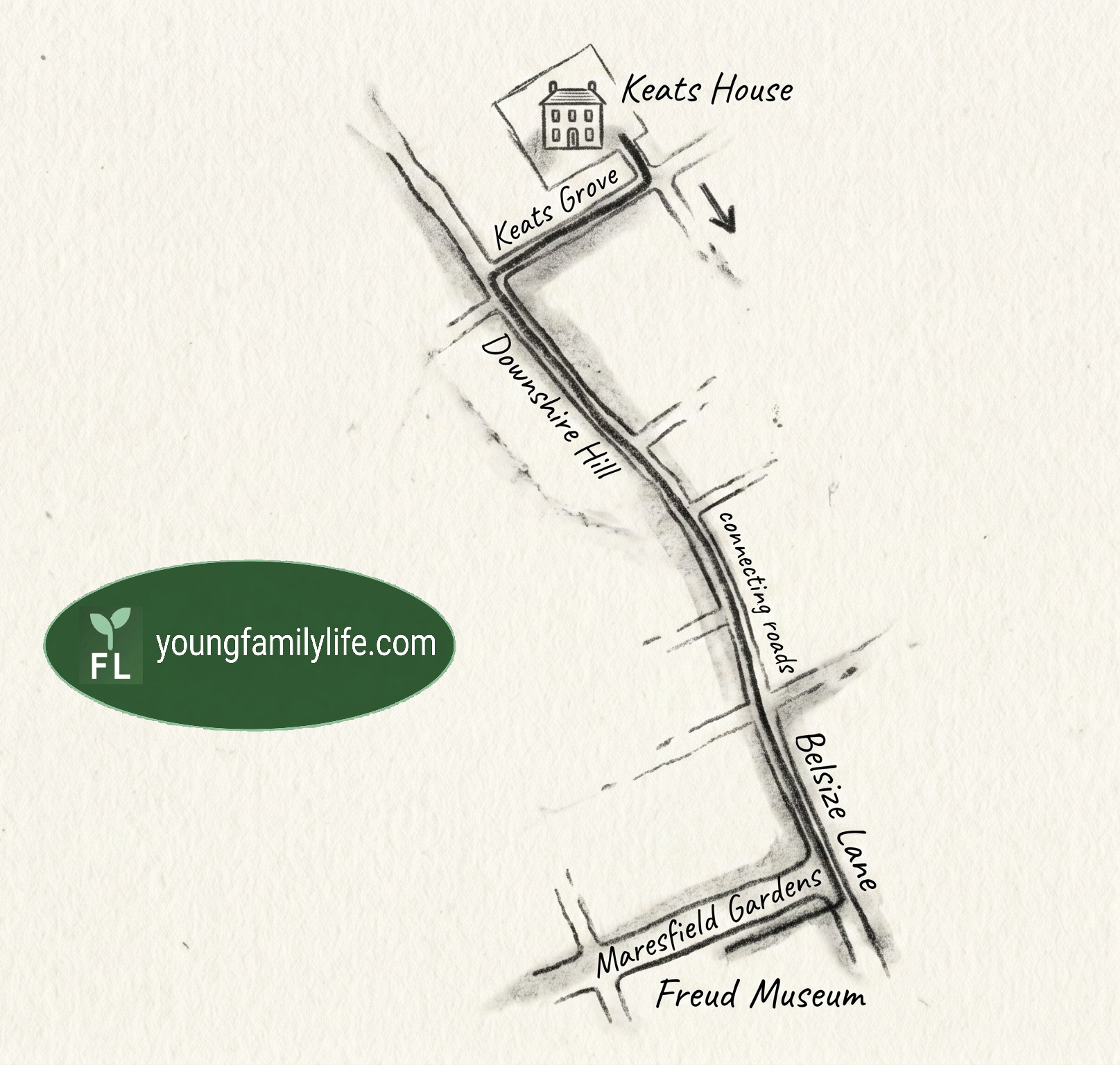
John Keats lived at Wentworth Place, Keats Grove, Hampstead, from December 1818 until September 1820. The house is 0.65 miles from 20 Maresfield Gardens, where Freud would arrive more than a century later. A twenty-minute walk through the same streets, the same plane trees, the same heath-adjacent air. Keats House and the Freud Museum sit within the same small geography, separated not by distance but by time.
Keats moved into Wentworth Place after the death of his brother Tom from consumption in December 1818. It was there that he met Fanny Brawne, the woman he would become engaged to and never marry. He left the house in September 1820 to travel to Italy, where he died in Rome in February 1821, at the age of just twenty-five.
It was in that house that he found inspiration, fell in love, found out he was dying, and wrote some of his most enduring works. The great odes of spring 1819 — Ode to a Nightingale, Ode on a Grecian Urn, Ode to Melancholy, Ode on Indolence — were composed there, in rapid succession, over a matter of weeks. They are among the most sustained explorations of the experience of pain, transience, and beauty in the English language.
What Keats's short life contained is worth stating plainly, because the plainness is the point. He was the orphaned son of a stable manager and had trained as an apothecary surgeon. His father died when he was just eight and his mother when he was fourteen. He lost his brother George to emigration and his brother Tom to tuberculosis within months of each other. He watched Tom die slowly, nursing him through it, and almost certainly contracted the disease himself in doing so. He fell in love and became engaged knowing — or suspecting — that he was dying. He left England for Italy on medical advice, separated from Fanny Brawne, and died alone in Rome, attended by his friend Joseph Severn, at twenty-five.
What Keats encountered in those years — early parental loss, the death of a brother nursed through a long illness, the slow recognition of his own dying, forced separation from the person he loved, death without adequate medical care or institutional support — was not unusual for his time. It was ordinary suffering, of the kind that most people in his era experienced without recourse and without language for it. What was unusual was what he did with it. He stayed with it long enough to find its shape. He did not resolve it, aestheticise it at a safe distance, or convert it into consolation. He looked at it directly, and wrote what he saw.
He had no safety net. Not a thread of it.
What he had instead was language. The capacity — extraordinary in its precision and its reach — to put into words what it actually feels like to be a human being navigating physical and psychological pain without adequate protection. Ode to Melancholy is not a description of depression; it is an account of what it is to experience beauty and loss simultaneously, to find that the two are inseparable, to discover that the sharpest awareness of beauty is the awareness of its transience. Keats writes of the goddess Melancholy that she dwells with Beauty — Beauty that must die; / And Joy, whose hand is ever at his lips / Bidding adieu; and aching Pleasure nigh, / Turning to poison while the bee-mouth sips. These are not consolations. They are observations about the structure of human feeling: that the intensity of joy and the awareness of its ending are not opposites but the same experience, held simultaneously.
Ode to a Nightingale reaches toward something darker and more personal. Keats, listening to the bird's song from the garden at Wentworth Place — the song that could be heard above the sounds of a dying man's breath — writes:
Darkling I listen; and, for many a time
I have been half in love with easeful Death,
Call'd him soft names in many a mused rhyme,
To take into the air my quiet breath.
This is not romantic posturing. It is the voice of a young man who had watched his brother die of the same disease he himself was developing, who knew what dying looked like from the inside of a sick room, and who found in the nightingale's oblivious song a temporary location for what could not be otherwise borne. The pull toward oblivion and the attachment to the world that makes the suffering meaningful sit together in the same stanza, unresolved.
These are not pretty sentiments. They are precise ones — and their precision is inseparable from what poetry is free to do that clinical language is not. Free of the requirement to generalise, to classify, to hold the observed experience at a measurable distance, poetry can tell a relational truth about pain — from inside it, in real time, without the protective apparatus that methodology requires. That is not a lesser kind of truth. It is a different one, and in some respects a prior one.
The point here is not to claim Keats as a proto-psychologist, or to read the odes as case histories. It is something more modest and more interesting. The psychological tradition that would assemble itself in these same streets a century later was trying to account for territory that Keats had already mapped — in a different register, with different instruments, arriving at recognisably similar ground. The vocabulary came later. The knowledge was already there, held in a form that required no laboratory and no clinical framework to be true.
The phrase he used — negative capability — for the quality he most admired in Shakespeare and most valued in himself, captures something that the north London psychological tradition would take a century to articulate in clinical terms. The term comes from a letter Keats wrote to his brothers George and Tom in December 1817, describing the quality he had observed in great writers: that is when man is capable of being in uncertainties, mysteries, doubts, without any irritable reaching after fact and reason. Negative capability: the capacity to remain in that condition — to sustain unresolved tension, to hold difference, to resist the closure that would simplify the truth.
It is, in essence, the capacity the Controversial Discussions required of everyone in the room. The capacity that Bowlby needed to sustain his position against the analytic establishment. The capacity the Middle Group exercised in refusing the clarity that either Kleinian or Freudian orthodoxy would have offered. The capacity that families need when the members who disagree most sharply are the ones who love each other most.
Keats House and the Freud Museum are twenty minutes apart on foot. The poetry and the psychology are further apart in form, but not nearly as far apart as that distance suggests. What both are reaching toward — imperfectly, in their different registers — is the same thing: a way of being present to human experience without flinching from what it contains.
II. Wentworth Place: the Hunt circle and the road to Bloomsbury
It is worth pausing on what Wentworth Place actually was during Keats's tenure — because it was not only, or even primarily, the private sanctuary of a dying poet. It was a social and intellectual node of some intensity, and the social world that formed around it carried its own radicalism that points, in a long arc, toward the century that followed.
The gravitational centre of that world was Leigh Hunt — poet, essayist, editor, and the man who first introduced Keats to the literary life of London. Hunt was the founder and editor of The Examiner, a weekly paper that had advocated the abolition of the slave trade, Catholic emancipation, and the reform of Parliament and the criminal law. For their attacks on the Prince Regent, Hunt and his brother had been imprisoned for two years in 1813 — years during which Hunt continued to write and edit from his prison cell, and was widely regarded as a martyr in the cause of liberty. After his release he moved to Hampstead, and it was through Hunt that Keats entered the circle that would define his brief creative life: the painter Benjamin Haydon, the poet John Hamilton Reynolds, the essayist William Hazlitt, the poet Shelley. Hunt introduced Keats to Shelley; Reynolds introduced Keats to his publisher. They wrote poems celebrating one another, competed in verse contests, argued about poetry and politics in each other's drawing rooms.
Their enemies named them the Cockney School — the label intended to be dismissive, marking the circle as provincially London, lacking classical education, presumptuous in their challenge to established literary and political authority. What the label captured, without meaning to compliment it, was the group's genuine radicalism: they were committed not only to new poetry but to a democratisation of culture, a dismantling of the hierarchies — of class, of education, of established taste — that governed who was permitted to speak, and about what. The attacks in Blackwood's Edinburgh Magazine addressed not only their politics but, revealingly, their religion, their sexuality, their food and fashion: the constituent components of what would later be called culture. The establishment understood that what was at stake was not merely literary taste but a whole way of being in the world.
Wentworth Place sat in the middle of this. The house where Keats wrote the odes was also the house where Hunt, Reynolds, Hazlitt, Shelley, and Brown gathered — where poetry was written in friendly competition, where political radicalism and sensual pleasure were treated as adjacent rather than opposed, where a young man from an ordinary background without a classical education could sit in a garden under a plum tree and write, in a matter of weeks, some of the finest poetry in the English language.
What this circle was doing — without quite knowing it, without the vocabulary that the century to come would develop — was insisting on the legitimacy of human experience in all its dimensions: physical, emotional, intellectual, political. The sensual delight that Hunt taught Keats to value. The grief that Keats could not avoid. The love that convention might have questioned. The political anger that found its outlet in verse as much as in pamphlets. These were not separate concerns. They were aspects of the same refusal — the refusal to be the kind of radicalism that the established order had already learned to absorb, permitted precisely because it threatened nothing it could not afford to lose.
The line from this to Bloomsbury is not straight but it is real. The most concrete thread runs through the Cambridge Apostles — Lytton Strachey, Leonard Woolf, John Maynard Keynes, E. M. Forster — who had absorbed, via G. E. Moore and the tradition of liberal dissent running from Godwin through Shelley and Mill, the same conviction the Hunt circle had already embodied: that human feeling, in all its dimensions, deserved honest examination rather than polite suppression. The Bloomsbury Group shared what had characterised the Hunt circle a hundred years before — fierce intellectual debate, the rejection of Victorian sexual convention, a refusal of the structures that their world required of them. The psychoanalytic tradition that assembled in this same north London geography a century later was making the same claim in a different register: that what was hidden, repressed, denied — in the individual, in the family, in the culture — pressed upward and found other forms. The interior life demanded attention not because attention was comfortable but because the cost of inattention was too high. Keats had already arrived at that territory, without the conceptual apparatus, through the garden at Wentworth Place, under a plum tree, listening to a nightingale.
III. The arrival: Freud in London
Sigmund Freud arrived at 20 Maresfield Gardens, Hampstead, in June 1938. He was eighty-two years old, seriously ill with oral cancer, and had been extracted from Vienna — where he had lived and worked for nearly eighty years — by the combined efforts of his daughter Anna, Princess Marie Bonaparte, and Ernest Jones, following the Nazi annexation of Austria. The Gestapo had detained Anna for questioning; her negotiation of the family's release and departure was, by any measure, an act of extraordinary composure under extreme duress.
Freud died in that house on 23 September 1939, sixteen months after arriving. He had worked until within weeks of his death. Anna Freud continued to live and work there until her own death in 1982. The house is now the Freud Museum — his study preserved exactly as it was, the famous couch still draped in its Persian rug, the antiquities still crowding the shelves — and it remains one of the most intellectually charged domestic spaces in London.
What Freud brought to England, beyond his own person, was a tradition: a way of thinking about the interior life of the human being that had been building for four decades, had fractured and reconfigured around disagreements with Adler and Jung, and had established itself — contentiously, partially, always in argument — as the dominant framework for understanding psychological suffering in the Western world. That tradition did not arrive in England intact. It arrived into an existing field of dispute, and the dispute deepened it.
IV. Klein and the Controversial Discussions
Melanie Klein had preceded Freud to England by more than a decade. An Austrian-born psychoanalyst, she had been invited to London by Ernest Jones in 1926 and had spent the intervening years developing her own distinctive account of early psychological development — one that located the origins of mental life in the first months of infancy, far earlier than Freud's own framework had proposed. Klein's work on infantile phantasy, the paranoid-schizoid and depressive positions, the mechanisms of projection and introjection in early object relations, represented a significant departure from classical drive theory. It was also, in many respects, a radicalisation of Freud's own insights — a development of his ideas about projection and the internal world into territory he had not himself explored.
When Anna Freud arrived in London with the Freudian tradition in hand, the collision with Kleinian theory was, in retrospect, inevitable. It became explicit in the Controversial Discussions of 1941 to 1945 — a series of formal scientific meetings of the British Psychoanalytic Society, conducted during the Blitz, in which the two schools argued their fundamental theoretical differences before their colleagues.
The Discussions were, by any account, fierce. Anna Freud and Klein agreed on almost nothing about the timing and nature of early psychological development, the relationship between phantasy and reality in childhood experience, or the appropriate technique for the analysis of children. The dispute threatened to split the Society permanently. The resolution — the creation of three training groups within the same institution, the Kleinians, the Freudians, and the Middle Group (later the Independents) — was a compromise that satisfied no one fully and preserved the institution by institutionalising the disagreement rather than resolving it.
That compromise, ungainly as it was, proved intellectually generative. The Middle Group — which included Donald Winnicott, Ronald Fairbairn, and Michael Balint — occupied the productive ground between the two schools, drawing on both and constrained by neither. It was from this position that some of the most practically significant clinical ideas of the century emerged: Winnicott's concept of the "good enough mother," the "holding environment," the transitional object; Fairbairn's account of the fundamentally relational nature of the self; Balint's work on the "basic fault" and the therapeutic relationship. These were not syntheses of Klein and Anna Freud. They were positions arrived at by people who had been forced to think carefully about what both schools were getting right and what each was missing.
V. Bowlby and the Tavistock: empiricism enters the room
John Bowlby trained as a psychoanalyst in the 1930s and was analysed by Joan Riviere, a committed Kleinian. He worked at the London Child Guidance Clinic before the Second World War, was seconded to army psychiatric work during it, and in 1948 founded the Separation Research Unit at the Tavistock Clinic — which had relocated by then to Belsize Lane, less than a mile from Maresfield Gardens.
Bowlby's interest in psychological issues had been kindled in 1929 whilst working at a school for troubled children. He had known an adolescent boy who had been thrown out of a public school for repeated stealing. Although socially conforming, he made no friends and seemed emotionally isolated from adults and peers alike. Those in charge attributed his condition to his having never been cared for during his early years by any one motherly person. Bowlby had read Freud's Introductory Lectures on Psychoanalysis; in light of his experiences at the school, Freud's ideas came alive for him.
What Bowlby brought to the Tavistock was something the psychoanalytic tradition had largely resisted: a commitment to empirical observation as the primary source of evidence. He appointed James Robertson as an assistant for a study of the effects on young children of hospitalisation with no or minimal visitation from their parents, and in 1950 expanded the research group, appointing Mary Ainsworth as a clinical postdoctoral researcher. Reflecting on the observations and ideas of this research group, Bowlby developed his novel theory of the nature of the parent–child relationship, of the role of inhibition as a defence against the expectation of rejection, and the form and nature of grief.
The film that Robertson made in 1952 — A Two-Year-Old Goes to Hospital, showing Laura, aged two, during eight days of hospitalisation without her parents — was not a theoretical argument. It was footage of a child in distress. It was shown to professional audiences who had theoretical reasons to minimise the significance of what they were seeing, and it was profoundly, undeniably, difficult to dismiss. It changed hospital visiting policy across the United Kingdom over the following decade.
There arose in British psychoanalytic circles great conflicts between Melanie Klein and Anna Freud, who agreed on little except that Bowlby was taking psychoanalysis in the wrong direction with his emphasis on the real life experiences of his patients. This is a remarkable sentence. The two women who had spent four years in formal theoretical warfare found their only common ground in their shared scepticism of Bowlby's methodology. He was, in their view, reducing the richness of psychoanalytic insight to behaviourism — privileging observable external events over the interior world of phantasy and drive.
Bowlby's response to this criticism was characteristically measured and characteristically firm. He did not abandon psychoanalysis. He extended it into conversation with ethology, developmental biology, cybernetics, and cognitive psychology — disciplines that the analytic establishment had largely ignored. It was at the Tavistock Clinic that he began the work that would transform our understanding of human development: attachment theory, which explains how bonds between infants and caregivers shape everything that follows.
The irony — which Bowlby was not above noting — was that what he was insisting on was closer to the original Freudian empirical spirit than the increasingly baroque theoretical elaborations of the analytic schools. Freud had been a scientist before he was a theorist. Bowlby was returning to that orientation.
VI. Anna Freud and the children of war
Anna Freud's contribution to this north London story runs alongside Bowlby's and is not always given the weight it deserves. The Hampstead War Nurseries, which she co-founded and directed with Dorothy Burlingham during the Second World War, cared for children who had been separated from their parents — either through evacuation, bombing, or parental death. The nurseries were located in Hampstead, adjacent to the family home.
What Anna Freud and Burlingham produced from this experience — Young Children in Wartime (1942) and Infants Without Families (1944) — was among the first systematic, longitudinal observation of the psychological effects of separation on young children. They documented, in close detail, the stages through which separated children moved: protest, despair, and eventual detachment. These observations directly informed Bowlby's theoretical account of separation and loss, and were acknowledged by him as foundational to his work.
Anna Freud's theoretical legacy — her systematic elaboration of defence mechanisms in The Ego and the Mechanisms of Defence (1936) — had already shifted the centre of gravity within the Freudian tradition from drives to the ego's own active strategies. This shift created the conceptual space that ego psychology occupied, and it also made possible a closer engagement with developmental observations: if the ego is active rather than merely reactive, then watching how it develops in real children becomes theoretically interesting in a way that classical drive theory had not fully admitted.
The link between Anna Freud's ego psychology, her wartime observations on separation, and the emergence of Bowlby's attachment theory is not a simple line of descent. It is something more complex and more interesting: a set of independently developed insights, shaped by proximity and argument, that turned out to be mutually informing.
VII. Grief, loss, and the extension of the tradition
The tradition did not stop with Bowlby. Colin Murray Parkes, who worked closely with Bowlby at the Tavistock and later with Elisabeth Kübler-Ross in the United States, extended the attachment framework into the territory of adult bereavement. His Bereavement: Studies of Grief in Adult Life (1972) — now in its fourth edition — applied the understanding of attachment bonds to the experience of loss, proposing that grief is not simply sadness but the active protest and searching of an attachment system that has lost its object. This reframing had immediate and enduring clinical implications: it explained the anger, the bargaining, the hypervigilance, the hallucinatory searching of the bereaved person as features of a biological system doing what it was built to do, not as signs of pathology.
Parkes's work, along with that of Phyllis Silverman and William Worden, established what is now known as the continuing bonds perspective — the understanding that the goal of grief is not the severing of attachment to the lost person but its transformation into a form that can be carried forward. This is a position with deep roots in the Freudian tradition — Mourning and Melancholia (1917) had proposed something related — but it was arrived at, in its contemporary clinical form, through the specifically Tavistockian combination of theoretical rigour and observational empiricism.
By the time Parkes was writing, the circle had widened considerably. Mary Ainsworth, who had worked with Bowlby in the early 1950s, had taken the attachment framework to Baltimore and developed the Strange Situation procedure — one of the most widely used observational measures in developmental psychology — which generated the empirical categories of secure, anxious-ambivalent, and anxious-avoidant attachment that are now standard in child development research worldwide. Main and Hesse would add disorganised attachment; the Adult Attachment Interview would extend the framework to adult representations of childhood experience. The intellectual lineage from the Tavistock nurseries to the contemporary neuroscience of attachment runs in a more or less unbroken thread.
VIII. What the geography tells us
It would be easy to romanticise this story — to see in the proximity of these figures and institutions a kind of golden age, a lost world of intellectual fellowship that we should mourn and try to recreate. That reading would be wrong in several important ways.
These people were not collegial in the way the word implies. The Controversial Discussions were conducted in an atmosphere of considerable personal animosity. Klein and Anna Freud maintained a mutual antipathy that lasted for decades. Bowlby was, for much of his career, a marginal figure in the analytic world he had trained in, his work dismissed as reductive and behaviourist by colleagues whose theoretical sophistication he respected even when he disagreed with it. Robertson's film was shown to audiences who found reasons to minimise what they were seeing. The productive encounter between these minds was not a smooth collaboration. It was a sustained argument.
And yet. The argument happened in the same place, within the same institutional frameworks, with access to the same clinical populations and the same professional literature. The disputes were real disputes — not the superficial disagreements of people who fundamentally agree, but encounters between genuinely different positions, held by people who understood each other's arguments well enough to contest them accurately. The Tavistock Clinic embraced a wide range of psychological approaches, and applied psychoanalysis and eclectic training. The institution was large enough, and its founding ethos open enough, to hold difference without requiring its resolution.
This is the element that tends to be lost when the story is told purely as intellectual history. The precondition for productive disagreement is not agreement about conclusions but agreement about the questions. Klein and Anna Freud disagreed about what happened in the first months of life, but they agreed that something important happened there, that understanding it mattered, and that the method for understanding it was close observation and theoretical accountability. Bowlby disagreed about the methodology, but he agreed that the interior life of the child was real, significant, and worth the sustained attention of serious people. The Middle Group disagreed with both schools, but they inhabited the same conceptual territory.
What made this corner of north London generative was not the proximity itself — proximity without shared commitment produces nothing — but the combination of proximity, genuine difference, and shared seriousness about the questions. The argument was possible because the participants could not escape each other, professionally or geographically, and were committed enough to the work to keep engaging even when engagement was uncomfortable.
IX. What this might mean
The story of Hampstead is, among other things, a story about what it costs to hold difference. The Controversial Discussions went on for four years during a world war. The Middle Group occupied an uncomfortable position for decades before the Independents achieved institutional recognition. Bowlby spent much of his career defending a position that the established tradition he had trained in found threatening. None of these paths were easy, and none of the figures involved were without the ordinary human impulse to win the argument rather than deepen it.
And yet the argument continued. The institutions held. The disagreements remained productive rather than terminal. Something in the shared commitment to the questions — to the belief that the interior life of the human being was real, significant, and worth the sustained attention of serious people — made it possible to remain in proximity with those who saw it differently, without requiring resolution that neither side could honestly offer.
This is not a story about harmony. It is a story about the conditions under which disagreement becomes generative rather than destructive. The difference itself — the genuine, non-resolvable theoretical disagreement between Klein and Freud, between psychoanalysis and ethology, between interior and observable experience — was not an obstacle to understanding. It was the engine of it. The knowledge that emerged from that cluster of institutions and arguments was richer than any single school could have produced, precisely because none of them was permitted to become entirely comfortable with its own conclusions.
Whether that pattern — proximity, genuine difference, shared seriousness about the questions — can be deliberately cultivated, or whether it requires the particular historical accident of displacement and crisis and a specific geography, is itself an open question. What is not in question is what it produced. The understanding that a child separated from its parents passes through protest, despair, and detachment — and that this matters — came from these streets. The understanding that grief is not weakness but a biological system doing what it was built to do came from these streets. The defence mechanisms that explain why people protect themselves from what they cannot bear, the holding environment that names what a child needs in order to develop, the attachment patterns that predict how an adult will relate — all of it built here, in displacement and argument and the refusal to stop working. That is not veneer. That is substance of the most durable kind.
Closing: The house on Maresfield Gardens
The Freud Museum at 20 Maresfield Gardens is open to the public four days a week. The study has been preserved as Freud left it — the couch, the desk, the antiquities crowding the shelves, the framed photographs of the inner circle. It is carefully maintained, and draws its visitors accordingly. As a monument to one man's self-presentation, it is entirely faithful.
What it is less faithful to is the substance this essay has been tracing. That substance did not come primarily from Freud's consulting room. It came from the people who argued with him, extended him, departed from him, or worked in the institutional spaces his tradition made possible without being bound by it. Anna Freud, systematising what her father had identified but not mapped. Klein, radicalising what he had proposed in directions he refused to follow. Bowlby, rejected by both schools, insisting on what a camera could show and a theory could not dismiss. Robertson, pointing a lens at a two-year-old in a hospital ward and asking the audience to stay with what they were seeing.
The Tavistock and Portman NHS Trust, a short walk away, continues that work without ceremony. The frameworks built in these streets are still operating — in every child protection visit that asks what a child is attached to and what it would cost to lose it, in every bereavement room where a counsellor names what the bereaved person is experiencing without pathologising it, in every therapeutic relationship where what the patient cannot say is held long enough to become something they can. None of that requires a museum. It requires people trained in ideas that were made here, carrying them into rooms where they are needed.
The people paying £1.49 million for a three-bed in this postcode have chosen it for its leafiness, its famous neighbours, its signal of arrival. The substance that gives this place its real claim on the human story has no estate agent and needs none. It is already everywhere — in the vocabulary people reach for when they try to understand themselves or the people they love, in the institutional practices that protect children and support the dying, in the questions that serious people in every generation have to keep asking because the answers are never finally complete.
And when the science reaches its own boundary — when the framework can name the pattern but not the experience of living inside it, when the clinical vocabulary runs out at precisely the point where the person most needs to be met — that is where poetry and literature have always done their work. The artistic intelligence that coalesced at Wentworth Place, that ran through Bloomsbury and outward beyond both postcodes, was not decorative. It was, in its own register, doing the same thing the science was trying to do: staying with what is difficult long enough to find its shape, and rendering that shape in a form precise enough to be recognised by anyone who has sat with the same difficulty. That is not a lesser kind of knowledge. It is the kind the science cannot replace — and the reason why the poets and novelists and artists who gathered in these streets belong in this story as much as the analysts and the empiricists.
Which is, in the end, what substance actually looks like.
References
Primary Sources and Core Texts
Freud, A. (1936). The Ego and the Mechanisms of Defence. Hogarth Press.
Freud, A., & Burlingham, D. (1942). Young Children in Wartime. Allen & Unwin.
Freud, A., & Burlingham, D. (1944). Infants Without Families. Allen & Unwin.
Freud, S. (1917). Mourning and Melancholia. In J. Strachey (Ed. and Trans.), The Standard Edition of the Complete Psychological Works of Sigmund Freud (Vol. XIV, pp. 237–258). Hogarth Press.
Bowlby, J. (1969). Attachment and Loss, Volume 1: Attachment. Basic Books.
Bowlby, J. (1973). Attachment and Loss, Volume 2: Separation: Anxiety and Anger. Basic Books.
Bowlby, J. (1980). Attachment and Loss, Volume 3: Loss: Sadness and Depression. Basic Books.
Bowlby, J., & Robertson, J. (1952). A two-year-old goes to hospital. Proceedings of the Royal Society of Medicine, 46, 425–426.
Klein, M. (1946). Notes on some schizoid mechanisms. International Journal of Psychoanalysis, 27, 99–110.
Parkes, C. M. (1972). Bereavement: Studies of Grief in Adult Life. Tavistock Publications. (4th ed. 2010, Routledge.)
Winnicott, D. W. (1953). Transitional objects and transitional phenomena. International Journal of Psychoanalysis, 34, 89–97.
Winnicott, D. W. (1965). The Maturational Processes and the Facilitating Environment. Hogarth Press.
Historical and Contextual Sources
Ainsworth, M. D. S., Blehar, M., Waters, E., & Wall, S. (1978). Patterns of Attachment: A Psychological Study of the Strange Situation. Lawrence Erlbaum.
Dicks, H. V. (1970). Fifty Years of the Tavistock Clinic. Routledge.
Grosskurth, P. (1986). Melanie Klein: Her World and Her Work. Hodder & Stoughton.
King, P., & Steiner, R. (Eds.) (1991). The Freud–Klein Controversies 1941–45. Routledge.
Kohon, G. (Ed.) (1986). The British School of Psychoanalysis: The Independent Tradition. Free Association Books.
Rustin, M., & Rustin, M. (2016). Reading Klein. Routledge.
Seligman, S. (2018). Relationships in Development: Infancy, Intersubjectivity, and Attachment. Routledge.
Van Dijken, S. (1998). John Bowlby: His Early Life. Free Association Books.
Young-Bruehl, E. (1988). Anna Freud: A Biography. Summit Books.
On Productive Disagreement and Intellectual Development
Kuhn, T. S. (1962). The Structure of Scientific Revolutions. University of Chicago Press.
Meehl, P. E. (1978). Theoretical risks and tabular asterisks: Sir Karl, Sir Ronald, and the slow progress of soft psychology. Journal of Consulting and Clinical Psychology, 46, 806–834.
Stern, D. N. (1985). The Interpersonal World of the Infant. Basic Books.
Keats: Life and Poetry
Motion, A. (1997). Keats. Faber & Faber.
Bate, W. J. (1963). John Keats. Harvard University Press.
Keats, J. (1819). Ode to a Nightingale. In H. W. Garrod (Ed.), The Poetical Works of John Keats (2nd ed., 1958). Oxford University Press.
Keats, J. (1819). Ode to Melancholy. In H. W. Garrod (Ed.), The Poetical Works of John Keats (2nd ed., 1958). Oxford University Press.
Keats, J. (1817). Letter to George and Tom Keats, 21 December 1817 [on Negative Capability]. In R. Gittings (Ed.), Letters of John Keats (1970). Oxford University Press.
The Hunt Circle and the Bloomsbury Lineage
Cox, J. N. (1999). Poetry and Politics in the Cockney School: Keats, Shelley, Hunt and Their Circle. Cambridge University Press.
Hay, D. (2010). Young Romantics: The Shelleys, Byron and Other Tangled Lives. Bloomsbury Publishing.
Roe, N. (2012). John Keats: A New Life. Yale University Press.
Woolf, V. (1927). To the Lighthouse. Hogarth Press.
Lee, H. (1996). Virginia Woolf. Chatto & Windus.
Holroyd, M. (1994). Lytton Strachey: The New Biography. Chatto & Windus.
Topics: #WhyHampstead #Keats #Freud #AnnaFreud #Klein #Bowlby #Winnicott #AttachmentTheory #Psychoanalysis #Tavistock #IndependentEnquiry #ProductiveDisagreement #Psychology #ChildDevelopment #FamilyLife #YoungFamilyLife
Copyright Notice
© 2026 Steve Young and YoungFamilyLife Ltd. All rights reserved.
This essay was developed collaboratively using AI assistance to research academic sources and refine content structure, while maintaining the author's original voice, insights, and "Information Without Instruction" philosophy. No part of this essay may be reproduced, distributed, or transmitted in any form or by any means, including photocopying, recording, or other electronic or mechanical methods, without the prior written permission of the copyright holders, except in the case of brief quotations embodied in critical reviews and certain other noncommercial uses permitted by copyright law.
For permission requests, contact: info@youngfamilylife.com