The Problem With Being a Mammal in the Ocean
Dolphins are mammals. That means they breathe air. They don't have gills. They can't extract oxygen from water the way a fish can. Every few minutes, no matter what else is happening, a dolphin has to surface and breathe — or it dies.
This creates an obvious problem when it comes to sleep. Most animals sleep by becoming unconscious. Unconsciousness in open water, for an air-breathing mammal, is fatal. A dolphin that lost consciousness completely would sink, stop surfacing, and drown.
So dolphins evolved a solution. They sleep with one half of the brain at a time.
One hemisphere goes into slow-wave sleep — the deep, restorative kind. The other stays awake, keeping the dolphin swimming, monitoring the environment, triggering the surface-and-breathe reflex. After a period, the hemispheres swap. The sleeping side wakes up. The waking side rests. The dolphin is never fully unconscious, but it gets what it needs from sleep — because the brain isn't treating sleep as a whole-body on/off switch. It's treating it as a resource to be managed one half at a time (Lyamin et al., 2008).
One Eye Open, One Eye Closed
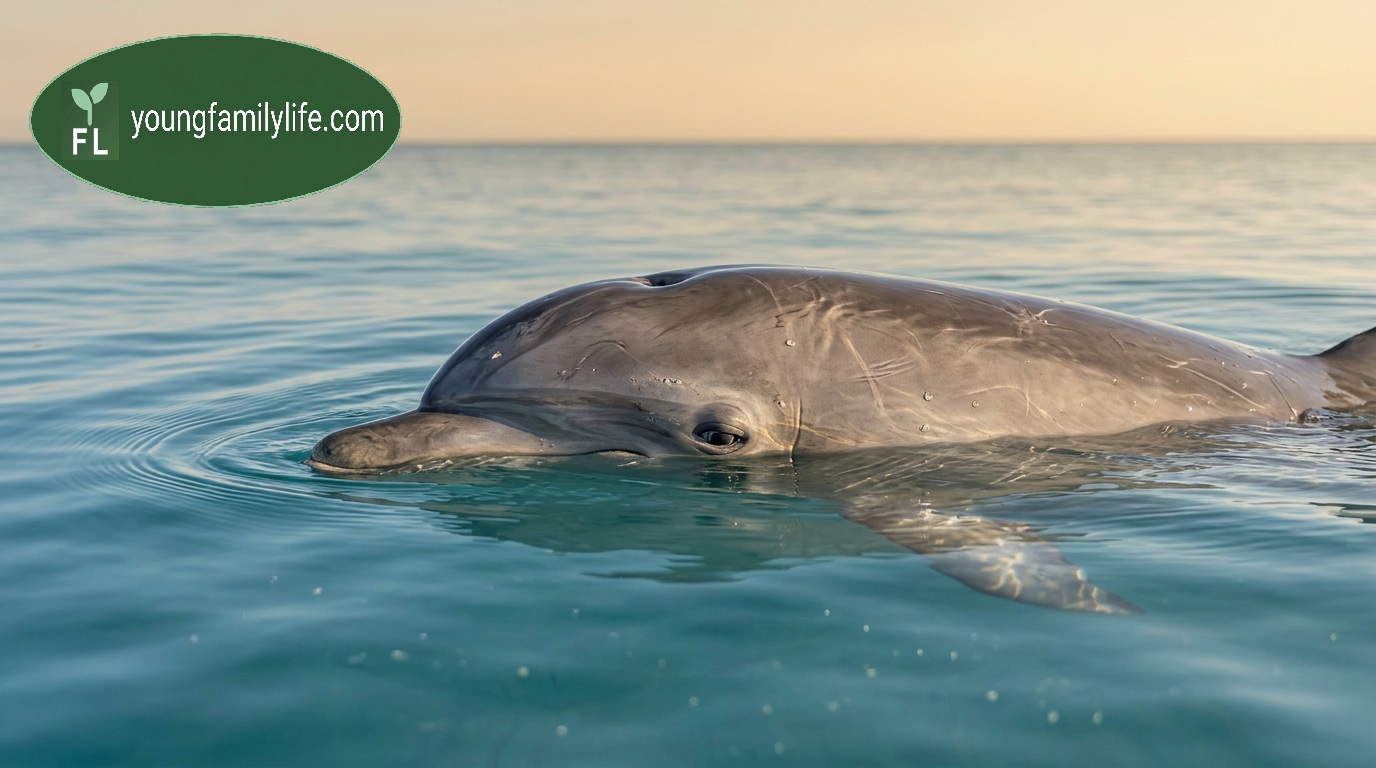
The physical expression of this is visible. When a dolphin is in unihemispheric sleep — the technical term for sleeping one hemisphere at a time — one eye closes and one stays open. The closed eye is connected to the sleeping hemisphere. The open eye is connected to the waking one. The dolphin is literally half-asleep: aware on one side, resting on the other.
It keeps swimming. It keeps surfacing to breathe. It maintains its position in the water. A sleeping dolphin, from the outside, looks almost indistinguishable from a waking one — because functionally, half of it is.
And when dolphins sleep in groups, the open eye tends to face outward — away from the group, toward the direction from which a threat is most likely to come. The sleeping brain is doing triage: maintaining the surveillance that matters, resting everything else.
Dolphins aren't the only animals that do this. Fur seals, manatees, and beluga whales have the same capacity. Birds use it too — but for a different reason. In birds, unihemispheric sleep is primarily about predator detection rather than breathing. Mallard ducks sleeping at the exposed edge of a group sleep with one eye open facing outward; ducks in the protected centre sleep more deeply. The open eye shifts depending on where the threat is most likely to come from (Rattenborg et al., 1999). Same architectural solution, different ecological problem.
The Frigatebird Goes Further Still
If unihemispheric sleep is striking in dolphins, what great frigatebirds do with it is extraordinary. These large ocean-going birds make non-stop flights over the Pacific lasting up to ten days — no landing, no rest, just continuous flight. During those crossings, electrophysiological recordings have shown that frigatebirds sleep in flight: sometimes one hemisphere at a time, sometimes briefly with both (Rattenborg et al., 2016).
Their average sleep during a ten-day crossing is around forty minutes a day. Back on land, the same birds sleep for nearly thirteen hours. The ecology of the flight determines how much sleep is available. The biology provides the tool — the capacity for partial, flexible, architecturally unusual sleep — and the bird uses whatever form of it its situation allows.
This is a long way from the picture of sleep as a binary. On or off. Asleep or awake. The dolphin, the mallard, and the frigatebird are all showing the same thing: a biological system capable of running different states simultaneously in different parts of the brain, allocating rest and wakefulness spatially rather than in a single block, responding dynamically to what the situation actually needs.
What This Tells Us About Sleep
The reason the dolphin's sleeping architecture matters beyond being a fascinating fact about marine mammals is what it reveals about the nature of sleep itself.
Most public conversation about sleep treats it as a fixed requirement — a specific amount, in a specific form, at a specific time, or the consequences will be serious. The dolphin's brain does not work this way. Neither does the mallard's, or the frigatebird's. Each of them is running a flexible system that calibrates the depth, duration, and architecture of sleep to match what their circumstances actually demand. What varies is not whether they sleep — all of them do, in some form — but how, how much, and in what configuration.
Jerome Siegel at the University of California, Los Angeles, has argued that this flexibility is the defining feature of sleep biology across the animal world (Siegel, 2009). Sleep is not a fixed rule. It is an adaptive strategy — the organism withdrawing from the cost of full wakefulness in whatever form its situation permits, for as long as its situation allows.
The dolphin that is half-asleep, one eye open, surfacing to breathe in the dark, is not failing to sleep properly. It is sleeping perfectly, for a dolphin, in an ocean. The biology is doing exactly what it evolved to do.
The Half-Alert Parent
For parents of young babies, the experience of being perpetually half-alert — one ear always open, never quite fully off even during sleep, waking at the slightest sound — is one of the most commonly reported features of early parenthood. It can feel like a failure to rest properly. Like sleep that doesn't count because it isn't deep enough or complete enough.
The dolphin offers a different frame. The capacity to maintain partial alertness while resting — to keep one ear effectively open while the rest of the system recovers — is not a malfunction of the sleep system. It is a feature of it. The brain's ability to run different states simultaneously, to distribute rest and awareness across its architecture in response to what the situation demands, is one of the most sophisticated things biology does.
A parent who wakes at their baby's sound while their partner sleeps through it is not sleeping poorly. Their brain has assessed the situation and calibrated accordingly. The biology knows what it's doing. It has been doing this kind of thing, in one form or another, for a very long time.
Topics: #dolphin #unihemisphericsleep #sleepbiology #adaptiveinactivity #sleepscience #frigatebird #mallard #Siegel #Rattenborg #HeyWantToKnow #YoungFamilyLife #informationwithoutinstruction #evolutionarybiology #parentalsleep #sleepflexibility
Further Reading
These links dig deeper into the topics covered here:
Unihemispheric sleep research:
- Cetacean sleep: an unusual form of mammalian sleep — Lyamin et al. (2008), Neuroscience and Biobehavioral Reviews — The research paper on dolphin and cetacean sleep architecture: the mechanism, the evidence, and what it means for understanding how mammalian sleep works.
- Evidence that birds sleep in mid-flight — Rattenborg et al. (2016), Nature Communications — The frigatebird study: how a large seabird manages on around forty minutes of sleep a day during ten-day ocean crossings, using unihemispheric sleep in flight.
Sleep as adaptive strategy:
- Sleep viewed as a state of adaptive inactivity — Siegel (2009), Nature Reviews Neuroscience — The research paper behind the energy-conservation account of sleep: why the flexibility seen in dolphins and frigatebirds is the defining feature of sleep biology, not the exception.
How This Essay Reflects YFL Values
This piece uses one of the most architecturally unusual examples of sleep in the natural world to challenge the idea that sleep is a binary — fully on or fully off — and that anything departing from a consolidated block of unconsciousness is a failure. The dolphin's solution is not a compromise or a workaround. It is a precisely engineered response to a genuine constraint, and it works. The implication for how fragmented or partial human sleep is understood follows from the biology without being forced.
YoungFamilyLife puts the evidence out there and leaves what to make of it entirely to the reader. What people do with this information is their own call.
Informed people make better decisions for themselves and their families. That is the only assumption this platform makes.
Related YFL Essays and Resources
Sleep Across the Spectrum — The full essay behind this piece: unihemispheric sleep examined in depth alongside the full biological continuum from daily torpor to years-long aestivation.
Why Your Body Sleeps Differently Depending on What It Needs — The companion piece on sleep flexibility in humans: the afternoon dip, sleep during illness, sleep after physical effort, and how sleep changes across a lifetime — all expressions of the same adaptive system the dolphin is using.
Why Polar Bears Give Birth in Their Sleep — The companion curiosity piece: another extreme expression of the adaptive withdrawal principle, this time showing how a body can simultaneously rest and do its most demanding biological work.
IOW — Where the Idea of Eight Hours Sleep Actually Came From — The plain-language version of the full sleep series: what sleep is, what nature and history show about it, and where the modern anxiety came from.
Copyright Notice
© 2026 Steve Young and YoungFamilyLife Ltd. All rights reserved.
"Hey!, Want To Know" is a copyrighted content format of YoungFamilyLife Ltd.
This essay was developed collaboratively using AI assistance to research academic sources and refine content structure, while maintaining the author's original voice, insights, and "Information Without Instruction" philosophy. No part of this essay may be reproduced, distributed, or transmitted in any form or by any means, including photocopying, recording, or other electronic or mechanical methods, without the prior written permission of the copyright holders, except in the case of brief quotations embodied in critical reviews and certain other noncommercial uses permitted by copyright law.
For permission requests, contact: info@youngfamilylife.com