What Most People Get Wrong About Polar Bears
Ask most people whether polar bears hibernate and they'll say yes. The image is familiar — a large animal tucked up somewhere warm, sleeping away the Arctic winter, waking up in spring. It's a reasonable assumption. It's also mostly wrong.
The majority of polar bears don't hibernate at all. Male polar bears and females without cubs stay active through the Arctic winter, hunting seals on the sea ice, covering huge distances, managing the most extreme cold environment on Earth through sheer metabolic efficiency and fat reserves (Polar Bears International, 2024). The popular image of the hibernating polar bear applies to a much smaller group — and what that group actually does is considerably more interesting than hibernation.
The exception is the pregnant female. And what she does over the Arctic winter is one of the most striking biological performances in the natural world.
The Den
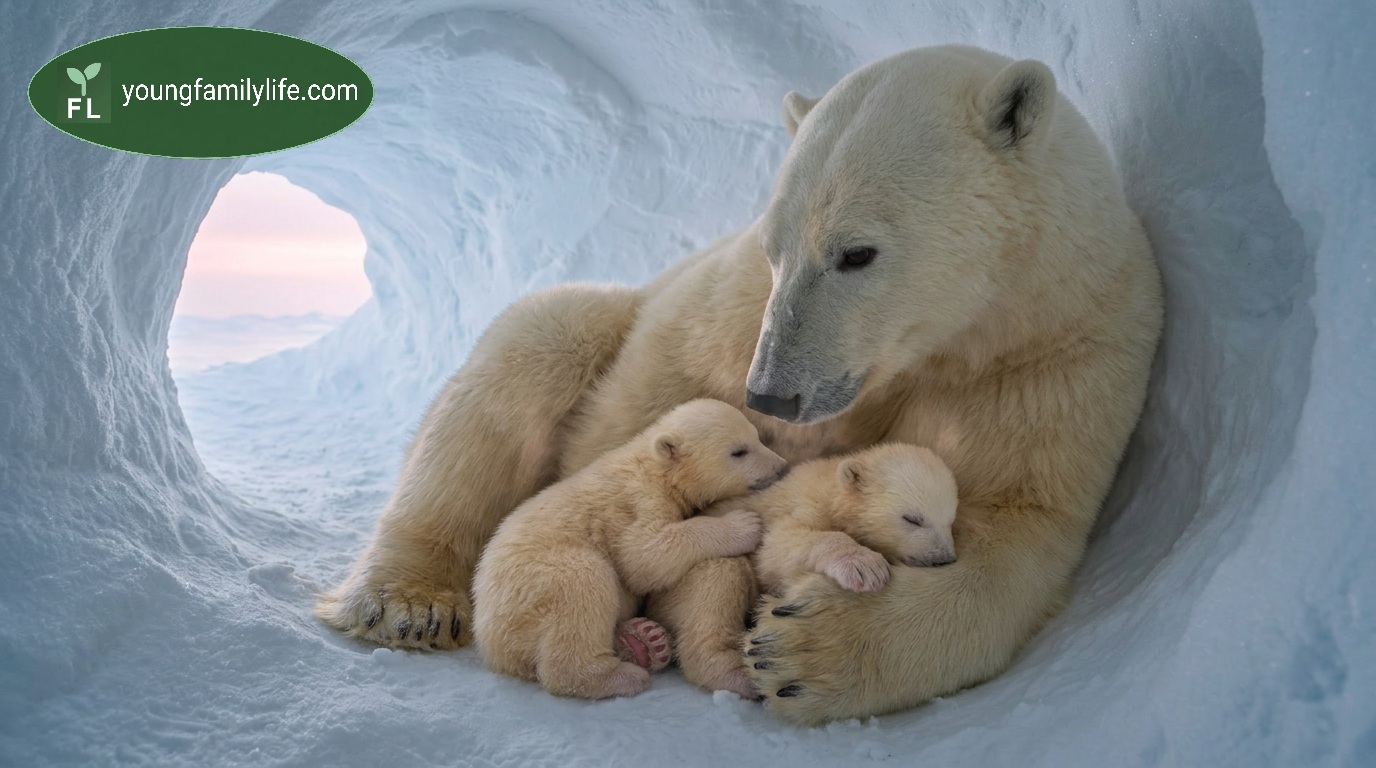
Between October and November, pregnant polar bears find a snowdrift — on land, or sometimes on sea ice — and dig in. They excavate a small chamber, curl up inside, and the snow seals over them. Their body heat warms the interior to as much as 25°C above the Arctic air outside (Polar Bears International, 2024). The den is a passive heat trap, engineered by the bear's own metabolic output.
Inside the den, the bear's heart rate drops to as low as 8–10 beats per minute during sleep (Folk et al., 1980). Her metabolic rate falls by somewhere between 25 and 50% of what it would normally be (Robbins et al., 2012). Her body temperature drops a few degrees — from around 37–38°C to approximately 35°C (Whiteman et al., 2015). She stops eating, drinking, urinating and defecating entirely. Metabolic waste gets recycled biochemically rather than excreted. She will not eat again until she emerges in spring — a fast that, including the weeks before denning, can total up to eight months.
And in December or January, in the dark and the cold and the silence of the den, she gives birth.
The Work That Happens During the Rest
The cubs are born weighing around half a kilogram — tiny, blind, toothless, completely unable to regulate their own temperature. They are among the most helpless newborns of any large mammal. They need warmth, constant closeness, and frequent nursing to survive.
The mother's milk is exceptionally rich — around 31% fat (Polar Bears International, 2024) — and she nurses actively through the denning period. The cubs grow from 500 grams at birth to around 10 kilograms by the time the family emerges in March or April. That growth happens entirely on the mother's stored fat reserves, converted to milk, while she barely moves and barely breathes and has a resting heart rate in single figures.
This is not a bear that has switched off for winter. This is a bear that has selectively withdrawn from one set of costly activities — foraging, locomotion, thermal regulation against an extreme external environment — while simultaneously intensifying another: birth, nursing, cub thermoregulation, the whole extraordinary physiological project of keeping two newborn animals alive through an Arctic winter on nothing but what she stored in her body the previous autumn.
The withdrawal enables the work. The rest is the condition that makes the productivity possible.
What This Shows About Sleep
The popular picture of sleep — and of hibernation, and of rest more generally — is that it is the opposite of activity. The body switched off. The biological pause. Nothing happening.
The polar bear maternity den makes that picture look inadequate. What's happening inside that snow chamber is not nothing. It is a precisely calibrated biological reconfiguration — some systems reduced to minimum, others running at full stretch, the whole arrangement held in a careful balance by a body that knows exactly what it is doing and why.
Researchers who study sleep across the animal world have argued that this is actually what all sleep is, at its core. Jerome Siegel at the University of California, Los Angeles, has made the case that sleep is best understood as energy conservation — the organism withdrawing from the cost of wakefulness when wakefulness offers no return, and redirecting those freed resources toward whatever the body most urgently needs (Siegel, 2009). The polar bear is doing this in its most complex form: withdrawing from the enormous energy cost of surviving the Arctic winter as a mobile, active animal, and redirecting everything available toward reproduction.
The active/inactive binary doesn't hold. The bear is both at once. She is resting and she is working. The rest is how the work gets done.
What It Means Beyond the Arctic
The polar bear doesn't have a sleep problem. There is no external standard she is failing to meet, no eight-hour rule she is violating, no chart telling her how active she should be. Her biology calibrates to what her situation actually demands — withdrawing precisely as far as her circumstances allow, maintaining precisely what her circumstances require, and producing something remarkable in the process.
That flexibility — the capacity to withdraw from one set of demands in order to meet another — is visible across the full range of biological sleep. The hummingbird in overnight torpor. The frigatebird sleeping forty minutes a day during a ten-day ocean crossing. The lungfish surviving four years in dried mud. And the polar bear nursing cubs through an Arctic winter on a heartbeat in single figures.
All of them are running the same strategy. The form it takes changes dramatically depending on what the situation needs. The principle — withdraw from what can be withdrawn, maintain what must be maintained, and let the biology do its work — stays constant.
For the human parent up at 3am, feeding a baby in the dark, operating on interrupted sleep and uncertain about whether everything is as it should be: the polar bear maternity den is a useful image. The body is not simply being depleted. It is selectively reconfigured around a biological priority — and it has been managing exactly this kind of reconfiguration, in one form or another, for as long as there have been parents and young.
Topics: #polarbear #maternityden #sleepbiology #adaptiveinactivity #hibernation #sleepspectrum #Siegel #sleepscience #HeyWantToKnow #YoungFamilyLife #informationwithoutinstruction #evolutionarybiology #parenthood #newbornbiology
Further Reading
These links dig deeper into the topics covered here:
Polar bear biology:
- The basics of polar bear denning — Polar Bears International (2024) — An accessible overview of maternity denning: the timeline, the physiology, the cubs' growth, and the den's thermal engineering.
- Polar bear maternal denning — USGS (2024) — The US Geological Survey's research resource on polar bear denning: scientific detail on the physiology and ecology of the denning period.
Sleep as adaptive strategy:
- Sleep viewed as a state of adaptive inactivity — Siegel (2009), Nature Reviews Neuroscience — The research paper behind the energy-conservation account of sleep: why the body withdraws from wakefulness, and why this flexibility across species is the system working as designed.
How This Essay Reflects YFL Values
This piece uses one of the most striking examples in the natural world to challenge a comfortable assumption — that rest and activity are opposites. The polar bear maternity den is not offered as a metaphor. It is presented as evidence: evidence that the biology of sleep is capable of supporting intense productivity precisely through the mechanism of withdrawal, and that what looks like inactivity can be the condition that makes the most demanding biological work possible.
YoungFamilyLife puts the evidence out there and leaves what to make of it entirely to the reader. What people do with this information is their own call.
Informed people make better decisions for themselves and their families. That is the only assumption this platform makes.
Related YFL Essays and Resources
Sleep Across the Spectrum — The full essay behind this piece: the complete biological argument from daily torpor to years-long aestivation, with the polar bear maternity den examined in full physiological detail alongside the hibernating primate, the African lungfish, and unihemispheric sleep in dolphins.
How a Lungfish Can Sleep for Years — The companion curiosity piece: another extreme expression of the same adaptive withdrawal principle, this time in a fish that survives four years in a dried riverbed on a heartbeat of twice a minute.
Why Exhausted Parents Are Adapting, Not Failing — The HWTK piece that connects the biology directly to the experience of early parenthood: why the body copes better than the sleep industry implies, and why the anxiety around infant night waking is largely manufactured.
IOW — Where the Idea of Eight Hours Sleep Actually Came From — The plain-language version of the full sleep series: what sleep is, what nature and history show about it, and where the modern anxiety came from.
Copyright Notice
© 2026 Steve Young and YoungFamilyLife Ltd. All rights reserved.
"Hey!, Want To Know" is a copyrighted content format of YoungFamilyLife Ltd.
This essay was developed collaboratively using AI assistance to research academic sources and refine content structure, while maintaining the author's original voice, insights, and "Information Without Instruction" philosophy. No part of this essay may be reproduced, distributed, or transmitted in any form or by any means, including photocopying, recording, or other electronic or mechanical methods, without the prior written permission of the copyright holders, except in the case of brief quotations embodied in critical reviews and certain other noncommercial uses permitted by copyright law.
For permission requests, contact: info@youngfamilylife.com