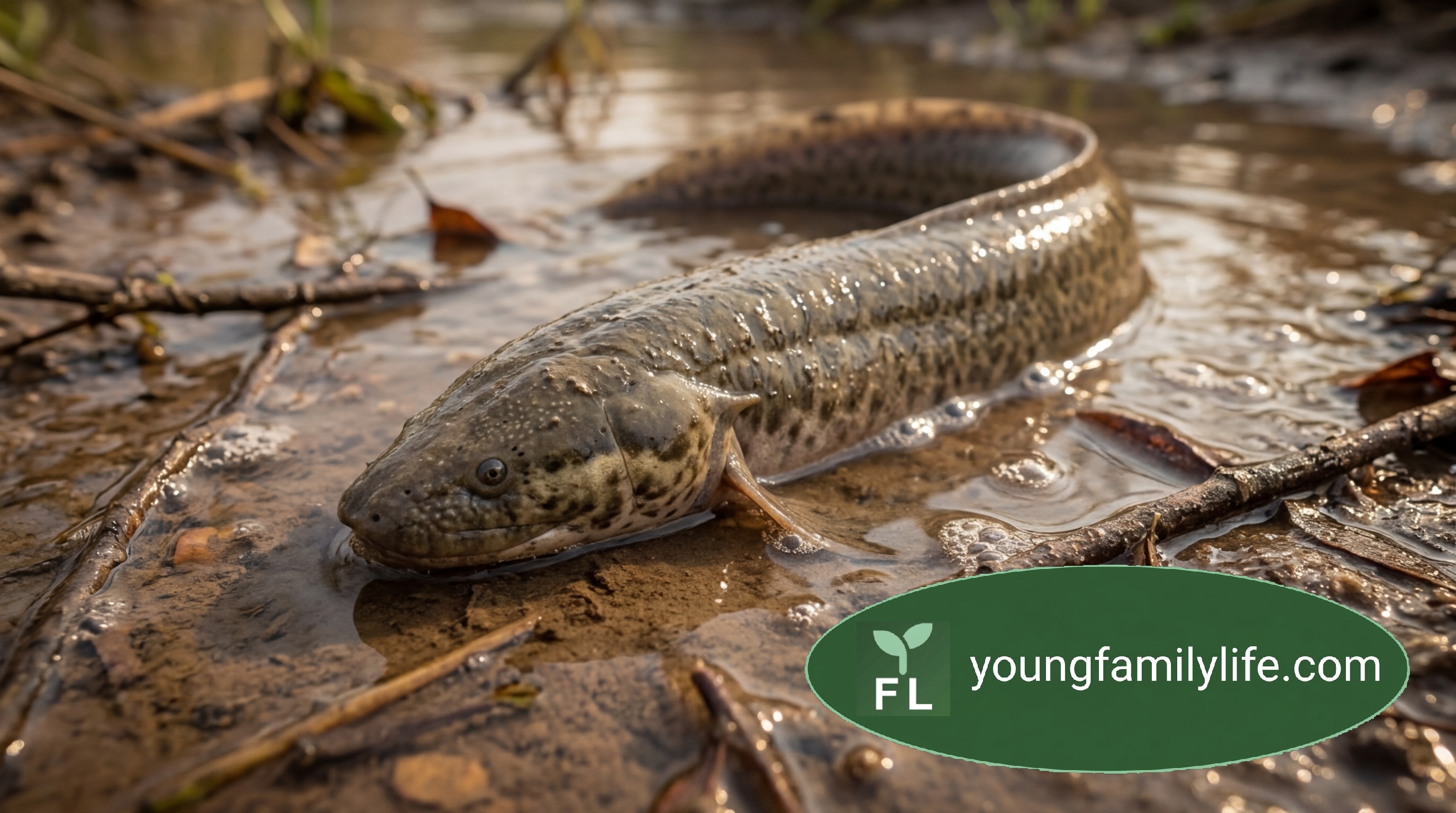
The Most Extreme Sleeper on Earth
Sub-Saharan Africa has a dry season. Rivers shrink. Wetlands dry out. The water disappears for months — and sometimes, in the worst years, for much longer than that.
Most fish die when that happens. The African lungfish does something different. As the water recedes, the lungfish burrows down into the mud of the drying riverbed. It wraps itself in a cocoon made from its own mucus — leaving just a small gap at its mouth to breathe through — and it goes still. Its heart rate drops from around 25 beats a minute to two. Its oxygen intake falls to about half of what it uses when active in water. And it waits.
It can wait for months. In extreme cases, it can wait for up to four years (Oxford Scientist, 2023).
Four years without food, without water, without moving. And when the rains come back and the water returns, the lungfish breaks out of its cocoon, rehydrates, and carries on as if nothing happened.
This isn't a curiosity. It's a clue — one of the most striking in nature — about what sleep actually is and how far the biology can take it.
It's Not Just Switched Off
The tempting way to think about the lungfish is that it goes into a kind of biological pause — everything stops, it just waits, then starts up again. But that's not quite what's happening. The lungfish during dormancy is actually doing a remarkable amount of active management.
Its immune system keeps working throughout. The cocoon itself isn't just a physical barrier — research has shown it actively traps bacteria, providing a layer of defence against the pathogens in the surrounding mud (Navas et al., 2023). The lungfish can't fight an infection actively while it's dormant, so it has outsourced some of the immune work to the cocoon itself.
Its muscles don't waste away the way a human's would during four years of immobility. The lungfish produces a protein that specifically prevents muscle atrophy — a precisely targeted response to a precisely anticipated problem. It knows, at a biological level, that it will need those muscles when it wakes up.
And in the early stages of going into dormancy, the lungfish's brain actually increases its expression of growth hormone — the same hormone that humans associate with sleep and recovery. It's not shutting down its growth and repair systems. It's running them in a context of profound stillness, not activity. The biology is not resting. It is working — selectively, precisely, with extraordinary economy.
Where This Fits in the Bigger Picture
The lungfish's dormancy is called aestivation — the summer equivalent of hibernation. Where hibernation is a response to cold and scarcity, aestivation is a response to heat and drought. Different trigger, same underlying logic: when conditions make activity pointless or impossible, the body withdraws from the cost of being active and waits for better conditions.
Researchers who study sleep across the animal world have argued that this is actually what all sleep is, at its most fundamental. Jerome Siegel at the University of California, Los Angeles, has made the case that sleep is best understood not as restoration — the body repairing itself overnight — but as energy conservation (Siegel, 2009). The body withdrawing from the metabolic cost of wakefulness when wakefulness offers nothing in return. Sleep, torpor, hibernation, and aestivation are not separate biological states. They are the same strategy operating at different intensities, across different timescales, in response to different environmental signals.
The hummingbird drops its body temperature dramatically every night because staying warm at its size would cost more energy than it has. The bear reconfigures around giving birth while barely moving for months. The frigatebird sleeps for forty minutes a day during ten-day ocean crossings, one half of the brain at a time. And the lungfish buries itself in a dried riverbed and runs its body on almost nothing for up to four years.
All of them are doing the same thing. The depth and duration changes. The principle doesn't.
What It Means for How We Think About Sleep
The lungfish doesn't have a sleep problem. Nobody is telling it that it needs to get eight hours a night in a consolidated overnight block. Its biology calibrates to what its environment actually demands — withdrawing when withdrawal is the sensible strategy, resuming fully when conditions allow.
That's the picture the full range of evidence points toward: not a fixed requirement that every organism must meet in the same way, but a flexible system that takes what it can, when it can, in the form that fits. The variation isn't failure. It's the strategy working.
For humans, this has implications that run from the curiosity of the lungfish all the way to the exhausted parent at 3am. The anxiety that's been built up around whether sleep is being done correctly — the right number of hours, at the right time, in the right shape — sits uneasily alongside what biology actually shows. The lungfish has never heard of eight hours. It sleeps for as long as its circumstances require, and wakes up fine.
Just to Be Clear About the Biology
The lungfish's dormancy is obviously at an extreme end of what's biologically possible — well beyond anything a human body does or needs. The point isn't that humans can or should sleep like a lungfish. The point is what the existence of that extreme reveals about the nature of sleep itself.
Sleep is not fragile. It is not a precise requirement that falls apart if the conditions aren't exactly right. It is one of the most robustly adaptable strategies in the natural world, capable of expressing itself across an extraordinary range of durations, depths, and architectures. What counts as the right amount of sleep for any given organism is determined by what that organism's situation actually calls for — not by a fixed standard applied regardless of circumstance.
That's a more interesting and more generous picture than the one most sleep messaging offers. The lungfish, buried in its mud cocoon with its heart beating twice a minute, is not failing to sleep correctly. It is sleeping perfectly, for a lungfish, in a drying African riverbed. The biology has always been this flexible. The anxiety is the newest thing in the story.
Topics: #lungfish #aestivation #sleepbiology #adaptiveinactivity #sleepspectrum #hibernation #torpor #Siegel #sleepscience #HeyWantToKnow #YoungFamilyLife #informationwithoutinstruction #evolutionarybiology #naturalsleep
Further Reading
These links dig deeper into the topics covered here:
The biology of aestivation:
- Aestivation in nature: physiological strategies and evolutionary adaptations — Navas et al. (2023), International Journal of Molecular Sciences — The research paper covering aestivation across species: the lungfish in detail, the three phases of dormancy, and the broader adaptive logic.
- A fish out of water: How African lungfish sleep through the heat — Oxford Scientist (2023) — An accessible account of the lungfish's dormancy: the heart rate figures, the four-year survival, and the mucus cocoon in plain language.
Sleep as an adaptive strategy:
- Sleep viewed as a state of adaptive inactivity — Siegel (2009), Nature Reviews Neuroscience — The research paper behind the energy-saving account of sleep: why the body withdraws from wakefulness, and why the flexibility of sleep across species is the system working correctly.
How This Essay Reflects YFL Values
This piece follows the YFL approach of starting with something genuinely surprising in nature and letting it change how a familiar subject looks. The lungfish's biology isn't presented as a metaphor or a lesson — it's presented as evidence, because that's what it is. The implications for how human sleep variation is understood follow from the biology, not from the other way around.
YoungFamilyLife puts the evidence out there and leaves what to make of it entirely to the reader. What people do with this information is their own call.
Informed people make better decisions for themselves and their families. That is the only assumption this platform makes.
Related YFL Essays and Resources
Sleep Across the Spectrum — The full essay behind this piece: the complete biological argument from daily torpor in hummingbirds to the lungfish's years-long dormancy, including the hibernating primate, the polar bear maternity den, and the unihemispheric sleep of dolphins.
Why Do Animals Sleep at All? — The companion HWTK piece on why sleep exists in the first place: the energy-saving argument, the animal evidence, and why the vulnerability of sleep is the puzzle that leads to the answer.
Why Polar Bears Give Birth in Their Sleep — The companion piece on polar bear maternity denning: another extreme expression of the same adaptive principle, this time in a mammal doing some of the most demanding biological work of its life while barely moving.
IOW — Where the Idea of Eight Hours Sleep Actually Came From — The plain-language version of the full sleep series: what sleep is, what nature and history show about it, and where the modern anxiety came from.
Copyright Notice
© 2026 Steve Young and YoungFamilyLife Ltd. All rights reserved.
"Hey!, Want To Know" is a copyrighted content format of YoungFamilyLife Ltd.
This essay was developed collaboratively using AI assistance to research academic sources and refine content structure, while maintaining the author's original voice, insights, and "Information Without Instruction" philosophy. No part of this essay may be reproduced, distributed, or transmitted in any form or by any means, including photocopying, recording, or other electronic or mechanical methods, without the prior written permission of the copyright holders, except in the case of brief quotations embodied in critical reviews and certain other noncommercial uses permitted by copyright law.
For permission requests, contact: info@youngfamilylife.com