Something adults can lose sight of
Time does something to the memory of childhood. The sharpest edges soften. The weight of certain ordinary moments — the lunch hall, the playground, the end of a lesson when everyone else seems to know where they are going — fades into something more manageable than it felt at the time.
Growing up now brings those same pressures, in a social world that has its own particular shape and speed. This piece is an attempt to go back inside those moments — and to consider what they feel like from the inside of a child's developing brain today.
A lunch hall, somewhere
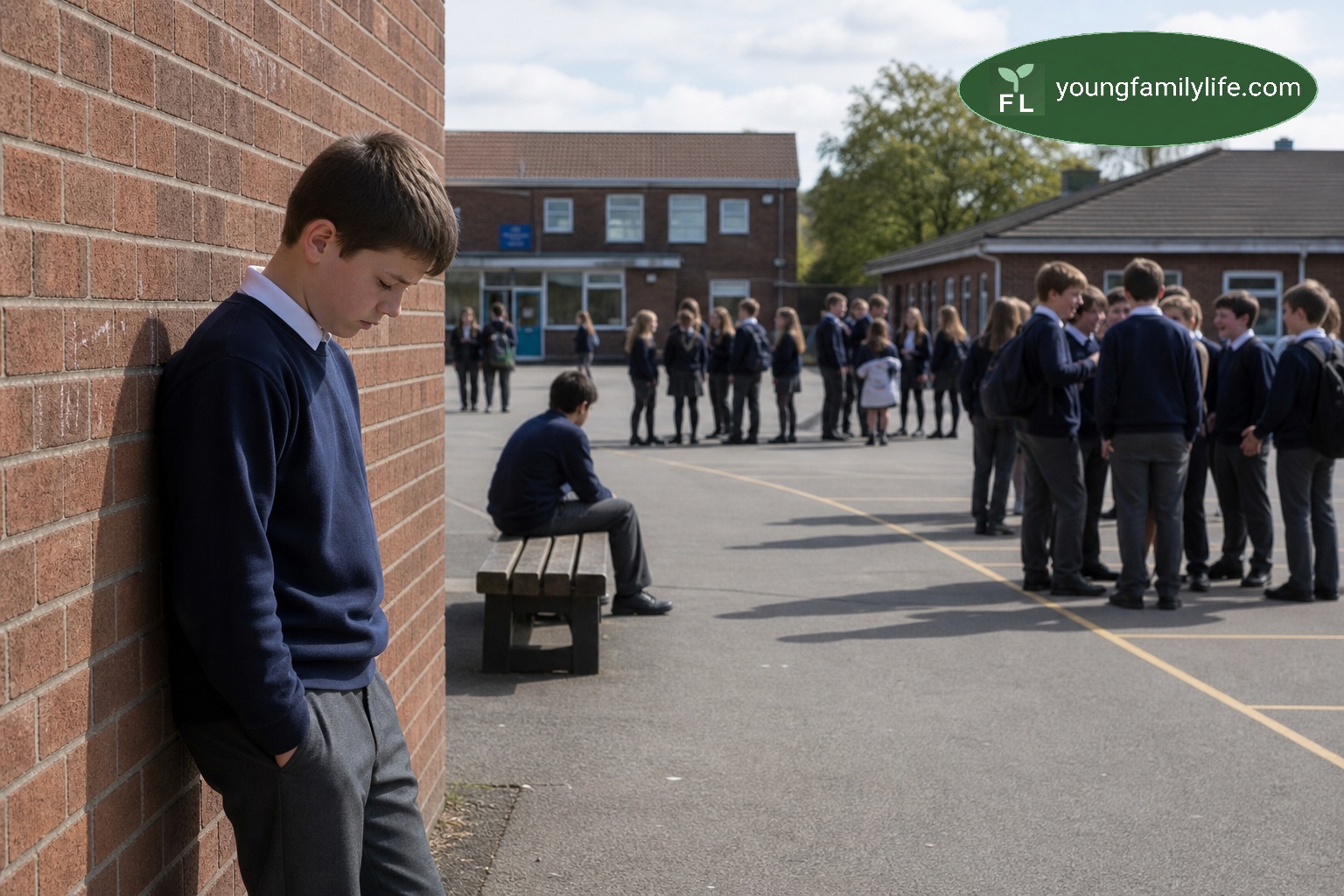
Picture a child in the first year of secondary school. New building, new faces, no one they have known for years. The lesson ends. Everyone moves into the corridor and disperses in directions that already seem established — groups that formed in the first weeks, connections made in ways that happened faster than this particular child managed.
The lunch hall is full. There are seats available. There is food. Nothing is technically wrong. And yet the experience of sitting down — of choosing where, of whether there is anywhere that feels like a right place to be — carries a weight that has no name and no obvious cause. Nothing happened. It is just the daily experience of not quite belonging yet, in a space that has no purpose except to be social.
From the outside, this child is having lunch. From the inside, those forty minutes are the hardest part of the day.
This is what loneliness in the growing-up years often looks like. Not dramatic. Not visible. Not something with a clear event attached to it. Just a private experience, carried quietly, in the middle of an ordinary Tuesday.
When the move was not a choice
The child in the lunch hall at least arrived when everyone else did. They walked through the same door on the same September morning. The social world they are trying to enter was, at that point, still being built.
There are children who arrive in a different way entirely. Mid-year. Mid-term. Into a school where groups have already formed, friendships are established, and the shared history of a peer group is already in circulation. This child is not beginning with everyone else. They are beginning alone, in a room that has already begun without them.
The reasons for these moves vary. A family may have relocated. A managed move may have been arranged — the process through which a child at risk of exclusion is transferred to a new school, sometimes by genuine agreement, sometimes under pressure. Or a school may have quietly signalled that a child is no longer the right fit, through a process that does not appear in any formal record. Research suggests that tens of thousands of secondary pupils in England experience these kinds of unexplained school transfers every year — moves that fall outside the normal expected patterns of school change, and that are frequently invisible in the data.
For some of these children, the move is connected to needs that have not been identified or met. A child who finds a classroom overwhelming in ways they cannot explain, who responds to that overwhelm in ways the school has recorded as behaviour — may find themselves moved without anyone having asked what was actually happening. The need was present. It was not named. And now the child is somewhere new, carrying both the unmet need and the accumulated weight of having been, in some sense, removed.
This child is not the introvert who has developed a practised way of existing at the edge of a group. This child has been placed, without preparation, into a social environment their brain was given no time to anticipate. The school they have arrived at is, first and foremost, a psychological barrier — one that has to be navigated before the brain can settle enough to learn, to connect, or to begin to find where it belongs.
What the brain is doing in those years
The teenage brain is not a smaller version of an adult brain. It is a brain undergoing substantial rebuilding — particularly in the areas that govern social awareness, emotional intensity, and sensitivity to how others see them.
During adolescence, the brain becomes much more sensitive to social situations. The question of where a person stands — who notices them, who chooses them, who they belong with — stops being something in the background and becomes the main thing in almost every waking moment. This is not vanity or immaturity. It is what the brain was designed to do at this stage of development. Belonging to a peer group is preparation for adult life. The brain cares about it so intensely because it is built to work this way.
This is why the social pressures of the growing-up years feel so large from the inside — often larger than the adults around them understand. The child is not overreacting. Their brain is built to feel social things more deeply than it will at almost any other point in their life.
A beach, and a different kind of experience
Not all of it is painful. The same period of growing up that produces the loneliness of the lunch hall also produces something quite different in another child.
Picture a different scene: a group of children on a beach. At some point, the group moves off to do something new. One child stays where they are, sitting in the sand. Not left behind. Not failed to notice. Simply choosing, without apparent difficulty, to remain where they are.
From the outside, it might look like social difficulty. From the inside, it is contentment. A child whose brain works better with one or two close people than with a crowd. Who genuinely prefers their own company — it is not a second choice.
At some point, this child had a friend say to them: "Are you autistic?" The reply came without defensiveness and without distress: "No. I'm not autistic. But I can see why you might say that."
That reply shows a level of self-awareness that is not easy to hold at that age. The friend had noticed a difference and reached for a label. The child had a clearer account of themselves than the label offered. They knew who they were. They were not suffering from it.
Two brains, two experiences, one social world
These two glimpses — the child in the lunch hall, the child in the sand — are not opposites. They are both inside the same social world, navigating the same pressures, with different results.
The child in the lunch hall is lonely. The loneliness is real, and it has weight, and it is the harder experience to carry. It is also invisible — to teachers, to other children, possibly to parents. Nothing visible is wrong. The child is attending, functioning, getting through the day. The experience stays private because there is no obvious moment to name it, and naming it takes a kind of courage that those years do not always make easy.
The child in the sand is not lonely. They are someone who prefers fewer, deeper connections than the social world around them tends to expect. The social pressure they experience is of a different kind: the pressure of being different in a visible way, of being noticed and labelled, of a social world that moves at a pace and in a direction that does not always match their own.
Both are normal. Both are within the wide range of what those years look like from the inside. The difference that matters is not what they look like from the outside — it is what the child themselves is carrying.
What the social pressures of these years actually ask of a child
The growing-up years ask something specific and substantial of a developing brain. They ask it to:
Find its people — in an environment made up of whoever happens to live nearby or be in the same year, among peers it did not choose and cannot easily leave.
Build social confidence — through trial and error, in conditions where getting it wrong feels unusually costly, because the brain is built to feel it that way.
Hold its own sense of self — while the peer group becomes the main place where a child works out who they are.
Do all of this without many words for it — because the words for what is happening inside them develop slowly, and the years when the pressure is highest are often the years when a child is least able to name what they are going through.
This is not a gloomy picture. Most children get through it — imperfectly, slowly, sometimes painfully, but through. The child in the lunch hall does not stay there forever. The social world beyond school is more self-selecting. The people who were hard to find at eleven tend to exist in considerable numbers elsewhere. The confidence built slowly — through the child finding their own way, not someone else finding it for them — turns out to be more useful than it felt while it was being built.
But understanding what those years actually feel like from the inside changes what adults see when they look at a child going through them. The child who is quiet at the dinner table after school. The one who shrugs when asked how their day was. The one who says everything is fine and means it — and the one who says it and doesn't.
What is worth staying close to
The child is usually the most reliable guide to their own inner experience — when asked in a way that does not come with a preferred answer already attached.
The question worth asking is not "do you have friends?" — which gets a reassuring answer whether it is true or not. It is something quieter: "what are the hard parts of the day?" Or simply staying close enough, and present enough, that the moment when something is said — at bedtime, in the car, dropped into dinner without warning — is a moment that gets heard.
The social pressures of the growing-up years are real. They are often invisible. And the child carrying them is usually doing so more privately than the adults around them know.
Topics: #HWTK #SocialPressure #GrowingUp #ChildLoneliness #AdolescentBrain #Introversion #Belonging #PeerRelationships #Parenting #ChildDevelopment #YoungFamilyLife
Related YFL Essays and Resources
In Other Words: If Your Child Is Feeling Lonely — the plain-language account of what loneliness in childhood actually is, how friendship develops, and what the research distinguishes as normal variation versus something worth attending to.
The Social Brain and the Lonely Child — the full Repositorium essay; the complete research picture behind everything this piece touches.
Learning to Survive — How the Human Brain Navigates Opportunity and Danger — the foundational YFL essay on how the brain builds itself in childhood and what early experience leaves behind.
In Other Words... How a Brain Builds Itself — the plain-language account of the three-brain framework and what the brain is doing during the growing-up years.
Copyright Notice
© 2026 Steve Young and YoungFamilyLife Ltd. All rights reserved.
"Hey!, Want To Know" is a copyrighted content format of YoungFamilyLife Ltd.
This essay was developed collaboratively using AI assistance to research academic sources and refine content structure, while maintaining the author's original voice, insights, and "Information Without Instruction" philosophy. No part of this essay may be reproduced, distributed, or transmitted in any form or by any means, including photocopying, recording, or other electronic or mechanical methods, without the prior written permission of the copyright holders, except in the case of brief quotations embodied in critical reviews and certain other noncommercial uses permitted by copyright law.
For permission requests, contact: info@youngfamilylife.com