What loneliness in a child actually is
When a child says they have no friends, or that they feel lonely, it lands differently to most things children say. There is no obvious next step. Nothing to fix straight away. Just the weight of what has been said, and the question of what it means.
The first thing the research is clear on is this: a child who says they are lonely is not reporting a failure. They are reporting a gap. The human brain was built — shaped by millions of years of evolution — to need social connection. It is not an optional extra. Robin Dunbar, a professor of evolutionary psychology at Oxford, spent decades establishing that the human brain grew to the size it did specifically to manage relationships — not to solve problems or navigate landscapes, but to maintain a social world. Connection is the primary thing the brain evolved for.
When that connection is missing or feels out of reach, the brain signals the gap in the same way it signals hunger or pain: not to punish, but to prompt. Loneliness is that signal. Seeing it that way changes things. It moves a lonely child from the category of something being wrong with them, to the category of a brain doing exactly its job.
Friendship builds gradually — and transitions can reset the clock
One of the most useful things research has found is that friendship is not something children either have or don't. It builds in stages, and each stage looks quite different.
Very young children's friendships are simple and changeable. A friend, at age four, is basically whoever they are playing with today. That is not a shallow version of friendship — it is the right version for that age. The brain is building the foundations.
By the middle primary school years — roughly seven to twelve — something shifts. Friendship becomes about being chosen. About loyalty, shared secrets, and the experience of mattering to someone else. Research consistently finds that having one genuine friendship at this age — one real, mutual connection — is what makes the difference to a child's sense of themselves. Not five friends. Not a group. One.
Adolescence brings the biggest shift of all. During the teenage years, the peer group begins to replace the family as the most important social world. This is not a phase or a problem. It is biology. The teenage brain is being substantially rebuilt during these years, and belonging to peers is part of what it was designed to do during that rebuild. A teenager who cares intensely about where they stand socially is not being dramatic. Their brain has been built to care about exactly this, more than almost anything else.
What the research also shows is that transitions can reset this process entirely. A child who moves up to secondary school at eleven — especially one who has not moved up with an existing group of friends — does not carry their social confidence across with them. The network they built in primary school belonged to that environment. Secondary school is a new social world, populated mostly by strangers, and the brain has to start building again.
This is where loneliness tends to land hardest — not in the classroom, where there is a task and a structure, but in the unstructured parts of the day. The playground. The lunch hall. Forty minutes with nothing to do except find where they belong, in a space full of people they do not yet know.
There is a version of this that is harder still, and more common than the data tends to capture. Not every child who arrives in a new school does so at the start of a new year, with everyone else. Some arrive mid-term, mid-year, or mid-adolescence — because a family has moved, or because a managed move has been arranged, or because a school has, quietly or not so quietly, decided they are no longer the right fit. The Education Policy Institute has identified around 30,600 secondary pupils in England who changed schools in a single year in ways that could not be explained by the normal patterns of parental choice or expected transition. Many more move through informal processes — managed moves, off-site direction, and what is known as off-rolling — that rarely appear in official figures.
The child who arrives this way enters a social world whose architecture is already established. Groups have formed. Friendships exist. The shared language of a peer group — who is friends with whom, what happened last term, whose house they were at on Saturday — is already in circulation, and the newcomer has no access to any of it. This is a different experience to the normative secondary school transition, where every child is, to some degree, starting again at the same time. Here, the child must begin alone in a room where everyone else has already begun together.
For children whose move is linked to SEND — whether formally identified or not — there is an additional layer. A child whose additional needs have never been named, or who has been quietly steered out of a school that did not have the provision or the inclination to support those needs, arrives carrying that history without a vocabulary for it. Research consistently finds that children with SEN support are over five times more likely to be excluded from school than their peers without identified needs — a figure that reflects not just individual difficulty but the frequency with which unmet need is read as behaviour, and behaviour is managed through removal rather than support. The new school may or may not know this child's history. The child almost certainly feels it, in ways they may not be able to name.
What the family models without realising it
Children do not learn social skills by being told about them. They learn by watching them. Research is consistent on this: the way adults in a family navigate their own social world — whether social situations feel easy or difficult, whether other people are welcomed or kept at arm's length — shapes what the child's brain learns to expect from social connection.
A household where adult friendships are easy and visible, where conversations with neighbours happen naturally, where the child sees adults enjoying other people — gives the child a picture in their head of what friendship looks like day to day. That picture travels with them to every new situation they encounter. The child does not know they have been given it. They absorb it, the same way they absorb language — through watching it happen, long before it becomes something they can think about or name.
A family that is more isolated, or in which social situations are managed with difficulty, passes on a different picture. This is not a source of blame — it simply describes something that happens without either side knowing it.
There is a second pattern worth naming here. When parents arrange all of a child's social life — every playdate planned, every friendship managed, every awkward social moment smoothed over before the child encounters it — something is left unbuilt. The skill of finding connection — reading a new social environment, making an approach, recovering from a rebuff, trying again — is built by doing it, in conditions where they don't know if it will work. A child who has never had to find a friend for themselves arrives at secondary school — new building, new faces, no ready-made group — without having practised the most important part of what that situation requires.
This is not a criticism of involved parenting. It is a description of something that happens quietly and without intention. The parent who has managed their child's social world from the best of motives may not have known that some of the difficulty — the awkwardness, the uncertainty, the risk of a social approach that might not be welcomed — was exactly the experience the child needed to build their own confidence.
Introversion is not loneliness
The research makes a distinction that much parenting advice skips past. Introversion — preferring quieter social situations, finding large groups tiring, wanting fewer but deeper friendships — is a temperament. It is not a problem. It is not loneliness. It is simply a different way of being wired.
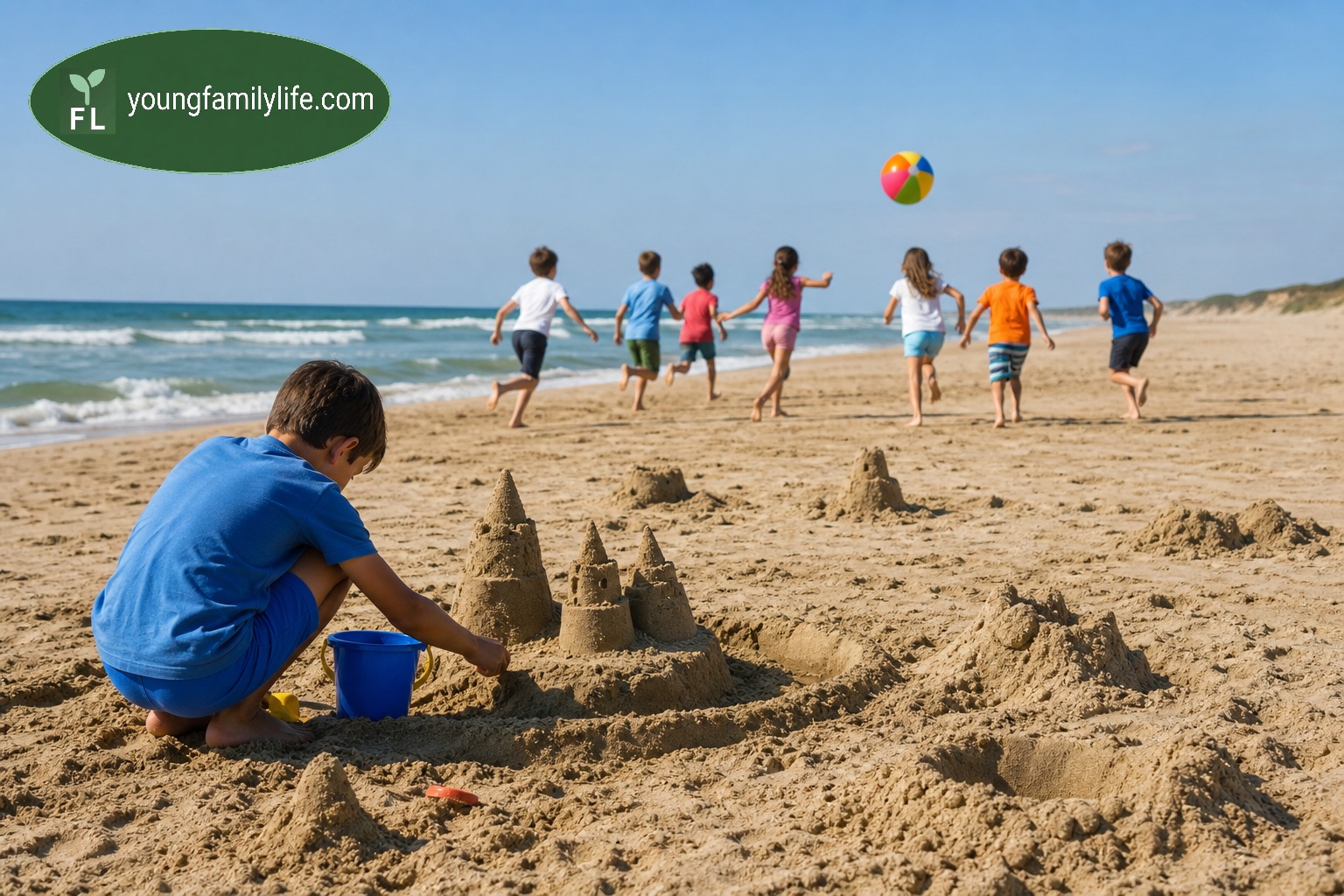
A parent once described watching her son on a beach with a group of other children. At some point the group moved off together to do something new. Her son stayed where he was, sitting in the sand, apparently content. He had not been left behind. He had not failed to notice. He had simply chosen to remain where he was. From the outside, it could easily have looked like exclusion or social difficulty. From the inside — from where he was sitting — it was a preference.
The same boy, at some point, had a friend say to him: "Are you autistic?" His reply was: "No. I'm not autistic. But I can see why you might say that." That response holds something worth paying attention to. The friend had noticed a difference and reached for a label to explain it. The boy knew his own inner world clearly enough to hold his own account of it — without defensiveness, without distress, and with enough self-awareness to acknowledge what his friend had seen. He was not suffering from being the way he was. He knew who he was.
Studies of children who are slow to warm to new situations, who hold back in unfamiliar groups, who take longer to connect — consistently show that these children make friends at the same rate as more outgoing children, once they are in familiar surroundings with consistent contact. The difficulty arises in specific conditions: unstructured settings, unfamiliar faces, no obvious structure to lower the social stakes. This is a problem of setting, not a problem with the child.
The question the research actually points to is not how many friends a child has. It is whether the child has at least one relationship in which they feel genuinely seen and chosen. That is what the evidence connects to wellbeing. Everything beyond it is measured against a standard that is not the same for every child.
Loneliness and introversion look similar from the outside. They feel entirely different from the inside. The child who is content with one close friend, who finds large groups draining, who prefers a quieter social life — is not lonely. The child who wants connection and cannot find the way to it is. The child themselves is usually the most reliable guide to which one they are experiencing — when asked in a way that does not come with a preferred answer already attached.
The social brain keeps building — the story is not finished
One of the most important things the research says — and one of the least communicated to parents when a child is struggling socially — is that childhood loneliness is not a sentence.
The social brain does not stop developing at eleven, or fifteen, or eighteen. It continues to be shaped by new environments, new relationships, new experiences throughout adolescence and into early adulthood. The child who found secondary school socially hard, who spent lunch times on the edge of things, who arrived without a network and built one slowly — is not on a fixed path. The social skills that were not yet there at eleven can develop at sixteen, at nineteen, at twenty-three.
The adult social world is, in important ways, more self-selecting than school. Adults find communities built around shared interest, shared values, shared sense of humour — rather than the accident of being in the same year group at the same school. The child who never quite found their people in school sometimes discovers, with genuine surprise, that those people exist in considerable numbers elsewhere — and that the confidence they built slowly, through finding their own way through something hard, turns out to be more portable than it felt at the time.
This is not a reason to dismiss a child's loneliness now. The experience is real and it matters. But it is worth holding as context: the brain is still building. The story is not finished.
What is worth watching more carefully
Most of what brings parents to this question sits within ordinary developmental experience. A child who is quieter than their peers, who takes longer to find their footing in a new environment, who prefers one close friend to a group — none of this signals that something is wrong.
There are situations that are worth closer attention. If a child who previously had friendships has withdrawn significantly — not following a specific event that can be understood, but gradually and without a clear reason — and that withdrawal has continued for several months, the change is worth exploring. A change in pattern tells more than any single snapshot.
If a child is being actively and repeatedly excluded by other children, rather than simply taking longer to connect, that hurts differently — and tends to have a longer effect. Research consistently distinguishes between a child who is slower to connect and a child who is being kept out. Both matter, but they are not the same situation.
If the loneliness the child describes is affecting their sleep, appetite, mood across most days, or willingness to go to school — the child's own account of what they are experiencing is the most important guide. Not as a list of symptoms, but as what a child is communicating about what their life actually feels like from the inside.
The distinction that matters most is this: introversion is a preference. Loneliness is a signal. One describes how a child's social brain is built. The other describes a gap between what the brain was built for and what it is currently finding. A child who says they are lonely is sharing the second thing. It deserves to be heard for what it is — not dismissed as passing, not treated as a crisis, but taken seriously as real information from someone who knows their own inner life better than anyone else does.
Topics: #InOtherWords #ChildLoneliness #ChildFriendship #SocialBrain #SchoolTransition #Introversion #FamilyCulture #Parenting #ChildDevelopment #YoungFamilyLife
Related YFL Content
Learning to Survive — How the Human Brain Navigates Opportunity and Danger — the foundational YFL essay on the three-brain model and how early experience shapes the brain that arrives at every social situation; the biological ground beneath everything this piece covers.
In Other Words... How Attachment Styles Shape the Way People Handle Life and Relationships — the IOW account of how early relationships become a template for later ones; the internal working model that a child brings to the playground, and where it first formed.
In Other Words... How a Brain Builds Itself — the plain-language account of the three-brain framework and what the brain is doing during the growing-up years; the developmental context for understanding why transitions hit the social brain so hard.
Hey!, Want To Know ... Why Caring Parents Get Short Tempered With Their Children — the family climate piece from the parent's side; how the adult's own nervous system shapes the social environment the child is growing up inside.
Copyright Notice
© 2026 Steve Young and YoungFamilyLife Ltd. All rights reserved.
"In Other Words" is a copyrighted content format of YoungFamilyLife Ltd.
The information in this piece is based on established research and theory. Full academic sources, references, and evidential detail are available in the linked YoungFamilyLife essays.
This essay was developed collaboratively using AI assistance to research academic sources and refine content structure, while maintaining the author's original voice, insights, and "Information Without Instruction" philosophy. No part of this essay may be reproduced, distributed, or transmitted in any form or by any means, including photocopying, recording, or other electronic or mechanical methods, without the prior written permission of the copyright holders, except in the case of brief quotations embodied in critical reviews and certain other noncommercial uses permitted by copyright law.
For permission requests, contact: info@youngfamilylife.com