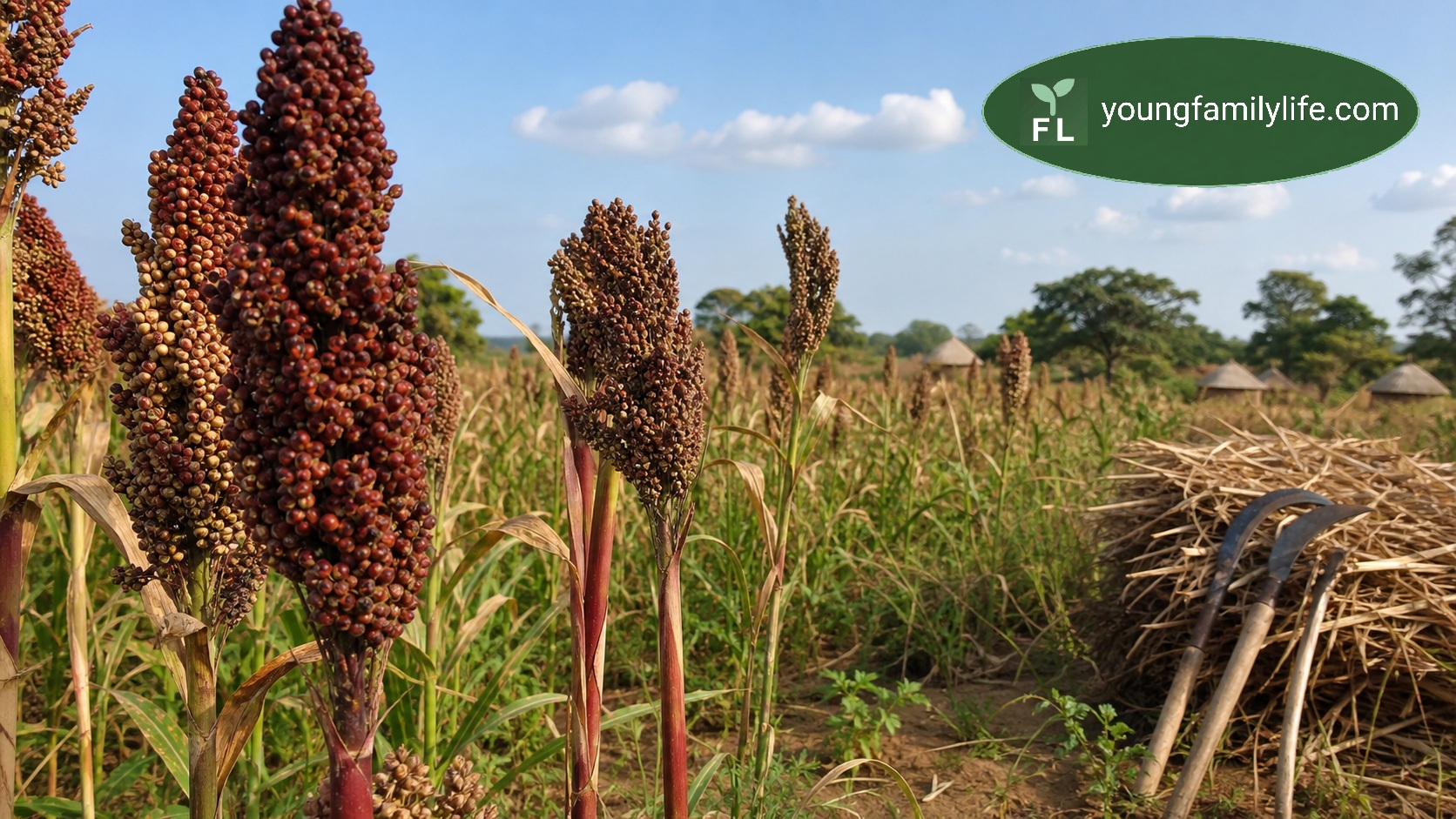
What Africa was already growing
Before the famines, Africa was not a continent without an agricultural tradition. Across sub-Saharan Africa and the drier regions of East and West Africa, communities had been developing food systems for thousands of years — crops specifically adapted to the soils, the climate, and the rainfall patterns of the places where they grew.
Sorghum thrives in semi-arid conditions that would kill European wheat. Millet survives where rainfall is unpredictable. Teff — a tiny grain from Ethiopia and Eritrea — is one of the most nutritionally complete cereals in the world and can grow on soils that nothing else will tolerate. It has around 130,000 locally adapted varieties, each developed over centuries for specific conditions in specific places. Cowpea, Bambara groundnut, pigeon pea, cassava, yam: a full food system, low-cost to grow, ecologically matched to the land, deeply embedded in local cooking and local markets.
These were not subsistence crops scratched from poor soil. Native grain species cover around 151 million hectares of cultivation across sub-Saharan Africa. European wheat, by comparison, covers 3.3 million hectares. The native grains were the foundation. Wheat was the outsider.
What happened — and what was sent
The famines of the 1970s and 1980s — most visibly in the Sahel and in Ethiopia — were driven by prolonged drought, conflict, political instability, and the damage already done by colonial agricultural policies that had redirected land from food crops to export commodities. When the droughts came, already-fragile systems collapsed.
The response was food aid at scale — primarily European wheat flour and American maize, sent by Western governments to communities that were starving. In the immediate crisis, this was the right call. People were dying. Food was available. It saved lives.
What is less often noted is where that food came from. Western agricultural systems, heavily subsidised since the 1940s, were producing more than their own populations could eat. The grain that went to famine-affected Africa was, in many cases, surplus that Western governments needed to move. Food aid was a humanitarian act. It was also a way of dealing with an agricultural surplus problem. Both things were true at the same time, and together they explain why so much of it went out, for so long, in the form that it did.
What long-term aid did to local food systems
Keeping people alive in a famine is straightforward. What happens to the food system afterwards is not.
Free wheat flour, arriving consistently in communities where local grain markets had collapsed, did not just fill a gap. It became the new normal. It was the food that arrived when things were desperate. It was the food that kept families fed. Over years, it became the food associated with sufficiency, with modernity, with not being poor. A generation grew up eating bread and wheat-based flatbreads and came to see their own grain heritage — the sorghum porridge, the millet bread, the teff injera — as the food of poverty. Not because it was inferior. Because of when and how it arrived.
This is not a criticism of the people who made those associations. If a food arrives free when you are desperate, and your own crops have failed once already, the preference that develops is entirely understandable. But it is also, precisely, how a temporary intervention becomes a permanent one.
The research now available puts numbers on what followed. Sixty per cent of African food consumption is now based on wheat, rice, and maize — imported commodity crops. The native species that cover 151 million hectares of cultivation receive a fraction of the agricultural research investment that European and American crops attract. Teff, with its extraordinary nutritional profile and drought resilience, lags significantly behind other cereals in yield improvement — not because the plant lacks potential, but because the science went elsewhere. Researchers describe this as a neglected treasure trove: the capacity is there, the knowledge of how to use it survives, but the investment, the market infrastructure, and the cultural familiarity have been progressively eroded.
What Live Aid found when it tried to go further
The Ethiopian famine of 1984–85, and the global response it generated through Band Aid and Live Aid, brought the longer-term problem into wider view. Some of the funds raised were used not just for food but for seeds, agricultural tools, and support for smallholder farming — an attempt to address the conditions rather than just the immediate hunger.
What those efforts ran into was the scale of what had already changed. By 1985, in the communities most severely affected, the seed knowledge had been disrupted, the markets had restructured around imported grain, and a generation had grown up eating wheat flour. The tools for recovery were available. The system those tools needed to work within had already shifted. The recovery was harder, more expensive, and slower than it would have been if the developmental support had been built into the response from the beginning — rather than arriving after years of food aid had already done its work.
What the dependency left behind
In February 2022, Russia invaded Ukraine. Within weeks, Black Sea grain shipments — carrying wheat that Egypt, for example, sources for around 85% of its supply — were severely disrupted. Food security pressure rippled through countries across Africa and the Middle East whose food systems had been rebuilt around imported grain.
Egypt had a native agricultural capacity. It had crops adapted to its conditions, farming knowledge embedded in its communities, land that had grown food for millennia. What it no longer had, at the scale required, were the markets, the processing infrastructure, the seed systems, and the cultural familiarity with those crops that would have made falling back on them possible. The dependency that food aid and subsidised imports had created over decades was not theoretical. It was the gap between what the country needed and what it could produce for itself.
That gap is what this piece is about — not the famine, and not the food aid, but the space between an acute intervention that saved lives and the long-term conditions that would have allowed those same communities to feed themselves. The first was delivered. The second was not.
Topics: #InOtherWords #FoodAid #FoodSovereignty #AfricanAgriculture #NativeGrains #FoodSecurity #LandHusbandry #FoodDependency #InternationalDevelopment #NaturalHealing #YoungFamilyLife
Related YFL Content
In Other Words: The Market Problem — The broader market structure argument of which food aid is one strand: how subsidies and procurement logic shape what gets grown, and make farming differently very hard to sustain.
In Other Words: How the Energy Crisis Is Also a Food and Land Problem — A parallel case of a system that works but lacks the conditions to sustain itself: vertical farming, electricity costs, and what might eventually change.
In Other Words: Fission and Fusion — Two Ways of Getting Energy from Atoms — The physics behind the energy solution that is not yet available — and why the distinction matters for how food systems might develop.
Natural Healing: Understanding Recovery Across Physical, Psychological, and Therapeutic Domains — The companion essay this series draws on: what happens when an acute intervention is sustained without the conditions that would make it unnecessary.
Copyright Notice
© 2026 Steve Young and YoungFamilyLife Ltd. All rights reserved.
"In Other Words" is a copyrighted content format of YoungFamilyLife Ltd.
The information in this piece is based on established research and theory. Full academic sources, references, and evidential detail are available in the linked YoungFamilyLife essays.
This essay was developed collaboratively using AI assistance to research academic sources and refine content structure, while maintaining the author's original voice, insights, and "Information Without Instruction" philosophy. No part of this essay may be reproduced, distributed, or transmitted in any form or by any means, including photocopying, recording, or other electronic or mechanical methods, without the prior written permission of the copyright holders, except in the case of brief quotations embodied in critical reviews and certain other noncommercial uses permitted by copyright law.
For permission requests, contact: info@youngfamilylife.com