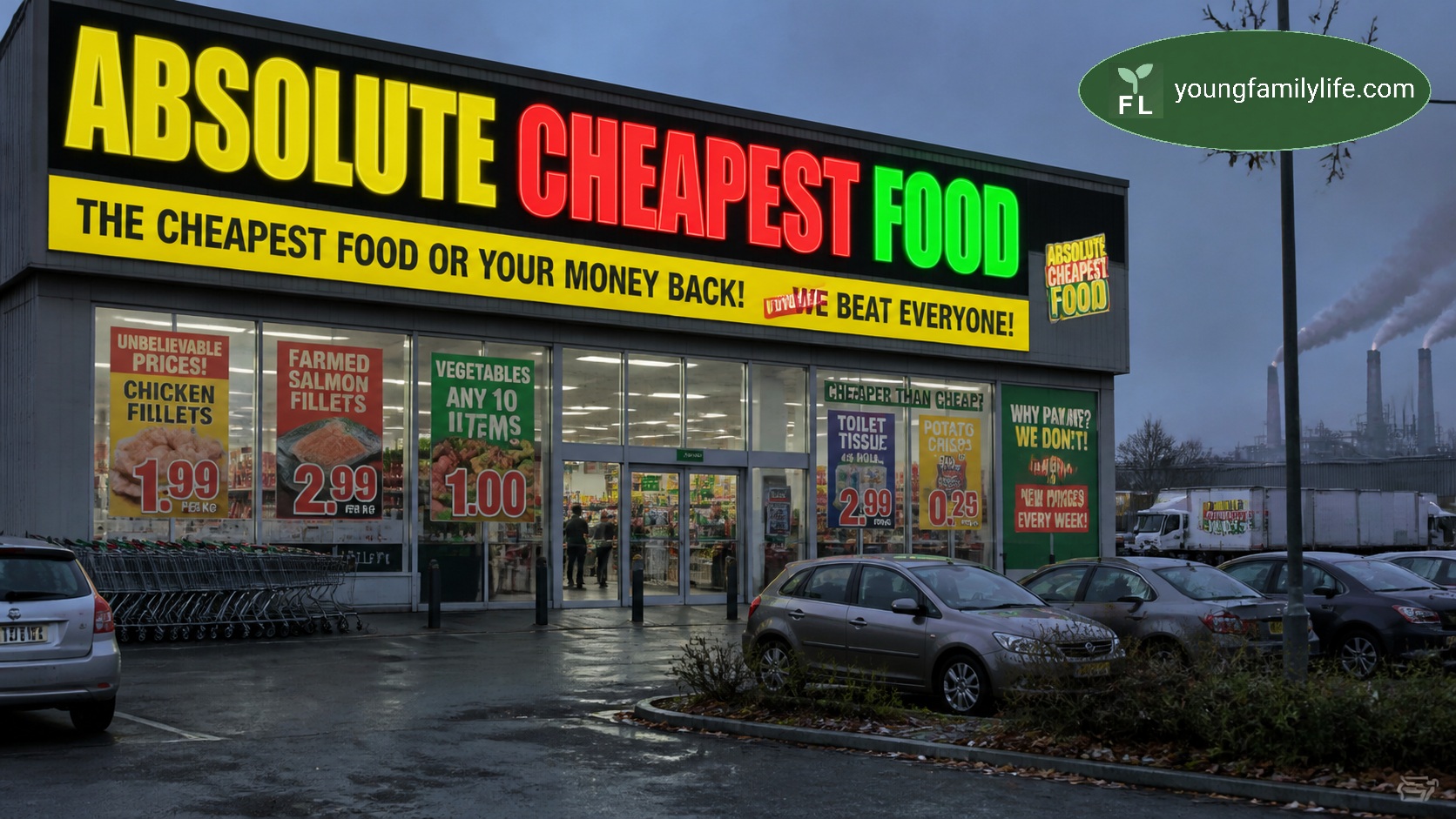
Why food is cheaper than it should be
When you pick up a chicken breast in a supermarket, the price on the label is not what it cost to produce. It is what it cost to produce, minus whatever government support the farmer received to grow it. In Britain, in Europe, in the United States, and across most major farming economies, governments pay farmers to keep food cheap. The reasons go back to the Second World War.
Countries that came out of the war having experienced genuine food shortages — rationing, empty shelves, people going hungry — made a political decision that this would not happen again. They would pay their own farmers to produce as much food as possible, and protect those farmers from cheaper competition from abroad. Britain did it. France did it. Germany did it. The United States did it. The Soviet Union did it in its own way. China does it today.
In Europe, these national programmes eventually merged into one: the Common Agricultural Policy, which at its peak consumed over 70% of the entire EU budget. Even now, after decades of reform, it accounts for nearly a third of EU spending. The money flows to European farmers, keeping their costs down and their prices competitive — not because European farming is the most efficient in the world, but because European taxpayers are making up the difference.
The result is a global food market where the price of food does not reflect what it actually costs to grow. It reflects what it costs to grow, minus the subsidy. That gap is paid by governments. And that gap is the problem.
What that means for everyone else
Imagine you run a small bakery and your landlord secretly subsidises the supermarket next door, covering two-thirds of their ingredient costs. You are not competing with the supermarket. You are competing with the supermarket plus your landlord's money. You will lose.
That is approximately what happened to wheat farmers across West Africa when subsidised European wheat arrived in their markets. Oxfam calculated that EU wheat was being sold internationally at roughly a third of what it actually cost to grow. The other two-thirds was covered by European taxpayers. A West African farmer, growing drought-adapted grain on a small plot without any government support, was not competing on a level field. The European wheat was cheaper not because Europe grows wheat better, but because someone else was paying most of the bill.
Many of those West African farmers could not compete. Many gave up. The land that had grown local grains for generations switched, or was abandoned. The communities that had eaten sorghum and millet for centuries switched to wheat flour because it was what was available and affordable. That shift is examined in more depth in the companion IOW piece on the African grain story. What matters here is the mechanism: subsidised food does not just feed people. It reshapes markets. And reshaped markets are very hard to unreshape, even when the subsidies change.
The same logic, closer to home
The same thing happens in Britain, at smaller scale, every time a school, hospital, or fast food chain places a food order.
The people who buy food for large organisations — catering companies, restaurant chains, ready meal manufacturers — are not shopping the way an individual does. They are buying thousands of units at a time, on fixed contracts, to a specification that has one overriding priority: cost per unit. Not welfare. Not how the animal was raised. Not whether the farm has wildflower meadows or hedgerows. Cost, consistency, and shelf life.
This is not because these buyers are bad people making bad decisions. It is because they are operating inside their own cost pressures, serving their own clients, who are also watching their budgets. A school meals contractor who switches to higher-welfare chicken faces a price increase they have to pass on to the council, who has to pass it on to parents, who are already stretched. The logic of cheapest-compliant locks in at every level of the chain.
The consequence for farmers trying to do things differently is direct. A farm that rewilded half its land, widened its hedgerows, and raises its cattle in genuinely free-roaming conditions produces food that costs more. That cost reflects what good farming actually requires. But the bulk of British food demand — the school kitchens, the hospital canteens, the ready meal lines — is not buying on those terms. It is buying on price. And on price, the welfare farm cannot compete with the industrial one.
What certification can and cannot fix
The most obvious answer to this is certification — putting a label on food that tells the consumer it was produced to a higher standard, and charging a premium that makes that standard financially viable for the farmer.
It works, up to a point. Organic certification, run in the UK primarily through the Soil Association, created a real market for ecologically managed food that did not exist before. People do pay more for organic, and some of that money does reach farmers who are farming differently.
But the organic story also shows where certification runs into trouble. As the market grew, the label stretched. The organic standard prohibits synthetic pesticides and requires a two-year conversion period — but it does not require hedgerows, or mixed farming, or any of the things that make a farm genuinely good for wildlife. A large single-crop organic operation covering hundreds of acres with no ecological management meets the standard. It carries the same label as a small mixed farm teeming with wildlife. The consumer cannot tell the difference from the packaging.
Supermarkets compounded this by using organic as a way to charge more without necessarily paying more to the farmer. The premium at the till does not reliably reach the field. The label gradually loses its meaning as the gap between its best and worst examples widens.
The newer certification schemes — WildEast accreditation, regenerative farming labels, higher-tier welfare standards — are attempting to do better. They have the organic experience to learn from. Whether they design out the same failure modes, or quietly repeat them at larger scale, is an open question.
What would actually change it
The market problem is the most stubborn of all the obstacles to Britain's ecological farming revolution, because it is not one decision anyone can make. It is the accumulated result of millions of purchasing decisions, each individually rational, collectively pointing in the wrong direction.
Two things could shift it. The first is mandatory minimum standards for publicly funded food — schools, hospitals, prisons, government canteens. If the state required that all food bought with public money met a meaningful ecological and welfare floor, a significant slice of demand would move. That is a political decision. It has been discussed. It has not been made.
The second is a production cost shift — making ecological farming cheaper to do, so the price gap between welfare-positive food and intensively produced food narrows. That is what the technology trajectories described in the companion IOW pieces are attempting from the supply side: not charging more for better food, but making it possible to produce food at lower ecological cost. That shift is not yet here.
In the meantime, the market continues to reward the approach it was built to reward: the most food, at the lowest price, with the ecological and welfare costs absorbed by the land, the animals, and the communities least able to push back.
Topics: #InOtherWords #FoodMarkets #AgriculturalSubsidies #LandHusbandry #FoodSovereignty #OrganicFood #RegenerativeFarming #FoodSecurity #BritishFarming #NaturalHealing #YoungFamilyLife
Related YFL Content
In Other Words: The African Grain Story — The same mechanism at the sharpest end: how subsidised food exports and food aid reshaped African agriculture, and what that displacement left behind.
In Other Words: How the Energy Crisis Is Also a Food and Land Problem — The energy constraint that currently prevents ecological farming from becoming price-competitive: vertical farms, electricity markets, and what might eventually change.
In Other Words: Fission and Fusion — Two Ways of Getting Energy from Atoms — The physics behind the energy solution that is not yet here — and why the distinction matters for how food systems might develop.
Natural Healing: Understanding Recovery Across Physical, Psychological, and Therapeutic Domains — The companion essay that ties the series together: market structure as one of the five conditions necessary for land recovery to proceed.
Copyright Notice
© 2026 Steve Young and YoungFamilyLife Ltd. All rights reserved.
"In Other Words" is a copyrighted content format of YoungFamilyLife Ltd.
The information in this piece is based on established research and theory. Full academic sources, references, and evidential detail are available in the linked YoungFamilyLife essays.
This essay was developed collaboratively using AI assistance to research academic sources and refine content structure, while maintaining the author's original voice, insights, and "Information Without Instruction" philosophy. No part of this essay may be reproduced, distributed, or transmitted in any form or by any means, including photocopying, recording, or other electronic or mechanical methods, without the prior written permission of the copyright holders, except in the case of brief quotations embodied in critical reviews and certain other noncommercial uses permitted by copyright law.
For permission requests, contact: info@youngfamilylife.com